
The Systems Should Have Come First — Comparing the Ideal Order With Mine, After I Built the Ledger and Calendar Following 15 Published Articles
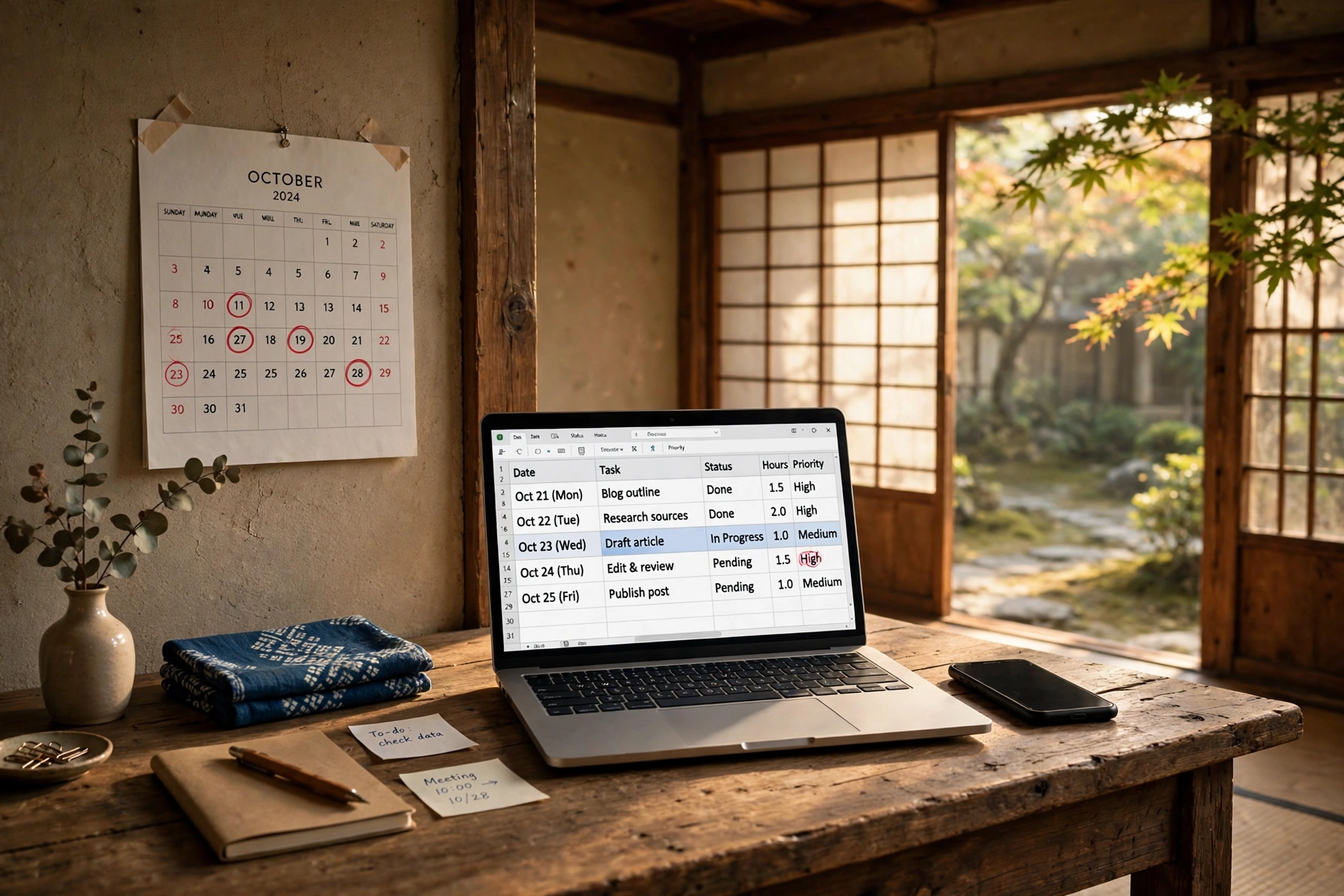
The result first: build the management systems before you publish, not after. A ledger, a calendar, and a receptacle for automatic posting — if these three are ready from the first article, you never have to reconstruct what was published and where it was posted.
I only realized this after publishing 15 articles on the blog.
As articles increase, you lose track of “what was published, and where it was posted.”
Moka, my AI butler, carries the writing itself. But management after publication, without a system, depends on human memory. I put all of that system off, and built it together after 15 articles.
I am Kurashiki Bouzu (kurashiki-bouzu). This article is that reflection and comparison. I compare the ideal order, where you build it first, with the order I actually followed, so that people who are about to start a blog or social media posts do not have to take my detour.
The ideal order and my order
First, the comparison of the conclusion.
| Item | Ideal order (build first) | My order (build after 15 articles) |
|---|---|---|
| Ledger | Stack one line at a time from the first article | Pick up 15 articles again from memory and files |
| Posting status | Remains on the spot each time you post | No record remained, and “unconfirmed” was left |
| Calendar | Accumulates automatically on the publication date | Put 15 items back in together |
| Sharing settings | Finished only once at the beginning | Stopped by “access permission is required” |
In my case, the order was reversed. I built the blog (2026-11-03), kept publishing articles first, and added the management system afterwards on 2026-11-07.
System 1: The ledger is a spreadsheet for Moka
The first is a table that brings together the status of articles and posts in one line. I call this the “Moka management ledger.” Its place is a Google Spreadsheet.
The columns are arranged like this:
- Publication date, title, category
- Blog status (published / draft)
- Posting status for X, Bluesky, Threads, Instagram, Facebook, and note
- Where the announcement text file is
- Where the main text file (MD) is placed
- Mark of the place (production / draft)
There are two important rules.
Do not paste the main text into the table. Paste only its place.
If you put the main text into the table as well, every time you read the table the full text comes with it, and the amount the AI reads (tokens) increases. The table is a table of contents, and the main text is in a different place. That was the trick to keep the reading amount down.
Write only statuses that have been confirmed.
In my ledger, which I made afterwards, many fields honestly remained as “unconfirmed.” For the early articles, no record of where they had been posted remained in the files. For example, for X, among the 15 articles, there is still not a single article that could be confirmed as “posted.” The text had been prepared, but there was no material afterwards to confirm whether it had been posted.
If the ledger had existed from the beginning, this “unconfirmed” would never have been born.
System 2: The calendar is a table for people to see
The second is reflection in a calendar.
The ledger is a tool behind the scenes that Moka (the AI) reads and writes. What I open every day is not the ledger, but the calendar. So I decided to put published articles into the calendar on their publication date, as all-day events with the “title.” If you open the event, you can see the blog address and the status of each social media account.
For process management there is a specialist diagram called a “Gantt chart,” where many lines are arranged. That starts from learning how to read it.
A calendar is easier to understand than a Gantt chart.
It is something everyone opens every day, and there is nothing to memorize. The fact that “on this day, this came out” enters your eyes just as it is. Instead of learning a new specialist tool, you bring the work to a tool you always use. That suited me.
System 3: A receptacle for automatic posting, moved by status
The third is automation of posting itself. It is still in the middle of verification, so I will write honestly up to the point that has been completed.
The trigger was an official article from an automation service called Yoom.
- Reference: Yoom official blog, “How to automatically post to X when a Google Spreadsheet is updated” https://lp.yoom.fun/blog-posts/google-spreadsheet-x-auto-post-app-integration
The system in this article is that when a status is updated in a spreadsheet, it automatically posts to X. I am trying whether this can be done with Moka, without using Yoom.
The difference between Yoom’s way and Moka’s way is as follows:
| Item | Yoom’s way | Moka’s way |
|---|---|---|
| Intermediary | External service | Moka herself |
| Additional contract | Yoom plan | None |
| Starting point | Status update | Status “post” |
| Posting to X | Connection via the service | No dedicated connection (under verification) |
| Human confirmation | None (posts immediately) | Includes approval of the text |
| Recording of results | On the service side | Written back to the table and calendar |
I made the receptacle table (a test spreadsheet). It is a table where you put the post text and status, in a form where Moka picks up only the lines whose status has been changed to “post.”
However, the final barrier remains. Moka has no dedicated connection to X, and posting from a browser has stopped in the past due to login restrictions. Whether this can pass is the current focus of verification. If it cannot pass, I will have to decide again whether to use X’s official system (API).
What should be built “first” is this receptacle and the rule of “managing by status.” Automatic posting itself can be raised after that.
What happens when you build it afterwards
Let me arrange my own examples.
1. Work appears to pick up the past again
I picked up the status of 15 articles, one by one, from memory and announcement text files. Recent articles with records can be filled in, but for the early ones “unconfirmed” remains. If I had stacked them from the beginning, this picking up itself would not exist.
2. You are stopped by forgetting to share
A table made by Moka is owned by Moka’s account. When I opened it with my own account, “access permission is required” appeared, and I was stopped. Making a table and finishing sharing should have been a set.
3. “Whether you posted it” disappears most easily
The main text of an article remains. The fact of publication also remains. What disappeared most easily was “whether it was posted to social media.” This is exactly the reason a ledger is needed from the beginning.
What I learned by measuring
I also actually measured the effect of the ledger. This is a record comparing the work of “identifying the place of a specific article’s main text and its posting status” without a ledger and with a ledger.
- For a simple article, the ledger was actually slower (because communication to fetch the table takes 0.5 to 0.9 seconds per time)
- For an article with 5 different versions, the number of times tools were called was halved from 4 times to 2 times, and the step of hesitating over “which is the original” disappeared
In other words, the effect of a ledger appears not in “speed in seconds,” but in fewer steps and the disappearance of mistakes. Writing as if it were simply fast would be exaggeration, so I will write it as it is.
Why go this far?
The reason is simple.
Because if a person does it by hand, human error will always occur.
It also happened often in the days of building websites. From partway through, it was a manual relay: write an article in a document, paste a link in a spreadsheet, and upload it to WordPress. The tools were all there, but connecting them was all by human hand, and I was fed up with copying and pasting for each post.
This system is to remove that relay. What a person touches is only “deciding the text” and “changing the status.” I made bookkeeping and transcription the butler’s work.
Summary: Even if the order is different, it works from the day you build it
The ideal is to build these three before you start publishing.
- Ledger (a spreadsheet for Moka) — one line per article, main text is only its place
- Calendar (visual confirmation for people) — records accumulate on the publication date
- Receptacle for automatic posting — the rule of managing by status, and a table for posting
My order was reversed, and I put everything off. Even so, from the day I built it, the anxiety of “losing track” disappeared.
Even if the order is different, a system does not betray you. If you are about to start, please use the ideal order by all means. I hope my detour becomes your shortcut.
- November 18, 2026 ― English draft created (results-first rewrite of the Japanese article, ledger No. 18). Not published; publication is a separate step.(7,116 characters)