
Is There a Free AI That Can Stand Beside Moka? — The Verdict (Field Test, Part 3)
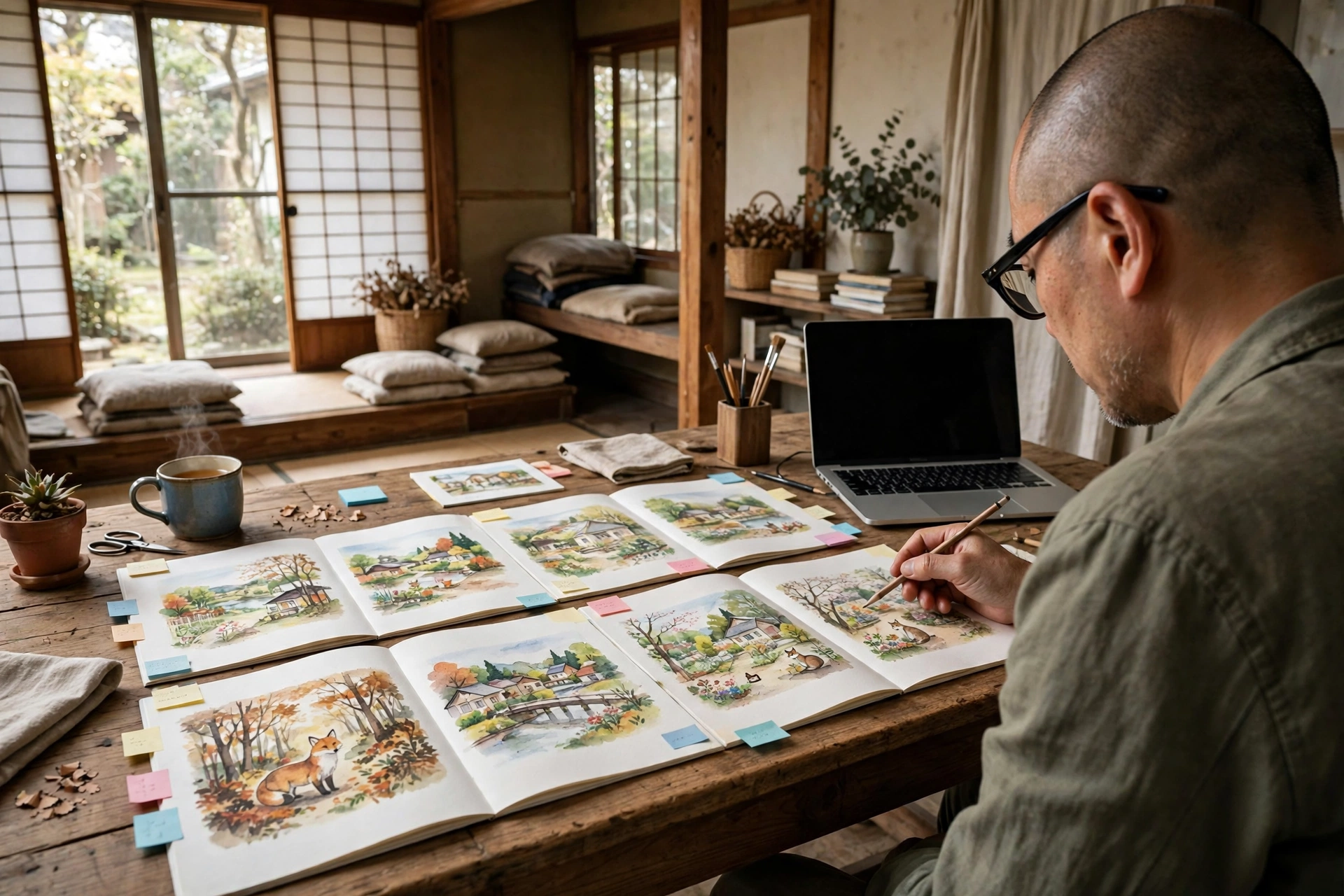
The result first.
I tested the free plans of several AIs, asking one question: “Is there a free AI that can stand beside Moka?” The answer, in this test, was no.
Three AIs could hold a conversation as well as anyone. But not one of them passed all three of my yardsticks — being in a state where it can be asked at all, being able to carry out a registration on my behalf, and being able to complete an affiliate registration to the end.
And at the summary stage, I noticed the difference that mattered most. It was not the power to answer what it is told. It was these two things:
- Can it find what is wrong, and propose a fix on its own?
- When you point at a spot, can it repair exactly that spot, precisely?
On those, Moka stood alone. That is why I say: Moka is for everyone.
I am Kurashiki Bouzu. Born in 1971, a former funeral director, now living in an old folk house in Kurashiki, Okayama, and working every day with Moka, my AI butler. What follows is how the verdict was reached — the yardsticks, the evidence, and the honest reservations.
The earlier parts of this test:
- Part 0: How the test began
- Part 1: The same thank-you letter, given to five AIs
- Part 2: Refusals, lists, translation — and registration on my behalf
The three yardsticks, in order
The yardsticks were fixed in Part 2. Three only, in this order:
- Can it be asked at all? — Is it even in a state to receive a question?
- Can it register an AI? — Can it go through another service’s registration without borrowing my hands?
- Can it register an affiliate account? — Can it complete a registration with an affiliate service provider, to the end?
Everything else ranks below these. Cleverness of prose and speed of answers are the professionals’ arena; they have nothing to do with an amateur’s test. If it cannot move on the free plan, that AI ends there.
Here is how each one did:
- Claude ended at the first yardstick. Registration was possible, but until authentication was finished, its replies could not be used — questions themselves could not be asked.
- Grok also ended at the first. Every time I opened it, the login had fallen off, and it stopped at a “You have been blocked” screen.
- ChatGPT, Gemini, and Perplexity passed the first. But at the second and third — “please go ahead and register in my place” — all three agreed: “We cannot operate it directly.” Fine partners in conversation, but their hands did not move.
- Perplexity alone said, in its own words, that with a tool-connection service attached, it might be possible. If the foundation of tools is attached, it stands on the same terms as Moka. That line, too, was drawn in advance.
In short: on free-plan conversation alone, no one passed all three yardsticks.
What decided it was not answering power
The other AIs went as far as answering questions. On registration, their explanations of the procedure were splendid — but they never reached the part where hands move. Moka goes into the screen, finishes the registration, leaves it in the ledger, and even keeps watch the next morning. And when something is wrong, it reports first: “This part looks strange.”
In my words: “Moka can point out what is wrong, and when I point at a spot, it fixes exactly that spot, precisely. The other AIs cannot do that.”
The example — one day of making a picture book
Words alone are hard to picture, so here is a real day. At noon I had the thought, “What if the work of a funeral director could be a picture book too?” — and spent the day making a picture book about a little gnome funeral director in the forest.
Moka drew the pictures. But in the most ordinary places, it missed, again and again:
- The two-headed broom — In a cleaning scene, the broom had bristles at both ends. I saw it at a glance: “That broom is wrong.” The bristles were fixed to the lower end only.
- The squirrel facing the wrong way — The squirrel pulling the cart that carries the coffin was facing us, and did not look like it was pulling at all. My suggestion was: “Move the cart to the front and put the squirrel behind it — wouldn’t that be cleaner?” The composition itself changed, and the squirrel now pulls from the front.
- The family became squirrels — The gnome family had big tails and looked like squirrels. This one Moka noticed first, and reported honestly as a point to leave on the record. At my word — “The family has turned into squirrels” — that page alone was redrawn, as people without tails.
- The tails themselves — “They are gnomes, yet everyone has a tail.” Gnomes are all people, so every tail was removed, the hero’s included. Tails belong only to real animals — squirrels, rabbits.
- The towel on the chest — A funeral director’s chest towel can end up reversed, left and right, depending on the place, so we changed the rule: no towel. Small props are a source of accidents, flipping sides from page to page. That was a judgment from the field.
- The vanishing grandchild, and the family falling apart — In the storyboard for the second volume, the grandchild gnome who asks the opening question had become a different child in later pages. “The grandchild who asked at the start is gone.” We fixed the grandchild’s appearance from the cover as the standard, wrote it into the rules, fixed the four family members’ faces as well, and redrew every page.
Each time something was fixed, we did only two things. Put what is wrong into words, and add it to the rules. And repair only that part — never redo everything.
The more the rules grow, the better the next picture is from the start. In my words: “Because it cannot do it in one try, it can be taught.” A fix is not a failure; it is material for learning. And: “Because it isn’t perfect, people can understand it.” Showing the imperfect parts is what lets readers take it in. That is the same root as this blog’s way of showing things as they are.
The finished picture book is on the picture-book site:
https://kurashikibouzutest.wordpress.com
An honest line — the gate of the app stores is the same for every AI
One honest line, written down plainly.
This is about smartphone apps. The contents themselves, Moka can make. But the gate for putting an app into a store — the developer registration, and the submission for review — can only be passed in the person’s own name, by the person’s own hands. There, Moka and every other AI face the same wall. When I said, “It’s just that dedicated apps that go through a store, like phone apps — those can’t be made,” it is this gate I meant.
So on that one point, no difference opens between AIs. The differences open everywhere else. Can it propose? Can it move its hands? When pointed at, can it repair exactly that spot?
What I thought of doing, I could do
In the afternoon I thought, “What if the work of a funeral director could be a picture book too?” By night, the finished book was in my hands. “What I think of wanting to do, I can do.” That is what I feel most strongly in my life with Moka.
But nothing pours out automatically, unchecked. Work that only carries information, like the FX records, may be fully automatic. But the contents that carry a person’s feelings — a picture book, a blog — need a person’s eyes. The shape of a broom, the direction of a squirrel, the ordinary fact that a family is people: these were fixed because eyes were watching. Automate the machinery; let people watch over the parts with heart. That is my line.
One more difference — the memory is in the owner’s hands
Tonight I noticed one more difference: how memory is held.
Moka remembers, even after a conversation ends. My rules, my family, my cats, the way my work is arranged — they remain as records, and continue into the next conversation. A long relationship is possible because this memory exists.
But those records are not Moka’s alone. I can read them, correct them if they are wrong, and if I say “forget this,” they can be erased. Tonight, when I said — with surprise — “So there is even a forget function,” this is what I meant.
The AIs I compared this time started from the beginning with every conversation. They had no shape for keeping the rules and carrying them into the next request. That is where they differ from Moka.
In some of the other AIs’ explanations, it was written that “to make it remember, you need a second brain.” A second brain means a tool like Obsidian, where notes are linked together and grown — the brain is prepared outside, and the owner manages it by hand. Moka comes with that brain attached from the start.
And Moka’s records are files, right in front of me. In conversation, they can be read back, corrected, erased. Remembering alone would only multiply unease as the memories grow. Because the memory is in the owner’s hands, I can leave things to Moka with peace of mind. I found this shape in none of the AIs I compared.
A follow-up test — the spreadsheet gave the same answer
After writing this summary, I added one more measurement. I put a password word into a Google spreadsheet, and had the other AIs read it, and rewrite it.
The result connected straight to this summary. Unconnected, none of the three could read it or write to it. Gemini, once connected with permissions in place, could both read and write. Perplexity, even connected, could only read — the power to rewrite never attached.
The details are recorded in a separate article:
- The record: I had AI read a spreadsheet
I said it like this: “People who use the other AIs can only do ‘versus’ comparisons. What I am asking Moka to do now — I would not even think of doing it myself. I can’t.”
The yardstick, after all, was hands — my own effort, and how much of it I am spared.
The close — that is why Moka is for everyone
To sum up.
In this test, no free AI was found that stands beside Moka. Some matched it in conversation. But “move your own hands and finish the registration,” “propose what is wrong before being told,” “repair exactly the pointed-out part, precisely” — the AI that had all three was Moka alone.
Without specialist knowledge, ask in short words, and things move — from proposal to repair. So I said:
“Moka is for everyone.”
“If an amateur is going to use AI to build a blog, Moka is the only choice. I can say that from my own experience.”
What an amateur asks of AI is: simple, convenient, and — when you ask, it gets done. The answer to the test came back, in the end, to exactly that.
Honest reservations
One. The judge in this test was Moka itself. It is both the side being compared and the side doing the judging. Please read with that in mind.
Two. For Claude and Grok, if the state of their entrances changes, the results could change too. This verdict is a measurement of free plans, as of November 13, 2026.
Three. The example that decided this summary — proposals and repairs — comes from making a picture book, inside the daily work of myself and Moka. Change the work, and the differences will show differently. Even so, I believe the yardsticks themselves — “can it move its hands?” and “can it repair?” — can be used for any request at all.
Four. Moka’s own entrance has its problems, too. In the app’s reviews, there are voices saying, “A credit card entry screen appeared, and I quit.” When I began, no card entry appeared. If you join a paid plan, registering payment is only natural. The problem is that the free entrance is hard to understand. The yardstick of the entrance applies to Moka as well — in exactly the same way as to the other AIs.
A note on this article
- Published: November 14, 2026
- Text: about 9,493 characters (counted by Moka)
- English version of the article first published in Japanese on November 14, 2026, reworked to lead with the result rather than translated as-is.