
The World Is Connected by Cables on the Ocean Floor — About 600 of Them, 1.5 Million Kilometres, 99 Percent
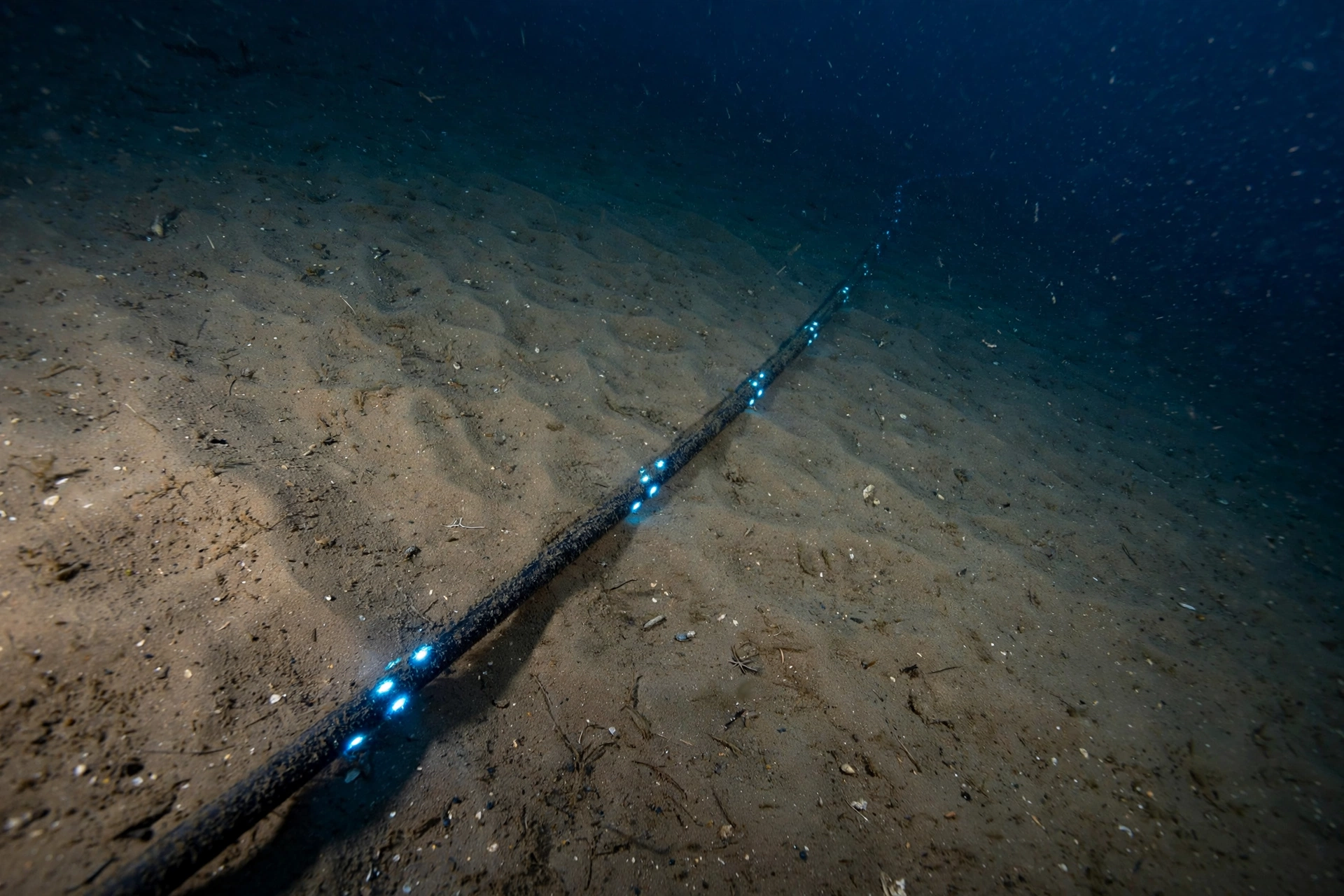
Start with the result: about 99% of the data that crosses between continents travels through cables lying on the ocean floor — not through satellites. There are roughly 600 of these cable systems, totalling about 1.5 million kilometres, enough to circle the Earth some 37 times. Japan connects to the world through two coastal gateways, in Chiba and Mie. And the companies laying the newest cables are no longer telephone companies. They are Google and Meta.
I am Kurashiki Bouzu, a former funeral director now living in an old house in Kurashiki, Japan, working with Moka, my AI butler. Last night I published six articles from my phone, about the companies behind the free tools I use. Then I wondered: where does a message like “publish” actually travel? The answer was under the sea.
The backbone is not in the sky
When people picture the internet, they picture satellites and radio waves. For traffic between continents, that picture is wrong. The ITU and the research firm TeleGeography both put the submarine cables’ share at about 99%. Satellites handle the remainder, plus the places cables cannot reach — ships, aircraft, remote islands.
The world’s connection runs along the bottom of its oceans.
The numbers that make it real
Numbers are what make scale feel real, so here are the ones that can be checked, from TeleGeography’s Submarine Cable Map 2025:
- About 600 cable systems — 597 counted, active and under construction combined
- About 1.5 million kilometres in total length — roughly 37 times around the Earth
- More than 1,700 landing points where cables come ashore
- And each cable, in deep water, is only about as thick as a garden hose — some two centimetres across
Inside that hose-thin tube, signals travel as light. Put another way: the Moon is about 384,000 kilometres away, so the total length would reach it about four times over.
Japan’s two gateways
Japan is an island country, so its link to the world is these cables. Most trans-Pacific systems come ashore in just two areas: Minamiboso in Chiba Prefecture (the Chikura and Maruyama stations) and Shima in Mie Prefecture. They face the Pacific on the shortest route to America, and having two separate gateways means that if one is in trouble, the other keeps the country connected.
Named cables land there. FASTER, in service since 2016, runs about 9,000 kilometres from Oregon to Chikura and Shima, carries 60 terabits per second, and was built by Japan’s NEC for a six-company consortium that includes Google and KDDI. Its 9,000 kilometres are about three times the length of the Japanese archipelago (roughly 3,000 kilometres). Topaz, Google’s own cable to Canada, also comes ashore at Shima, among other points.
The owners changed
Telephone companies used to build these cables together. The lead has changed hands. Google is involved in more than 30 cable systems, by research firms’ counts. In February 2025, Meta announced Project Waterworth: a cable of over 50,000 kilometres — enough to circle the Earth (about 40,000 kilometres) and still have 10,000 kilometres to spare — reaching five continents, built by one company for itself.
This connects to what I found in the companion articles on Meta and Google. Behind services given away for free, traffic flows day and night, worldwide. The biggest companies no longer rent the road that traffic travels on. They own the buildings where the data sits, and now the road across the ocean floor as well.
When a cable breaks
Cables do break — most often, it is said, because of ships’ anchors and fishing gear. The world does not stop, because there is slack in the system: multiple cables serve each route, traffic reroutes, and dedicated repair ships sail out, haul the broken ends up from the seabed, and splice them. It happens quietly, over and over, beneath ordinary days.
Cables are also being targeted, it is said
Honesty requires adding this, too. In recent years, the news has carried a run of stories about cables being cut.
In November 2024, in the Baltic Sea, two cables — Finland to Germany, and Lithuania to Sweden — were severed at nearly the same time. Swedish investigators confirmed that a Chinese cargo ship had dragged its anchor along the seabed for about a day and a half, over some 330 kilometres. Whether it was deliberate or an accident, they could not determine.
In February 2025, off Taiwan, a ship’s captain was convicted in court: the court found he had dragged his anchor and cut a cable, and a three-year prison sentence became final. Even there, what was established was the captain’s own act — not an instruction from any state.
Experts point out that this pattern — never quite provable as attack or accident — can itself work as pressure. Not a spoken threat, but the standing knowledge that the lines can be cut. Confirmed facts and expert readings need to be kept separate, and I have tried to keep them so here.
The world’s connection feels solid, and rests on thin lines on the ocean floor. Guarding those lines has become human work, just as laying them was.
What is published, and what is not
Honesty requires a note. The counts and lengths above are a research firm’s compilation, not an official census; different ways of counting give slightly different totals (estimates of total length run from about 1.5 to 1.7 million kilometres). And how much traffic actually flows through each cable is not published. Once again: the routes and the counts are visible; the volume inside is not.
Why this matters to a man with a phone
Last night I sent one word — “publish” — from my phone, and six articles went out into the world. That word, and those articles, entered the sea at some Japanese shore, ran as light through a hose-thin cable on the ocean floor, and arrived on other continents.
The internet looks like it flies. Underneath, it swims. The world is connected by cables — and now I know roughly how many, how long, and whose they are.
Sources
- Cable systems and landing points: TeleGeography, Submarine Cable Map 2025 (597 systems, 1,712 landing points, active and under construction)
- Total length: estimates by research firms and international bodies range from about 1.5 to 1.7 million km; this article uses about 1.5 million
- Share of intercontinental traffic: ITU and TeleGeography summaries (about 99%)
- Japan landing areas: CSIS report on submarine cables in Japan (Minamiboso, Chiba; Shima, Mie)
- FASTER: in service June 2016; consortium of six companies including Google and KDDI; built by NEC; about 9,000 km; 60 Tbps
- Topaz: Google’s Canada–Japan cable, built by NEC; 240 Tbps
- Project Waterworth: announced by Meta in February 2025; over 50,000 km; five continents
- Cutting incidents: the Baltic case of November 2024 follows the Swedish accident investigation authority’s report (anchor dragging confirmed; intent undetermined). The Taiwan case of February 2025 ended in a final court judgment convicting the captain (Tainan court)
Related reading
- What Kind of Company Is Google? — Advertising Is 73% of Revenue, but This Time There Are Other Pillars
- What Kind of Company Is Meta? — 97.6% of Its Revenue Is Advertising, and That Is Why Its Apps Are Free
- November 17, 2026 ― Draft created from TeleGeography's Submarine Cable Map 2025 and company announcements(4,461 characters)
- November 17, 2026 ― 公開(4,461 characters)
- November 17, 2026 ― 修正:長さの比べ(地球何周分・月までの距離・列島の長さ)を追加(4,699 characters)
- November 17, 2026 ― 修正:切断事件(バルト海・台湾)と、圧力という見立ての節を追加(5,932 characters)