
Atsuta Jingu (Nagoya, Aichi) — The Shrine Enshrining Amaterasu Omikami with the Kusanagi Sacred Sword as Her Sacred Object
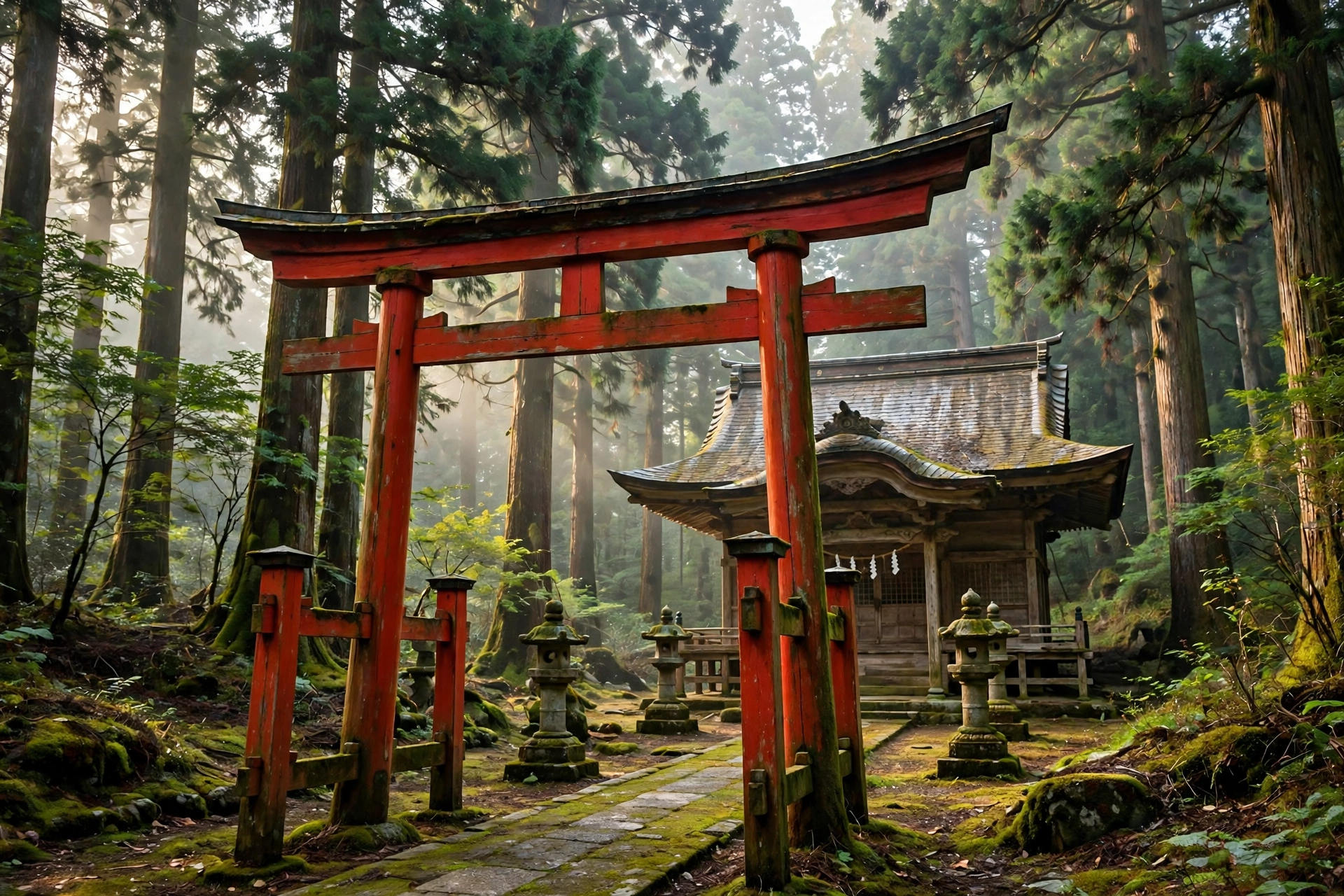
The point first: Atsuta Jingu in Atsuta Ward, Nagoya, Aichi, enshrines Atsuta Omikami — Amaterasu Omikami who takes the Kusanagi no Mitsurugi (the Kusanagi sacred sword), one of the Three Sacred Treasures, as her mitamashiro and sacred object. Five associated deities are enshrined alongside, the precinct covers about 60,000 tsubo with 43 shrines in addition to the main and auxiliary shrines, and its grand festival, the Reisai (Atsuta Matsuri), is held every year on June 5 from 10:00 a.m., drawing about 250,000 worshippers according to the official site. Worship is possible 24 hours a day, and parking for about 400 cars in total is free. The starting year of its founding, the details of the main sanctuary building, and whether official guidance on Shinto funerals exists could not be confirmed this time.
Hello, I am Kurashiki Bouzu (kurashiki-bouzu). I was born in 1971, I am a former funeral professional, and I now live in an old house in Kurashiki, Okayama, working together with Moka, my AI butler.
This is one article in a series introducing shrines across Japan, one shrine at a time. This time it is Atsuta Jingu in Atsuta Ward, Nagoya, Aichi. This article is organized from official published sources; it is not an account of a visit I made myself, and I say so honestly at the outset.
Basic information
- Shrine name: Atsuta Jingu. It is also called “Atsuta-sama” and “Miya.”
- Enshrined deity: Atsuta Omikami. The official site explains that Atsuta Omikami is “Amaterasu Omikami, who takes the Kusanagi no Mitsurugi (Kusanagi sacred sword), one of the Three Sacred Treasures, as her mitamashiro (spirit vessel) and sacred object.”
- Associated deities: Five deities — Amaterasu Omikami, Susanoo no Mikoto, Yamato Takeru no Mikoto, Miyazu-hime no Mikoto, and Takeinadane no Mikoto (the official “Five Deities”) — deities deeply connected with the Kusanagi sacred sword.
- Shrine rank: The official site describes it as a shrine of special reverence, second only to Ise Jingu, and records that it was listed as an Engishiki Myojin Taisha and a Chokusai-sha (a shrine receiving imperial messengers). Classifications such as its former shrine rank could not be confirmed this time.
- Address: 1-1-1 Jingu, Atsuta Ward, Nagoya 456-8585. The telephone number is 052-671-4151 (Atsuta Jingu office).
History
According to the official site, the sacred sword Ame no Murakumo no Tsurugi, which Susanoo no Mikoto obtained by slaying the eight-headed serpent Yamata no Orochi and presented to Amaterasu Omikami, is regarded as what later became the Kusanagi sacred sword. The name “Kusanagi” is said to derive from Yamato Takeru no Mikoto mowing down grass with this sacred sword in the eastern provinces to escape danger.
The official account relates that Yamato Takeru no Mikoto pacified the eastern provinces under the protection of the sacred sword, and that after his death the sword was enshrined at Atsuta by Miyazu-hime no Mikoto, where it remains to this day. According to Nagoya City materials, on his way back from the eastern expedition, the prince, who had taken Miyazu-hime no Mikoto as his consort, left the sword with her when he set out for Mount Ibuki, and died on his way back to the capital; the sword was then enshrined at Atsuta by Miyazu-hime no Mikoto. Please take this as tradition, as a story handed down in the Kojiki and Nihon Shoki. The same materials also record that the Kusanagi sword returned to Atsuta in the first year of Shucho (686).
The official site states that the shrine “has marked 1,900 years since its founding,” but its starting year could not be confirmed this time, so I will not state it definitively. The precinct covers about 60,000 tsubo, and the official guide says that 43 shrines are enshrined in addition to the main and auxiliary shrines.
Highlights
- Main shrine (Hongu): The center of ceremonies, beginning with the Reisai. The Reisai is held for all shrines inside and outside the precinct. The details of the style and construction year of the main sanctuary building could not be confirmed this time.
- The Great Camphor Tree (Okusu): Located north of the hand-purification pavilion, it is said to have been planted by Kobo Daishi himself (this is tradition), and its age is said to exceed 1,000 years.
- Treasure House (Homotsukan): It holds about 6,000 items donated by a wide range of people. Designated cultural properties number 177, and with many swords among them it is also called a “treasure house of famous swords.”
- Kusanagi-kan, Treasure House of Swords: Opened in 2021 (Reiwa 3). It has corners such as sword experiences, and exhibits in rotation about 450 famous swords dedicated to the shrine.
- Kagura-den: A shrine building where prayers are offered, built in 2009 (Heisei 21). Up to 370 people can enter it.
Festivals
- Reisai (Atsuta Matsuri): Held every year on June 5 from 10:00 a.m. It is the most important and solemn festival, attended by an imperial messenger. Also called the “Shobu-sai,” it features events such as fireworks and martial arts, and the official site records that about 250,000 people visit — a festival that announces summer to Nagoya. The starting time of the fireworks differs between sources, so I will not state it definitively. Please check the latest official information before going out.
- Hatsu Ebisu: Every year on January 5. The official site explains that about 60 festivals a year and about 10 special rites have been handed down to the present.
Connection with life’s milestones
From the viewpoint of a former funeral professional, I also checked the guidance on milestones. The official “Visiting and Prayers” page guides visitors to pray to Atsuta Omikami for gratitude at life’s milestones such as a baby’s first shrine visit, Shichi-Go-San, and weddings, and for protection for a safe life, such as warding off misfortune and car blessings.
For Hatsumiya-mairi (a baby’s first shrine visit), which reports a child’s birth and prays for growth, the official guide says the custom is the 32nd day after birth for boys and the 33rd day for girls. Reception is every day from 8:30 a.m. to 4:00 p.m. at the Kagura-den, on the day itself, and no reservation is needed for individual prayers. For Shichi-Go-San, the custom is age 3 and 5 for boys and age 3 and 7 for girls, and visits are possible not only on November 15. The official site also introduces Shinto weddings, and accepts prayers for unlucky years, car blessings, safe childbirth, and more.
As for Shinto funerals (shinsosai), no guidance could be confirmed in the official visiting and prayer guide or the “Frequently Asked Questions” checked this time. I therefore will not write that “Shinto funerals can be held at Atsuta Jingu.” Those who need one should contact the shrine directly.
Practical information for a visit
- Worship hours: Worship is possible 24 hours a day. For nighttime worship, visitors are guided to use the west gate parking lot.
- Amulet office: Amulets are available every day from around 7:00 a.m. until around sunset. Prayer reception is every day from 8:30 a.m. to 4:00 p.m.
- Treasure House and Kusanagi-kan: From 9:00 a.m. to 4:30 p.m., with last entry at 4:00 p.m. Please check the latest official information for closing days and admission fees.
- Parking: About 400 cars in total (about 300 at the east gate, about 40 at the west gate, about 60 at the south gate), free of charge. The lots close at 5:00 p.m. and may be restricted during festivals. Because the lots remain full on Saturdays, Sundays, and holidays, the official site calls on visitors to use public transportation.
- Access (by train): The west gate is a 7-minute walk from Atsuta Jingu Nishi Station on the Meijo subway line, the south gate a 7-minute walk from Atsuta Jingu Temma-cho Station, and the east gate a 3-minute walk from Jingu-mae Station on the Meitetsu line. From JR Atsuta Station, sources give both 7 and 8 minutes, so please allow extra time. By car, it is 5 minutes from the Horita exit of the Nagoya Expressway.
The starting year of the founding, the details of the main sanctuary building, the final confirmation of whether guidance on Shinto funerals exists, and direct confirmation on official pages of the Shichi-Go-San prayer fees and admission fees could not be confirmed this time. Separating what is known from what is not known is how this series proceeds.
Sources
- Atsuta Jingu official, “Enshrined Deity” https://www.atsutajingu.or.jp/jingu/about/enshrined.html
- Atsuta Jingu official, “About Atsuta Jingu” https://www.atsutajingu.or.jp/jingu/about/
- Atsuta Jingu official, “Reisai (Atsuta Matsuri)” https://www.atsutajingu.or.jp/jingu/about/event/event_detail12.html
- Atsuta Jingu official, “Precinct Guide” https://www.atsutajingu.or.jp/jingu/about/map.html
- Atsuta Jingu official, “Frequently Asked Questions” https://www.atsutajingu.or.jp/jingu/qa/
- Atsuta Jingu official, “Visiting and Prayers” https://www.atsutajingu.or.jp/jingu/visit/
- Aichi Prefecture official tourism site “Aichi Now,” Atsuta Jingu https://www.aichinow.pref.aichi.jp/spots/detail/10/
- Nagoya City materials https://www.city.nagoya.jp/_res/projects/default_project/page/001/017/245/rekimachi_2_2.pdf
- November 22, 2026 ― Published in English (translation of the Japanese article, ledger No. 3131)(7,680 characters)