
Byodoin — The Temple of the Pure Land Paradise, Represented by the Phoenix Hall on the 10-Yen Coin
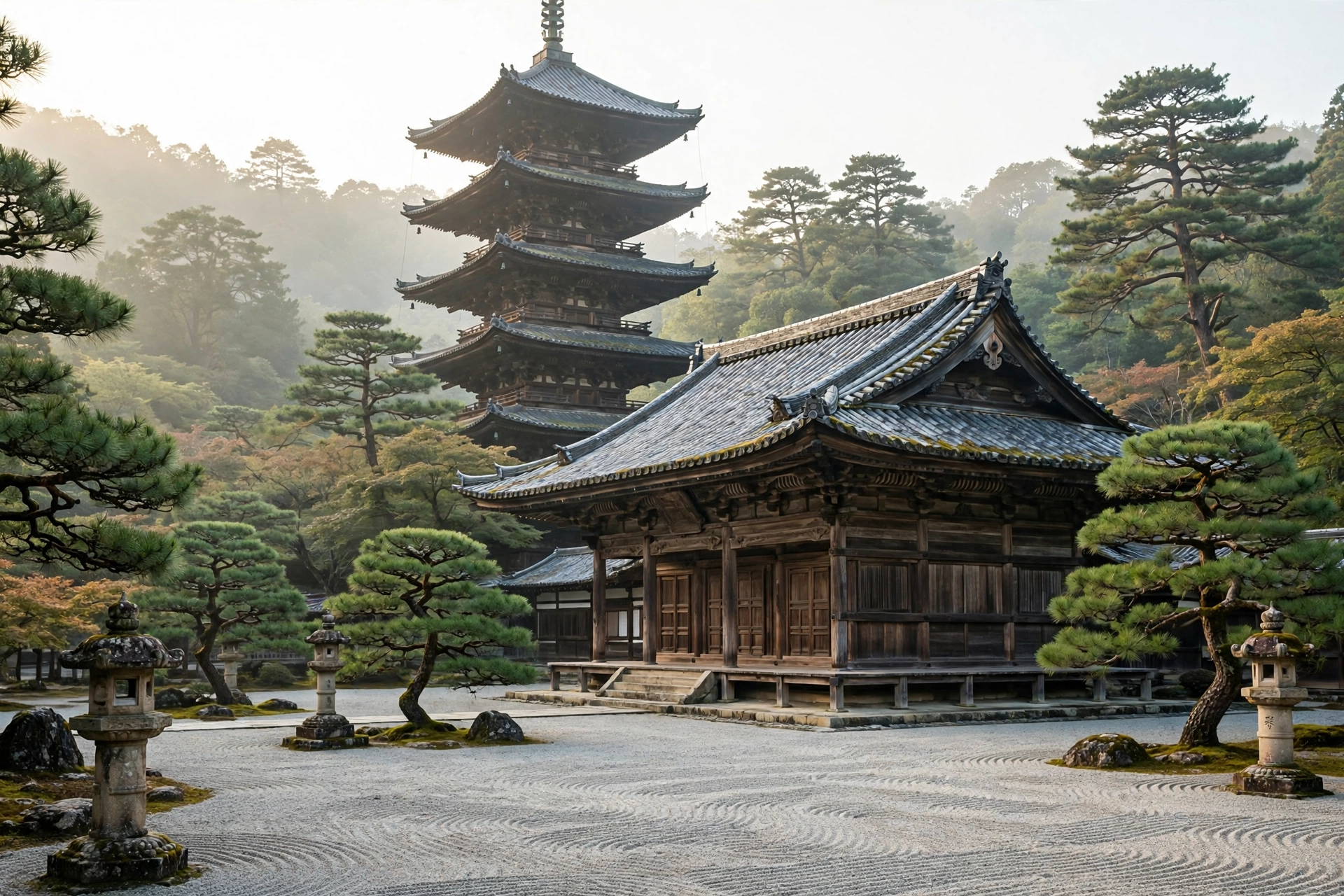
The point first: Byodoin in Uji, Kyoto, was founded in 1052 when Fujiwara no Yorimichi converted a villa inherited from his father Michinaga into a Buddhist temple, and its Phoenix Hall (completed in 1053), housing the National Treasure seated Amida Buddha by Jocho, together with its garden, is explained as embodying the Western Pure Land Paradise. The Phoenix Hall and the Amida Buddha were designated National Treasures in 1951, the same year the Phoenix Hall was adopted as the design of the 10-yen coin, and in 1994 the temple was registered as a UNESCO World Cultural Heritage site as part of the “Historic Monuments of Ancient Kyoto.” No guide to funerals, perpetual memorials, interment or memorial service applications was found on its official site, and this article says so plainly.
I am Kurashiki Bouzu (kurashiki-bouzu), born in 1971, a former funeral professional now living in an old house in Kurashiki, Okayama, working with Moka, my AI butler.
This is one article in a series introducing temples across Japan, one temple at a time. This time it is Byodoin in Uji, Kyoto Prefecture. This is not a record of a visit I made myself; it is an article organizing only confirmed facts from the official site and published sources of Kyoto Prefecture and Kyoto City. Please read it as preparation before a visit.
Basic information
- Temple name: Byodoin
- Address: 116 Uji Renge, Uji, Kyoto 611-0021
- Principal image: Amida Buddha. Inside the Phoenix Hall is enshrined the seated Amida Buddha of jo-roku size by Jocho (National Treasure)
- Form of custodianship: The official history explains that from Kanbun 10 (1670), the Jodo-in of the Jodo School and the Saisho-in of the Tendai School began to jointly maintain the temple in cooperation. As for the formal wording of the current school classification, no clear statement was found within the range checked this time, so this article does not assert one
Byodoin was registered in 1994 as a UNESCO World Cultural Heritage site as part of the “Historic Monuments of Ancient Kyoto.”
History
In Eisho 7 (1052), Fujiwara no Yorimichi, the Kampaku (imperial regent) of the time, converted a villa (betsugyo) inherited from his father Michinaga into a Buddhist temple and founded Byodoin. The official explanation states that this year was regarded as the first year of the Latter Day of the Law (mappo), and that Pure Land faith, wishing for birth in the Pure Land Paradise, was widely popular among all layers of society.
In the following year, Tenki 1 (1053), the Amida Hall (Phoenix Hall) was completed, and inside it was enshrined the seated Amida Buddha of jo-roku size by Jocho. Many of the halls and pagodas from the founding period have now been lost to fire.
In Jisho 4 (1180), Minamoto no Yorimasa was defeated in battle at Uji and took his own life at Byodoin. That place is now called “Ogi no Shiba” (Fan Lawn), and Yorimasa’s grave is also within the grounds. In Kenmu 3 (1336), due to war fire, many temple buildings were burned, except for a portion.
Jodo-in was founded in the Meio era (1492–1501) for restoration, and Saisho-in was founded in Shoo 3 (1654). In Kanbun 10 (1670), a large-scale repair of the Amida Hall was carried out, and from around this time it came to be called the Phoenix Hall, and the two schools began to jointly maintain it in cooperation.
In 1951, the Phoenix Hall and the seated Amida Buddha were designated National Treasures, and at the same time the Phoenix Hall was adopted as the design of the 10-yen coin.
Highlights
The Phoenix Hall was originally the Amida Hall, with a central hall at its center, wing corridors spreading to the left and right, and a tail corridor extending at the back. Phoenixes are placed at both ends of the large roof, and the interior is adorned with a canopy, bodhisattvas making offerings among clouds, and paintings on walls and doors. Kyoto City materials explain that, together with the garden with a pond in front, it embodies the Western Pure Land Paradise.
National Treasures are not limited to the Phoenix Hall. Kyoto City’s tourist guide lists, as National Treasures, in addition to the four buildings of the Phoenix Hall, the seated Amida Buddha, 52 wooden statues of bodhisattvas making offerings among clouds, the wooden canopy, a pair of phoenixes, the temple bell, and 14 wall and door paintings. In the interior viewing, you can receive guidance from staff in front of the seated Amida Buddha.
The Byodoin Garden is a National Historic Site and Place of Scenic Beauty. The official garden page explains that it follows the style of a Pure Land garden and reproduces the Buddha’s Pure Land. The present suhama (pebbly shore) restores the Heian-period form found in an excavation in 1990, and the flat bridge and arched bridge were also restored in 2000.
The Byodoin Museum Hoshokan, opened in 2001, is another pleasure. Officially it is introduced as a space presenting “National Treasures close before your eyes.” The details of its permanent exhibition could not be confirmed within the range checked this time, so this article does not describe them.
In addition, there are the Kannon Hall, built in the early Kamakura period on the site of the main hall from the founding time, the Rakan Hall built in Kanei 17 (1640), Ogi no Shiba, and Yorimasa’s grave. As there is a notice on the official site about preservation and repair work for the Kannon Hall, please check its opening status before going.
Events
Within the range of the official site checked this time, no page listing the names and dates of annual events in a single list was found. For that reason, this article does not list the names or dates of individual events.
What can be confirmed in the official visiting guide is that interior viewing of the Phoenix Hall may be suspended due to memorial services, events, and the like. Interior viewing may also be suspended due to severe weather or events. An official notice about the suspension of special night viewing is also posted, so please check it when you go.
Funerals and memorial services
As a former funeral professional, what draws my attention is guidance on funerals and memorials. Within the range of the official site checked this time, no guide to funerals, perpetual memorials, interment, or memorial service applications was found. Whether the sub-temples Jodo-in and Saisho-in handle memorial services could also not be confirmed. For that reason, this article does not describe Byodoin as “a temple that accepts funerals and perpetual memorials.”
What can be confirmed is the background of faith. Byodoin was founded amid the spread of Pure Land faith wishing for birth in the Pure Land Paradise, and the Phoenix Hall and garden are explained as embodying the Western Pure Land Paradise. Its character as a space that represents in this world “the Pure Land Paradise after death” lies at the foundation of this temple.
If you have an actual consultation about memorial services, please contact the temple directly. The telephone number listed officially is 0774-21-2861.
Practical information for a visit
From the official guide, the confirmed contents. Fees and hours may change, so please reconfirm them on the official page before going.
- Visiting hours (garden): 8:45–17:30 (reception closes at 17:15). Open every day of the year
- Interior viewing of the Phoenix Hall: 9:30–16:10. Each session is limited to 35 people, with a replacement system, and guidance is given every 20 minutes. Reception starts at 9:10, and time tickets are obtained on a first-come, first-served basis at the reception inside the garden. The viewing takes about 15 minutes
- Byodoin Museum Hoshokan: 9:00–17:00 (reception closes at 16:45). Admission is included in the common fee with the garden, and there is no fee setting for the garden alone
- Admission (garden + Hoshokan): adults ¥700, junior and senior high school students ¥400, elementary school students ¥300
- Interior viewing of the Phoenix Hall is a separate fee, a donation of ¥300 per person. Only cash is accepted at the interior viewing reception and the stamp office
- Guide to time required: about 40 minutes for only the exterior of the Phoenix Hall and the Hoshokan, and 90–120 minutes if you also include viewing the sub-temples, shopping, and using the Fujika tea room
- Access: about a 10-minute walk from Uji Station on the JR Nara Line, and about a 10-minute walk from Uji Station on the Keihan Uji Line
- Parking: There is no dedicated parking lot. Use nearby coin parking and similar facilities
- Re-entry is not possible. Pets may accompany you only in the garden
Finally, I will honestly leave what could not be written. The formal wording of the school classification, a list of annual events, a guide to applications for funerals and memorial services, and the details of the Hoshokan’s permanent exhibition could not be confirmed within the range checked this time. Not writing what is not known is the rule of this series.
Sources
- Byodoin through the Ages (Byodoin official)
- Visiting Guide (Byodoin official)
- About Interior Viewing of the Phoenix Hall (Byodoin official)
- Access (Byodoin official)
- Q&A – General Visits (Byodoin official)
- Garden (Byodoin official)
- Byodoin (Kyoto Prefecture, World Heritage)
- World Heritage “Historic Monuments of Ancient Kyoto” Byodoin (Kyoto City)
- Byodoin (Kyoto City official, Kyoto Travel Navi)
- November 22, 2026 ― Published in English (translation of the Japanese article, ledger No. 3023)(7,778 characters)