
Daigoji — The Head Temple of the Shingon Daigo School, Known for 'Daigo no Hanami' and Kyoto's Oldest Five-Story Pagoda
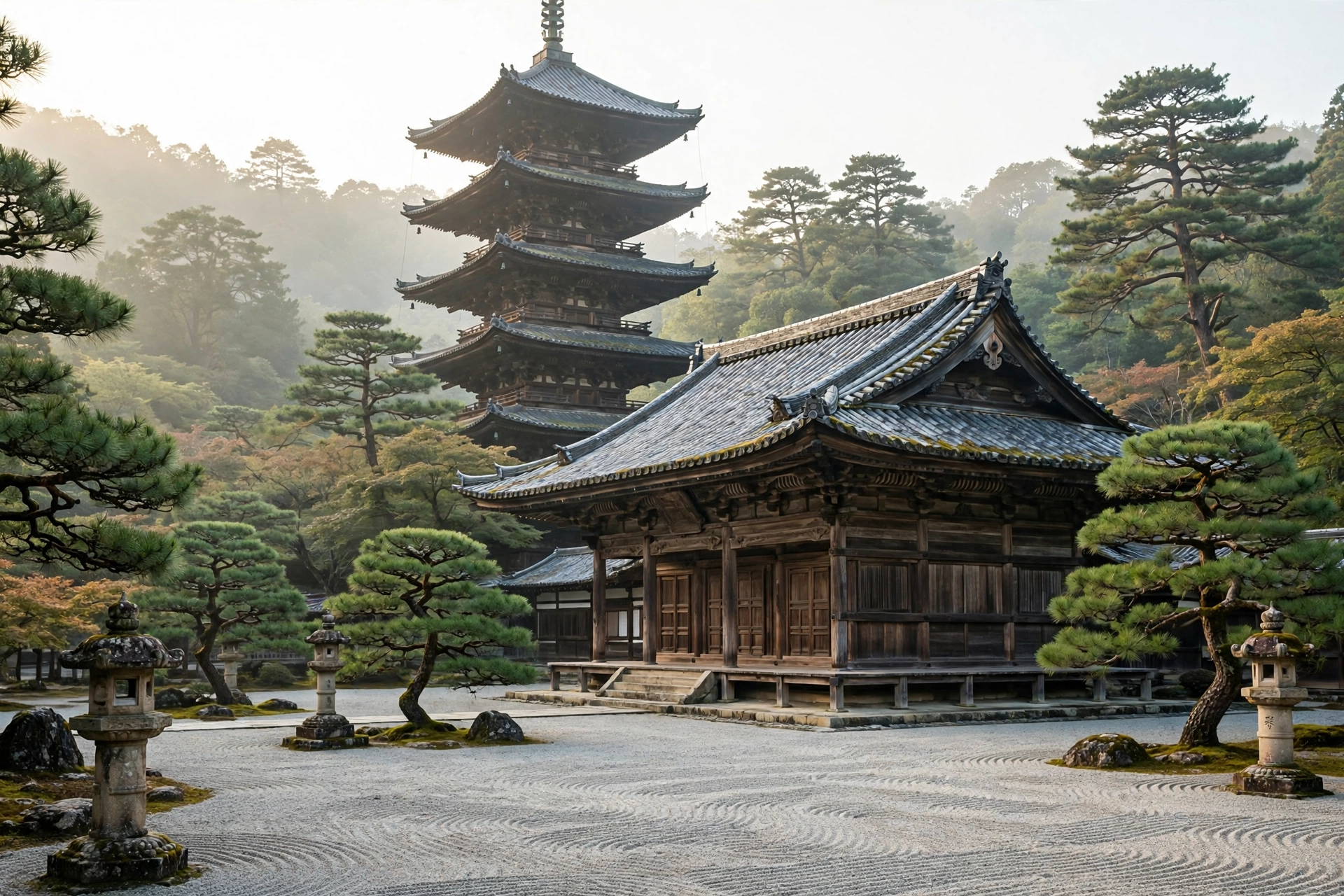
The point first: Daigoji, in Fushimi Ward, Kyoto, is the head temple of the Shingon Daigo School, with Yakushi Nyorai as its principal image. Its precinct stretches from Kami-Daigo on the summit to Shimo-Daigo at the foot of the mountain, said by the official site to cover two million tsubo, and in December 1994 it was registered as a World Cultural Heritage site as part of “Historic Monuments of Ancient Kyoto.” The Five-Story Pagoda of Shimo-Daigo (National Treasure), completed in 951, is Kyoto’s oldest surviving wooden building. The temple is also known for the cherry-blossom viewing “Daigo no Hanami” held by Toyotomi Hideyoshi. On memorial offerings, the official site accepts go-ekō (memorial prayers) at the Kannondo and Hoonin, but in the range checked this time, no official guide was found stating that Daigoji itself conducts general funerals, and this article says so plainly.
I am Kurashiki Bouzu (kurashiki-bouzu), born in 1971, a former funeral professional now living in an old house in Kurashiki, Okayama, working with Moka, my AI butler.
This is one article in a series introducing temples across Japan, one temple at a time. This time it is Daigoji in Fushimi Ward, Kyoto. This is not a record of a visit I made myself; it is an article organizing only confirmed facts from the official site and published sources of Kyoto City, Kyoto Prefecture and the Agency for Cultural Affairs. Please read it as preparation before a visit.
Basic information
- Temple name: Daigoji
- School: head temple of the Shingon Daigo School. Its patriarch is Kobo Daishi (Kukai), and its founder is said to be Rigen Daishi, Shobo
- Address: 22 Daigo Higashi-oji-cho, Fushimi Ward, Kyoto City
- Principal image: Yakushi Nyorai. The seated Yakushi Nyorai enshrined in the Kondo of Shimo-Daigo is the principal image, worshipped together with Nikko Bosatsu and Gakko Bosatsu as the Yakushi Triad (Important Cultural Property)
The temple grounds are called “Kami-Daigo” around the summit and “Shimo-Daigo” at the foot of the mountain, and the official site says the precinct covers two million tsubo. In December 1994, it was registered as a World Cultural Heritage site as one of the component assets of “Historic Monuments of Ancient Kyoto.”
History
In 874 (Jogan 16), it was founded by Rigen Daishi, Shobo. Shobo was a grand-disciple of Kobo Daishi Kukai, and the official history says the first step was his enshrining on Kami-Daigo the statues of Juntei and Nyoirin Kannon that he carved himself. In 2024, the temple marked the 1,150th anniversary of its founding.
According to the Daigoji Engi, Shobo was given this land by an old man drinking spring water in the mountains, together with the words “Ah, how it tastes of daigo.” That water is called “Daigo-sui,” and the official site says it still springs forth today.
In 907 (Engi 7), it became an imperial prayer temple of Emperor Daigo, and the Yakushido was built on Kami-Daigo. In time, the Shakado (later the Kondo) and the Five-Story Pagoda were built in Shimo-Daigo, and the form of the whole mountain temple took shape. Shimo-Daigo fell into ruin in the Onin and Bunmei wars, but in the Momoyama period, under Hideyoshi’s devotion, it was revived through “Daigo no Hanami.”
Highlights
The Five-Story Pagoda of Shimo-Daigo (National Treasure) was, according to the official history, begun by Emperor Suzaku to pray for the repose of Emperor Daigo, and completed in 951 (Tenryaku 5) under Emperor Murakami. It is regarded as Kyoto’s oldest surviving wooden building, and the wall paintings of its first story are also National Treasures.
The Kondo (National Treasure) is the central hall of Shimo-Daigo. It was originally the Shakado, founded in 926 (Encho 4); the present building was planned, on Hideyoshi’s orders, as a relocation from Yuasa in Kishu, and was completed in 1600 (Keicho 5). Inside are the principal Yakushi Triad and standing statues of the Four Heavenly Kings.
The Sanboin is like the temple’s main residence; its Omote-shoin and Karamon gate are National Treasures, and its garden is a Special Historic Site and Special Place of Scenic Beauty. The official guide says Hideyoshi himself made the basic design of the garden in 1598 (Keicho 3), on the occasion of “Daigo no Hanami.”
The Reiho-kan is a facility for both preserving and displaying the temple treasures; it opened in 1935 (Showa 10). Its exhibition rooms are the Main Hall, Heisei Hall and Buddha Statue Building, and special exhibitions are held in spring and autumn. Because the total number of temple treasures in its collection is stated differently among the official pages, this article does not settle on a single figure.
It is also a temple known for cherry blossoms. For “Daigo no Hanami,” the official history says as many as 700 cherry trees were brought in from across the Kinki region. Kyoto City’s guide says the cherry trees in the precinct number about 1,000. Descendants of the cherry trees Hideyoshi planted are called “Taiko-zakura” and have been handed down.
Kami-Daigo is the place of the founding, with buildings such as the Yakushido (National Treasure) scattered there. The principal Yakushi Triad of the Yakushido (National Treasure) has been moved to the Reiho-kan for preservation and management. Because the Junteido burned down after a lightning strike, the official FAQ says the goshuin stamp of the 11th station of the Saigoku Thirty-three Kannon Pilgrimage is currently received at the Kannondo in Shimo-Daigo.
Events
- Godairiki-son Niokai: February 23. The official site positions it as Daigoji’s largest annual event, fondly known as “Godairiki-san.” On the day, the “Miei” talisman against theft and disaster is bestowed
- Toyotomi Hanami Gyoretsu (Hideyoshi’s cherry-blossom procession): the second Sunday of April. Following the story of “Daigo no Hanami,” people in period costume parade through the precinct
- Daigoji Mantoe (Lantern Festival): August 5. An event to hold memorials for the ancestors and spirits of each family, with a spirit memorial service and a segaki offering service, and the Kondo and Five-Story Pagoda are lit up
- Kannon-kyo recitation meeting: held daily at the Kannondo at 10:30 a.m. and 2:00 p.m., and anyone may join. At the Hoonin, a goma prayer is held daily from 1:00 p.m.
Event schedules may change by year. Please check the latest information on the official site.
Funerals and memorial services
As a former funeral professional, what draws my attention is guidance on memorials. The official site calls prayers for “visible life” go-kigan (prayer), and prayers for “invisible life” go-ekō (memorial offering).
At the Kannondo, a kyoboku toba memorial is held at the time of the Kannon-kyo recitation meeting. The memorial fee is ¥1,000 per spirit, and the guide says the memorial is offered for one week before Juntei Kannon. At the Hoonin, after the daily goma ends, a memorial is offered before Amida Nyorai: ¥3,000 for a temporary memorial (one session only), ¥5,000 for a monthly tablet fee (once a month for one year), and ¥10,000 for a daily tablet fee (once a day for one year). Applications for special memorials such as kaiki (anniversary) services are also accepted at any time, and telephone consultation is offered.
On the other hand, in the range checked this time, no official guide was found stating that Daigoji itself conducts general funerals. What can be confirmed is only the go-ekō and go-kigan above, and acceptance of memorials at the Mantoe and Higan-e. Not writing what is not known is the rule of this series.
Practical information for a visit
From the official guide, the confirmed contents:
- Visiting hours: in summer (March 1 to the first Sunday of December), 9:00 a.m.–5:00 p.m.; in winter, 9:00 a.m.–4:30 p.m. Reception closes 30 minutes before closing. No reservation is needed
- Admission (regular season): the common ticket for the three places — Sanboin, Garan and Reiho-kan — is ¥1,500 for adults and ¥1,000 for junior and senior high school students. In spring (March 20 to the third Sunday of April), ¥1,800 for adults and ¥1,300 for junior and senior high school students. Elementary school students and younger are free
- Time needed: the official FAQ says about one and a half hours for the three places in Shimo-Daigo
- About entering Kami-Daigo: while the official visiting guide gives entry reception hours, the official top page carries a notice that part of the mountain trail is at risk of collapse and entry to Kami-Daigo is prohibited for the time being. Always reconfirm the current situation on the official top page at the time of writing. This article does not write on the premise that entry is possible
- Access: from Daigo Station on the Kyoto Municipal Subway Tozai Line, about a 10-minute walk from Exit 2. From the Hachijo Exit of Kyoto Station, about 30 minutes by the Keihan Bus “Kyoto Daigoji Line”
Sources
- History / Origins / Patriarchs (Daigoji official)
- Visiting hours / Fees (Daigoji official)
- Prayers / Memorials / Shakyo (Daigoji official)
- FAQ (Daigoji official)
- Guide to Sanboin (Daigoji official)
- Reiho-kan (Daigoji official)
- Annual events (Daigoji official)
- Access (Daigoji official)
- Daigoji (Kyoto City official Kyoto Travel Navi)
- Cherry blossoms of Daigoji (Kyoto City official Kyoto Travel Navi)
- Daigoji (Kyoto Prefecture World Heritage guide)
- What is the Shingon Daigo School (Shingon Daigo School official)
- November 22, 2026 ― Published in English (translation of the Japanese article, ledger No. 3068)(7,812 characters)