
Nanzenji — The Zen Head Temple Above the Five Mountains, Linked to Retired Emperor Kameyama
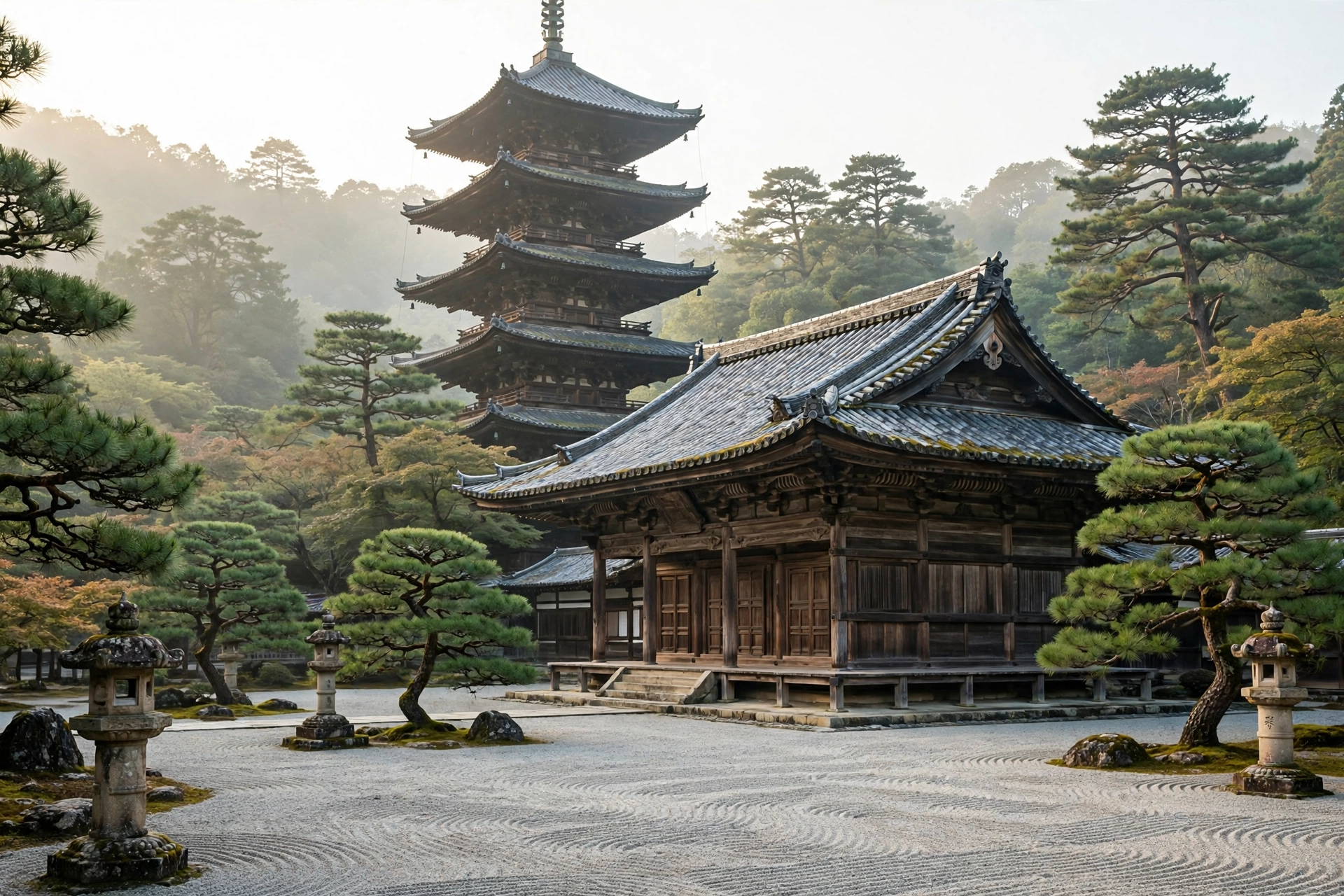
The point first: Nanzenji in Sakyo Ward, Kyoto, is the head temple of the Rinzai Nanzenji school, founded in 1291 when Retired Emperor Kameyama welcomed Zen master Mukan Fumon (Daimei Kokushi) as founding priest. Its Sanmon gate is an Important Cultural Property, its Hojo a National Treasure, and the brick Suirokaku aqueduct (completed in 1888, 93.2 meters long) stands in the southeast of the grounds. No guide to funerals, memorial services, or perpetual memorial applications at the head temple was found on its official site, and this article says so plainly.
I am Kurashiki Bouzu (kurashiki-bouzu), born in 1971, a former funeral professional now living in an old house in Kurashiki, Okayama, working with Moka, my AI butler.
This is one article in a series introducing temples across Japan, one temple at a time. This time it is Nanzenji in Sakyo Ward, Kyoto City, Kyoto Prefecture. This is not a record of a visit I made myself; it is an article organizing only confirmed facts from the official site and published sources of Kyoto City and Kyoto Prefecture.
Basic information
- Temple name: Nanzenji. According to Kyoto City’s official “Kyoto Travel Navi,” its proper full name is Taiheikokoku Nanzen Zenji
- School: head temple of the Rinzai Nanzenji school
- Principal image: Shakyamuni Buddha. This is stated clearly on the official “Scriptures and Principal Image” page
- Address: Nanzenji Fukuchi-cho, Sakyo Ward, Kyoto City, Kyoto Prefecture 606-8435
- Inquiries: Tel. 075-771-0365 (according to the Kyoto Prefecture Tourism Federation guide)
History
In the fourth year of Shoo (1291), Retired Emperor Kameyama founded the temple, welcoming Zen master Mukan Fumon (Daimei Kokushi) as its founding priest. Its predecessor was a detached palace built by Emperor Kameyama as a residence for his mother, Omiya-in, a place called “Zenrinji-dono,” which was converted into a temple.
In the second year of Shoo (1289), the retired emperor took the tonsure at this palace, became a cloistered emperor (Ho-o), and took the Dharma name Kongogan. The official “History of Nanzenji,” citing the Bunno Kotei Gaiki, relates that strange, ghostly events soon occurred at the palace, but ended simply because Zen master Mukan lived there with trainee monks in a life of zazen, cleaning, and services. This is a story introduced as a tradition, and not something that can be asserted as historical fact.
Because the founding priest, Zen master Mukan, passed away in December of the founding year, in the following year, the fifth year of Shoo (1292), the cloistered emperor appointed Zen master Kian Soen (Nan’in Kokushi) as the second abbot. As the palace had no temple buildings, their construction was assigned to Zen master Kian, and after about 15 years they were largely completed. This is why Zen master Kian is called the “founding builder.” In the third year of Kagen (1305), Retired Emperor Kameyama died at Kameyama-dono in Saga at the age of 57.
In the first year of Kenmu (1334) the temple became first among the Kyoto Five Mountains, and Ashikaga Yoshimitsu placed it at the highest rank, “above the Five Mountains.” The buildings burned in the Onin War are said to have been restored by Ishin Suden. Within the grounds, the Chokushimon gate, Sanmon gate, Hatto hall, and Hojo stand in a straight line, with 12 sub-temples around them.
Highlights
The Sanmon is an Important Cultural Property, a huge gate in the Zen style. Kyoto City’s official guide relates that in the fifth year of Kanei (1628), Todo Takatora donated it to pray for the repose of his retainers who died in the Summer Campaign of Osaka Castle; its lower level is called “Tenka Ryumon” and its upper level “Gohoro,” and from the upper floor the city of Kyoto can be seen in one view.
The Hojo is a National Treasure, made up of the Daihojo and Shohojo. The Daihojo is also explained as the Seiryoden, and many of its interior screen paintings are Important Cultural Properties. The Shohojo holds the “Group of Tigers,” said to be by Kano Tan’yu (Important Cultural Property), and is called the “Tiger Room.” The front garden of the Daihojo is a dry landscape garden said to be the work of Kobori Enshu, famous as “Tora no Ko Watashi” (leading the tiger cubs across). It is a garden of white sand with trees, moss, and six stones, and is a national Place of Scenic Beauty.
The Suirokaku in the southeast of the grounds is a brick aqueduct on a branch line of the Lake Biwa Canal. Kyoto City’s official guide explains that it was completed in the 21st year of Meiji (1888), is 93.2 meters long, and was designed by Tanabe Sakuro with care for the landscape. Its distinctive point is that it is not a temple building but an aqueduct from the Meiji canal project, and it is a city-designated historic site.
Nanzen-in is a sub-temple, said to be the place where Nanzenji originated. It is guided as famous for the only Kamakura-period garden in Kyoto (a pond strolling garden). However, the official site carries a notice suspending visits while also carrying a guide to special autumn openings, so whether ordinary visits are possible needs to be confirmed in the official guide at the time of visiting. This article does not write of it as a place that can be visited year-round.
In addition, the Hatto hall and the Chokushimon gate, an Important Cultural Property, are listed in the guide to the grounds.
Events
The top of the official site posts a monthly “Guide to visiting hours and events.” A combined list of annual events through the year was not found within the range checked this time, so this article introduces events in the form of the monthly guides.
Examples of events include dawn zazen (Gyoten Zazen), shakyo (sutra-copying) gatherings, and “Neijitsue,” a gathering for goeika chanting. One month guided the dawn zazen as about one hour of Dharma talk and zazen, and the shakyo gathering as a 1,000 yen offering with no particular items to bring. As dates and times change by month in all cases, please confirm them in that month’s official guide. The official site also posts cultural lectures and special early-morning and special autumn openings, but please read those as limited-period programs.
Funerals and memorial services
As a former funeral professional, what draws my attention is guidance on funerals and memorials. Within the range of the official head-temple site checked this time, no page was found guiding funerals held as the head temple, how to apply for memorial services, or fees and procedures for perpetual memorials or interment. To be honest, no such guide appeared on the official site.
For that reason, this article does not write things like “funerals can be held at Nanzenji” or “Nanzenji accepts perpetual memorials.” Guidance may differ by sub-temple, but the individual official sites of sub-temples were not included in the range checked this time.
As a matter connected with memorials, Kyoto City’s official guide records that the Sanmon is related to have been donated by Todo Takatora to pray for the repose of retainers who died in battle. However, this is a story with the premise “it is related.” Not writing what is not known is the rule of this series.
Practical information for a visit
- The grounds are free to enter. Fees apply only to visiting the Hojo garden, the Sanmon, and Nanzen-in
- Visiting hours: from March 1 to November 30, 8:40–17:00; from December 1 to the end of February, 8:40–16:30. Reception closes 20 minutes before closing. Some months extend hours on Saturdays, Sundays, and holidays, so the monthly official guide takes priority
- Closed: no general visiting from December 28 to 31
- Admission (individual): Hojo garden — general 600 yen, high school students 500 yen, elementary and junior high school students 400 yen; Sanmon — the same, general 600 yen, high school students 500 yen, elementary and junior high school students 400 yen; Nanzen-in — general 500 yen, high school students 450 yen, elementary and junior high school students 350 yen. Nanzen-in has periods when visits are suspended for construction work, during which these fees may not apply
- Access: about a 10-minute walk from Keage Station on the Kyoto Municipal Subway Tozai Line; about a 10-minute walk from the city bus stop “Nanzenji / Eikando-michi”
- Parking: paid parking is available. Fees are 1,000 yen for a regular car and 3,000 yen for a bus (both within 2 hours, according to the Kyoto Prefecture Tourism Federation guide)
- Wheelchair visits: the grounds and Hojo are partly possible, and assistance is needed because there are stairs. The Sanmon is guided as not possible. There are wheelchair-accessible toilets at three places in the grounds
Fees and hours may change. Please check the official guide before going.
Sources
- Nanzenji official top page (Rinzai head temple Nanzenji)
- History of Nanzenji (Nanzenji official)
- Scriptures and principal image (Nanzenji official)
- Doctrine and teachings (Nanzenji official)
- Guide to the grounds (Nanzenji official)
- Nanzenji (Kyoto City official, Kyoto Travel Navi)
- Daihonzan Nanzenji (Kyoto Prefecture Tourism Federation official)
- Nanzen-in (Kyoto Prefecture Tourism Federation official)
- November 22, 2026 ― Published in English (translation of the Japanese article, ledger No. 3095)(7,619 characters)