
Nikko Futarasan Jinja (Nikko, Tochigi) — Mountain Faith Venerating Mount Nantai and the Vermilion Shinkyo Bridge
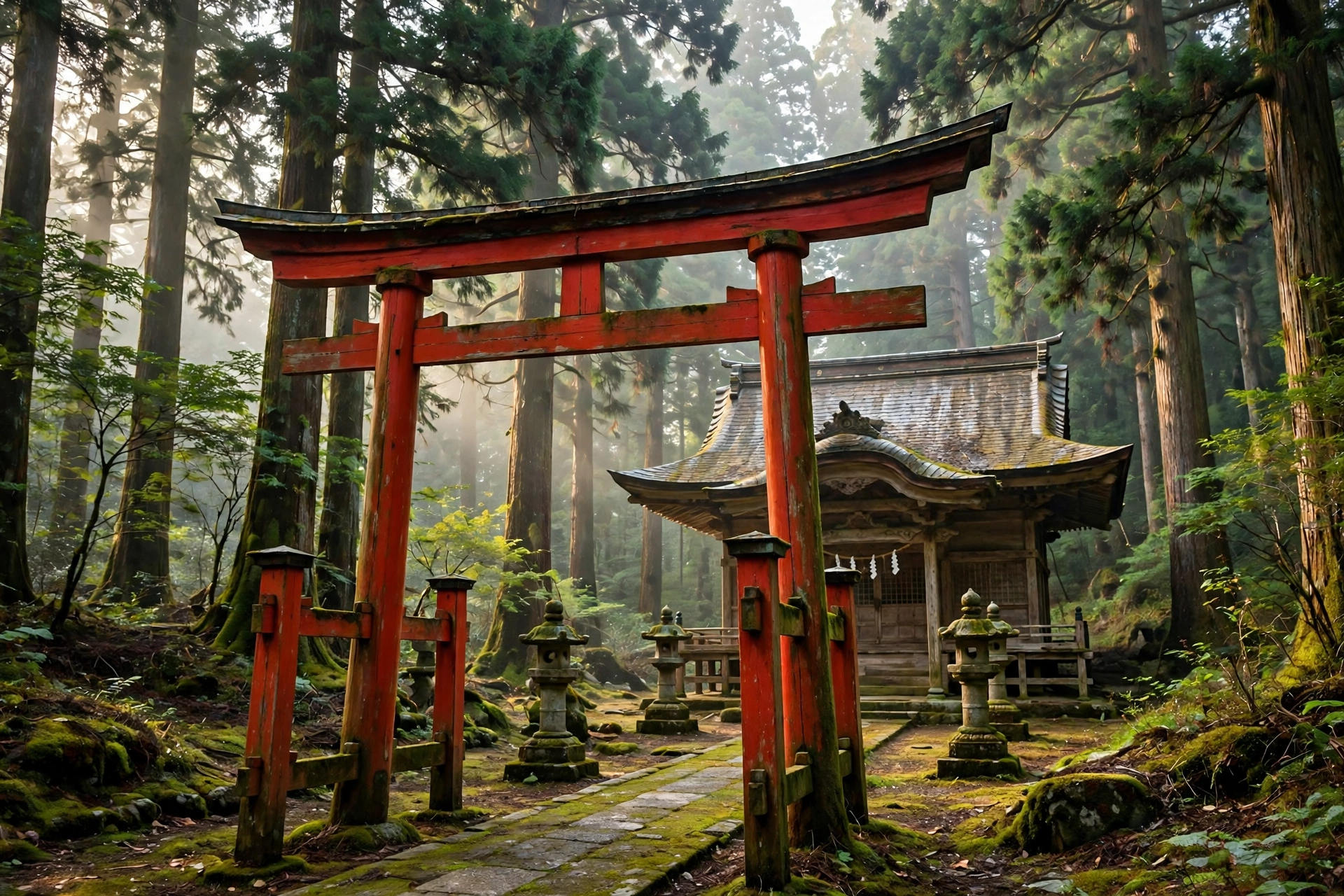
The point first: Nikko Futarasan Jinja in Nikko, Tochigi, enshrines a parent-and-child trio of deities collectively called Futarasan Okami, with Mount Nantai (2,486 metres) as its sacred body. Its precinct covers about 3,400 hectares, including the Chugu-shi shrine on Lake Chuzenji and the Okumiya shrine on the summit of Mount Nantai. The vermilion Shinkyo Bridge over the Daiya River is often mistaken for property of Toshogu, but the bridge’s official FAQ states clearly that its owner is Nikko Futarasan Jinja. Together with Toshogu and Rinnoji, it was registered in December 1999 as a World Heritage site, the “Shrines and Temples of Nikko,” and 23 of its buildings, including the main hall and the Shinkyo Bridge, are Important Cultural Properties. The main hall dates from 1619. The Yayoi Festival is held from April 13 to 17, and the Mount Nantai climbing festival runs for eight days from July 31 to August 7. The shrine’s rank classification, the current admission fee for the sacred garden, and parking fees could not be confirmed within the scope of this check.
Hello, I am Kurashiki Bouzu (kurashiki-bouzu). I was born in 1971, I am a former funeral professional, and I now live in an old house in Kurashiki, Okayama, working together with Moka, my AI butler.
This is one article in a series introducing shrines across Japan, one shrine at a time. This time it is Nikko Futarasan Jinja in Nikko, Tochigi. This article is organized from official published sources; it is not an account of a visit I made myself, and I say so at the outset.
Basic information
- Shrine name: Futarasan Jinja. There is also a Futarasan Jinja in Utsunomiya City, but its reading is “Futaarayama Jinja” and its enshrined deities are different. This shrine is called “Nikko Futarasan Jinja” and is a separate shrine from Toshogu and Rinnoji.
- Enshrined deities: A parent-and-child trio collectively called Futarasan Okami: the main deity Onamuchi no Mikoto, the consort Tagorihime no Mikoto, and their child Ajisukitakahikone no Mikoto.
- Sacred mountain: Mount Nantai (2,486 metres above sea level). Tochigi Prefecture’s official materials explain that the three mountains of Nikko (Mount Nantai, Mount Nyoho and Mount Taro) are venerated as sacred bodies.
- Shrine rank: It was confirmed that the official site presents the shrine as “Ichinomiya of Shimotsuke Province.” However, no explicit statement of classifications such as shikinaisha, former Kokuhei Chusha, or beppyo shrine could be confirmed on the official and Tochigi Jinjacho pages opened this time.
- Address (main shrine): 2307 Sannai, Nikko, Tochigi 321-1431. There are also the Chugu-shi shrine on the shore of Lake Chuzenji and the Okumiya shrine on the summit of Mount Nantai. The precinct covers about 3,400 hectares.
History
According to the official historical chronology of Nikko City, Shodo Shonin founded Shihonryuji Temple in Tenpyo Jingo 2 (766), which is the origin of Mount Nikko, and in Jingo Keiun 1 (767) he enshrined Futarasan Okami on the north bank of the Daiya River. This was the founding of Hongu Jinja.
The pillars of its history are the mountain faith directed at Mount Nantai and Shodo Shonin’s opening of Nikko. Shodo Shonin attempted the climb in 767 and 781 but did not succeed; in Enryaku 1 (782), on his third attempt, he made the first successful ascent, and the Okumiya shrine was founded on the summit. Tochigi Prefecture’s cultural property materials say that Chugu-shi was founded in Enryaku 3 (784). The present main shrine is the “Shingu” arranged afterwards; it originally stood on the present site of Toshogu and is said to have been moved because of the construction of Toshogu.
Highlights
- World Heritage: The “two shrines and one temple” — Futarasan Jinja, Toshogu and Rinnoji — and their precincts were registered in December 1999 as a World Heritage site under the name “Shrines and Temples of Nikko.” Twenty-three buildings, including the main hall and the Shinkyo Bridge, are Important Cultural Properties.
- Main hall (Important Cultural Property): Built in Genna 5 (1619). Tochigi Prefecture’s official materials state that it is in the yatsumune-zukuri style, was donated by Tokugawa Hidetada, and is the only building on Mount Nikko that retains its appearance from the time of its construction. The worship hall was also built in Genna 5 (1619).
- Shinkyo Bridge (Important Cultural Property): A wooden vermilion-lacquered bridge over the Daiya River at the entrance to Mount Nikko. This is a point that is easy to get wrong: the Shinkyo Bridge is not the property of Toshogu. The FAQ on the bridge’s official site states clearly that its owner is Nikko Futarasan Jinja. It is 28 metres long, 7.4 metres wide and 10.6 metres above the water surface. The present form of the bridge dates from Kanei 13 (1636); it was washed away by a flood in Meiji 35 (1902) and rebuilt in Meiji 37 (1904). It is also called the “Yamasuge no Jabashi” (Snake Bridge of Mountain Sedge).
- Branch shrines: Hongu Jinja enshrines the child deity and is regarded as the place of origin. Takinoo Jinja, about 1 kilometre west of the main shrine, enshrines the consort deity. It has the Kodane-ishi stone and is known as a deity of child-giving and safe childbirth.
- Chugu-shi and Okumiya: Chugu-shi takes its name from being midway between the main shrine and the Okumiya on the summit, and it is a base for climbing worship.
Festivals
- Annual festival, Yayoi Festival (Yayoisaï): From April 13 to 17. The official explanation of the name is that it was formerly held in the third month of the lunar calendar (Yayoi). On April 16 and 17, a total of 11 flower floats (hanayatai) are brought out. Because a mistake in the procedures leads to “gota” (trouble), it is also called the “Gota Festival.”
- Mount Nantai Climbing Festival (Chugu-shi): Tochigi Prefecture tourism materials guide visitors to the eight days every year from July 31 to August 7. During the period there is night climbing, when the climbing entrance is opened at midnight.
- Main annual festivals: Saitansai (January 1), Busha Festival (January 4, at Chugu-shi), Setsubun Festival (February 3), Kaisan Festival (April 25), Daikoku Festival (first Saturday and Sunday of June), Yoi-en Festival (late September to November 23), Heizan Festival (November 11), and others. Mount Nantai closes on November 11, and entry is prohibited until the following spring.
Connection with life’s milestones
From the perspective of a former funeral professional, I also checked whether the official site carries guidance connected with life’s milestones.
For weddings there is official guidance: the “Wedding Ceremony Order” page lists steps such as purification, the oath-drinking rite (sansankudo), the oath, the exchange of rings, and tamagushi worship. According to the Tochigi Jinjacho guide, prayers require no reservation, and the divine virtues listed include good relationships, prosperous business, safe childbirth and child-giving. For Shichi-Go-San, it was confirmed that the shrine answers enquiries on the official site’s bulletin board. A dedicated guide for Hatsumiya-mode (a baby’s first shrine visit) could not be confirmed within the scope of this check.
For Shinto funerals (shinsousai), no guidance was found within the scope of the official pages opened this time and the Tochigi Jinjacho shrine details. The Jinjacho’s note “on-site ceremonies: available” can be read as referring to general on-site ceremonies such as ground-breaking ceremonies, so it is not used here as grounds for saying that Shinto funerals are held.
Practical information for a visit
- Worship hours (main shrine): From April to October, 8:00 to 17:00; from November to March, 9:00 to 16:00; reception until 30 minutes before closing. Worship is free.
- Admission to the sacred garden: Public tourism guides coexist with a figure of 500 yen for adults and an older figure of 300 yen for adults, so the current amount could not be stated with certainty. Please check the official site before going out.
- Crossing the Shinkyo Bridge: Hours are 8:30 to 16:30 from April to October, and 9:30 to 15:30 from November to March (last entry 30 minutes before). Tochigi Prefecture tourism materials give the crossing fee as 300 yen for adults, 200 yen for high school students and 100 yen for elementary and junior high school students. There is no dedicated parking.
- Parking and goshuin: The Tochigi Jinjacho lists the main shrine’s parking as “available: paid (50 vehicles),” but the fee could not be confirmed this time. Goshuin stamps can be received, and the offering is 500 yen.
- Access (main shrine): From Nikko Station and Tobu-Nikko Station, about 15 minutes by the World Heritage tour bus, getting off at “Taiyuin / Futarasan Jinja-mae,” right by the shrine. By car, about 10 minutes from the Nikko Interchange on the Nikko-Utsunomiya Road.
Finally, a summary of the points that could not be confirmed. The explicit statement of the shrine rank classification, the current admission fee for the sacred garden, parking fees, the founding year of Hongu Jinja (the years differed between sources), and the final confirmation of whether there is a dedicated Hatsumiya-mode guide and Shinto funeral guidance could not be completed within the scope of this check.
Both the Shinkyo Bridge and the faith in Mount Nantai originally belong to this shrine.
Sources
- Nikko Futarasan Jinja official site
- Nikko Futarasan Jinja official “Yayoi Festival”
- Nikko Futarasan Jinja official “Wedding Ceremony Order”
- Shinkyo Bridge official site
- Shinkyo Bridge official site “FAQ”
- Tochigi Jinjacho “Nikko Futarasan Jinja”
- Nikko City official “Shrines and Temples of Nikko: Futarasan Jinja”
- Tochigi Prefecture official “Nikko Futarasan Jinja”
- Agency for Cultural Affairs, Database of Nationally Designated Cultural Properties “Futarasan Jinja Shinkyo Bridge”
- Nikko City Tourism Association official, Nikko Tabi Navi “Nikko Futarasan Jinja”
- Tochigi Prefecture Tourism and Products Association, Tochigi Tabi Net “Nikko Futarasan Jinja”
- November 22, 2026 ― Published in English (translation of the Japanese article, ledger No. 3185)(8,387 characters)