
Ninnaji — A Monzeki Temple Called the Omuro Imperial Palace, Home of the Late-Blooming Omuro Cherry Blossoms
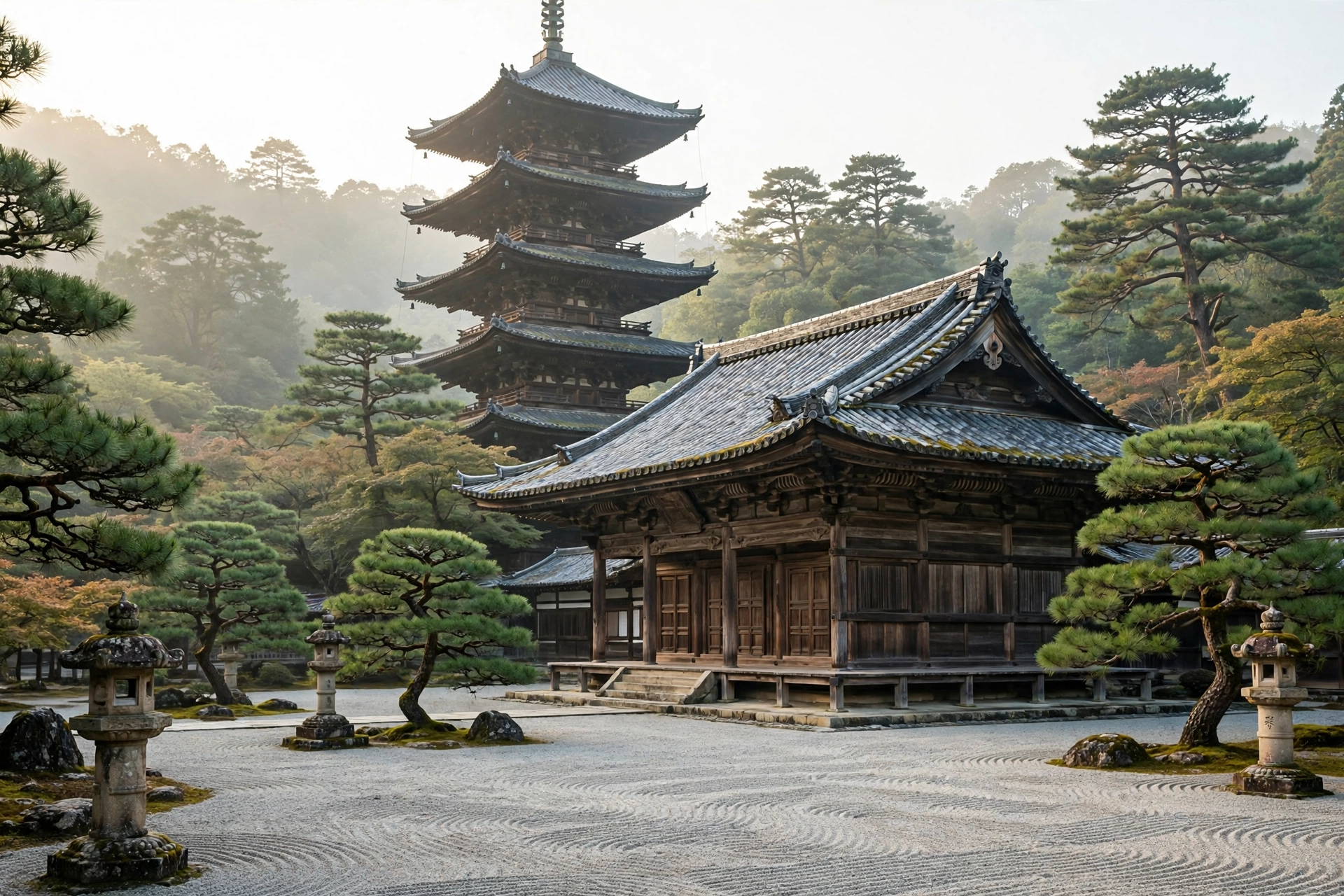
The point first: Ninnaji in Ukyo Ward, Kyoto, is the head temple of the Omuro School of Shingon Buddhism. Founded after Emperor Koko vowed its construction in 886 and completed in 888 by Emperor Uda, it became a monzeki temple known as the Omuro Imperial Palace, where members of the imperial family served as successive abbots. Its Kondo, a National Treasure, is the relocated Shishinden of the Imperial Palace and enshrines the principal image, the Amida Triad, and the temple is also known for its late-blooming Omuro cherry blossoms. Officially, the temple does not accept weddings or funerals, nor does it dispatch priests for funerals or memorial services, while ancestor memorials and prayers are accepted, and perpetual memorial services are offered at the Reiwa Amida Hall and the Omuro Mausoleum.
I am Kurashiki Bouzu (kurashiki-bouzu), born in 1971, a former funeral professional now living in an old house in Kurashiki, Okayama, working with Moka, my AI butler.
This is one article in a series introducing temples across Japan, one temple at a time. This time it is Ninnaji in Ukyo Ward, Kyoto City. This is not a record of a visit I made myself; it is an article organizing only confirmed facts from the official site and published sources of Kyoto City and Kyoto Prefecture. Please read it as preparation before a visit.
Basic information
- Temple name: Ninnaji. The official site’s title is “World Heritage, Head Temple of the Omuro School of Shingon Buddhism, Ninnaji”
- School: head temple of the Omuro School of Shingon Buddhism
- Address: 33 Omuro Ouchi, Ukyo Ward, Kyoto City, Kyoto Prefecture
- Principal image: the Amida Triad. The Kondo enshrines the Amida Triad, the principal image of Ninnaji
In 1994 (Heisei 6), Ninnaji was registered as a UNESCO World Heritage site (Cultural Heritage) as one of the “Historic Monuments of Ancient Kyoto.” It is one of the 17 component sites.
History
Ninnaji began in 886 (Ninna 2), when the 58th emperor, Emperor Koko, vowed to build a temple called the “Nishiyama Goganji.” Emperor Koko passed away the following year, and the temple was completed in 888 (Ninna 4) by the 59th emperor, Emperor Uda, who inherited his wish. The temple name Ninnaji came from the era name “Ninna.”
After abdicating, Emperor Uda took the tonsure and became the first abbot of Ninnaji, Emperor Uda (Kanpyo) the Dharma Emperor. Because he set up an Omuro (an imperial residence) within the temple, it was also called the “Omuro Imperial Palace,” and thereafter, as a monzeki temple where members of the imperial family served as successive abbots (monzeki), it maintained the highest status from the Heian through the Kamakura periods.
In the Onin War, almost the whole temple was lost to fire, but the principal image, the Amida Triad, together with temple furnishings and sacred teachings, had been moved to Shinkoin, an affiliated sub-temple, and was handed down. About 160 years later, in the Kan’ei era, reconstruction advanced: the Shishinden of the Imperial Palace and other buildings were relocated to become the Kondo, and the Niomon gate, Chumon gate, Five-Story Pagoda and other buildings were also built. The present temple complex is mainly from this time. In 1867 (Keio 3), the 30th abbot, Prince Jun’nin, returned to secular life, ending the history of the imperial monzeki.
Highlights
The Kondo is a National Treasure. It is the Shishinden of the Imperial Palace, built in the Keicho era and relocated in the Kan’ei era, and is regarded as the oldest surviving Shishinden. It enshrines the principal image, the Amida Triad, and on its walls the Pure Land and other subjects are painted in rich colors.
The Five-Story Pagoda is an Important Cultural Property, built in 1644 (Kan’ei 21), with a total height of 36.18 meters. Its appearance, in which the width of each story differs little, is characteristic, and inside are enshrined Dainichi Nyorai and the Buddhas of the four directions. It is introduced, together with the Omuro cherry blossoms, as a symbol of Ninnaji. Please note that you cannot climb the Niomon gate or the Five-Story Pagoda.
The Omuro cherry blossoms are a Place of Scenic Beauty. The variety is Omuro Ariake, with about 130 trees in the cherry garden and about 200 trees across the whole precinct. The trees are low, about 3 meters in height, and their characteristic is that branches spread from near the roots as they bloom; they are also called Otafuku cherry blossoms. The best viewing time is from early to mid-April. As for the reason they are low, the official guide states that it is not precisely known, and that research is progressing.
At the Imperial Palace Garden and the palace buildings, you can see 7 buildings including the Shinden, the North Garden and South Garden, and tea houses. The North Garden is a pond-strolling garden, from which, beyond the Hitotei tea house, you can look out to the Chumon gate and the Five-Story Pagoda. The South Garden is a garden of white sand arranged with pines and cedars. The tea houses Hitotei and Ryokakutei are Important Cultural Properties. In addition, there are Important Cultural Property buildings such as the Niomon gate, Mieido, Kannondo and Kyozo. The Reiho-kan museum is open only for limited periods in spring, summer and autumn, and houses many treasures.
Events
As monthly events, the official events guide lists the following services.
- Monthly service: on the 4th of each month from 11:00, at the Amida Hall (Reiwa Amida Hall)
- Kannon service: on the 18th of each month from 11:00, at the Kannondo
- Miei-ku: on the 21st of each month from 9:30, at the Mieido
- Omuro 88 Goma service: on the 25th of each month from 14:00, at the Manreido. On the same day from 13:00 there is also a sutra-copying hall
- Goma service: on the 28th of each month from 10:00, at the Daikokudo
The main annual events include the Shusho-e, the First Prayer Service, the Setsubun-e, the Omuro Flower Festival and the Spring Exhibition of Famous Treasures, the Higan-e, and the Autumn Exhibition of Famous Treasures. Schedules change by year, so please confirm them in the official guide for that year.
Funerals and memorial services
As a former funeral professional, I will write the points that draw my attention, just as the official guide states them. The official “Frequently Asked Questions” clearly states, in answer to the question “Can we hold a wedding or a funeral at Ninnaji?”, that “we do not accept them.” Regarding the dispatch of priests for funerals and memorial services as well, it clearly states that “we do not accept it.” The official form is that Ninnaji itself neither serves as a venue for funerals nor dispatches priests for funerals or memorial services.
On the other hand, ancestor memorials and prayers are guided as “we accept them,” and the form is to inquire in detail by telephone. No fee table is published on the official site. Regarding the cemetery, it is guided that there are a divided cemetery and a communal burial cemetery.
There is also an official guide to perpetual memorial services. The Reiwa Amida Hall was completed in December 2019 (Reiwa 1) as a perpetual memorial tablet hall, and it is stated that, regardless of sect or school, it enshrines memorial tablets, and Ninnaji performs memorial services in principle up to the 100th memorial anniversary. The memorial fees are ¥5,000,000 for daily-tablet memorials, ¥3,000,000 for monthly-tablet memorials, and ¥1,000,000 for yearly-tablet memorials, and payment in installments is not possible, according to the guide. The official site clearly states that Ninnaji does not confer Buddhist names, and that those who have a family temple should consult the abbot of their family temple in advance.
The perpetual communal grave “Omuro Mausoleum” was built in July 2020 (Reiwa 2) in the Omuro Cemetery next to the east side. The interment fee is ¥250,000 per spirit, regardless of sect or school, and applications during one’s lifetime are also possible, according to the guide. A reservation is always required for a visit. Fees may be revised, so please reconfirm with the official source in advance.
Practical information for a visit
From the official guide, the confirmed contents.
- Visiting hours (Imperial Palace Garden): from March to November, 9:00–17:00 (reception until 16:30); from December to February, 9:00–16:30 (reception until 16:00). About 1 hour is said to be needed for a visit
- Admission: the Ninnaji Imperial Palace Garden is ¥800 for adults, and free for high school, junior high school and elementary school students. The Reiho-kan museum (limited period) is ¥500 for adults, and free for high school students and younger. The special admission for the Omuro Flower Festival is ¥800 for adults, and free for high school students and younger
- Access: about a 3-minute walk from Omuro-Ninnaji Station on the Randen (Keifuku Electric Railroad). By bus, the nearest bus stop is “Omuro Ninnaji.” The parking lot on the east side has space for 98 ordinary cars and 12 buses and large vehicles, and from October 11, 2025 it changed to a 24-hour coin-operated parking lot
There are places within the official site where old admission fees remain, but this article adopts the current fees in “Visiting and Transport Guide.” The parking fee amount is not published on the official page, so I do not write it. During the Omuro cherry blossom season, the official site calls for the use of public transport. Fees and hours may change, so please confirm them before going.
Sources
- About Ninnaji (Ninnaji official)
- Guide to the precincts (Ninnaji official)
- Visiting and transport guide (Ninnaji official)
- Events guide (Ninnaji official)
- Frequently asked questions (Ninnaji official)
- Perpetual memorial services at Ninnaji (Ninnaji official)
- World Heritage “Historic Monuments of Ancient Kyoto,” Ninnaji (Kyoto City)
- Head Temple Ninnaji (Kyoto City official, Kyoto Travel Navi)
- November 22, 2026 ― Published in English (translation of the Japanese article, ledger No. 3059)(8,242 characters)