
Ryoanji — The Zen Temple of the World Heritage Rock Garden, Where 15 Stones Quietly Welcome You
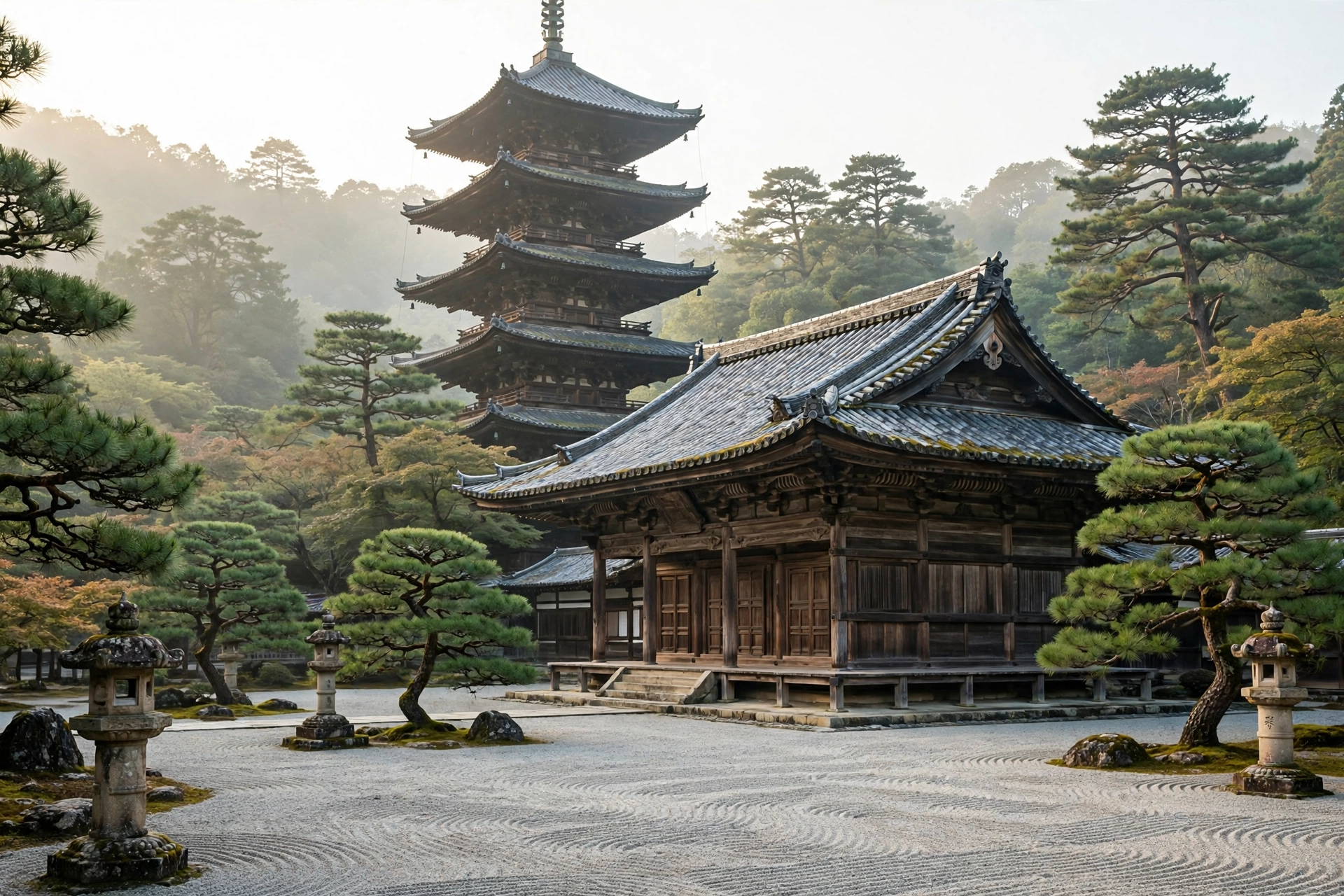
The point first: Ryoanji in Ukyo Ward, Kyoto, is a Zen temple of the Rinzai Myoshinji school, registered in 1994 as a World Heritage site as part of the “Historic Monuments of Ancient Kyoto.” Its centerpiece is the Hojo Garden, the rock garden: white sand spread over about 25 by 10 meters, with 15 stones arranged 5, 2, 3, 2, 3 from the east. The official site does not name the garden’s creator, and its construction is passed down only as tradition, so this article does not state a creator or an exact date as fact. In the range of the official site checked this time, no general guide to funerals, cemeteries, interment or perpetual memorials was found, and this article says so plainly.
I am Kurashiki Bouzu (kurashiki-bouzu), born in 1971, a former funeral professional now living in an old house in Kurashiki, Okayama, working with Moka, my AI butler.
This is one article in a series introducing temples across Japan, one temple at a time. This time it is Ryoanji in Ukyo Ward, Kyoto City. This is not a record of a visit I made myself; it is an article organizing only confirmed facts from Ryoanji’s official site and published sources of Kyoto City, Kyoto Prefecture and the Agency for Cultural Affairs. Please read it as preparation before a visit.
Basic information
- Temple name: Ryoanji. Its mountain name is Daiunzan, and the official site’s title is “Daiunzan Ryoanji”
- School: Rinzai school, Myoshinji branch
- Address: 13 Ryoanji Goryonoshita-cho, Ukyo Ward, Kyoto City
- Principal image: In the range of Ryoanji’s official site and the published sources of Kyoto City, Kyoto Prefecture and the Agency for Cultural Affairs checked this time, no description clearly stating a principal image was found. For that reason, this article does not state a principal image as fact
Ryoanji was registered in 1994 (Heisei 6) as a World Heritage site as one of the “Historic Monuments of Ancient Kyoto.” The official guide states that the rock garden and the entire temple grounds are included in that listing.
History
This land is said to have held a villa of the Tokudaiji family in the Heian period. In 1450 (Hōtoku 2), Hosokawa Katsumoto, kanrei (deputy shogun) of the Muromachi shogunate, received the mountain villa of Lord Tokudaiji and founded the temple, welcoming Zen master Giten Genshō as its founding priest.
Soon after its founding it burned down in the Ōnin War, and was revived by Hosokawa Masamoto, Katsumoto’s biological son. In 1499 (Meiō 8) the Hojo was built, and the rock garden is also said to have been created at this time. However, the official sources record this in the form of tradition, and it cannot be stated as a certain date.
Toyotomi Hideyoshi is also officially said to have visited Ryoanji several times, and a prohibition notice in his own hand is said to still remain. In 1797 (Kansei 9), fire destroyed the Hojo and other buildings, and the present Hojo became the Hojo relocated from Seigen-in, a sub-temple. The official site records that the graves of the founder Hosokawa Katsumoto and his wife, of Masamoto and others, remain to this day together with the grave of the founding priest.
Highlights
The centerpiece is the rock garden called the Hojo Garden. It is a national Historic Site and Special Place of Scenic Beauty, and the official guide describes white sand spread over an area 25 meters wide, 10 meters deep, about 75 tsubo, with 15 stones arranged 5, 2, 3, 2, 3 from the east side. It is a representative dry landscape garden, also known by the names “Tora no Ko Watashi” (tiger cubs crossing).
For this rock garden, it is important not to state its creator or its exact date of creation as fact. The official site does not give a creator’s name, guides visitors by saying that “four great mysteries are hidden” in it, and passes down its construction in the form of tradition. Kyoto City also explains it with a reservation: it is thought to have been made by the mid-15th century. That its creator remains unknown may itself be part of this garden’s quietness.
The Hojo (main hall) is an Important Cultural Property. It was originally built in 1606 (Keichō 11) as the Hojo of Seigen-in, and was relocated after the fire. Inside, the guide notes fusuma paintings of dragons and other subjects, painted by Satsuki Kakuō over five years beginning in 1953 (Shōwa 28).
Within the grounds there is also Kyoyochi Pond, remaining from the days of the Heian-period villa. It is officially said to have once been more famous than the rock garden and a noted place for mandarin ducks; today ducks and herons can be seen, and seasonal flowers can be enjoyed. There are also other places to view quietly: a tsukubai basin where the central water hole and four characters together read “Ware tada taru koto wo shiru” (I learn only to be content), the Wabisuke camellia said to have been praised by Hideyoshi, and the Ryoanji-gaki fence, in which split bamboo is set in a diamond pattern.
Events
In the range of the official site checked this time, no list of annual events was found. For that reason, this article does not list event names or dates such as a founding priest’s memorial day.
What could be confirmed officially was only the guide stating that the Butsuden (Buddha hall) is used for memorial services of parishioners and the like. The names and dates of events, and whether the general public can take part, are not officially announced, so please confirm directly with the temple when you go out. As for seasonal highlights, Kyoto City’s sightseeing guide gives cherry blossoms as usually from early to mid-April and autumn leaves as usually from mid- to late November, but these are guides to the best viewing times, not events.
Funerals and memorial services
As a former funeral professional, what draws my attention is guidance on funerals and memorials. Ryoanji is a Zen temple of the Rinzai Myoshinji school, but in the range of the official site checked this time, no general application guide to funerals, cemeteries, interment or perpetual memorials was found. To be honest, no such guide appeared on the official site.
What can be supported officially is that the Butsuden is used for memorial services of parishioners and the like, that memorial tablets of the Imperial family and of successive head priests are enshrined in the Butsuden, that memorial tablets of successive kanrei of the Hosokawa family are in the Hosokawa Mausoleum, and that the graves of the founding Hosokawa family members and of the founding priest remain. Beyond this, what kinds of services can be requested, and by whom, is not written officially, so this article does not call it “a temple where funerals and perpetual memorials can be held.” The details require direct confirmation with the temple. Not writing what is not known is the rule of this series.
Practical information for a visit
From the official guide, the confirmed contents:
- Visiting hours: from March 1 to November 30, 8:00–17:00; from December 1 to the end of February, 8:30–16:30. Open every day of the year
- Admission: adults ¥600, high school students ¥500, elementary and junior high school students ¥300. There is no group discount
- Time needed for a visit: 30 to 40 minutes is given as a guide
- Parking: visitors to the rock garden are guided as receiving one hour free
- Access: from Keihan Sanjō Station, take city bus No. 59 and get off at Ryoanji-mae, right there. From Randen (Keifuku Electric Railroad) Ryoanji Station it is a 7-minute walk. From Kyoto Station, take city bus No. 50, get off at Ritsumeikan University-mae, and walk 7 minutes, according to the guide
- Inquiries: telephone 075-463-2216
Fees and hours may change. Please check the latest guide on the official site before going.
Sources
- Ryoanji official site
- Guide to the grounds (Ryoanji official)
- History of Ryoanji (Ryoanji official)
- Mysteries of the rock garden (Ryoanji official)
- The way to Ryoanji (Ryoanji official)
- Frequently asked questions (Ryoanji official)
- Ryoanji (Kyoto City, World Heritage “Historic Monuments of Ancient Kyoto”)
- Ryoanji (Kyoto City official Kyoto Travel Navi)
- World Heritage Ryoanji (Kyoto Prefecture)
- Ryoanji main hall (Agency for Cultural Affairs, Cultural Heritage Online)
- November 22, 2026 ― Published in English (translation of the Japanese article, ledger No. 3032)(6,800 characters)