
Sanjusangendo — A Long Hall Where a Thousand Kannon Statues Stand in Rows
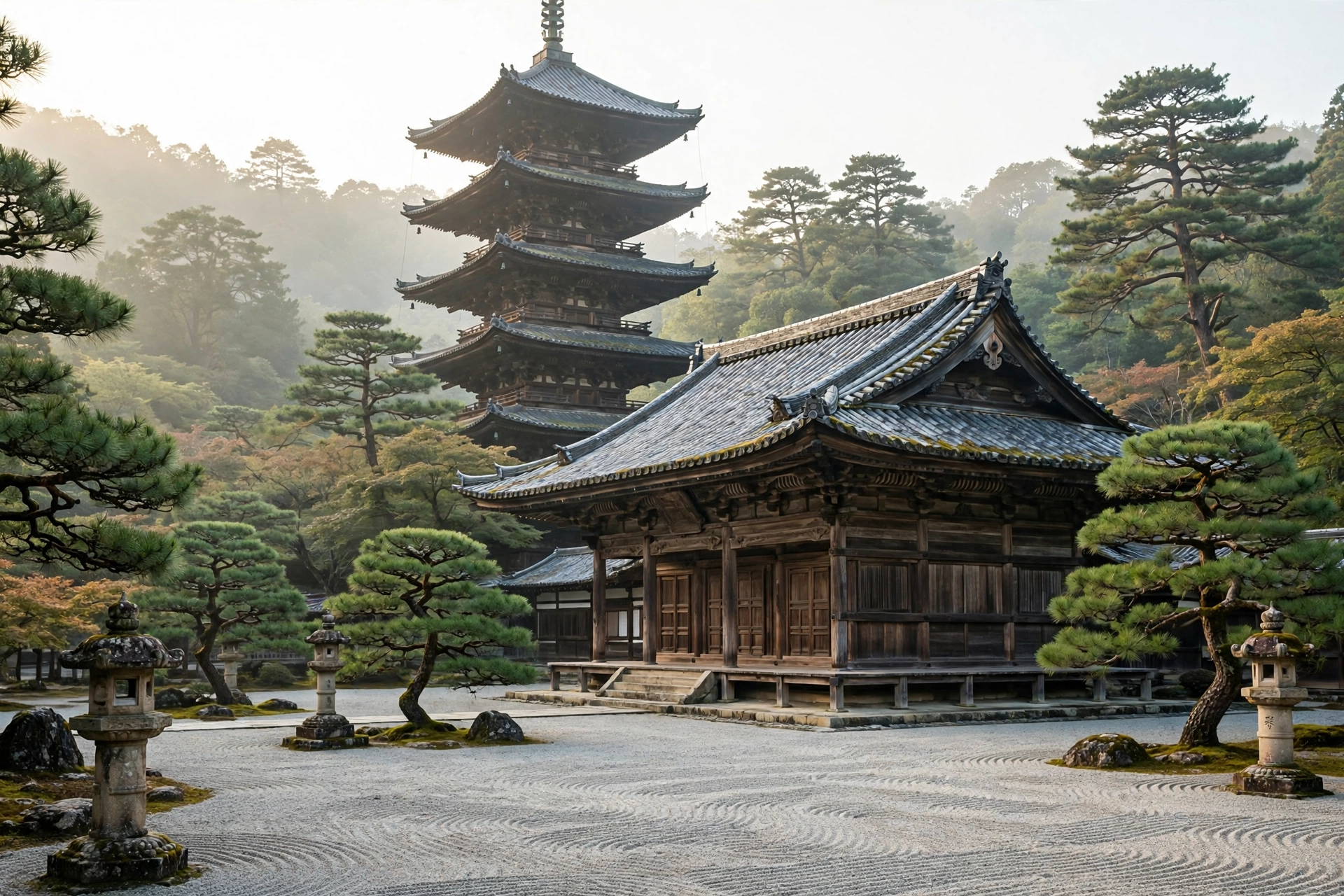
The point first: Sanjusangendo in Higashiyama Ward, Kyoto — formally Rengeoin — is a Tendai hall now administered by Myohoin. Its National Treasure main hall, rebuilt in the Kamakura period, holds a central seated Thousand-Armed Kannon (National Treasure) flanked by one thousand standing Thousand-Armed Kannon statues (National Treasures), plus the Twenty-Eight Guardians and the Wind and Thunder Gods, all National Treasures. The hall is about 120 metres long north to south. Its best-known memorial rite is the Higan-e, where a memorial altar is set up for ancestral services and mizuko memorials; no official guide was found saying that Sanjusangendo itself conducts funerals, perpetual memorials or interment, and this article says so plainly.
I am Kurashiki Bouzu (kurashiki-bouzu), born in 1971, a former funeral professional now living in an old house in Kurashiki, Okayama, working with Moka, my AI butler.
This is one article in a series introducing temples across Japan, one temple at a time. This time it is Sanjusangendo in Higashiyama Ward, Kyoto. This is not a record of a visit I made myself; it is an article organizing only confirmed facts from the official site and published sources of Kyoto City and the Agency for Cultural Affairs.
Basic information
- Temple name: Sanjusangendo (Sanjusangen-do). Its formal name is Rengeoin, and the building is formally called the Rengeoin Main Hall. It is called “Sanjusangendo” because there are 33 spaces between the pillars of the inner sanctuary of the main hall
- School: Tendai. It is now a hall administered by Myohoin of the Tendai school
- Address: 657 Sanjusangendo Mawari-cho, Higashiyama Ward, Kyoto. Telephone 075 (561) 0467
- Principal image: Thousand-Armed Kannon (Senju Kannon). The seated Thousand-Armed Kannon at the centre of the hall is the principal image, and one thousand standing Thousand-Armed Kannon statues stand on either side. The official site explains that all the Buddhist statues are National Treasures
History
In Chokan 2 (1164), Taira no Kiyomori built it in one part of Hojujidono, the cloistered government seat of the Retired Emperor Go-Shirakawa. The vow was made by the Retired Emperor Go-Shirakawa, and Taira no Kiyomori carried out the construction. The founding hall was once destroyed by fire, but it was rebuilt in Bun’ei 3 (1266), and Kyoto City’s explanation says that after four major repairs since then, it has been preserved for more than 750 years.
Remains from the Momoyama period also survive in the precinct. The earthen wall called the Taikobei and the South Gate, both associated with Toyotomi Hideyoshi, are Important Cultural Properties, and Kyoto City’s explanation says the South Gate was built in Keicho 5 (1600) by Toyotomi Hideyori.
Highlights
The greatest highlight is the main hall itself (National Treasure), rebuilt in the Kamakura period. It is a very long hall running north to south; its length is written as “about 120 metres north to south” on the official site and as “118 metres” in Kyoto City’s explanation, so the wording varies slightly. In this article I will write about 120 metres. Shoes are not allowed inside the hall, and shoe lockers are provided at the entrance.
At the centre of the main hall is the principal seated Thousand-Armed Kannon (National Treasure). The official site explains that at the Kamakura-period rebuilding, the master sculptor Tankei led his disciples to complete it. It is made of hinoki wood in the joined-block technique, with crystal inlaid eyes, and lacquer and gold leaf over the whole body. The height of the statue, however, is 355 cm on the official site and 3.35 m in Kyoto City’s explanation, so the figures differ by source. I will not settle on one, and I note that here.
On either side, one thousand standing Thousand-Armed Kannon statues (National Treasures) stand in orderly rows on a stepped platform of ten tiers, front to back. Of the thousand, 124 are statues from the Heian period, and the others were restored over 16 years in the Kamakura period. The names of the sculptors remain on about 500 statues, and it is said that many groups took part, including the Kei school, the In school and the En school. In Heisei 30 (2018), statues that had been deposited elsewhere returned to the main hall, and the Thousand-Armed Kannon statues were all assembled together. As for how they are counted, the standing statues are designated in the Agency for Cultural Affairs’ National Treasure designation as one thousand and one statues. In this article I will limit myself to writing of a group centred on the thousand standing statues and the central seated statue.
The Twenty-Eight Guardians who attend the Thousand-Armed Kannon, and the statues of the Wind God and Thunder God, are also National Treasures. The Twenty-Eight Guardians are described as a rare example surviving as a complete set, and as masterpieces of Kamakura sculpture. In the precinct there is also a pond-strolling garden completed in 2021.
This hall is also known as the stage where, in the Edo period, Toshiya — shooting an arrow the full length under its long eaves — was held. Today, around New Year, a national kyudo tournament of large-target archery named after Toshiya is held, and it has become a winter feature of Kyoto. The distance and the number of arrows in Edo-period Toshiya records could not be confirmed in the official sources checked this time, so I will not write them with figures.
Events
I list the main items from the official annual events. Please reconfirm the schedule in that year’s announcements.
- Monthly on the 1st: Kannon Sutra recitation meeting, 10:00–11:00. Monthly on the 17th: Great Prajna Sutra transference reading, 10:00–11:00
- Shushoe: January 1, 9:00–10:00. A New Year service praying for safety in the new year
- Yanagi no Okaji (Yanagi Josui-ku): mid-January, on the same day as the national large-target tournament. It is regarded as the most important rite of this hall; consecrated water prayed for with a willow branch is sprinkled on visitors to remove illness, and it is said to be especially effective for headaches. On that day the precinct is opened free of charge
- Setsubun-e: February 3, 10:00–11:00. After the service, lucky beans are given out
- Shuntoe (Spring Peach Festival): March 3, 9:00–15:30. A service for the Peach Festival, where the number “three” overlaps, and the precinct is opened free of charge
- Higan-e: on the middle day of the spring Higan week, 10:00–15:00. This is the memorial service touched on in the next section
- Hana Matsuri (Flower Festival): April 8. Sweet tea is poured over the birth Buddha in the flower pavilion
Funerals and memorial services
As a former funeral professional, what draws my attention is guidance on funerals and memorials. At the centre of the memorial guidance that can be confirmed officially is the Higan-e. On the middle day of the spring Higan week, a special memorial altar is set up in the hall, and it is announced that, by application, services for the repose of ancestors and mizuko memorials (toba memorial services) are held as applications come in. However, how the autumn Higan is handled, how to apply, and the amounts for toba memorial services could not be confirmed in the official guide.
On the other hand, in the range of the official site checked this time, no official guide was found saying that Sanjusangendo conducts funerals, or accepts perpetual memorials or interment. For Myohoin, which administers it, no official publication of conditions or fees for accepting funerals or perpetual memorials could be confirmed either. Not writing “it can be done,” and honestly writing that it could not be confirmed, is the rule of this series.
The prayers of the Shushoe and the Yanagi no Okaji are services separate from memorials for the departed.
Practical information for a visit
- Visiting hours: from April 1 to November 15, 8:30–17:00; from November 16 to March 31, 9:00–16:00. Reception closes 30 minutes before closing, and the hall is open every day of the year
- Admission: general ¥600, junior and senior high school students ¥400, elementary school students ¥300. On presentation of a disability certificate or rehabilitation certificate, the person and one carer pay half price. Group reservations are not accepted
- Access: immediately by the “Hakubutsukan Sanjusangendo-mae” bus stop. From Kyoto Station, city buses 100, 206 and 208 take about 10 minutes (it varies by time of day). About a 7-minute walk from Exit 2 of Shichijo Station on the Keihan Railway
- Parking: space for about 50 cars, and advance reservations are not accepted. However, on the days of the national large-target tournament and the Yanagi no Okaji, Kyoto City’s guide says there is no parking. The parking fee could not be confirmed as clearly stated in the official guide, so this article does not touch on it
- Barrier-free: wheelchairs are available to borrow, and there are slopes on the visiting route in the hall and on the paths in the precinct
Visiting hours and fees may change. Please check the official site.
Finally, leaving figures that vary as not known is the promise of this series.
Sources
- Sanjusangendo official site
- Sanjusangendo official, Buddhist statues
- Sanjusangendo official, seated Thousand-Armed Kannon
- Sanjusangendo official, one thousand standing Thousand-Armed Kannon statues
- Sanjusangendo official, Twenty-Eight Guardians
- Sanjusangendo official, visiting
- Sanjusangendo official, annual events
- Kyoto City official, Rengeoin (Sanjusangendo)
- Kyoto City official, Rengeoin Main Hall
- Kyoto City official, national large-target tournament (Toshiya)
- Kyoto Prefecture Tourism Federation, Yanagi Josui-ku
- Agency for Cultural Affairs, explanation of National Treasures newly designated in Heisei 30
- November 22, 2026 ― Published in English (translation of the Japanese article, ledger No. 3086)(8,153 characters)