
Tofukuji — A Great Zen Temple in Kyoto with the View from Tsutenkyo Bridge and Four Gardens
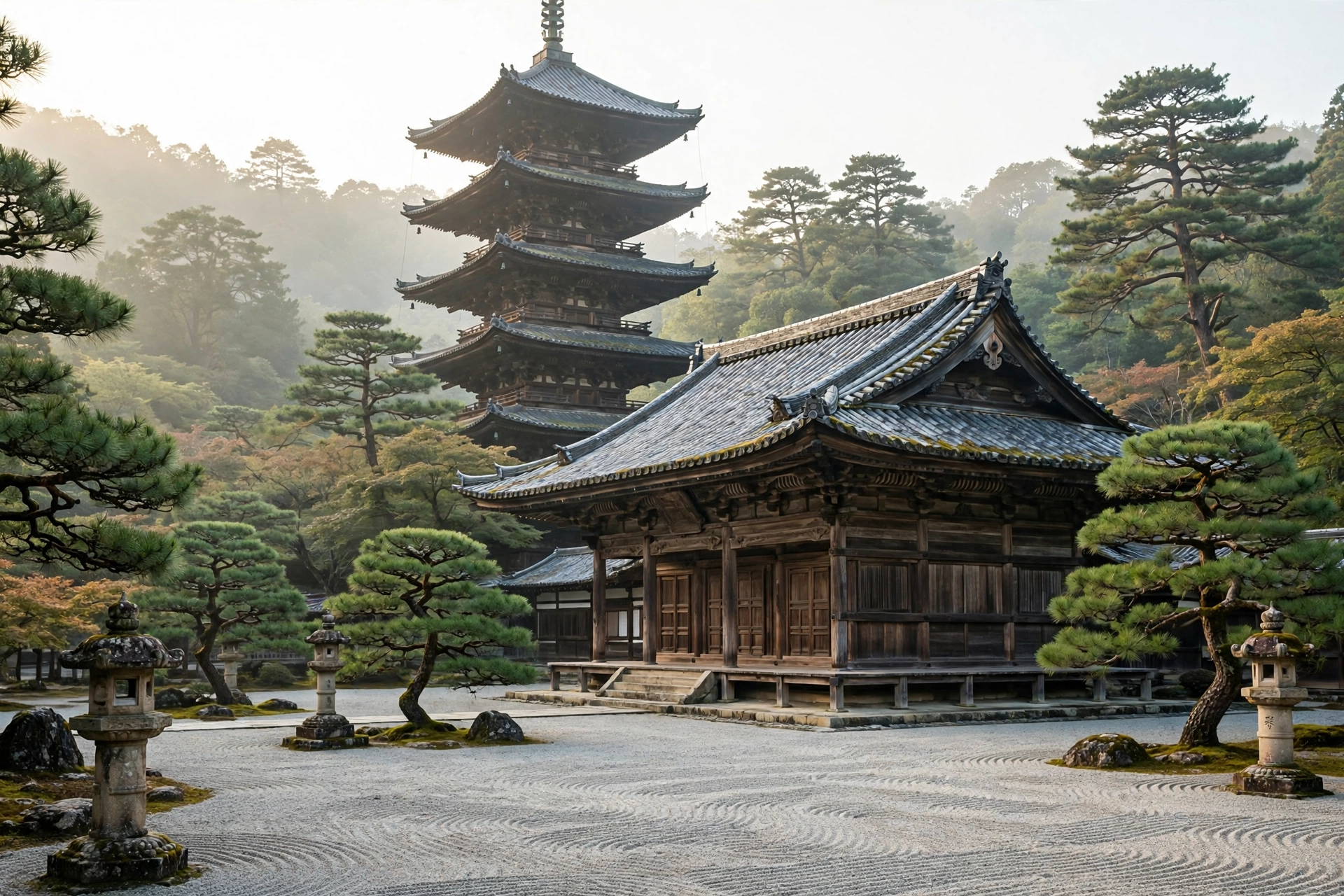
The point first: Tofukuji, in Higashiyama Ward, Kyoto, is the head temple of the Rinzai Tofukuji school. Its name takes one character each from Todaiji and Kofukuji in Nara, and it was built over 19 years, from 1236 to 1255, aiming to be Kyoto’s largest temple complex. Its Sanmon gate is a National Treasure, said to be the oldest, largest and finest surviving Zen Sanmon; the Hojo garden, the “Garden of the Eight Phases” created by Mirei Shigemori in 1939, is a nationally designated Place of Scenic Beauty; and Tsutenkyo Bridge, linking the main hall to the founder’s hall, looks out over maple trees. No guide to general funerals, perpetual memorials or interment, and no published fees, were found on the official site checked for this article, and this article says so plainly.
I am Kurashiki Bouzu (kurashiki-bouzu), born in 1971, a former funeral professional now living in an old house in Kurashiki, Okayama, working with Moka, my AI butler.
This is one article in a series introducing temples across Japan, one temple at a time. This time it is Tofukuji in Higashiyama Ward, Kyoto. This is not a record of a visit I made myself; it is an article organizing only confirmed facts from Tofukuji’s official site and published sources of Kyoto City and the Agency for Cultural Affairs.
Basic information
- Temple name: Tofukuji. Its mountain name (sango) is Enichisan
- School: head temple of the Rinzai school’s Tofukuji branch
- Address: 15-778 Honmachi, Higashiyama Ward, Kyoto, Kyoto Prefecture
- Founder: Shoichi Kokushi. His secular name was Enni Ben’en, and according to the official “History,” the title “Shoichi Kokushi,” bestowed by Emperor Hanazono, was the first such title granted to a Japanese Zen monk
- Principal image: The official “History” relates that the Shakyamuni statue (15 m tall) that was the principal image of the Buddha hall was known by the name “Shin-Daibutsuji.” However, no official page clearly stating the principal image of the present main hall (the combined Buddha hall and Dharma hall) was found within the scope of the official site checked this time. This article therefore does not state definitively what the principal image of the present main hall is
History
The temple’s name comes from the regent Kujo Michiie, who modeled it on Todaiji and Kofukuji in Nara and took the character “To” from one and “Fuku” from the other. Aiming for the largest temple complex in Kyoto, it was completed over 19 years, from Katei 2 (1236) to Kencho 7 (1255).
The founder, Shoichi Kokushi, traveled to Song China, succeeded to the Dharma of Wuzhun of Mount Jing in Hangzhou, and returned to Japan. In Kangen 1 (1243) he was welcomed by Kujo Michiie to the capital and became the founder of Tofukuji. He passed away in Koan 3 (1280) at the age of 79. On his return he brought back many texts.
Afterwards, most of the temple was lost in successive fires in Gen’o 1 (1319), Kenmu 1 (1334) and Engen 1 (1336), but reconstruction proceeded, and after rebuilding the temple took on the full appearance of a Zen temple. In Meiji 14 (1881) the Buddha hall, Dharma hall, Hojo and Kuri were also lost to fire, and the present main hall (the combined Buddha hall and Dharma hall) was completed in Showa 9 (1934).
Highlights
The Sanmon gate is a National Treasure. It is said to be the oldest, largest and finest surviving Zen Sanmon, with a ridge height of over 22 meters, in the form of a two-story double gate with five bays and three openings, designated a National Treasure building in Showa 27 (1952). Its plaque, “Myounkaku,” is in the hand of Ashikaga Yoshimochi, and the upper floor enshrines a seated Hokan Shaka Nyorai and the Sixteen Arhats. It is normally closed to the public and is opened on occasions such as special autumn openings. The year of completion of the present Sanmon differs between sources — the official Sanmon guide gives Oei 32 (1425), while the official special-opening guide and Kyoto City’s official site give Oei 2 (1405) — so this article does not state the year definitively.
The Honbo garden surrounding the Hojo on all four sides is called the “Garden of the Eight Phases” and is a nationally designated Place of Scenic Beauty. It is a modern garden created by Mirei Shigemori in Showa 14 (1939): the south garden is explained as a stone arrangement representing the Four Immortal Islands with white sand, the east garden as column stones arranged to represent the Big Dipper, and the west and north gardens as compositions incorporating checkerboard patterns. According to the official guide, Tofukuji’s Honbo garden is the only Hojo garden laid out around all four sides of the Hojo.
Tsutenkyo Bridge is a covered bridge linking the main hall to the founder’s hall. It is said to have been built by Shun’oku Myoha in Tenju 6 (1380), and maple trees spread out below it. The rare three-lobed maples that turn golden are said to be Chinese maples brought from Song China by Shoichi Kokushi. The fresh-green season is also noted as a highlight.
The Hojo of Ryugin-an, a sub-temple, is the oldest surviving Hojo building and is designated a National Treasure; it is opened during special autumn openings.
Events
- Nehan-e: March 14 to 16. A service for Shakyamuni’s entry into nirvana, at which Myocho’s Great Nirvana painting is shown in the main hall
- Higan-e: the spring and autumn equinox days. A service for the memorial of parishioners’ ancestors
- Gotan-e (Buddha’s birthday): April 8. A service celebrating Shakyamuni’s birth (Hana Matsuri)
- Shoryo Okuri: August 16. A Bon rite sending off the spirits welcomed into the home
- Kaisan-ki: October 17. The annual memorial on the anniversary of the founder, Shoichi Kokushi
- Kanpu special opening: from November to early December. A special opening in the autumn foliage season
- Sunday zazen meeting: every Sunday (suspended on service days), 6:30 to 7:00 a.m., in the Daizendo
The 2026 special openings of the National Treasure Sanmon and the National Treasure Ryugin-an are both officially announced as running from November 7 to December 6. Event dates may change by year, so please check the official guide for the year of your visit.
Funerals and memorials
As a former funeral professional, what draws my attention is the guidance on funerals and memorials. Among the official events are some connected with ancestral memorials, such as the Higan-e at the spring and autumn equinoxes (memorials for parishioners’ ancestors) and the Shoryo Okuri on August 16. Services remembering the founder also continue, such as the Kaisan-ki and the founder’s monthly memorial on the 17th of each month.
On the other hand, no guide stating that Tofukuji conducts funerals for the general public, no application guide for perpetual memorials or interment, and no published fees were found within the scope of the official site checked this time. The acceptance of funerals or memorials by individual sub-temples could also not be confirmed within the scope checked this time. To be honest, no such official guide was found. If you are considering a consultation, please check directly with the temple first.
Practical information for visiting
- Visiting hours (regular): April 1 to October 31, 9:00 to 16:00 (last admission 16:00, closing 16:30). December 7 to March 31, 9:00 to 15:30 (last admission 15:30, closing 16:00)
- 2026 Kanpu special viewing: November 14 to December 6. Tsutenkyo Bridge 8:30 to 16:00, Hojo garden 9:00 to 16:00
- Admission (regular season): Honbo garden (Hojo) 600 yen for adults, 300 yen for children (revised on November 1, Reiwa 8). Tsutenkyo Bridge and founder’s hall 600 yen for adults, 300 yen for children. A combined ticket is 1,000 yen for adults, 500 yen for children. “Children” means elementary and junior high school students; there are no group rates, and re-entry is not permitted
- Admission (autumn season): Tsutenkyo Bridge and founder’s hall 1,000 yen for adults. However, the children’s autumn fee is stated differently between official pages, so this article does not state it definitively. Please check the official guide before going
- Access: about a 10-minute walk from Tofukuji Station on the JR Nara Line and from Tofukuji Station on the Keihan line. Parking is free but is closed during the foliage period (October 25 to December 10). Using public transport in autumn is recommended
- Disability discount: by showing a disability certificate at reception, the holder and one accompanying person may enter free of charge
Visitors are asked to refrain from eating and drinking in the precincts, photography using a tripod, sketching, and bringing pets. Fees and hours may change, so please check the latest official guide.
Sources
- Tofukuji official site
- History (Tofukuji official)
- Visiting guide (Tofukuji official)
- National Treasure Tofukuji Sanmon guide (Tofukuji official)
- Tsutenkyo Bridge (Tofukuji official)
- Access (Tofukuji official)
- Events (Tofukuji official)
- Tofukuji (Kyoto City official, Kyoto Travel Navi)
- November 22, 2026 ― Published in English (translation of the Japanese article, ledger No. 3077)(7,459 characters)