
Toji — The Fundamental Training Center of Shingon Esoteric Buddhism Entrusted to Kukai, with a Five-Story Pagoda Standing in the Kyoto Sky
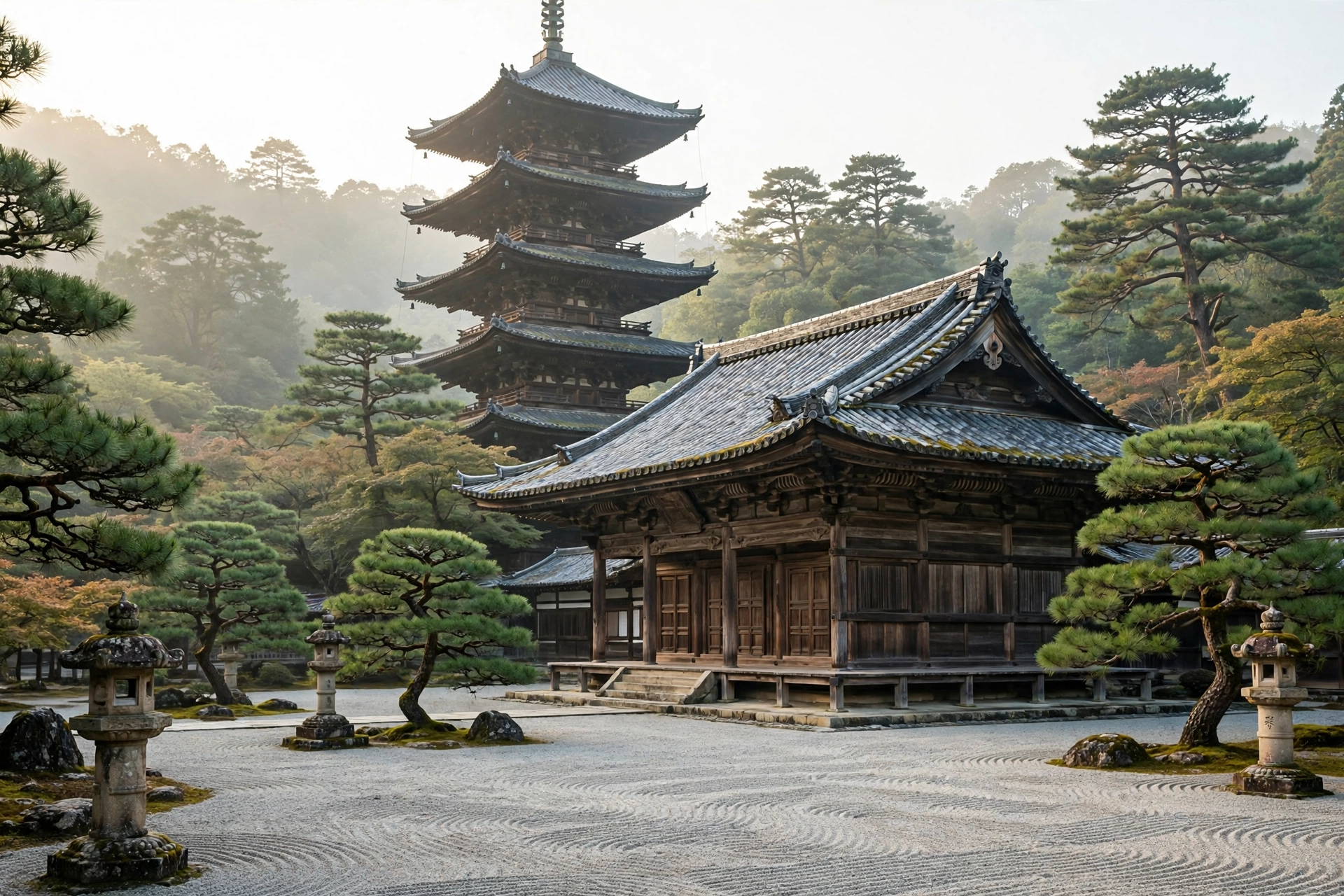
The point first: Toji (Kyoo Gokoku-ji) in Minami Ward, Kyoto, is the head temple of the Toji Shingon School and the fundamental training center of Shingon esoteric Buddhism, entrusted in 823 by Emperor Saga to Kobo Daishi Kukai, who had studied esoteric Buddhism in Tang China. Founded in 796 as an official temple guarding the capital, it was registered in December 1994 as a World Cultural Heritage site as part of the “Historic Monuments of Ancient Kyoto.” Its Five-Story Pagoda, a National Treasure about 55 meters tall, is described by the temple as the tallest wooden building in Japan. Its principal image is Yakushi Nyorai. As for funerals and perpetual memorials, no official guide stating that Toji conducts funerals was found within the scope of the official site checked this time, and this article says so plainly.
I am Kurashiki Bouzu (kurashiki-bouzu), born in 1971, a former funeral professional now living in an old house in Kurashiki, Okayama, working with Moka, my AI butler.
This is one article in a series introducing temples across Japan, one temple at a time. This time it is Toji (Kyoo Gokoku-ji) in Minami Ward, Kyoto. This is not a record of a visit I made myself; it is an article organizing only confirmed facts from the official site and published sources of Kyoto City and Kyoto Prefecture.
Basic information
- Temple name: Toji. Its formal name is Kyoo Gokoku-ji
- School: head temple of the Toji Shingon School. It is regarded as the fundamental training center of Shingon esoteric Buddhism
- Address: 1 Kujo-cho, Minami Ward, Kyoto City, Kyoto Prefecture
- Principal image: Yakushi Nyorai. The Kondo enshrines the Yakushi Triad, an Important Cultural Property, with Yakushi Nyorai in the center, Nikko Bosatsu on the right as seen by visitors, and Gakko Bosatsu on the left. It is in an old style without a medicine jar, and is regarded as a Seven-Buddha Yakushi Nyorai with seven transformed Buddhas arranged on its halo
In December 1994, Toji was registered as a World Cultural Heritage site as part of the “Historic Monuments of Ancient Kyoto.” Kyoto City presents Kyoo Gokoku-ji as one of its component properties and explains that it is “the only surviving structure by which the position and scale of Heian-kyo can be confirmed.”
History
In 794 (Enryaku 13), Emperor Kanmu built Heian-kyo. Flanking the Rajomon, the main gate of the capital, as if spreading both wings, Toji and Saiji were built; Toji was an official temple charged with protecting the royal capital on the east side of the country. Toji was founded in 796 (Enryaku 15), and the first construction begun was the Kondo. Both Saiji and the Rajomon disappeared with the passage of time, and Toji became the only surviving structure of Heian-kyo.
In the winter of the 29th year after the move to Heian, Emperor Saga entrusted Toji to Kobo Daishi Kukai, who had studied esoteric Buddhism in Tang China and returned to Japan. It was in 823 (Konin 14), and here Toji was born as the fundamental training center of Shingon esoteric Buddhism. Kukai first set to work on building the Kodo; construction of the Kodo began in 823 (Konin 14) and was completed in 839 (Jowa 6).
Afterward it repeated decline and revival. Signs of revival appeared in the Kamakura period, and in 1233 (Tenpuku 1) a seated statue of Kukai by Kosho, son of Unkei, was completed. In the Bunmei Doikki uprising of 1486 (Bunmei 18), the Kondo, Kodo and other buildings were lost to fire, but the Kodo was rebuilt in 1491 (Entoku 3) and the Kondo in 1603 (Keicho 8). The Five-Story Pagoda, lost to fire from a lightning strike, was also rebuilt in 1644 (Kan’ei 21).
Highlights
The Five-Story Pagoda is a National Treasure, and the present pagoda is the fifth generation. Each time it was lost to fire, from lightning strikes and other causes, on four occasions, it was rebuilt. It is about 55 meters tall, and the official site describes it as “boasting the greatest height of any wooden building in Japan” and as “the landmark tower of Kyoto, the city of Buddha.” The interior of the first story is an esoteric space with the central pillar as Dainichi Nyorai, surrounded by Nyorai and Bosatsu, and viewing is limited to periods of special opening.
The Kondo is a National Treasure, rebuilt in the Momoyama period. On the pedestal of its principal image, the Yakushi Triad, the Twelve Heavenly Generals who guard Yakushi Nyorai are lined up. The Kodo is an Important Cultural Property, known for its “three-dimensional mandala,” in which 21 Buddhist statues centered on Dainichi Nyorai are enshrined.
The Treasure House opens only during its exhibition periods: in spring from March 20 to May 25, and in autumn from September 20 to November 25. Works including the standing statue of Senju Kannon Bosatsu, formerly the principal image of the Shokudo (refectory), are exhibited. The Mieido (Daishido), in the northwest of the precincts, is a National Treasure and was Kukai’s residence. You may visit freely from 6 a.m. until the gates close, and admission is free.
On the 21st of each month, the Kobo Market is held, bustling with nearly 1,000 stalls. It is a market that has continued for more than 700 years.
Events
- Shojin-ku: every day at 6 a.m., at the Mieido. A rite offering food to Kukai as if he were still alive; anyone may attend
- Dai-hannya-e: on the 1st of each month at 10 a.m. The 600 volumes of the Great Perfection of Wisdom Sutra are transread, praying for the peace of the nation, abundant harvests, and the safety of households
- Taiya: on the 20th of each month at 2 p.m. A rite on the day before the Mie-ku of the 21st
- Mie-ku: on the 21st of each month at 10 a.m., at the Mieido. A rite of gratitude and requital to Kukai; the Kobo Market is also held on the same day
- Goshichinichi Mishiho: from January 8 to 14, at the Kanjo-in. A New Year rite begun by Kukai, regarded as the highest ceremony of the Shingon School. You cannot enter the hall, but the procession of monks may be observed
- Sho Mie-ku: on April 21 at 10 a.m., at the Mieido. Among the Mie-ku rites, this is the rite of the principal day
Event schedules may change depending on the year. Please check the official site for the latest information.
Connection with funerals and memorial services
As a former funeral professional, what draws my attention is the guidance on funerals and memorial services. At Toji, an Eko memorial rite is held at the Dainichido at 1 p.m. on the 21st of each month. It is a rite for the repose of ancestors, and the official site states that “those who have applied for the Eko memorial for ancestors may enter the hall.” The Dainichido is also a hall for venerable memorial tablets, enshrining the memorial tablets of Emperor Saga, Ashikaga Takauji and others, and the official site explains it as “a hall where memorial services for ancestors are held.” I think that a place for ancestral memorial services is permanently established within the temple is a feature of Toji’s form of memorial services.
On the other hand, no official guide stating that Toji conducts funerals was found within the scope of the official site checked this time. No dedicated guide to perpetual memorials or interment could be confirmed either. Also, the details of fees and application methods for prayers and Eko rites could not be fully verified on the official pages, so this article does not give figures for them. That prayers for traffic safety are accepted could be confirmed in the official “Frequently Asked Questions.” Not writing what I do not know is the rule of this series. For details, please contact Toji directly.
Practical information for visiting
From the official “Guide to Visiting,” here is what could be confirmed. The amounts are from the 2026 guide; admission fees were revised on March 20, 2025.
- Gate opening and closing: gates open at 5 a.m. and close at 5 p.m.
- Visiting hours: the Kondo and Kodo are from 8 a.m. to 5 p.m. (reception until 4:30 p.m.). The Kanchi-in and the Treasure House (only during exhibition periods) are from 9 a.m. to 5 p.m. Visiting the Mieido, Shokudo and other halls is free
- Admission fees (year-round, individual): Kondo and Kodo — adults 800 yen, high school students 400 yen, junior high school students and younger 300 yen. Kanchi-in — adults 600 yen, junior high school students and younger 300 yen. A combined ticket (Kondo/Kodo and Kanchi-in) is 1,200 yen for adults
- During special openings (individual): the first story of the Five-Story Pagoda plus the Kondo and Kodo is 1,200 yen for adults. The Treasure House is 600 yen for adults
- Access: 15 minutes on foot from the Hachijo Exit of JR Kyoto Station, 10 minutes on foot from Kintetsu Toji Station. By car, about 3.5 kilometers north on National Route 1 from the Kyoto Minami Interchange
- Parking: private cars and taxis are 600 yen / 2 hours. However, on the 21st of each month, parking cannot be used because of the Kobo Market
- Inquiries: Toji (Kyoo Gokoku-ji), telephone 075-691-3325
Admission fees and hours may change. Please check the latest guide on the official site before going.
Sources
- Toji official site
- History of Toji (Toji official)
- Kondo (Toji official)
- Kodo (Toji official)
- Five-Story Pagoda (Toji official)
- Guide to visiting (Toji official)
- Access guide (Toji official)
- Guide to rites (Toji official)
- Kyoo Gokoku-ji (Kyoto City)
- November 22, 2026 ― Published in English (translation of the Japanese article, ledger No. 3041)(7,691 characters)