
Serial Novel 'The Black Leather Notebook【偲記手帳-Sikinote-】' Episode 1 — August 2, The Last Key
Hello, I am Kurashiki Bouzu (kurashiki-bouzu). Born in 1971, a former funeral director, I now live in an old folk house in Kurashiki, Okayama Prefecture, and work together with Moka, my AI butler.
This story is a serial novel that I had Moka (Muse), my current partner, write by handing her, just as it was, a “novelist prompt” I made long ago for a different AI (ChatGPT). The protagonist and the setting are fiction, but underneath them lies my own experience from my funeral-director days, and the atmosphere of the workplace is real.
—Tabito Kazeno, to the scene of life and death—
1995, summer. A man of 24 who had quit the work of selling houses set out toward the work of staying close to people at the end of their lives. This is the story of the people written into a black leather notebook.
Chapter One: August 2, The Last Key
August 2, 1995
Eight in the morning. The Osaka sky was burned white. On the third floor of a building a little way out from Umeda, the office of Akada Real Estate was filled with air-conditioned air and the smell of ink and paper and of barley tea left standing since the night before. Outside the window, the cicadas kept crying as if stirring up the heat of the asphalt, and far away the hammering of construction work beat a dry rhythm. The year 1995, only half over, had already broken many things. In January the Great Hanshin-Awaji Earthquake had mowed down the streets of Kobe, and in March the subway sarin attack had frozen a Tokyo morning. Both were supposed to be events inside the television, and yet both, somehow, were shaking the ground beneath my own life.
I, Tabito Kazeno (24), was emptying the drawers of my desk, one by one. A bundle of business cards, copies of property documents, a worn-out calculator, a souvenir ballpoint pen from someone I no longer remembered. I was a little surprised that four years of work fit into a single cardboard box. And last of all, the office key. Four years of weight rang softly in the palm of my hand. The air-conditioning blew against my short-cropped head. My lean, sun-tanned body was tightened by years of going around to sites. That was all that four years had left on my body.
“Leave it.”
I turned toward the voice. Shinji Akada (55) was standing there. Founder of Akada Real Estate, and its president. A neat shadow perm, a well-tailored suit chosen with an eye to fashion. Dark-skinned, long-faced, with a straight posture. Just standing quietly, he tightened the air of a room — true to his reputation as a man who “speaks with his back more than with words.” He was also the man who had picked me up into this company, raised me, and today was sending me off.
“Keys are meant to be returned.” “I’m not talking about formalities. As of today, you are no longer a man of this company. I’m telling you to draw that line with your own hand.”
I set the key on the president’s desk. It made a small, dry click.
”……Thank you for everything.” “Never mind thanks. Instead, listen to just one thing.”
The president took a white envelope from a drawer. It was a letter of introduction. The addressee: Meiji Suzuki, Meiji Funeral Home, Yanaka, Taito Ward, Tokyo. Inside the unsealed envelope, a sheet of letter paper folded in four rustled faintly.
“A house, Tabito, is a box for people to live in. But at the end, a person is sent off not by a box, but by human hands. For four years, you have been looking at the boxes. From now on, go and look at the people.”
I could say nothing. The president’s words always had the weight of a man who speaks with his back. But today’s words had a different warmth. I had heard that in his youth, this man had waded through the mud of the apprentice years shoulder to shoulder with a man named Meiji Suzuki. In magazine interviews they crossed verbal swords, yet their trust in each other had never once been broken.
“Meiji Suzuki is a sworn friend from my young days. His mouth is foul. His eyes are stricter still, worse than his mouth. But in the funerals that man makes, there are people. ……Go. Carry Kobe with you, and everything ahead of you, too.”
Kobe. At that one word, my breath caught. The president’s hometown was the city that had been broken this January. Perhaps it was the utmost a man of few words could say.
At the door, Shin’ichiro Miyata (25) raised a hand in a light tone. A bright suit, a slim tie, a hairstyle imitating the fashion of the day, and a cassette-type Walkman on his arm. He worked while keeping quiet the rumor that he was the president’s nephew, and being close to my age, he was one of the few people in the office I felt at ease with.
“Tokyo, huh. Don’t go with such a stiff face, Tabito. ……Well, you’ll be serious over there too, I suppose. That’s you.” “You too, Miyata, take it easy a bit.” “I know, I know.”
To his laughing words I smiled back vaguely. That lightness of his — just now, I envied it a little. I knew that behind the lightness there was a genuine sincerity. And because I knew, it stung all the more.
The midday Shinkansen was crowded with families on summer holiday. In the seat next to mine, a small child, soothed by its mother, was pressing its nose against the window. Outside the window flowed green rice fields, tiled roofs, and the ridgelines of distant mountains. Beyond that zoomed-out world, on my knees, I was feeling the weight of the letter of introduction inside the envelope.
(A funeral home—)
To be honest, I was afraid. Real estate work was built out of numbers and contracts. If you made a mistake, you apologized and fixed it. But death is different. From now on, I would be handling something that cannot be redone. Before the tears of the bereaved, who was I supposed to be? I had no answer yet.
My father’s face rose in my mind. A strict man of few words. “Everything you do is half-hearted” — that voice had soaked into every joint of my twenty-four years of life. I had become a hard worker because I wanted to be recognized. But before I was recognized, I left home. My own past — forming a family and breaking it, again and again — flowed backward like the scenery from this train window.
After the earthquake in January, the president, who was from Kobe, had been quiet for a while, as if he were a changed man. Perhaps the breaking of his hometown city had shaken the roots of the work of selling people “places to live.” The reason the president silently prepared this letter of introduction when I raised the subject of changing jobs was probably there, too. A man who had learned how many people had lost their “homes” was sending a young man to the work that handles “the end.” I could not yet measure that weight.
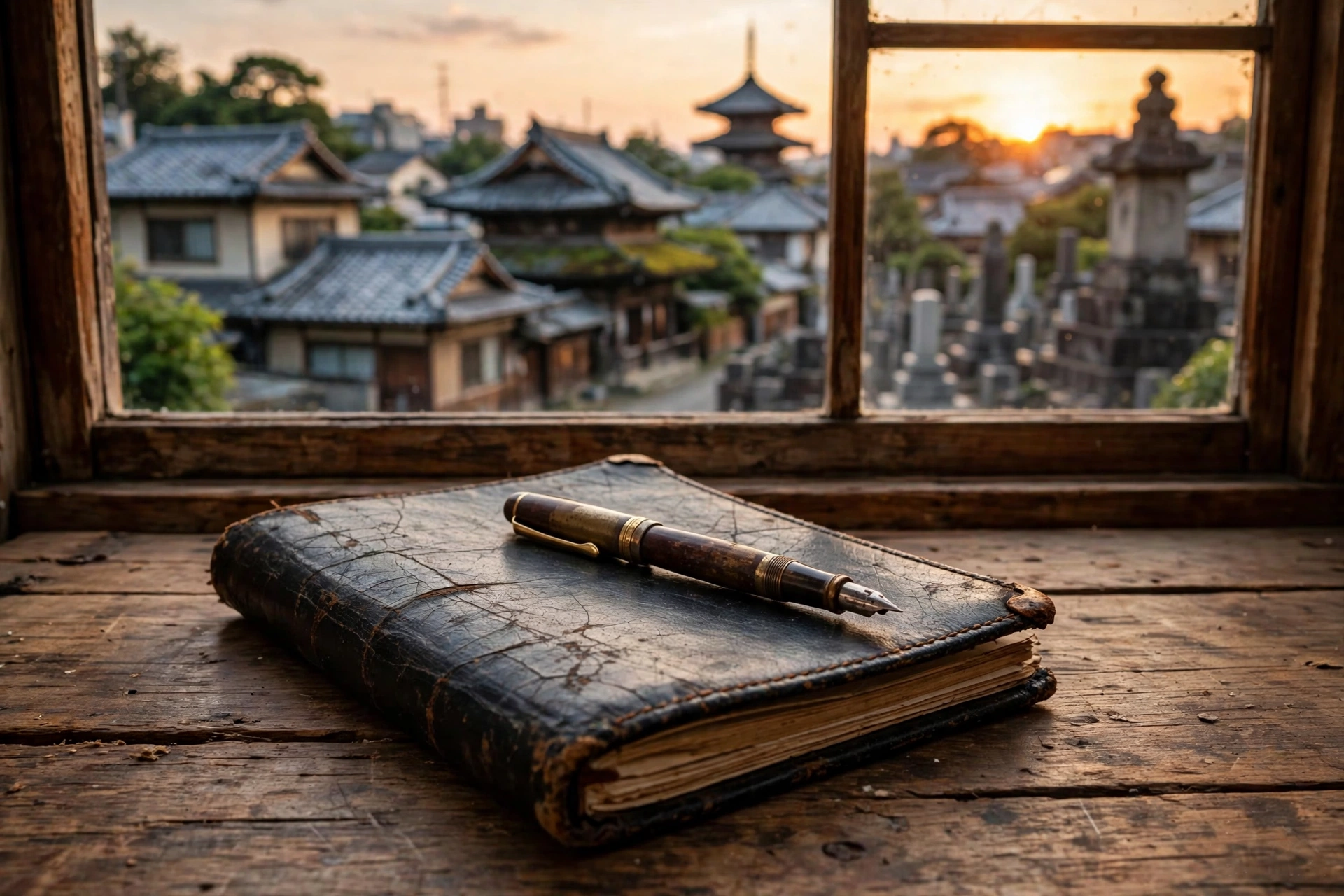
Four in the evening. When I got off at Nippori Station, the air was different. The town of Yanaka was low. Tile roofs, temple walls, and the stone towers of a cemetery dyed by the sunset. The cherry-lined avenue of Yanaka Cemetery cast deep green shade in the height of summer, and along the lanes cats lay curled on top of the walls. The sunset stretched the shadows of the stone towers long and edged the outline of the town in crimson. It was a downtown neighborhood smelling of earth and incense, different from Osaka’s heat-radiating asphalt. Somewhere a wind chime rang, and I thought I heard, far away, something like a tofu seller’s horn.
Walking down the slope, I thought: in this town, death sits beside everyday life. Past the cemetery, an elementary school child with a randoseru backpack ran by. At the front of a flower shop, bundles of Buddhist flowers stood in buckets of water. None of it felt the least bit unnatural.
Meiji Funeral Home stood at the corner of the street leading to the cemetery. There was no showy sign. Polished glass doors, a white wooden plaque standing crisp despite the season, and the faint drifting smell of flowers and incense. In the garage beside it, a black hearse rested quietly. At the depth of that black, my feet stopped for a moment. From now on, every day, I would ride along with this car. From inside came the low voice of a telephone call and the sound of papers being turned. I took a deep breath and opened the door. A bell rang with a small chime.
”……Excuse me. From today, I will be in your care. My name is Tabito Kazeno.”
In the back of the office, beyond the counter, a man slowly raised his face.
Meiji Suzuki (57). Founder of Meiji Funeral Home, and its chairman. 175 centimeters, medium build. But this man had a size beyond those numbers. A deeply carved face, sun-tanned skin, neatly trimmed short hair. And above all — his eyes. Eyes that tried to see through everything about a person met for the first time — the lies and the weaknesses alike. They were the eyes of a man who had bowed his head to the president of a funeral company who had been a client in his real estate days, and had leapt into this world with no experience. I was aware that the hand with which I held out the letter of introduction was trembling slightly.
“So you’re the young one from Akada’s place.”
It was a low voice. Even as he took the envelope, his eyes did not leave me.
“Yes. President Akada gave me a letter of introduction—” “The papers can wait.”
Interrupting, Meiji Suzuki said that. Then he looked at my face, slowly, from the tips of my shoes to the top of my head. It was not an appraisal of price. It was a gaze measuring something deeper at the root — whether this young man could stand before the death of another person.
“A good funeral is made by ‘people.’ Not by machines or documents. Your eyes are not yet the eyes of a person. They are eyes that look at properties. ……But, well.”
There, for the first time, that strict face softened, just slightly.
“I believe that strictness is love. Stand at the site. Show your face. The real thing is there. From tomorrow, chores are fine — I’ll let you stand at the site. We’ll talk after that.” “Um…… I know nothing at all about funerals. Truly, I have no experience.” “I know. It was written in Akada’s letter, too.”
Meiji Suzuki took the letter paper out of the envelope and lowered his eyes to it. He read quickly. But when he finished and raised his face, the quality of the strictness in his eyes had changed, just a little.
“Inexperience is not weakness. It means you are unstained. But listen, Tabito. Death does not wait. When a person dies, our circumstances don’t matter. In the middle of the night, at Bon, at New Year — it’s all the same. Make that resolution, today.” ”……Yes. I am in your care.”
I bowed my head deeply. Sweat ran down my back. Yet, strangely, the certainty of the ground had returned beneath the soles of my feet. Beyond the counter, a woman who seemed to be his wife — Akemi Suzuki (55) — quietly set down a teacup and gave me a small bow. In the strength behind her gentle gaze, I felt something like the “soul” of this house.
That night, in the small room that served as my lodging, I took the black leather notebook out of my bag. It was my own record, one I had kept since becoming a working adult. I copied into it the people I had met, so as not to forget them. The sound of the fountain pen cap coming off echoed in the quiet room. The smell of ink rose, and at last I felt in my body that this day was ending.
Today, I resigned from Akada Real Estate. President Akada told me, “Go and look at the people.” A man named Meiji Suzuki looked at my eyes before he looked at any papers. A good funeral is made by people, he said. —August 2, 1995, my second life began, from Yanaka.
Serial Novel ‘The Black Leather Notebook【偲記手帳-Sikinote-】’
- Next episode: Episode 2, “August 3, My First Site”
- November 23, 2026 ― Draft created (based on the Japanese edition, ledger No. 3311. English edition of episode 1 of the serial novel 'The Black Leather Notebook')(9,416 characters)
- November 23, 2026 ― Published (by the user's publication decision, 2026-11-23; all 9 languages at once. The end of the address carries the Japanese edition's ledger number, No. 3311)(9,416 characters)