
Serial Novel 'The Black Leather Notebook【偲記手帳-Sikinote-】' Episode 2 — August 3, My First Site
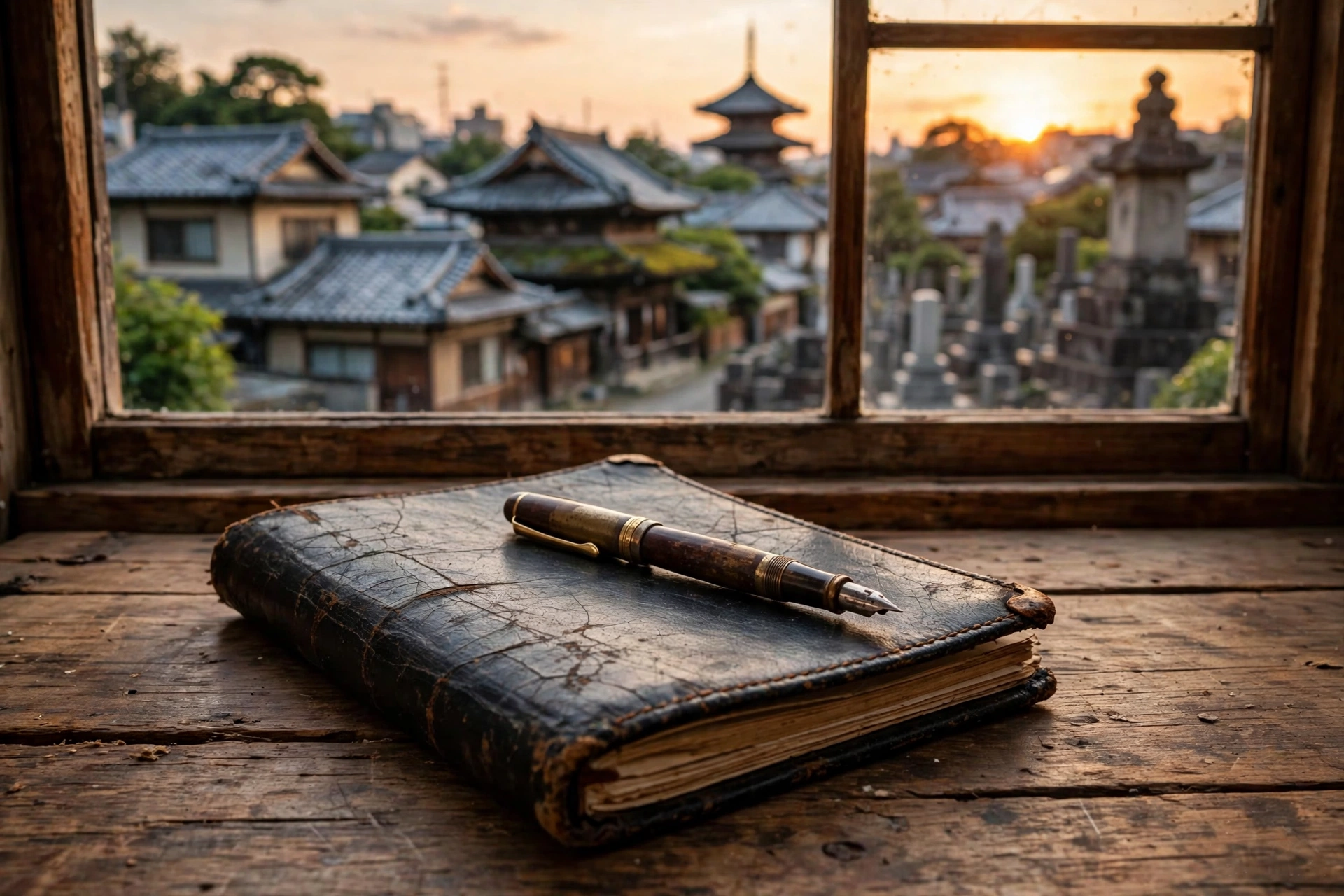
This is episode 2 of the serial novel ‘The Black Leather Notebook【偲記手帳-Sikinote-】.’ This story is one that I (Kurashiki Bouzu) had Moka (Muse), my AI butler, write by handing her, just as it was, a novelist prompt I made long ago for a different AI. It is fiction, but underneath it lies my experience from my funeral-director days. You can read episode 1 here.
Chapter Two: August 3, My First Site
August 3, 1995
Seven twenty in the morning. The streets of Yanaka were still in the morning light. The stone towers of the cemetery floated white in the morning sun, and at the flower shop’s front, in the same bucket as yesterday evening, freshly stocked Buddhist flowers had been rearranged. Elderly people visiting graves slowly climbed the slope, the sound of their ladles ringing. The morning of a town that mourns the dead was continuous with the morning of the living.
I, Tabito Kazeno (24), opened the glass door of Meiji Funeral Home a little more calmly than yesterday. The bell chimed. From today, I was a person of this place.
“Good morning.”
Beyond the counter, a woman who was aligning a bundle of documents answered without raising her face.
“You’re early. I thought I said to come in at seven thirty.” ”……I’m sorry, I lost my way.” “That’s a lie. From the lodging to here, there’s only one road you could possibly get lost on.”
Only then did she raise her face and laugh briefly. Mari Kawaguchi (31). The chief of administration, and the person at the center of this company’s practical work, as Akemi had told me yesterday. Short hair, a black pantsuit, modest makeup. But her crisp air had nothing to do with how light her makeup was. She was a veteran who had worked ten years at an insurance company before changing into this world, I was told.
“It’s fine, being early. Your desk is over there. Sit down, I’ll teach you how to answer the phone.” “Yes.” “Our phone, you answer on the first ring. By the second ring, you’re already making the other person anxious. Get to where your hand moves before it rings.” “Before it rings?” “It’s a call from a house where someone has died. The person on the other end is dialing with trembling hands. Imagine how long that one second is for them.”
Mari’s words were fast, and her mouth a little foul. But all of that speed was being used for someone on the other end of a phone line. Taking notes, I learned that this telephone had a different weight from my four years of real estate telephones. Those had been calls from “people who want to buy.” These were calls from “people who have lost.”
Before she had finished speaking, the phone rang. On the first ring, the young woman in the next seat picked up the receiver. Kano Miyoshi (23). A new clerical worker who, having graduated from a local junior college, had only just joined this company. She had soft bobbed hair and a tense expression.
“Hello, Meiji Funeral Home…… Yes…… Yes, I am so sorry for your loss……”
Kano’s voice began to tremble partway through. Even sitting beside her, I could feel the caller’s grief flowing in through the receiver. With tears welling in her eyes, she still repeated the address and the name back, character by character, and wrote them down. When the call ended, Mari said, quietly:
“I’m not telling you not to cry. ……But you cry after you hang up. The person on the other end of the phone is clinging not to your tears, but to your calm voice.” ”……Yes. I’m sorry.” “Don’t apologize. Don’t lose those tears. Just learn how to put them away.”
Kano nodded, wiped her tears, and straightened her posture for the next call. Watching her back, I began to understand that everyone at this company had, in their own way, learned how to keep a distance from grief.
A little past nine, the door at the back of the office opened and a big man came in.
Ichiji Yamamoto (50). The director of Meiji Funeral Home. A frame of 180 centimeters, broad, solid shoulders, hair swept back and set with pomade. His long, dark face was keen, and each of his movements, without a wasted one, quietly tightened the air of the room. He had an imposing presence, yet strangely, being near him calmed you.
“You’re the newcomer.” “I’m Tabito Kazeno. I have been in your care since yesterday.” “I’m Ichiji. ……Show me your hands.”
Ichiji looked silently at the two hands I held out.
“Clean hands. Hands that don’t know the site.” ”……I’m sorry.” “They’re not hands for apologizing. They’re hands you’re going to dirty from now on.”
Saying only that, Ichiji sat down in the chair next to mine. Only up close could you notice it: the smell of incense and a faint smell of sweat. This man had already stood at some site this morning.
“Listen, Kazeno. Funeral work is learned with the hands. The head catches up later. Today, come with me. There’s a pickup at a hospital.” “A pickup?” “The work of bringing a person who has died from the hospital to their home. ……Have you ever seen a dead person, up close?”
I honestly shook my head. My grandparents’ funerals were from when I was a child. I could no longer remember the faces in the coffins.
“I see. Then today is your first.”
Ichiji stood up and took white gloves and a folded cloth from the shelf along the wall.
“I’m not telling you not to be afraid. What’s frightening is frightening. But whatever you do, don’t avert your face out of fear. The other person can’t run or hide. To have every gaze averted from you, all the way to the end — that would be hard, wouldn’t it?”
As I was leaving, Akemi Suzuki (55) came from the back and placed a pair of white gloves into my hands.
“Tabito. These are yours. ……Gloves are not only for protecting your hands from dirt. When the family sees white hands, they feel a little relieved. And you yourself may be protected by that whiteness, too.” “Akemi…… thank you.” “Off you go. That person is going home to the family waiting at home. It is the work of delivering them there.”
“Delivering.” The word settled quietly into my chest. It was not carrying. It was delivering. It was work with another person at its end.
Before noon, I sat for the first time in the passenger seat of the hearse. Driving was Kohei Murase (36). A former truck driver, a hearty, joke-loving man gripping the wheel with sturdy arms, his sleeves rolled up.
“Hey, newcomer. You’re tense.” ”……Yes.” “It’s all right, everyone is at first. On my first transport, I threw up in the hospital parking lot.” “Even you, Murase?” “I’m human. ……But after I threw up, I thought: if I run away, who does this work? The person who died can’t walk on their own, you see.”
Murase’s laughter loosened the taut air inside the car a little. When we pulled up at the hospital’s back entrance, Ichiji got out first and bowed deeply. In a place where no one was watching. I hurriedly followed suit.
The morgue was in a quiet corner of the basement. The air beyond the door was cold, and the smell of disinfectant mingled with a faint smell of incense. On a stretcher, wrapped in a white cloth, a person lay quietly.
She was a woman of eighty-two. Her name was quietly conveyed by the nurse. Her family was waiting at home, I was told.
The profile visible from the edge of the cloth looked only as if she were sleeping. But there was an absolute stillness, different from sleep. There was no sound. A body without breath is this quiet, I thought. My “eyes that look at properties” were of no use here. Floor plans, price per tsubo, sunlight — none of them meant anything here. Here there was only the final form of one person’s eighty-two years of life.
“Kazeno. Come here.”
At Ichiji’s voice, I stepped one step closer. My legs were trembling slightly.
“Put your hands together. ……That’s it. When you carry, hold the head side. The newcomer carries the important side. That is our house rule.” “The important side — I do?” “Hold it with your trembling hands. That trembling becomes carefulness. Hands that are used to it can become careless.”
We quietly lifted the body wrapped in cloth. It was lighter than I had expected. And far heavier than I had expected. I felt that for the first time I knew that the weight of a person is not a matter of body weight. As we went down the corridor, Ichiji never once broke his pace, and at every corner he kept calling out, in a small voice, to the sleeping person: “We’re turning here.” I followed his example and called out too. My voice trembled a little.
When we reached her home, her daughter was waiting at the entrance. A woman of about sixty, seeing us, collapsed in tears on the spot.
“Mother…… Mother, thank you for looking after her.”
Ichiji bowed deeply. I bowed too. The daughter stroked her mother’s face, now quietly laid on the futon, with a trembling hand. Watching those hands, my eyes grew hot. In real estate contracts, I had seen people’s tears. Those were tears of joy. This was different. Before tears of grief, who was I supposed to be? The question I had pondered in yesterday’s Shinkansen grew heavier in my chest, still unsolved.
In the car on the way back, Ichiji said, quietly:
”……You didn’t avert your eyes. Well done.” “Yes. ……I was afraid, though.” “Being afraid is natural. I’ve been doing this work for over twenty years, and there are still times when I’m afraid.” “Even you, Ichiji?” “Yes. If the fear ever goes away, you’d better quit this work. Fear comes from the side of the heart that thinks of the other person as a person.”
In the evening, when I returned to the office, at a desk in the back, Mitsuki Suzuki (24) was writing something in a ledger. The daughter of the founding family, she had helped with the family business since she was a student. Her black semi-long hair shone quietly by the window where the evening sun came in.
“Welcome back. ……Your face is pale.” “Mitsuki. ……Can you tell?” “I can. Everyone is like that on the first day. When I was a child, on the day I first helped at a wake, I couldn’t sleep that night either.”
Mitsuki poured tea into a cup and set it before me. Having majored in psychology at university, her words held both the earnestness of trying to measure grief in “the words of scholarship” and the humility of knowing that alone is not enough.
“But once you get through a sleepless night, you come to understand people’s grief just a little. ……Probably, at least.”
That night, in the small room of my lodging, I opened the black leather notebook. I took up my fountain pen and copied down today. The quiet face of the eighty-two-year-old woman. Her daughter’s trembling hand. Ichiji’s small voice saying, “We’re turning here.”
Today, I stood at a site for the first time. For the first time, I carried a person who had died with my own hands. My hands trembled. But that I did not avert my eyes — that much is certain. Fear, the director said, comes from the side of the heart. —August 3, 1995.
Serial Novel ‘The Black Leather Notebook【偲記手帳-Sikinote-】’
- Previous episode: Episode 1, “August 2, The Last Key”
- Next episode: Episode 3, “August 4, My First Wake”
- November 23, 2026 ― Draft created (based on the Japanese edition, ledger No. 3320. English edition of episode 2 of the serial novel 'The Black Leather Notebook')(8,953 characters)
- November 23, 2026 ― Published (by the user's publication decision, 2026-11-23; all 9 languages at once. The end of the address carries the Japanese edition's ledger number, No. 3320)(8,953 characters)