
Serial Novel 'The Black Leather Notebook【偲記手帳-Sikinote-】' Episode 28 — March 10, The Answer of the Key
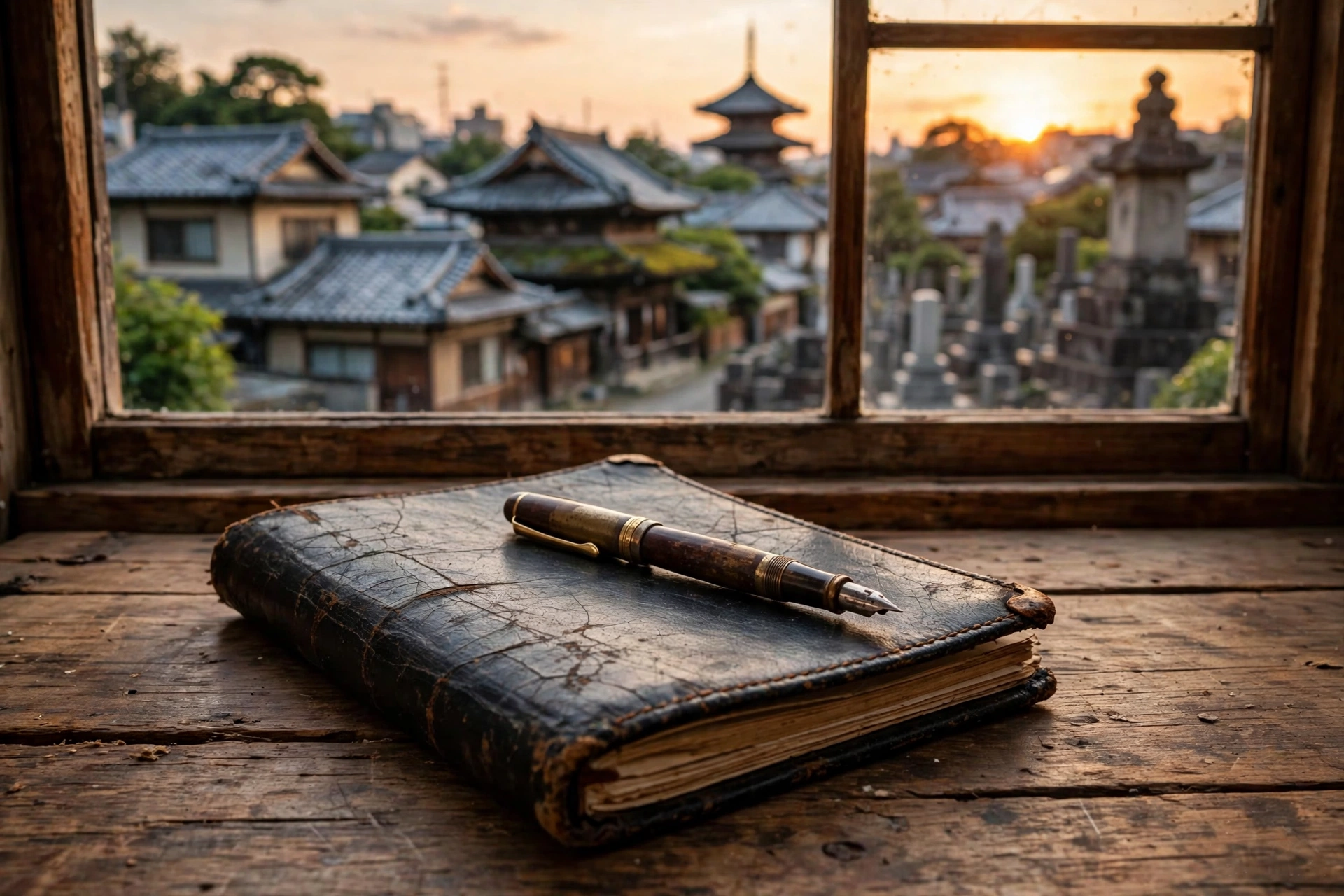
This is episode 28 of the serial novel ‘The Black Leather Notebook【偲記手帳-Sikinote-】.’ This story is one that I (Kurashiki Bouzu) had Moka (Muse), my AI butler, write by handing her, just as it was, a novelist prompt I made long ago for a different AI. It is fiction, but underneath it lies my experience from my funeral-director days. You can read episode 1 here.
Chapter Twenty-Eight: March 10, The Answer of the Key
March 10, 1996
March 10. The sky over Yanaka was thinly clear from the morning. The plum trees in the cemetery, as if the few blossoms of February had been a lie, were open in white, all over their branches. The line of people visiting graves, ahead of the spring equinox, was beginning to grow a little longer.
That morning, in the March column of the arrangements sheet of the Meiji Funeral Company, a circle in red pencil was shining quietly. “Attending, with promises.” Those were the words Mari Kawaguchi (31) had written out in a clean copy.
As they were leaving, Akemi Suzuki (55), straightening the collar of the coat of Meiji Suzuki (57), said:
“You know. There are two promises. To remain seated. And if you think it is too much, to go home.” “Yes. ……It is a promise with Mr. Kashiwagi. I will keep it.” “It is not only a promise with Mr. Kashiwagi that you are keeping. ……It is a promise with me, too.”
Go Watarai (42) had brought the company car around to the front entrance.
“Chairman. To the Haneda house, we will go by car. ……On the way back, too, I will drive you. The arrangement for going and the arrangement for returning carry the same weight.” “Watarai. ……Again today?” “Today above all, sir.”
Those accompanying him were Masayoshi Sakuma (47), Mitsuki Suzuki (24), and I, Tabito Kazeno (24). Hifumi Yamamoto (50) said, in front of the glass door of the office:
“Chairman. ……I will keep the chair empty for you. The place you come back to is here.” “Hifumi. ……Yes. I am off, then.”
The Haneda house was a small wooden house at the edge of Yanaka. We arrived a little earlier than the family. Inside the house, Mr. Kazuhiko was alone, making the last preparations. Lining up the cushions, wiping before the family altar, preparing the tea. The way his hands moved was an extension of the quiet movements of the monthly day of airing the house.
“Mr. Kazeno. ……Today, this becomes a house where people gather, on my mother’s day. Not an empty house.”
The windows were already thrown open. The spring wind passed straight through the house. On the family altar, flowers the family from Saitama had brought were offered, and Kazuhiko Haneda (55) bowed his head deeply at the entrance.
“Chairman. ……You really came.” “Mr. Kazuhiko. ……What has been entrusted to me — delivering it is the work of the ledger.”
Mr. Kazuhiko’s wife brought the tea. The son and his wife who had come from Saitama, and their two grandchildren, also put their hands together before the family altar. The neighbors, too, gathered, one house and then another. They were the houses that had received a share of Toshiko’s pickles every year. One brought flowers, another came carrying a stacked lunch box, saying, “I cannot serve Toshiko’s pickles, but if it is my pickles…”
Before the memorial service began, Mitsuki stood small before the gathered people.
“Everyone. Let me tell you briefly how today will proceed. ……First, there will be the sutra chanting by Abbot Kashiwagi. After that, everyone will offer incense. If there is anything you do not understand, please ask me at any time. I will be at the back.”
That was all. Few words were sent out, many words were held back. It was exactly the shape she had been taught at Renzui-ji in February for the place of a memorial service. But after those short words, the air of the room visibly loosened. I could see the tense shoulders of the family from Saitama go down.
The sutra chanting of Abbot Yoshimichi Kashiwagi (58) quietly filled the house. Meiji, as promised, remained seated. He stood only at the time of offering incense. Mr. Kazuhiko checked that figure again and again out of the corner of his eye. Whether the person who had come was pushing himself too hard. It was the quiet care of the man who had invited him.
When the chanting ended, Kashiwagi, as promised, left his seat.
“The temple does not remain at the place of deciding. That, too, is part of the order. ……Everyone, please have a good day.”
It became the time of the meal. The neighbors’ pickles, the rice the wife had cooked, and the sweets the family from Saitama had brought. When everyone held chopsticks before the photograph of Toshiko on the family altar, the talk flowed, naturally, to memories of Toshiko.
“You know, Toshiko never, ever told us the salt balance of her pickles. ‘Learn it with your tongue,’ she would say.” “Mother was stubborn, after all.”
One of the neighboring wives offered the pickles in the stacked box to Meiji as well.
“Mr. Suzuki. You eat some too, please. ……They are far from Toshiko’s taste, though.” ”……Thank you. That woman’s pickles — on the night of a funeral day, I received a share of them too. ……The salt was a little strong, and they were good pickles.” “Oh my. ……So she showed her weak side to you too, Mr. Suzuki.”
Laughter filled the small house. The grandchildren looked up at the photograph on the family altar and said:
“Grandma is smiling, isn’t she.”
At those words, Mr. Kazuhiko’s eyes quietly grew moist. The memory of the day of deciding remains longer than the content of what was decided. The very scene of Meiji’s words was there.
After the meal ended and before the neighbors went home, on the veranda, Meiji and Mr. Kazuhiko exchanged a few short words, just the two of them.
“Chairman. ……After this, we will talk with just the family. We will talk about deciding.” “Yes. ……We are in a place where we only need to listen. The ones who decide are the family.” “We have finally come to the promised day we decided at New Year. ……I feel a little afraid, too.” “Mr. Kazuhiko. A house that decided the day of deciding by itself does not run away from the content of the deciding, either. ……Your face today is different from your face at the entrance in October.”
Mr. Kazuhiko nodded, and went back to the room with the family altar.
When the neighbors had gone home, only the family remained in the house. Before the family altar, the family’s own time began.
The first to speak was the son from Saitama.
“Father. ……I will say it honestly. I understand the feeling of wanting to keep this house. But a house where nobody lives will decay if it is left alone. Coming here from Saitama is heavy for you alone, too. ……I do not think selling it would be a betrayal of Mother, either.”
Mr. Kazuhiko listened in silence. His wife said quietly:
“You know. ……For me, talking about this house as ‘a thing to dispose of’ has always been painful. It is the house where my mother-in-law waited for us, isn’t it. ……I do not want it to become a story of selling the house that waited for us because it can no longer wait.”
One of the grandchildren found, on the pillar beside the family altar, the marks of height measurements.
“Is this Father’s? ……I want my height measured here too.”
The room fell quiet. Mr. Kazuhiko slowly took out the key. It was that key of which he had said in October, “I want to hold it myself just a little longer.”
”……Listen to me. Today, let us decide. I want to keep this house. I will not sell it. ……But, you see, ‘just a little longer’ ends today. Not a ‘just a little longer’ with a deadline — this house will remain, as the Haneda house. I will go on holding the key. The airing, and the flowers for the family altar, remain my role. ……In exchange, promise me just one thing. Someday, if the day really comes when talk of letting go of this house comes up, then too, let us all gather here like today and decide. We will not decide alone. ……That is this house’s way of deciding.”
The son looked at the family altar for a while. At last, he nodded.
”……I understand. It is not something to make Father carry alone. Deciding is done by everyone. ……At Bon, we will come to air the house too.”
The wife put a hand on the grandchild’s head and said:
“Then, let us do the height measuring at Bon. ……On this pillar, we will carve your height too.”
The family’s answer was decided quietly before the family altar. Neither selling, nor keeping it with a deadline. “It remains as the Haneda house, and when it is decided again, everyone decides together.” That was the answer given by the man who holds the key, and his family.
Mr. Kazuhiko, after a while, brought a single sheet of letter paper from the kitchen. With a fountain pen, he wrote slowly.
“March 10. Decided by the whole family together. This house will remain as the Haneda house. When it is decided again, too, everyone will gather and decide.”
That paper he put away carefully in the drawer of the family altar.
“If we do not write it down and leave it, a promise flies away on the wind. ……Hearing the story of Sumiko’s envelope, I thought that. To give it shape and leave it. That is the shape of keeping a promise.”
Meiji, still seated, nodded quietly.
“Mr. Kazuhiko. ……You have become a person on the side that holds a ledger, too.”
When the evening light had begun to tilt, Meiji stood up quietly. Only at the time of greeting does he stand. Within the range of that promise, Meiji stood before Mr. Kazuhiko.
“Mr. Kazuhiko. ……Today was a good day, wasn’t it.” “Chairman. ……Thank you so much for coming.” “‘I will take charge of the feeling of wanting to go.’ That is what I said, isn’t it. ……A feeling taken into keeping is something to return to its owner on the day it is fulfilled. Today, I came to return it.” ”……Yes.” “And one more thing. ……Let me keep the promise to go home, too. To go home before I think it is too much. That is my other promise today.”
Mr. Kazuhiko saw him off to the entrance. To Meiji, climbing into the car Watarai had brought around, Mr. Kazuhiko bowed his head deeply. That entrance was the entrance of the man who, in October, had worn a heavy face while inserting the key. Today, that man’s face was clear.
When they returned to the office, Mrs. Akemi was waiting with a teacup prepared.
“You know. ……Did you keep both promises?” “Yes. ……The promise to come, and the promise to go home. Both of them.” ”……Very well done.”
Meiji sat in the center chair, and traced with a finger the circle in red pencil in the March column of the arrangements sheet.
“Mari. ……Beside the circle, write this for me. ‘Fulfilled.’” “Yes. ……I will write it.”
That night, at my lodgings, I opened my black leather notebook. I set down the matter of the answer of the key, and that the two promises had been fulfilled.
I, today, was present at the day of the Haneda family’s gathering. The answer of the man who holds the key was the end of “just a little longer.” The house remains as the Haneda house, the key remains in its owner’s hand, and even the way of deciding on the day of deciding again became a promise of the whole family. And Meiji Suzuki kept both promises — a promise to come, and a promise to go home — and came back. To fulfill is not only to come. To go home, too, in the very shape of the promise, was also to fulfill. —March 10, 1996.
Serial Novel ‘The Black Leather Notebook【偲記手帳-Sikinote-】’
- Previous episode: Episode 27, “February 20, The Road to Renzui-ji”
- Next episode: Episode 29, “March 18, The House Where the Plum Blooms”
- November 23, 2026 ― Draft created (based on the Japanese edition, ledger No. 3578. English edition of episode 28 of the serial novel 'The Black Leather Notebook')(9,350 characters)
- November 23, 2026 ― Published (by the user's publication decision, 2026-11-23; all 9 languages at once. The end of the address carries the Japanese edition's ledger number, No. 3578)(9,350 characters)