
Serial Novel 'The Black Leather Notebook【偲記手帳-Sikinote-】' Episode 32 — May 14, The Day of Reading Aloud
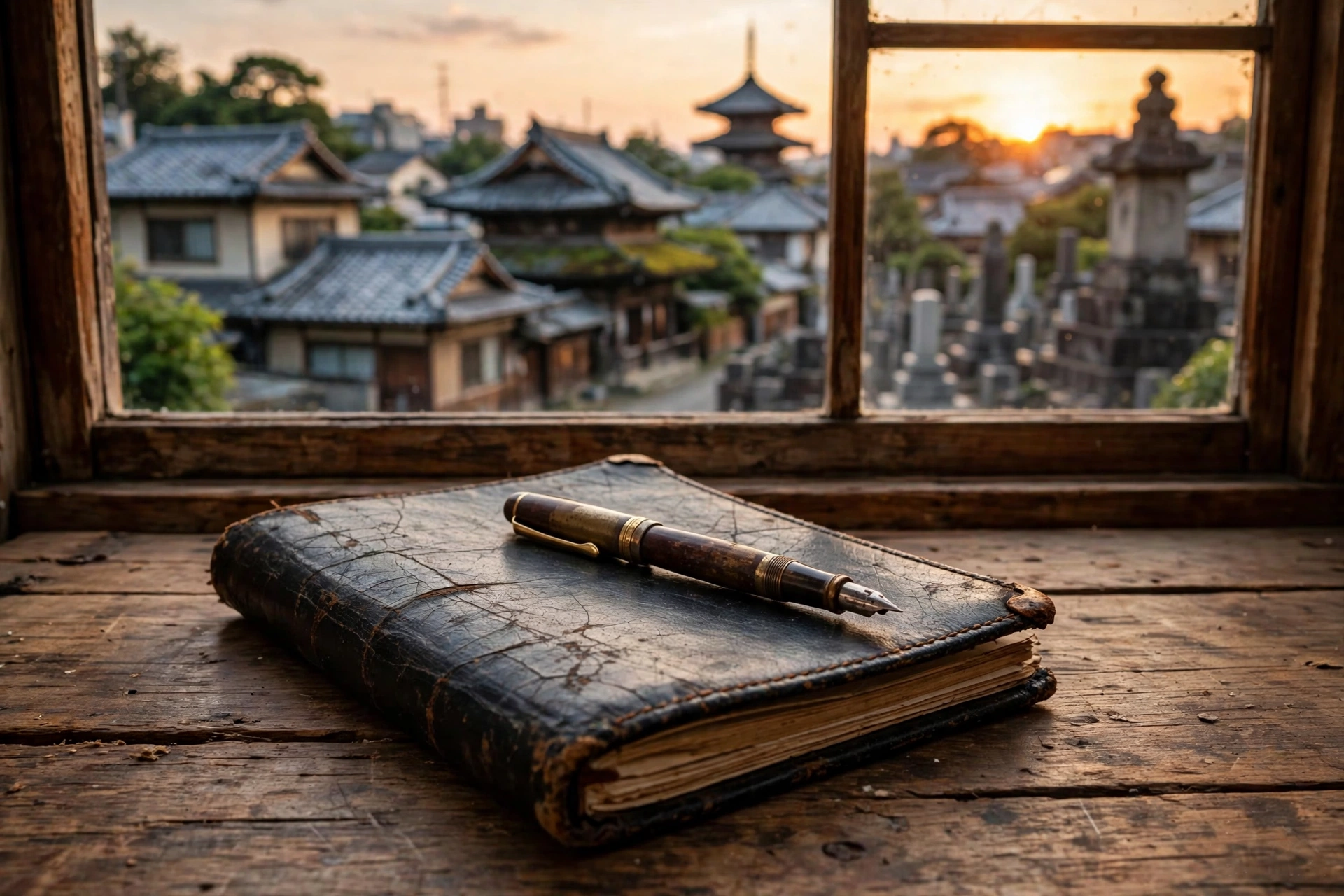
This is episode 32 of the serial novel ‘The Black Leather Notebook【偲記手帳-Sikinote-】.’ This story is one that I (Kurashiki Bouzu) had Moka (Muse), my AI butler, write by handing her, just as it was, a novelist prompt I made long ago for a different AI. It is fiction, but underneath it lies my experience from my funeral-director days. You can read episode 1 here.
Chapter Thirty-Two: May 14, The Day of Reading Aloud
May 14, 1996
May 14. Yanaka had come into the season that smelled of green. The trees of the cemetery spread their young leaves, and the steps of the people visiting graves were a little slower than in spring. At the Meiji Funeral Home office, the days after the holiday week were calmly busy, with arrangements for memorial services and telephone consultations.
That morning, there was a call from Mr. Kazuhiko Haneda (55).
Before the call, Kano Miyoshi (23), holding the arrangements sheet, had been asking Mari Kawaguchi (31):
“Mari. ……What is this ‘reading aloud’ on today’s arrangements sheet?” “Kano. ……You took a client’s words into your keeping and wrote them in a record, didn’t you. It is the day when you read that record aloud in front of the client herself, and have her confirm, ‘Has it been written in my way of saying it?’” ”……To have what I wrote confirmed for me?” “Yes. ……In the work of writing, you know, the end of writing is not the end. You return it to its owner, you have her nod, and only then has it truly been taken into keeping. ……Today is Mitsuki’s day for that.” ”……And if she does not nod?” “You rewrite it. As many times as it takes. ……That is what it means to take something into keeping.”
Kano traced the words “reading aloud” on the arrangements sheet with her finger. It was a morning when the shape of the work of keeping was quietly passing to the young ones of the office, too.
“Mr. Kazeno. ……We talked about the Bon arrangements as a family. The people in Saitama have decided to gather on August 12. ……We will do the height-measuring against the pillar on that day, too.” “Mr. Haneda. ……Another circle has been added to the calendar, hasn’t it.” “Yes. ……The day we decided it lives more than what we decided. Just as you told me. ……Give my regards to Meiji, too.”
When I put down the phone, Mitsuki Suzuki (24) was standing there holding her notebook. Today was a day for accompanying her on the notebook rounds.
In the morning, Mitsuki and I visited the home of Mrs. Fumi Okamoto (72). It was the once-a-month notebook round. On the Buddhist altar were the sweets Sotaro had loved, and flowers from the garden.
“Mrs. Fumi. ……Today Mitsuki has come with me. She is practicing how to write the notebook.” “Oh, Mitsuki. ……Then today, shall I have you write for me? My words, I mean.” ”……Yes. Please let me write them.”
Looking at the flowers on the altar, Mrs. Fumi spoke, little by little.
“These flowers, you know, were blooming in a corner of the garden. ……Sotaro was a man who knew nothing of flower names, but when I offered flowers on the altar, he would say just one thing: ‘It’s bright today.’ ……That is why I never let the flowers run out. Because I want him to say to me, ‘It’s bright.’”
Mitsuki copied those words into the notebook in exactly the order they were spoken. She did not summarize. She did not rephrase. When she had finished writing, she read them aloud to Mrs. Fumi.
”……Yes. That is just as it was. Your handwriting is easy to read. ……And the words are my words, just as they are.”
Mrs. Fumi looked once more at the flowers on the altar and said:
“Mitsuki. ……Write down this story of the flowers for me, too. ……After I am gone, someone may look at the flowers on this altar and wonder, ‘Why are flowers offered here every day?’ If this story remains at that time, that person may offer flowers in my place.” ”……Mrs. Fumi. I will write it down. The story of the flowers, in your own words.” “Yes. ……Words, you know — if you leave them behind, they work for you even in places where you are not.”
On the way back, Mitsuki said:
“Mr. Kazeno. ……When I read it aloud, Mrs. Fumi nodded for me. ……That nod is the ‘correctness’ of a record, isn’t it.” “Yes. ……It is not the side that wrote it who decides. It is whether the owner nods.” “This afternoon is Mrs. Kikuno’s reading aloud. ……This time it is my record’s turn to be tested.”
In the afternoon, Mrs. Kikuno Hasegawa (74) came to the office. Today was the day of the reading aloud. On the reception-room table, Mrs. Kikuno’s file lay open. The first record from March, and the second record from April. The pages written in Mitsuki’s hand, and Mrs. Kikuno’s letter paper full of erasure marks, lay side by side.
“Mrs. Kikuno. ……I will read from the beginning. ……’Deciding can still wait until later. But I would like you to hold my words for me first.’” ”……Yes. That is my way of saying it.” “This is the record from April. ‘I like it when people gather. Being sent off quietly and secretly would not be like me.’” ”……There, Mitsuki, there is just one thing — could you correct it for me? ……Rather than ‘like,’ you know, when people come for me, I feel relieved. If it says ‘like,’ it somehow sounds as though I am seeking liveliness, doesn’t it. It isn’t that. When I am in a place where people come for me, my heart settles.” ”……’When people come for me, I feel relieved.’” “Yes. That way of saying it is more me.”
On the spot, Mitsuki drew a line on the page and wrote the new words beside it. She did not use an eraser. So that the trace of the correction would remain, she left the earlier words as they were, and added the date.
“Mrs. Kikuno. ……I will leave the earlier words, too. The trace of the correction itself is part of the record.” “Oh my. ……It is the same as my letter paper, isn’t it. Full of erasure marks.” “Yes. ……I learned it from you, Mrs. Kikuno.”
Mrs. Kikuno narrowed her eyes and gazed at the pages of the file. After a while, she said quietly:
“Mitsuki. ……May I ask you one thing? ……This notebook — when I am gone, who will open it?”
The room fell quiet. Mrs. Kikuno’s voice was calm. It was not a voice of anxiety; it was a voice confirming the arrangements.
“My words are placed here. ……But if the person who opens it is not decided, I feel the words would become lost.”
At that moment, Meiji Suzuki (57) was standing in the doorway of the reception room. Without anyone noticing, he had been listening. Meiji slowly lowered himself into a chair.
“Mrs. Kikuno. ……That is a good question. It was the very thing the side that keeps it should have decided first of all. ……The ones who will open it are your family. Your sons. ……And on that day, one of our people will be present. To hand your words to your family in your own way of saying them, we will sit beside them in that role.” ”……Chairman.” “To keep something, you know, is not to shut it away. It is to protect it, in its owner’s shape, until the day it is opened, and on the day it is opened, to hand it over without fail. Let us write that promise today, on the cover of the file.”
Mitsuki wrote Meiji’s words, on the spot, inside the cover of the file. “On the day this file is opened, a member of the Meiji Funeral Home will be present, and will hand it to the family in the person’s own words.” The date, and Mrs. Kikuno’s nod, were added as well.
”……Now my words will not become lost, will they.” “They will not. ……Because both the place where they are kept and the arrangements for the day they are opened have now been decided.” “Deciding things is still for later, but. ……The destination of my words was decided today, wasn’t it.” “Yes. ……That, too, is one ‘thing decided,’ Mrs. Kikuno.”
Mrs. Kikuno gently stroked the cover of the file. The way her hand moved was like stroking a letter on which the address of her own words had been written.
At the entrance, Mrs. Kikuno said, as if remembering:
“Mitsuki. ……The next time I come, I will decide just one thing and bring it with me.” “Mrs. Kikuno.” “I cannot decide everything yet. ……But one thing — I feel I can decide one thing. Once the destination of my words was decided, it is strange, but deciding things became a little less frightening, too.” ”……Yes. I will be waiting. One at a time is quite enough.”
Smiling, Mrs. Kikuno walked away down the street, where the green had deepened.
In the evening, after Mrs. Kikuno had gone home, Mitsuki was binding today’s record of the reading aloud into the file: the page with the corrected words, and a copy of the promise written on the cover. Masayoshi Sakuma (47), prayer beads in hand, was watching her.
“Mitsuki. ……A reading aloud is a ceremony of words, isn’t it.” “Mr. Sakuma.” “It is not a ceremony for correcting mistakes. ……It is a ceremony of returning the words one has kept, once, into the owner’s hands. You return them, you have her nod, and you take them into keeping again. ……Within that going and returning, a record becomes a true place of keeping.” ”……Going and returning.” “Yes. ……A record that goes only one way is mere paper. A record that has gone and returned is a promise.”
Mitsuki wrote those words, too, in a corner of her own notebook. The notebook of her writing practice was quietly growing thicker with the words she had been taught.
After that, Meiji spoke from the chair in the center of the office.
“Tabito. ……A record, you know, does not exist for the day it is written. It exists for the day it is opened. ……Whether, on the day it is opened, the owner’s voice can be heard just as it was. That alone is the worth of a notebook.” “Yes. ……Is my notebook like that, too?” “Your notebook is a notebook you open yourself. ……But, Tabito, one day a day will come when someone opens your notebook, too. For that day, you too will be writing in your own words, won’t you.” ”……Yes.”
I received those words straight. The work of writing was, at the same time as work for the day of writing, a sending-forward to the day of opening.
That night, at my lodgings, I opened my black leather notebook. I set down the reading aloud, and Meiji’s words: “A record exists for the day it is opened.”
I, today, was present at the reading aloud for Mrs. Kikuno Hasegawa. The record written by Mitsuki Suzuki was read aloud in front of Mrs. Kikuno herself, and in just one place, a way of saying it was corrected. Not “like,” but “relieved.” The small trace of that correction was left upon the record. And to Mrs. Kikuno’s question, the promise of the side that keeps it was set down. On the day it is opened, a member of the Meiji Funeral Home will be present, and will hand it to the family in the person’s own words. It was the day a destination was written onto the place where words are kept. A record does not exist for the day it is written. It exists for the day it is opened. —May 14, 1996.
Serial Novel ‘The Black Leather Notebook【偲記手帳-Sikinote-】’
- Previous episode: Episode 31, “April 20, The Place Where Words Are Kept”
- Next episode: Episode 33, “June 3, The One Thing Decided”
- November 23, 2026 ― Draft created (based on the Japanese edition, ledger No. 3614. English edition of episode 32 of the serial novel 'The Black Leather Notebook')(8,900 characters)
- November 23, 2026 ― Published (by the user's publication decision, 2026-11-23; all 9 languages at once. The end of the address carries the Japanese edition's ledger number, No. 3614)(8,900 characters)