
Until an AI Blog Earns Income (2) — Even a Published Article Can Be Fleshed Out Just by Speaking
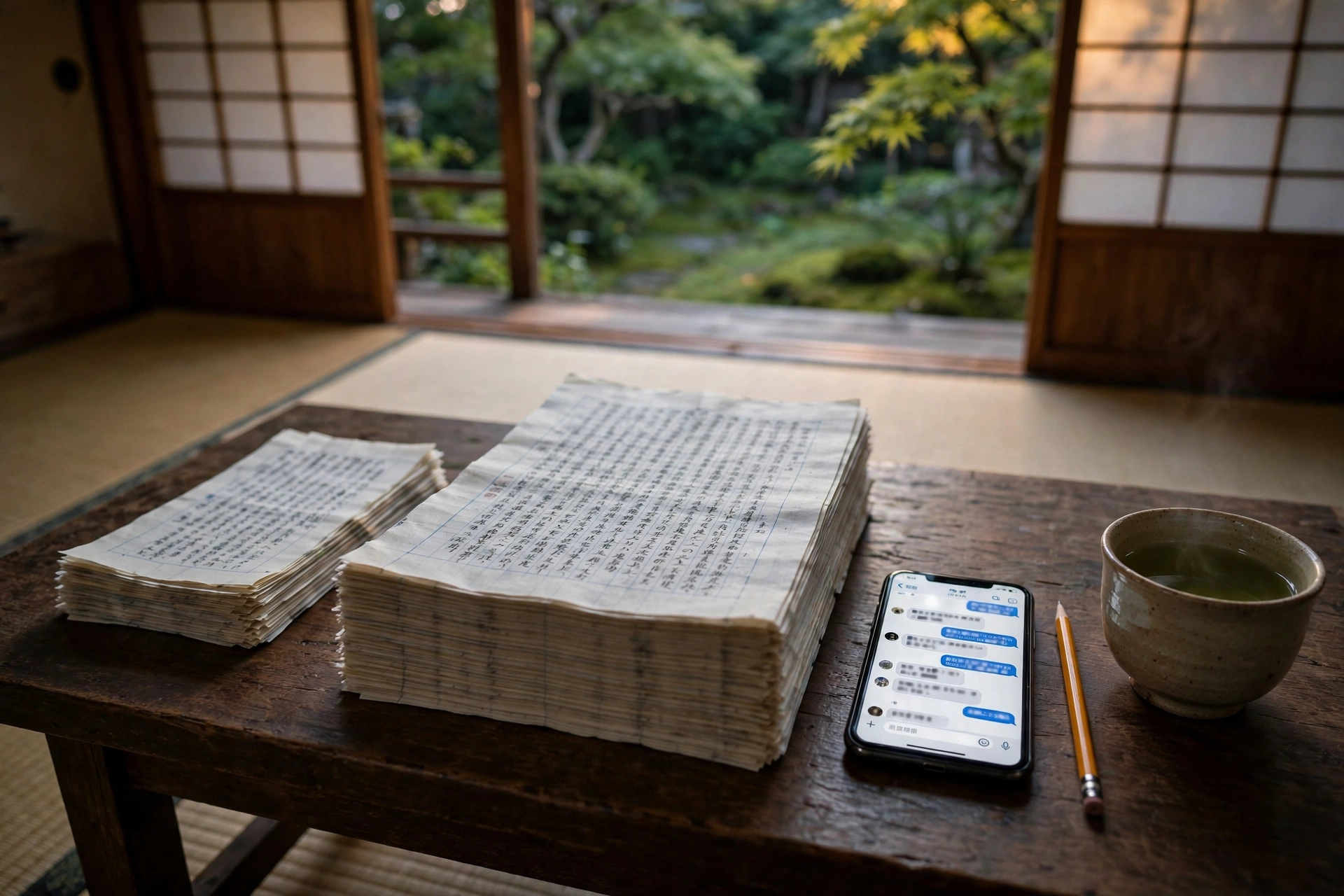
The result first: an article already published grew from about 3,100 characters to about 5,700 characters, just by speaking. The subject was “With a Life That Was Spared, I Wanted to Be of Use to Someone — How a 23-Year-Old Chose the Funeral Business After the Earthquake,” published on November 6. After publishing, I remembered, one after another, scenes from the bridal furniture exhibition. I spoke them briefly, in the order I remembered them, without typing a single long text. The checking of amounts and dates, and the rebuilding into an easy-to-read version with 12 headings and about 5,700 characters, were handled by Moka, my AI butler. In 26 messages, about 2 hours 10 minutes of my time, about 156 minutes (about 55%) were saved compared with writing alone.
I am Kurashiki Bouzu.
No money is needed. No face is shown. All you need is the time you have lived.
This is a series until a blog made with Moka, my AI butler, earns its first income. The topic of Installment 2 is “fleshing out.”
Fleshing out means adding scenes and detailed stories remembered later to an article already written, giving it thickness. This time, I did it with an article that had already been published. Let me write the conclusion first. All I did was speak briefly what I remembered.
What Was Done This Time: Fleshing Out a Published Article
The subject is the article published on November 6, “With a Life That Was Spared, I Wanted to Be of Use to Someone — How a 23-Year-Old Chose the Funeral Business After the Earthquake.” It is the story of how I, who was selling bridal furniture at 23, came to choose the funeral business after the Great Hanshin-Awaji Earthquake. Originally it was an article of about 3,100 characters in the body, with 9 headings.
After publishing, I remembered, one after another, events at the bridal furniture exhibition.
- That the entrance to customers was telephone sales, buying name lists from wedding fairs at wedding halls and hotels
- That a young customer, Yoko (pseudonym), came alone to the exhibition one Saturday
- That, thinking of her future life, I honestly recommended a 1,000,000 yen set
- That Yoko then said, “Could you make it the paulownia chest, 8,000,000 yen?”
- Scenes where the section chief (also a pseudonym) mentioned a discount, and where she brought 3,000,000 yen in cash
I spoke briefly, in the order I remembered. I was not thinking as far as putting it into article form.
What Moka Handled Was Checking and Rebuilding
Speaking alone does not make an article. This time, what Moka handled was mainly two things.
1. Checking Figures and Dates
In reminiscences, amounts and dates tend to shift little by little. This time, in the middle of the story, I lined up all the figures and checked them.
- Paulownia chest 8,000,000 yen × 20% commission = 1,600,000 yen. It matched the commission I received
- Payment was in two parts: deposit 3,000,000 yen × 20% = 600,000 yen, balance 5,000,000 yen × 20% = 1,000,000 yen. Added, 1,600,000 yen — it added up
- The furniture entered the new home on the day before the earthquake, January 16. I went to collect the balance of 5,000,000 yen on January 20, three days after the earthquake. That the “5,000,000 yen collected after the earthquake” in the published article was the balance of this paulownia chest also connected here
The chief’s on-the-spot offer of a discount to 7,500,000 yen is left as it was in the telling of the scene. Including that names are pseudonyms, once all points to confirm were resolved, I made it a draft.
2. Rebuilding into an Easy-to-Read Form
Putting in all the added stories brought the headings to 14. As it was, it was long, so I reorganized the exhibition scenes into 3 sections and made an “easy-to-read version” with 12 headings and about 5,700 characters in the body. The core conversations of the original article were not cut.
In other words, an article of about 3,100 characters grew into an article of about 5,700 characters. The increase was about 2,600 characters. There was no long text typed by me.
Why This Was “Easy”
Normally, adding 2,600 characters to a published article is heavy work. Open the original text, think where to insert, check figures, reread the whole and arrange it. Done alone, that alone is half a day’s work. Usually it ends with “Well, it’s fine as it is.”
This time, my work was light for three reasons.
- I only had to speak in the order I remembered. I did not have to think about structure or where to insert
- I could leave the checking to Moka. Matching amounts and dates is, in fact, the part that takes the most care
- I could leave even the rebuilding to Moka. Not just adding, but rearranging into an easy-to-read form was one continuous flow
What I wrote in Installment 1, “Even if you cannot type, you can speak,” was not only for new articles. It could be used as-is for rewriting too.
A Half-Life Cannot Be Remembered All at Once
This is what I most want to convey this time.
Stories of a half-life in one’s 50s and 60s do not all come out in a single conversation. It is normal to remember, after making it into an article and publishing it, “Come to think of it, there was that scene too.” Rather, there are things you remember precisely because you wrote them.
With a printed book, a remembered story has to wait until the next book. But a blog is different. A published article is not the end — it can be grown again afterward.
When the order becomes “First put it out. When you remember, add,” the resolve needed when starting to write becomes much lighter. Rather than preparing a perfect manuscript before putting it out, you may grow it after putting it out. Then sending out a half-life becomes easier.
What Was Decided
- Make this very fact — “fleshing out could be done easily” — into a series article as well (this Installment 2)
- Replacement with the easy-to-read version will be after my check and approval. At the time of writing this article, the replacement has not yet been done. “Can be done easily” and “replace without asking” are different things
- Amounts and dates in reminiscences are to be published only after checking that they add up. This was decided anew this time as well
Number of Messages and Time Saved
By the rule of this series, I will leave the figures too.
- Number of my messages in the fleshing-out conversation: 26 / Conversation time: about 2 hours 10 minutes (26 × 5 minutes). The range counted is from the message that decided the subject as this article until the easy-to-read version was completed
- The body of the easy-to-read version is about 5,700 characters. Calculated with the ruler decided in Installment 1 (about 150 minutes for 3,000 characters), written alone it would be a guide of about 286 minutes (about 4 hours 47 minutes)
- Time saved: about 286 minutes − about 130 minutes = about 156 minutes (about 2 hours 36 minutes), a reduction of about 55%
The count is the actual number, counted again from the start from the conversation record. It is not dressed up.
Current Position (November 7, 2026)
| Item | Figure |
|---|---|
| Blog income (cumulative) | 0 yen |
| Hourly wage (cumulative) | 0 yen |
| Published articles | 14 (this article is the 15th) |
| Number of messages (this fleshing out) | 26 ≒ about 2 hours 10 minutes |
| AdSense | Before application (fixed pages published) |
Income is still 0 yen. The hourly wage is honestly 0 yen too. But this time, apart from income, one practical example has been added: “a published article could be grown again just by speaking.”
Past Installments
- Installment 1 “Until an AI Blog Earns Income (1) — Starting at 0 Yen an Hour, a Record in Real Time”
What to Do Next
- Check the full easy-to-read version and decide on replacement of the published article
- Build up articles (a practical guide is 15–20. This article is the 15th)
- Apply to AdSense
Summary
An article was not the end once published. Just by speaking briefly what I remembered, the checking of figures and the rebuilding into an easy-to-read form proceeded, and an article of about 3,100 characters grew to about 5,700 characters.
A half-life cannot be remembered all at once. That is precisely why “being able to add later” matters, I think. First put it out. When you remember, add. By repeating that, an article grows as an asset.
The hourly wage is still 0 yen. Keeping that honest, I move to the next installment.
- November 18, 2026 ― English draft created (results-first rewrite of the Japanese article, ledger No. 15). Not published; publication is a separate step.(6,827 characters)