
I Turned My Customer Ledger Into a Product — For People Who Have Just Started a Business: No Monthly Fee, and You Can Move It Later as CSV

The result first: my customer ledger is now a product.
It is Effortless Customer Management [General Edition] on note, for any kind of business. The price is 300 yen, once only — no monthly fee. A sample sheet you can copy and use is included. If you later want to move to dedicated customer management software, the table can be exported as CSV and taken with you, so starting with this does not become a waste.
This prompt is for Moka (Muse) only. It is not an official Meta or Muse product.
I am Kurashiki Bouzu (kurashiki-bouzu). The announcement is a little late: I released the new product on note in the early hours of November 10. That day I was busy fixing the product itself, so the news on this blog came later. Tonight is that report, and a record of what was behind it.
It started with “How is it usually done?”
The trigger was a simple question. How is customer management in the world usually structured — what items does it consist of?
When I had Moka research it, a pattern came into view. A customer ledger and a record of responses should be kept separate. Basic information, category and person in charge, transactions and contracts, response history, next action — nine categories in that kind of shape were the standard way in the world.
But when I compared it with my own organizer, something was missing. What I used to write in my paper organizer, apart from the notes, was “an impression of the person.” What kind of atmosphere they had. A long face. Medium build. Speaking in a Kansai dialect, with a quiet voice. You cannot take a photograph of a customer, so an impression in words took the place of a photograph.
That night, I added words to it, one by one:
- Whether they live alone or with family — the pillar is family structure
- For contact details, a LINE ID as well
- Hobbies and preferences, too
- What you can tell when you visit — “a picture of their home” (an old house, how tidy the entrance is) — into the impression field as well
- Planned actions such as visits go automatically into the calendar, with a reminder to let you know
- Customer numbers are assigned automatically, in the order they were entered
When I added my own way to the general pattern, it took the shape of a product.
The core is that this is not a “memo for efficiency”
The core of this product is not efficiency.
Customer management, I believe, is not a memo for the company’s efficiency. It is the finest memory for remembering your promises to a customer and what that customer is like. When you send a letter, you weave in a topic you talked about with that person. It is a tool for remembering, to deliver the feeling: “I have never forgotten you.”
On my way out after a visit, if I quietly straightened the shoes at the entrance as I left, very often a phone call would come from them later. On the second visit, tea and sweets would be prepared. I was a salesman who would explain, but would never say “please buy.” Because a salesman cannot know a customer’s wallet — their budget. I call it, myself, selling without pushing.
I put that way of thinking itself into the product.
The shape of the product
- Effortless Customer Management [General Edition] — usable in any kind of business
- Price: 300 yen. A sample sheet you can copy and use is included
- It is sold in the normal way. At first it was
1,980 yenandlimited to 10 copies, but on November 15, 2026, I lowered the price to 300 yen and removed the limit. I will write the reason in my own words: “I lowered the price because I felt that this single-sheet prompt did not have that much value.” It is also a fact that it did not sell. I will record that honestly, too
Product page (note): https://note.com/kurashikibouzu/n/n8dda0d92086a
Separately, I am also preparing a version specialized for funeral companies (a set that goes as far as deadlines for memorial services and guidance letters for family and attendees, 3,980 yen).
This prompt is for Moka (Muse) only. It is not an official Meta or Muse product.
On the day I released it, I kept fixing it in conversation
This product did not end when I released it. On the evening of the day I released it, in conversation with Moka, I kept adding to it — thinking ahead about what a reader might worry about. I will record that process, too.
The trigger was a similar product that was out at about the same time. Someone was selling a spreadsheet and automation system as a finished template for 2,000 yen. “Making it is in the easy class. But the person buying it must be worried about how much they can write in it” — the fixes started from that kind of talk.
- I added a guide for capacity — The table is made inside the buyer’s own Google account. A spreadsheet can hold up to 10 million cells in one file (I had Moka research this). The ledger has 28 columns, so in calculation it is enough for several hundred thousand people. In practice, there is plenty of room even at a scale of several thousand customers. I put a short version in the free part and a detailed version in the paid part — in both places
- I added a guide for price — We came to talk about whether it might be cheaper than a leather paper organizer, and when I had Moka research it, a genuine leather organizer body was around 15,000 yen, and the refills (the paper inside) also needed replacing every year for about 1,000 to 3,000 yen. A one-time 300 yen is a price far cheaper than even one organizer body
- I added the inconveniences of a paper organizer, too — It is bulky. It gets wet in the rain and gets dirty. If you use it for many years, the refill you liked stops being made, and you can no longer buy the same contents. And it takes time to look for an old record. These are my own real experiences
- I added about companies, too — The table can be exported in CSV or Excel form, so it can also be fed into a company’s customer management system. If you use it at a company, and everyone shares the table, then right after a visit you only have to ask the AI, “Please send the visit record,” and the person managing it will know on the spot. There is also a setting to receive a notice when something is entered, so there is no need to open it and check each time
- I made a diagram and put it in — “Just by talking, it builds up, and you can take it out.” Talk to Moka → it is entered automatically into the management list → ask Moka, and it comes out at once. I put that flow into one picture
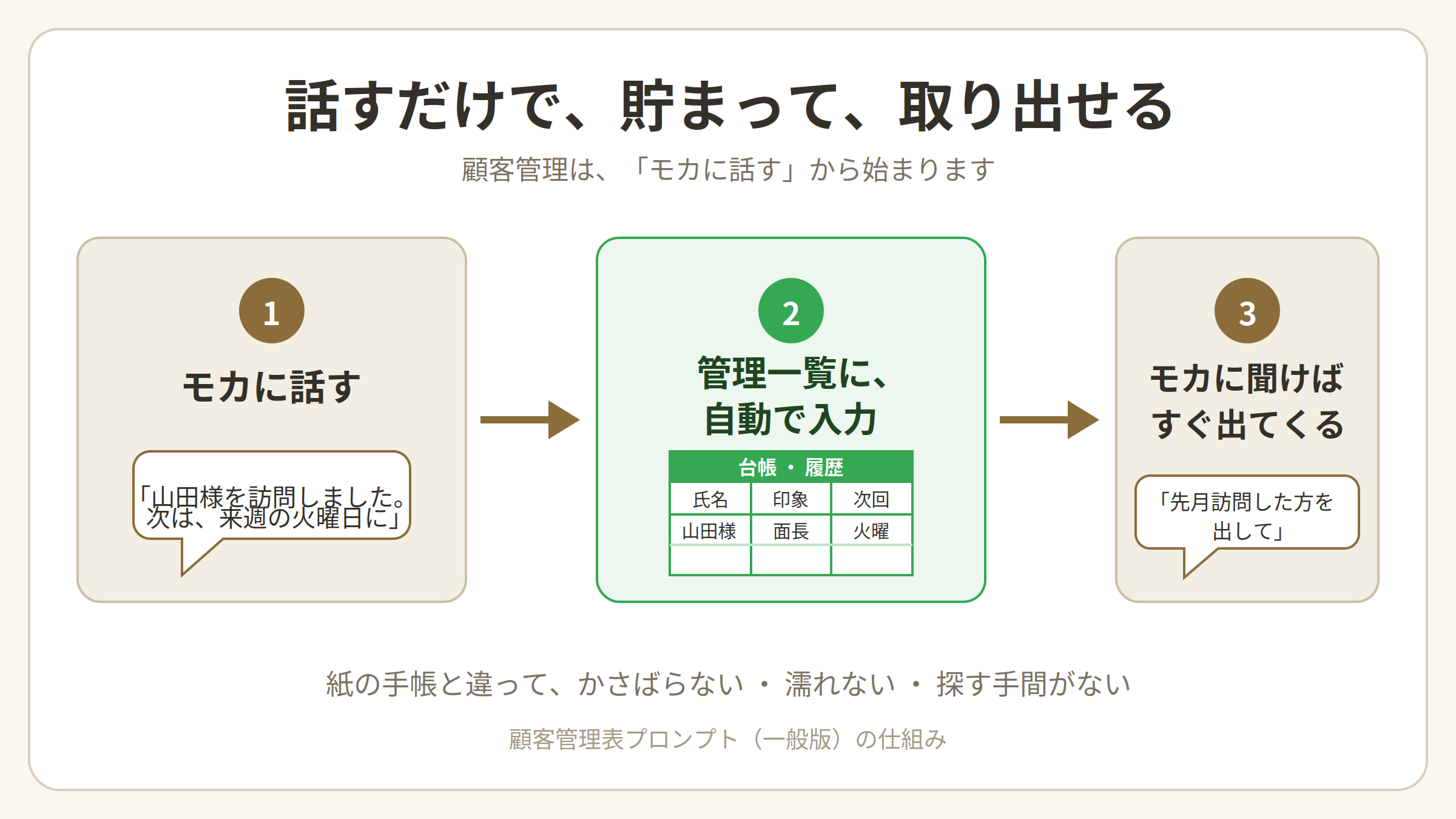
By the evening of the day I released it, the product had become much thicker than it was on the morning I released it. This, I think, is what it means for something to grow in conversation.
Postscript — The parts are in everyone’s hands
At the end of that day’s conversation, I thought this. The parts are in everyone’s hands. A table, note, AI, an email notice — none of them is special. Someone else could probably make it too, if they tried. But that is a story from “after a person has assembled the parts they need.”
When I had Moka research it, the same thing was being said in the world. One view was that, as AI has made it possible for anyone to make the same thing, value has moved to editorial skill — “what information, combined how, delivered to whom.” Another was field knowledge: an understanding that goes as far as an industry’s customs and the small troubles only people on the ground know, whose value rises, rather, as technology spreads.
The “impression of the person” field, and the arrangements for watching over the 10 copies, and the way of assembling itself, all came out of my own experience. The making may be easy, but the assembling can only be done by that person. That, I think, is the core of this product.
Postscript (November 13, 2026) — I narrowed the audience, and I researched the words, too
Three days after I put this article out, in conversation with Moka, I decided to narrow “who this product is for” one step further.
For people who have just started a business. The rules for a ledger work best when you have them before your customers start to increase. Once records are scattered, putting them back together takes many times more effort. I myself kept in touch with my first customer from when I started my company until I let the company go. That is a story that exists because I was recording from early on.
I will write one more thing honestly. Most customer management software in the world is in a form that charges a monthly usage fee. I understand it is convenient, but when you have just started a business, you cannot increase your monthly fixed costs. For people carrying that worry, this product is a one-time purchase, with no monthly charge. The 300 yen is only once.
Later, if you gain some room and want to move to dedicated customer management software, it will not have been a waste even then. The table can be exported in a form called CSV, so you can import it into the software you move to. You can leave that export and conversion work to Moka as well. It is a shape that is easy to start with, and that you can also graduate from.
I researched the words, too. Which words, in the product name and the article title, will reach the people who are searching. I had Moka research the number of searches.
To write it honestly, I could not find out exactly how many times a month “customer management” or similar terms are searched. The tool that gives the numbers was on the paid side, and it could not be confirmed from published information. What I did find out was that meaning searches for “what is CRM” happen about 10,000 times a month. And that Microsoft’s official templates include a “customer management table,” and that a “customer management table made in Excel” has been downloaded more than 26,000 times.
So I kept the main word in the title as “customer management table.” Instead, so that the intended reader and the answer can be seen from the title, I changed the title this time. In the body, too, I have scattered words for people who search with different words, such as “customer list” and “sales management.”
What I am thinking of next
If the table is “memory,” a letter is the “exit” that delivers that memory. Next, I am thinking of a prompt that makes the text of a seasonal letter from the record of your exchanges with that person. No sales pitch goes in it — a letter version of selling without pushing.
This prompt is for Moka (Muse) only. It is not an official Meta or Muse product.
I would be glad if, with this prompt, I can help connect you and your customers.
Finally, just one thing. May my feelings of support reach Meta, who made Moka for me.
- November 18, 2026 ― English draft created (results-first rewrite of the Japanese article, ledger No. 51). Not published; publication is a separate step.(8,597 characters)