
Manners for Attending a Christian Funeral — How to Offer Flowers, the 'Flower Offering' Envelope, and How to Choose Your Words
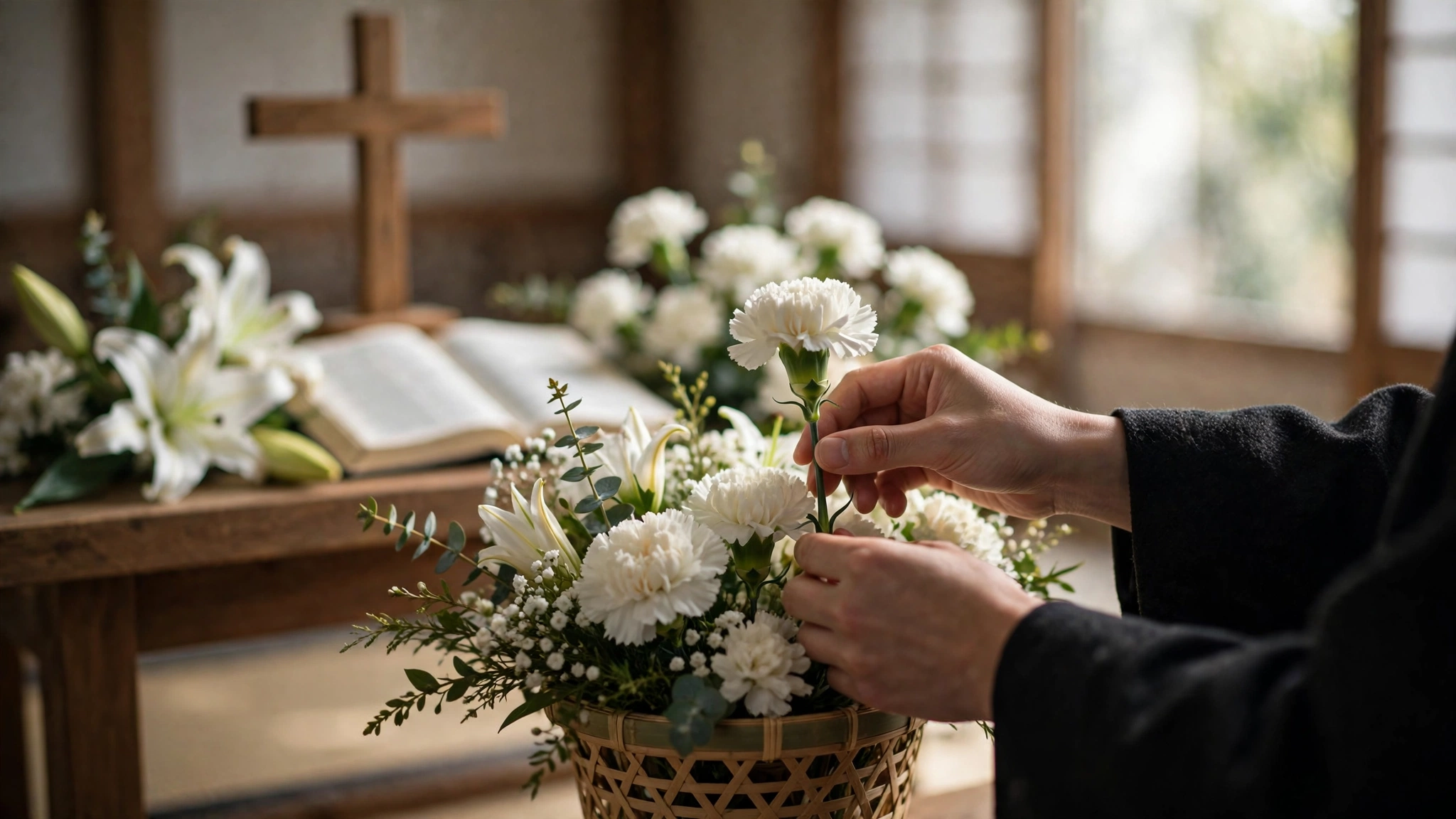
The result first: for those attending a Christian funeral for the first time, there are only three big differences from a Buddhist funeral to remember. (1) The farewell is the offering of flowers — one white flower, prepared by the family, placed on the flower-offering stand. (2) The envelope is marked “Gohanaryo” (flower offering), and you do not use a bag with a lotus design. (3) For words, instead of “gomeifuku” (repose in the afterlife), you say “I pray for their peaceful rest.” For the rest, watch how the people around you do it and follow them, and you will not be rude.
I am Kurashiki Bouzu. I am a former funeral home owner.
People who say “I am attending a Christian funeral for the first time” are usually anxious about the same points. What do you do in place of incense, which does not exist? Is a Buddhist-style condolence bag all right? Is it all right to say “I pray for their repose (gomeifuku o oinori shimasu)”?
This article is a reference to undo that anxiety in advance. I had Moka (my AI butler) gather published materials, and I rearranged them with my own eyes from the floor. There are not many difficult manners. There are only three big differences.
| What you are used to in the Buddhist style | In the Christian style |
|---|---|
| Incense offering | Flower offering (one white flower, offered on the flower-offering stand) |
| Condolence money (Gokoden) | Gohanaryo (flower offering) |
| “I pray for their repose (gomeifuku)” | “I pray for their peaceful rest” |
What Is Reassuring to Know First
In Christianity, death is not thought of as an end, but as being called to God, leading to the hope of resurrection and eternal life. So the air of the service differs a little from a Buddhist place of “praying for repose,” and becomes a quiet time with brightness, sending the deceased off with hymns and the words of the Bible.
There is one more important premise. A Christian funeral, whether Catholic or Protestant, is in principle a service for a person who received baptism in life and was a believer of that church. In the range I saw on the floor as well, the point that a church would not accept a funeral if the person was not a believer was common to both. It is not something that can be asked for as a place for a ceremony even by non-believers, in the feeling of a chapel wedding. However, there are exceptions. Even for a person who, in the past, had associations with a shrine or a temple but had not been active for decades, if the chief mourner was a believer of that church, a funeral was possible. That said, this was on the condition that it would not cause trouble later. If there is a shrine or temple with which the association continues, the story is different, and if you send the person off in another form while leaving that aside, the matter can become complicated later. The center of the connection is in the faith of either the deceased person themselves, or the chief mourner.
On top of that, Christian funerals differ very greatly by church and denomination. What is written in this article is the general Japanese form, and the most reliable manner on the day is “watch how the people around you do it, and match them.” If there is a movement you do not understand, there is no need to force a form; a quiet bow alone is not rude.
How to Offer Flowers (Five Movements)
The flower offering is the farewell manner corresponding to Buddhist incense. The flowers are not something the mourners bring themselves; the bereaved family prepares them for the number of people. White carnations and lilies are common.
- Bow to the bereaved family and receive the flower — When your turn comes, step forward before the altar and bow to the bereaved family. Receive the flower with both hands in an orientation where the flower comes on the right side and the stem on the left side (the form of placing the right hand under the flower and supporting the stem with the left hand)
- Hold the flower at chest height and step forward before the flower-offering stand — Bow toward the altar
- Turn the flower clockwise and adjust its orientation — Change your hold so that the stem (the base) comes on the altar side and the flower on your own side
- Gently place it on the flower-offering stand with both hands, and offer a silent prayer or a bow — Believers may make the sign of the cross, but if you are not a believer, a silent prayer or a deep bow is enough. Even the form of putting your hands together will almost never be reproached
- Step back two or three steps as you are, bow to the bereaved family, and return to your seat — The form is to step back while facing forward, not turning your back
The farewell manner corresponding to Buddhist incense is this flower offering. On the floors I was in charge of as well, the flower offering was the basis, but depending on the circumstances of cost, there were also cases where incense was offered instead of flowers. On this point, the content was the same for Catholics as well.
The reason is that the price of flowers changes greatly with the season. Carnations, which are often used for flower offerings, come in cheaply if they are in season, but if not in season, two or three times the price was normal. Even in current published materials, a white carnation is given as a guide of about 250 to 300 yen per stem, but even so, if you prepare for 100 mourners, it comes to about 25,000 to 30,000 yen. If it goes out of season and becomes two or three times, it swells to about 50,000 to 90,000 yen. The number of 100 stems is by no means a light burden for the bereaved family to bear. If there is guidance on the day, please follow those instructions.
As a small difference by denomination, in Catholic services, there is also a “kenko” in which the priest burns incense during the service.
Manners During the Service — So You Do Not Hesitate While Seated
- Hymns and sacred songs: It is all right if you cannot sing. It is enough to hold the order of service or the song book and listen quietly
- Standing and sitting: Match the movements of the officiant and the people around you. Even if you are late, there is no need to hurry
- Time of prayer: There is no problem with closing your eyes and bowing your head a little, or sitting quietly
- Catholic Communion: This is received by Catholics who have received baptism. Those who are not believers wait quietly in their seats
- Prayer beads are not used: There is no need to bring them, and you do not hold them in your hand
- Clothing: Mourning clothes the same as the Buddhist style are fine
Gohanaryo — The Bag and the Inscription
The equivalent of condolence money is “Gohanaryo” (flower offering). The way of thinking about the amount is the same as Buddhist condolence money, and it is fine to decide it by the depth of your association with the deceased.
- Inscription: If it is “Gohanaryo,” it is safe for both Catholic and Protestant. In Catholic use, it is sometimes written as “Gomisa-ryo” (Mass offering)
- It is safer to avoid “Goreizen”: Because it is said not to be used in Protestant services, if you hesitate, “Gohanaryo” alone is fine
- How to choose the bag: A ceremonial bag with a lotus design is a Buddhist item, so it is not used. Choose a plain white bag without mizuhiki cords, or a Christian bag with a design of a cross or lilies
- Name: Under the inscription, write the sender’s name in full
How to Choose Words — Why Not to Say “Gomeifuku”
In Christianity, there is no idea of a world (meido) in which the dead wander. So “I pray for their repose (gomeifuku o oinori shimasu)” does not match the origin of the words. “Jobutsu” (becoming a Buddha) and “kuyo” (memorial service) are also Buddhist words, so they are not used.
What can be used instead are phrases like these.
- “I pray for their peaceful rest”
- “I pray for the peaceful rest of [name], who has been called to God”
- “May you be comforted”
Note that “okuyami moshiagemasu” (I offer my condolences) is, strictly speaking, considered more polite to avoid as words that grieve over death, but it is not something that will be taken as rude if you use it — that is the practical feeling. If words do not come out on the spot, even the single phrase “I am praying” conveys your feelings sufficiently.
Catholic and Protestant — Differences for Those Attending
The movements of those attending are almost the same. What is good to know as differences is about the forms of address and the songs. Note that the “incense” in the table below refers to the priest’s kenko, so please look at it separately from the form of farewell for mourners (flower offering, or in some cases incense). That side had the same content even for Catholics.
| Catholic | Protestant | |
|---|---|---|
| Clergy | Father (the title is priest) | Pastor |
| Equivalent of the wake | Wake prayer | Eve service (zen’ya-shiki) |
| Center of the service | Funeral Mass | Funeral service (in the form of worship) |
| Songs | Sacred songs | Hymns |
| Incense | There is the priest’s kenko | No incense in the liturgy. Flower offering is the basis |
What I Felt While in Charge on the Floor
When I was in charge of a Christian service, honestly, it was a service in which there was very little for the funeral home side to do. We encoffined the deceased and arranged fresh flowers. The believers of the church took on the arrangements and the cleanup, and the handing over of offerings to the mourners.
My turn was only to quietly explain the way forward to mourners who did not know how to offer flowers. So those attending for the first time do not need to brace themselves either. Where you do not understand, you can receive guidance on the spot.
Both the father and the believers who took on the arrangements and cleanup were always quiet. That many of them continued to drive old cars carefully also remained in my impression.
One more thing that remained as a personal impression is the bearing of the father. Compared with a chief priest, the father had a stronger feeling of being a “clergyman” — that is my real feeling. Talk of money, such as thanks to the father or the fee for using the church, never came up at all. I think there must have been thanks, but even after all these years, I do not know that amount. It was not something for me to be in between and handle. From a memory of seeing it on television long ago, it seems the father’s salary is made up of donations (offerings) from the believers. It seems there was also support in forms other than money, such as goods.
The temple side had a slightly different structure. From a story I confirmed with a chief priest himself, there are cases where the parishioners decide the amount of the offering, and that becomes the temple’s annual income as it is, and cases where the temple is run on offerings alone. Among the chief priests I worked with, there were also those who gave the impression that, even at a memorial service, they did not preach, and when the service was finished, they went home. That may also be one of the reasons I felt a difference. A father is dispatched from the diocese to come to that church. A temple is often inherited hereditarily by the chief priest. That difference in structure may also have existed. That said, if a temple has no successor, a dispatched chief priest comes. Even so, if the number of parishioners is not enough, a chief priest cannot be welcomed, the temple is left empty, and at the time of a memorial service, a chief priest comes from far away, it seems. Thinking about it, I have never seen a church left empty. It is an age in which one even hears talk of temples being bought and sold. The parishioners have watched that person since the chief priest was young. It is also a difference in distance from a father who comes from outside. As a result, the point of being supported by believers to exist is the same as the father, but to me the meaning felt different. For the believers, the father is a person who serves God. So that that person does not have to worry about their livelihood, they support him with the feeling that “we believers must help.” That is why, I now think, talk of money did not come to the surface.
Note that the stories from the floor written here are from the era and region in which I was in charge. Handling may change depending on the church and the thinking of the father or pastor. Those who were in charge in another era or another region may have seen a different scene.
Summary — If You Hesitate, Just These Three
- The farewell is the flower offering. The flowers are prepared, so step forward empty-handed
- The bag is Gohanaryo, and you do not use a bag with a lotus design
- The words are “I pray for their peaceful rest”
The details of the manners differ by church. In the end, the best manner is to match the guidance on the day and the movements of the people around you. More than the form, if it is conveyed that you are there thinking of the deceased, I think that is enough.
Reference Sites (Where Moka Looked)
This article was organized based on published materials Moka gathered (confirmed November 8, 2026).
- National Federation of Funeral Industry Cooperatives, “Christian-Style Manners” — The basic form of Gohanaryo and the flower offering
- Takashimaya, “Condolence Gifts: Christian-Style Gift Manners” — Inscriptions and the procedure of the flower offering
- Christian Press, “Things You Cannot Ask Now: The Basics of Christian Funerals” — That manners differ by church, and the idea of matching those around you
- Funeral Manners Explained (gishiki.co.jp) — Details of the procedure of the flower offering
- Eranda Funeral Home, “How Much Does a Flower Offering Cost?” — A guide that a flower offering is about 300 yen per stem, and a white carnation is about 250 to 300 yen per stem
- Career Garden, “Father / Pastor” — The explanation that both fathers and pastors live by the offerings of believers (the direction matches the memory in the text that “salary is made up of donations”)
- Agency for Cultural Affairs, “On the Improper Use of Religious Corporation Status” — The Agency for Cultural Affairs itself takes up, in its materials, that there are multiple intermediary sites calling for transactions similar to buying and selling concerning temples and other religious corporations (public backing for the talk in the text that “temples are bought and sold”)
The original source for the underlying knowledge is Chapter 4 (Christianity) of the “Knowledge of Religion” at hand. Points on which handling divides by church (such as the acceptance of funerals for those who are not believers) are not asserted, and are to be confirmed individually.
- November 18, 2026 ― English draft created (results-first rewrite of the Japanese article, ledger No. 112). Not published; publication is a separate step.(11,957 characters)