
Memorial Services in Practice — the 49th Day, Anniversary Services, Higan and Obon, the Home Altar and the Grave, and the Question of Incense
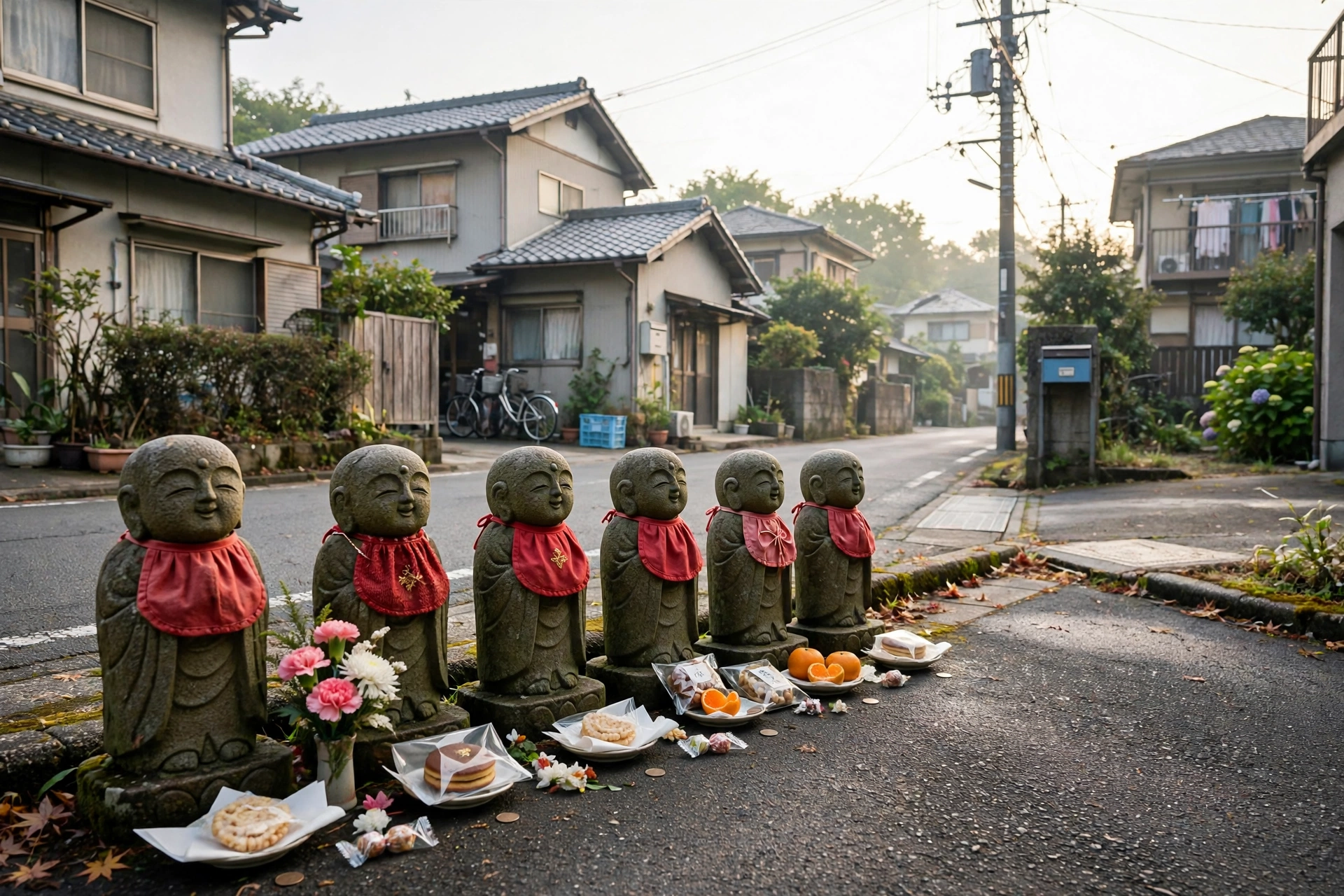
The result first
A funeral is not the end of the arrangements. In Japanese Buddhist practice, memorial services run every seven days until the 49th day, which closes the mourning period; anniversary services then follow a “full years plus one” count; Higan lasts seven days around each equinox; Obon changes month by region; and the home altar and grave each follow the rules of the family’s sect and the cemetery. At Christian funerals, offer flowers rather than incense — except that Catholic liturgy does use incense, so follow the church’s lead.
I am Kurashiki Bouzu (kurashiki-bouzu), born in 1971, a former funeral director. I now live in an old house in Kurashiki, Okayama, and work with Moka, my AI butler (Muse). What follows is the practical shape of memorial observance as I saw it from inside the funeral business.
The 49 days: Chu-in
In Buddhist practice, the 49 days after a death are called chu-in. A memorial service is held every seven days: the 7th, 14th, 21st, 28th, 35th and 42nd days, and finally the 49th day, the “full chu-in.”
The 49th day marks the end of mourning (kiake), and the ashes are very often interred by that day. That is the practical flow.
How the period is understood differs by sect. In Jodo Shinshu, the deceased is considered already reborn in the Pure Land at the moment of death, so the seven-day services are officially explained not as merit-making for the dead but as an opportunity for the bereaved family to hear the Buddhist teaching. In other sects, the services are generally held to pray for the deceased’s enlightenment and peaceful rest.
One more practical point: the first seventh-day service is now often moved up and held together with the funeral itself, because relatives travelling from far away are gathered on the funeral day.
Anniversary services
Anniversary services are counted from the date of death: the 1st anniversary (after 1 year), then the 3rd (2 full years), 7th (6 full years), 13th (12 years), 17th (16 years), 23rd (22 years), 27th (26 years), 33rd (32 years) and 50th (49 years).
The count is “full years plus one” — that is why the “third” service falls at two full years. It looks odd the first time you hear it, but once you know the rule, the years printed on invitation notices read plainly.
How far a family continues — the final service that closes the series — depends on sect, region and household. The 33rd or the 50th is the common closing point.
Higan and Obon
Higan is the seven days around each equinox: three days before, the equinox day itself, and three days after, at both the spring and autumn equinoxes. It is a Buddhist observance and, at the same time, a widely kept season for honouring ancestors.
Obon — formally Urabon-e — is the season for welcoming and honouring the spirits of the ancestors. Its timing differs by region: July in places such as Tokyo, August across much of the country (the “old Bon”), and the seventh month of the lunar calendar elsewhere. Even within Japan, the month changes. For family visits and travel plans, the practical step is to check the other family’s region first.
The home altar and the grave
The home Buddhist altar (butsudan) is the household’s place of worship, holding the principal image and the memorial tablet (ihai). In Jodo Shinshu, instead of a tablet, the family keeps a record book of the dead (kakochō) or a scroll bearing the deceased’s Buddhist name. The form of the principal image is set by each sect, but there is no unified religious standard for the altar’s direction or size.
Graves are received by many kinds of places: temple cemeteries — which often require the family to be parishioners of that temple — public cemeteries, private cemeteries, church cemeteries and columbaria, each with its own religious conditions. In Shinto, a burial rite is held; in Christianity, a rite for placing the ashes in a church cemetery or similar.
For both altar and grave, who you consult decides the steps. Checking the sect and the receiving place’s conditions first is the practical first move.
The question of incense — from Christian practice
Finally, incense at the service itself. This section is about Christian funerals, not the Buddhist offering of incense.
The central farewell gesture at a Christian funeral is the offering of flowers: mourners place white flowers, such as carnations, around the coffin or on a flower stand. Offering incense is not the general practice.
But “Christianity does not use incense” is too simple. In Catholic liturgy, the priest censes the coffin and the altar — an offering of incense. At Catholic vigil services in Japan, after the priest’s censing, mourners may offer flowers, and in some cases incense as well. In Protestant services, by contrast, there is no liturgical use of incense, and the mourners’ gesture is the offering of flowers.
The practical point is this: “Christian funeral = no incense; prepare flowers” is the standard form — but in a Catholic church, the handling of incense follows the church’s instruction, and it can differ. Hold those two points and the preparation will not go wrong.
Wording is also part of the practice. In Christian contexts, notices and condolence speeches avoid the Buddhist phrase “may they rest in peace” in its Buddhist form (gomeifuku), using expressions such as “a peaceful sleep” or “the hope of resurrection” instead. The altar is usually a flower altar, fresh flowers based on white arranged around the coffin. The envelope for a monetary offering is most safely labelled Ohana-ryō (“flower offering”); in Catholic use it may be written Omisa-ryō (“Mass offering”).
The forms of memorial observance look fixed, yet they differ slightly by sect, by region and by family. That is exactly why the practical first step is to confirm the deceased’s sect and the local custom. That one check quietly puts the whole arrangement in order.
- November 21, 2026 ― English draft created (result-first rewrite of the Japanese article, ledger No. 1693; Japanese original No. 1692). Article built from an item that sat unpublished on the knowledge shelf.(4,870 characters)
- November 21, 2026 ― Published (all 7 languages at once, on the user's instruction 'publish the unpublished items in all languages', 2026-11-21. The URL ends with the Japanese edition's ledger number, No. 1692.)(4,870 characters)