
Your Phone Is Now Your Key Ring — House, Car and ID, All in One Device
The result first.
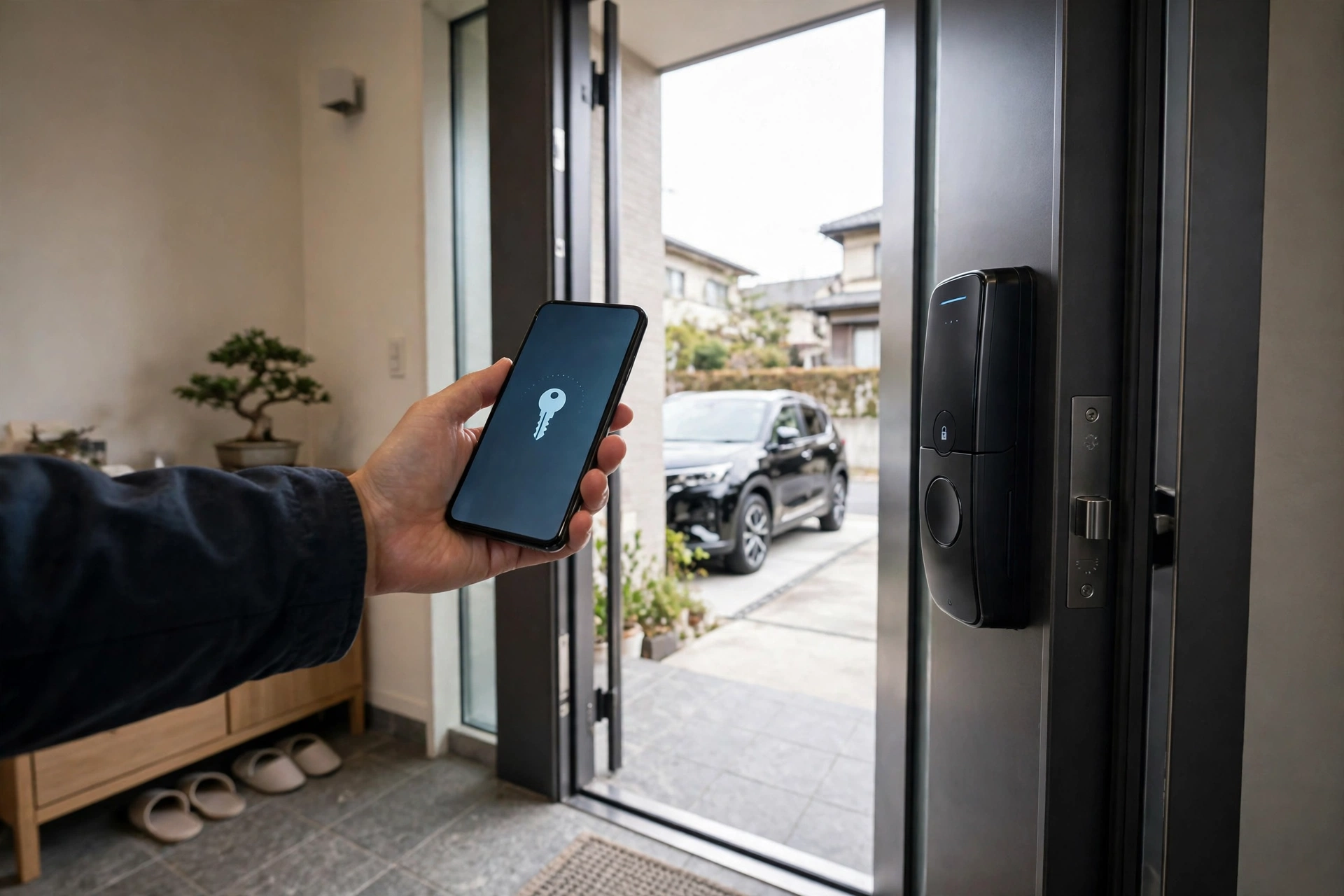
In Japan today, one smartphone can hold your house key, your car key, your national ID, your health insurance and your bank access. The metal key ring that used to jangle in your pocket has gone quiet — it moved into the phone. This article is about what that means, what each maker can actually do, where it still does not work, and how to protect yourself now that losing a phone means almost losing the whole key ring.
I am Kurashiki Bouzu, born in 1971, a former funeral director now living in an old house in Kurashiki, Okayama, working with Moka, my AI butler. The figures and maker details below were researched by Moka; the memories are mine. The main stage is Japan, as of November 2026, with one short column on other countries near the end.
The numbers: the phone passed the TV
Japan’s government survey of communications use (2025) puts smartphones in 91.8% of households — ahead of television, at 90.1%, for the first time. Personal computers are in 64.4%. For going online, 74.3% of individuals use a smartphone, against 45.6% for a PC. When this survey began in 2010, the smartphone figure was 9.7%.
My own house confirms it, and then some. I have one phone contract, plus an old phone on home Wi-Fi that I use just for searching. My wife has one contract and two Wi-Fi phones. Two people, five smartphones — plus three PCs. The TV is still there, but we hardly watch broadcast programmes any more. When I ran a funeral business, I watched TV because my customers were the TV generation and I needed the conversation. That job ended, and so did the reason.
My first screen of my own was a black-and-white Casio pocket TV, bought in high school with part-time job money — the kind you watched reflected in a mirror in the lid. After that came a 13-inch CRT from a second-hand shop. Back then it was TV, TV, everywhere. In the Showa era, the living room had one TV, and on Saturday nights at eight, families fought the “channel war”: the Drifters’ comedy show on one channel, Oretachi Hyokin-zoku on the other, at exactly the same hour. Now every person has screens of their own — and the key ring moved into one of them.
House keys: two roads, and one honest limit
There are retrofit locks that attach to your existing door, and locks built into a new door. Both do the same core things: open and close from the phone, auto-lock, hand a “spare key” to family through the app, check from outside whether you forgot to lock, and keep a record of who came home. Prices below are the makers’ published prices in Japan, November 2026.
Retrofit
| Maker / product | Price (approx.) | What stands out |
|---|---|---|
| CANDY HOUSE “SESAME 6 / 6 Pro” | ¥4,378 / ¥5,478 | The cheapest way in. Remote control needs a separate hub |
| SwitchBot Lock series | ¥8,980–¥22,980 | Add-on pads bring fingerprint, face, PIN and IC cards. The same company makes the remote controls for your appliances |
| Qrio “Qrio Lock” | Discontinued | A Sony-group pioneer, now officially end-of-sale. Its know-how lives on in Nature Lock below |
| Nature “Nature Lock” | ¥25,800 / ¥32,800 with key | Walk-up unlocking with its own key, about two years on a battery, works with Apple’s Find My. Pair it with the Nature Remo and the same app runs your air conditioner |
| Aqara “Smart Lock J200” | ¥17,280 / ¥23,480 with keypad | Rare in Japan: supports Apple Home Key, so you tap your iPhone or Apple Watch like a transit card |
Built into the door
| Maker / product | What stands out |
|---|---|
| LIXIL “FamiLock” | Each family member chooses: phone, remote, card or manual key. Cannot be retrofitted |
| YKK AP “Smart Control Key” | Tag, remote, face recognition, app. The top door even opens and closes itself after recognising your face |
| Sankyo Aluminum “e-Entry” | Electric locks built into the door, touch types included |
The honest limit: no maker tells you to throw the metal key away. These locks are designed to keep a manual key for the day the battery dies — LIXIL itself advises carrying it.
My own failure: the ¥30,000 tap-key that never fitted
Years ago, I tried to put a tap-your-phone lock on my office door. The name was “A-something” — that is honestly all I remember. It cost about ¥30,000, ran on batteries, and when the box arrived my first thought was: flimsy, for this price? Then came the real problem. The shape of the office lock did not match, and it could not be fitted at all. The future was in my hand; the metal in front of me said no.
My house in Kurashiki now has a sliding door, and retrofit locks are made for hinged doors with a thumb-turn — so the unit never found a home here either, and I eventually disposed of it. Twice rejected by shape.
Today the cheapest retrofit lock costs ¥4,378 — about one seventh of what I paid. If you are thinking of buying one, check the shape of your thumb-turn and the thickness of your door first. That is still where most people give up. I am one of them.
Car keys: three systems, uneven prices
A phone car key works in one of three ways: it talks to the car by radio or over the network through an app; you tap it like a transit card and the key lives in your phone’s wallet app; or it unlocks as you simply walk up with the phone in your pocket. All three can start the car, and all let you send a key to family with limits on time and functions.
| Maker / system | Cost | Notes |
|---|---|---|
| Toyota “T-Connect Digital Key” (app) | Free for 3 years, then about ¥550/month | 20+ models, but the equipment is basically order-only on a new car |
| Honda “Honda CONNECT” (app) | ¥880/month (base ¥550 + key ¥330), first 12 months free | The same app also runs the air conditioner remotely and finds the car |
| Tesla “Phone Key” (app) | No monthly fee | Walk up and it opens, walk away and it locks. The dream, as standard equipment |
| BMW “Digital Key / Plus” (tap / walk-up) | Usually no extra monthly fee on supported cars | The pioneer, putting an iPhone to work as a car key in 2020. Keys can be shared with about five devices |
| Mercedes-Benz / Audi / Porsche / Hyundai / Volvo | Depends on the model | Wallet-based tap keys and walk-up keys are the centre |
| BYD (app / tap) | No extra charge on equipped cars | For the newer EV makers, a phone key is standard thinking |
| Nissan / Mazda | — | In Japan, the factory offer is still centred on remote checks and remote air conditioning, not phone-start. Not every maker moved at once |
Two more honest notes. A dead phone battery means no key on many cars. And underground car parks are hard on the app type, while tap and walk-up types keep working. Every maker still recommends carrying the physical key or key card.
ID, money, remotes — and keys that are sent, not handed over
My health insurance card went: paper → plastic card → My Number card → smartphone. Paper cards, once one per household, became one card per person; new issuance of the old cards ended on December 2, 2024, and issued cards stop working in principle on December 1, 2025. Since September 19, 2025, prepared hospitals and pharmacies have begun accepting a smartphone tapped at the reader instead. My generation carried all four stages in its own wallet.
The My Number ID itself now also lives in the phone, and certificates can be issued at convenience stores with it. Money followed the same road: passbook and seal → cash card and PIN → phone and QR code. At Seven Bank ATMs in convenience stores, “Smartphone ATM” lets you deposit and withdraw cash with a banking app and a QR code on the ATM screen — no cash card. It began in 2017, covers 32 banks at Seven Bank ATMs and 9 at Lawson Bank ATMs, and has honest limits: no coins, no transfers.
The remote controls came too. Smart remotes from Nature and SwitchBot gather the TV, air conditioner and lights into one app — the same names as the door locks. The whole “house key ring” is collecting in one place.
And in Japan’s minpaku (private lodgings), the metal key is disappearing altogether. When a booking comes in, a PIN or QR code valid only for the stay is sent to the guest’s phone, and it expires by itself at checkout. The key stopped being something you hand over. It became something you send — with an expiry date.
What a phone still cannot do
A smartphone My Number card is not a driving licence. Japan’s “My Number licence” (from March 24, 2025) puts the licence data inside the physical card; when you drive, you still need the physical licence or the physical My Number card. The physical card is also still needed to set the phone version up, and if you lock yourself out of your PIN. So the honest summary is: most of the key ring has moved, the last few keys are still moving, and for now the phone and the physical card work as a pair.
Column: abroad, some have gone further
- United States: driver’s licences and state IDs in Apple Wallet reached 15 states, usable at TSA checkpoints in more than 250 airports. A passport-based Digital ID for domestic travel began in November 2025 — the physical passport is still needed abroad.
- European Union: by law, every member state must offer a digital identity wallet by the end of 2026, designed to work across borders.
- South Korea: mobile driver’s licences and mobile resident cards carry the same legal effect as the physical documents.
- Hotels: Hyatt was the first brand to put room keys into Apple Wallet — no front desk, straight to your room.
- China: mobile payment is reported at over 86% of people, and with Alipay and WeChat Pay the same phone pays, rides, orders and sends money. China largely skipped the card era and jumped straight to the phone.
If people in China heard us in Japan marvel that “a phone can do all this now”, they would probably say: Huh? Only now? Japan’s way — keep the physical card, add the phone — is slower, but it has one merit: when something is lost, the way back is easier.
If you drop it now, you drop the key ring — five ways to protect yourself
One phone now holds the house, the car, the ID, the money and the login keys. The good news: a digital key can be stopped, erased and searched for, which a metal key cannot. You do not have to fear the tool; you have to know the guardrails. Here they are, plainly:
- Lock the screen twice over — fingerprint or face, plus a passcode of six digits or more, and a short auto-lock time.
- Turn on “Find” before you lose it — remote lock and remote erase only work for people who set them up in advance.
- Keep backup codes on paper, somewhere else — if the only key is inside the phone, you can lock yourself out of your own life.
- Keep a physical spare — for the house and the car. The makers themselves say so.
- Do not postpone updates and restarts — install the fix, restart the phone. This is the unglamorous centre of all security.
Closing: the dream, and the price of progress
For someone born in the Showa era, the dream pictures came true: doors that open as you approach, an ID in your palm, a key you can send to a guest. Today’s children are, physically, well provided for — a screen of their own, anything they want to watch, no channel war, no sneaking around.
And yet I always wonder whether room to act and to imagine is getting thinner. I have no children, so I honestly do not know. But I remember this: years ago, a part-time worker used to bring her child to my office during the summer holidays, when the nursery was closed. I showed the child how to make a mask out of a newspaper — just newspaper, no screen, no battery — and the child’s eyes lit up. That was before smartphones spread the way they have now. What a child today would do in that moment, I cannot say.
Convenience and risk together are the price of progress. The key ring got lighter; in exchange, we have to guard it properly, and perhaps we lost a few occasions to think with empty hands. Know the guardrails, remember the old days a little, and this tool stays firmly on the side of daily life.
My own front door, by the way, is a sliding door in an old house, opened with a metal key you insert and turn. I write about the dream world with one foot still standing in the Showa era. That is exactly the record this blog keeps.
Notes: a “digital key” means the phone itself works as the key. A “wallet” is the phone’s wallet app, where money, cards and keys are kept together. A “hub” is a small relay box that connects a lock to your home network.
Sources
- Ministry of Internal Affairs and Communications, Communications Usage Trend Survey (2025) / Information and Communications White Paper: household ownership — smartphones 91.8%, TV 90.1%, PCs 64.4%; internet use by device — smartphones 74.3%, PCs 45.6%
- Digital Agency (Japan): My Number card on iPhone (from June 24, 2025); smartphone health-insurance use (from September 19, 2025, in stages); guidance that a smartphone My Number card cannot be used as a driving licence
- National Police Agency (Japan): My Number licence (from March 24, 2025)
- Health insurance cards: end of new issuance (December 2, 2024); end of use in principle for issued cards (December 1, 2025)
- House keys: published prices and guidance from SESAME, SwitchBot, Nature, Aqara, LIXIL, YKK AP and Sankyo Aluminum (November 2026); Qrio Lock end-of-sale notice
- Car keys: published material from Toyota T-Connect, Honda CONNECT, Tesla, BMW and other makers (November 2026)
- Smartphone ATM: Seven Bank and Lawson Bank published information (number of supported banks; service began in 2017)
- Overseas: US state wallet licences and TSA use; the EU digital identity wallet regulation; South Korea’s mobile IDs; Hyatt’s wallet room keys; reporting on mobile payment in China (as of 2026)
- November 17, 2026 ― Draft created — English version (result-first rewrite of the Japanese article, from makers' published data and the Japanese government survey, plus the author's own experience)(11,047 characters)
- November 17, 2026 ― Published(11,047 characters)