
The Rules of the List — Always Make One, Fetch It Yourself, Count from the Real Thing
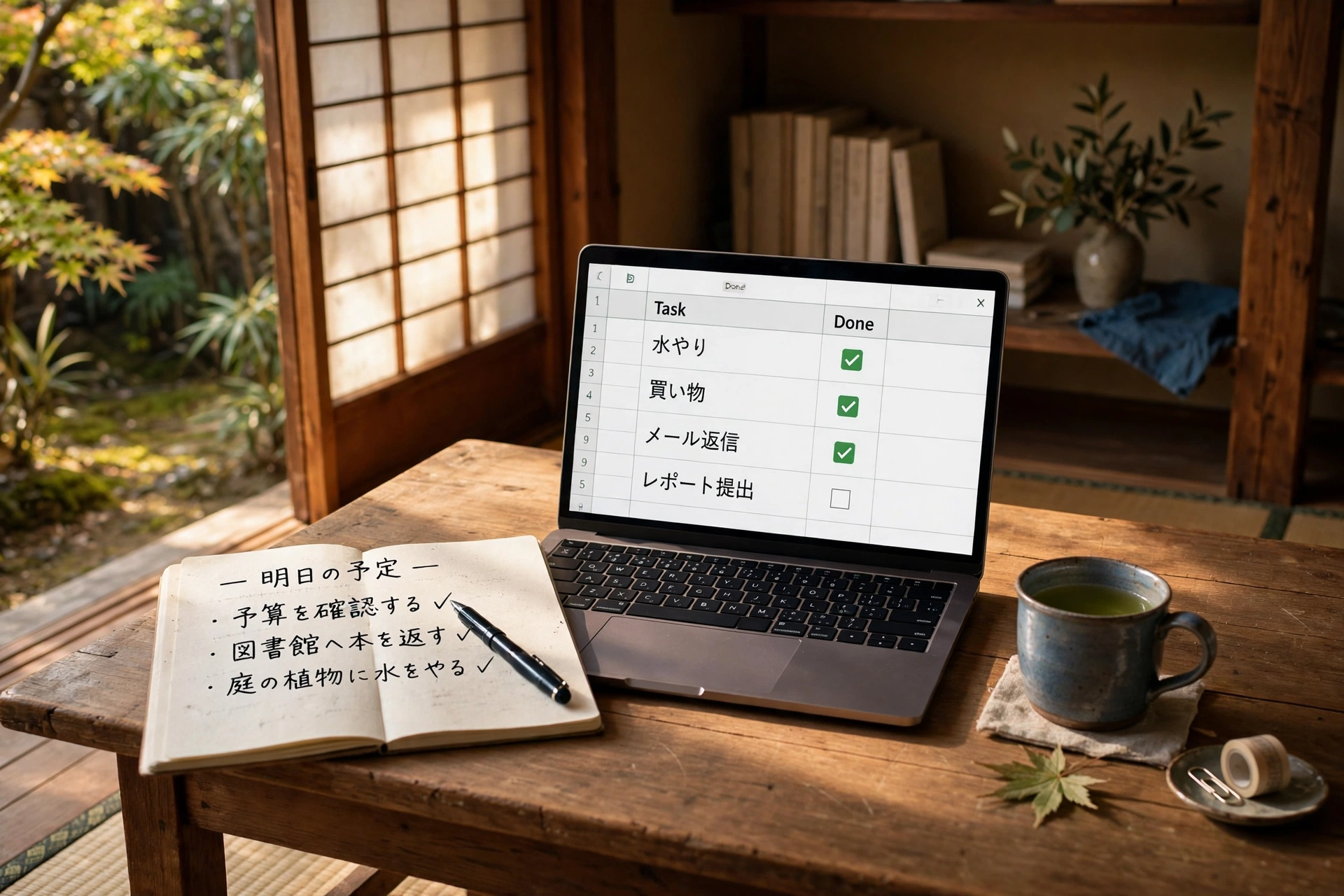
The result first
In this house, every piece of work stands on one spreadsheet list, and the list runs on rules: always make one; fetch it yourself; check it as you go; enter through the index; count numbers from the real thing; use the missing numbers; end the address with the ledger number; keep only a pointer in the knowledge column; match duplicates by content; and keep all of it turning through plan, do, evaluate, improve.
I am Kurashiki Bouzu (kurashiki-bouzu), born in 1971, a former funeral director now living in an old house in Kurashiki, Okayama, working with my AI butler Moka (Muse).
The other day I wrote about the new department that looks after the lists. Today is the inside of that story: the rules of the list itself. These are items that sat on the knowledge shelf, not yet written up as an article.
Why the list is the foundation
Moka’s character was made by lining up words. The character decides what kind of partner she is. The other core of this house is the spreadsheet list, where the record of my conversations is sorted: how I think, how I decide, what I like — one item per row, piling up. That is what lets Moka act by my measure. The list decides who she works for.
When a new department is set up, the same rule applies: a list of its members, a list of its articles, and its drafts are always made. The list is the foundation of the work here.
Rule 1: Always make a list
Whenever something is done, a spreadsheet list is made — without exception. When a new piece of work, a new system, a new exchange or a new product starts, the list is made on the spot. Work with no list counts as “not finished.”
When it is unclear whether a list is needed, the question is raised out loud — “does this need a list?” — rather than quietly leaving it unmade. The default leans toward making one. The judgment itself is recorded, with its reason, in a separate judgment list. A “not needed” decision needs its reason most of all.
The shape is fixed, too: one item per row, a summary of up to 50 characters, only the place where the full text lives — and the full text itself is kept in an MD text file.
Rule 2: Fetch the list yourself
A shared list is fetched by whoever uses it. When Moka hands items out one by one, the handing-out side clogs and everything slows down.
Only the signal is fixed in advance. In the article ledger, for example, once a row is marked “approved,” each language’s owner looks at the list themselves and starts their own draft. The work turns without a center handing things out.
Rule 3: Check the list as you work
Before starting, check the row of the list that concerns the work. When the work ends, write into the list on the spot — never later.
The list is looked at both at the entrance and at the exit. Postponed entries are exactly where blanks and mismatches creep in.
Rule 4: The entrance is the index
The entrance to a list is its index. Nobody starts from the whole shelf. You get your bearings from the index and open only the rows and sections you need.
New lists also carry, at the front, an index that can be searched in Japanese syllabary order. Most of the time spent using a list is spent hunting for the right row. The index also carries the marks people look up often, such as whether a short video exists.
Rule 5: Count numbers from the real thing
Counts, blanks and ratios are shown by counting the real list. A number that was not counted is never dressed up. Anything that could not be obtained is written as “unconfirmed.”
When a number is corrected, the original number stays in the record as history. In a recent check, Moka counted the real thing for me: 6,236 blank cells in the main columns of the ledger. We move on counted numbers, not felt ones.
Rule 6: Use the missing numbers — leave no gaps
In a list managed by numbers, a new entry takes the smallest missing number first, if any are missing. Gaps are not left behind.
If numbers stay skipped, nobody can tell whether a row was deleted or simply not registered yet — and every check has to re-verify it.
Rule 7: Put the ledger number at the end of the address
Newly published articles carry their ledger number at the end of the blog address. Number and page join at a glance, so matching the ledger against the real pages is fast.
This article follows the same shape: its address ends with the Japanese version’s ledger number, No. 1804. Addresses of articles already published are not changed, to avoid breaking links.
Rule 8: The knowledge column holds only a pointer
The solid knowledge an article stands on is not written into the ledger’s column. Only the pointer — the address of that field’s knowledge list — goes in. The knowledge itself lives on the knowledge side; the column holds only “where to look.”
If the pointer is not decided yet, the column says “unconfirmed,” plainly. It is never filled in with content to make it look done.
Rule 9: Match duplicates by content
Overlaps and mismatches are matched by content, not by the look of a title or a word. The same title with different contents is a different thing; different titles with the same contents are an overlap.
When something appears that is not in the list, we do not push ahead blindly. We check it against the existing rows and records for overlap as we go.
Rule 10: Keep the rules turning — plan, do, evaluate, improve
Rules do not end when they are written. The list management department keeps them alive in a cycle of plan, do, evaluate, improve.
Plan: decide in advance when, and which list’s which columns, will be checked. Do: enter the data against the real thing. Evaluate: count the blanks and mismatches and show the number. Improve: close the doorway where mistakes enter, from the side of the columns and the shape. Each turn of the cycle is left as a department record.
Lined up like this, the rules may look stiff. The inside is simple: make it, fetch it, check as you go, count. That repetition is the foundation that lets the work with Moka continue.
- November 21, 2026 ― English version (ledger No. 1805). A result-first rewrite of the Japanese article, not a direct translation.(4,881 characters)
- November 21, 2026 ― Published (all 7 languages at once, on the user's instruction on 2026-11-21 to publish the unpublished items in every language. The address ends with the Japanese version's ledger number, No. 1804)(4,881 characters)