
Serial Novel 'The Black Leather Notebook【偲記手帳-Sikinote-】' Episode 4 — August 5, The Morning of the Departure
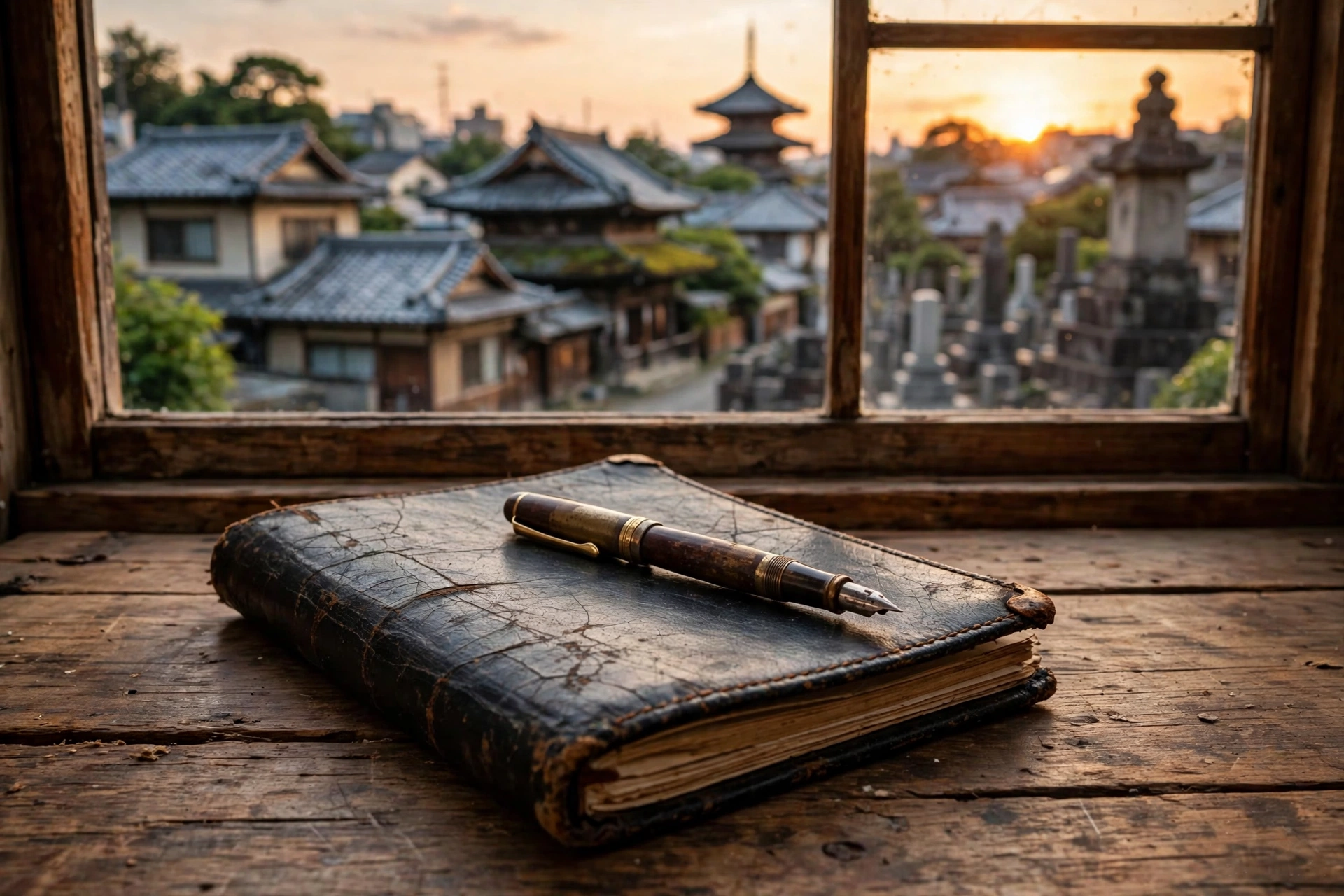
This is episode 4 of the serial novel ‘The Black Leather Notebook【偲記手帳-Sikinote-】.’ This story is one that I (Kurashiki Bouzu) had Moka (Muse), my AI butler, write by handing her, just as it was, a novelist prompt I made long ago for a different AI. It is fiction, but underneath it lies my experience from my funeral-director days. You can read episode 1 here.
Chapter Four: August 5, The Morning of the Departure
August 5, 1995
At six thirty in the morning, the sky over Yanaka was beginning to whiten, still holding a little of the heat from the night before. In front of the Kitamura home, I, Tabito Kazeno (24), stood beside the hearse. After last night’s wake, I had stayed at this house with the family, taking turns with Shuzo Noda (60) in the duty of not letting the light of the altar go out. More than sleepiness, the stillness of the night spent beside the coffin of Shizue (82) remained in the depths of my body.
“Kazeno. Go wash your face. Today is a day of sending. If the faces of those sending are clouded, the family can’t feel at ease.”
At Noda’s voice, I washed my face at the kitchen sink. The cold water took the heat from my cheeks.
Past eight, the relatives began to gather, one, then two. Beside the chief mourner, Kazuko Kitamura (60), stood a woman I had not seen last night. She was Kazuko’s daughter, and Shizue’s granddaughter, Saori Kitamura (35). She had married and moved far away, had not made it in time for last night’s wake, and had rushed here on this morning’s Shinkansen, I was told.
“Grandma……”
Kneeling before the altar, Saori looked at Shizue’s face in the coffin and for a while her voice caught.
“I didn’t make it…… I couldn’t see her at the end.” “Saori. Your mother was talking about you at the wake yesterday, too. ‘That child is doing her best, far away,’ she said. ……I think Grandma understood.”
At Kazuko’s words, Saori laid her own hand over Shizue’s hand. A hand grown cold, and a living hand. Before that overlapping, I stood stock-still for a moment, wondering whether it was all right for me to be here. But Noda’s words from last night came back. A mistake you remember becomes an asset. My work today was to keep standing in this place without running away.
At nine, Go Watarai (42) arrived and opened the program of the service. With the same strictness as yesterday’s instruction, today he checked the arrangements word by word.
“Kazeno. Tell me the flow of today’s service.” “Yes. Sutra chanting, eulogy, condolence telegrams, offering of incense, the chief mourner’s address, the departure of the coffin……” “The order is wrong. The chief mourner’s address comes before the offering of incense. ……Do you know why?” ”……” “The offering of incense is the time when the mourners face the deceased. Before that, with the chief mourner’s words, you hand over the character of the deceased. Every order has a meaning. Arrangements whose meaning you don’t understand become mere labor.” “Yes.”
At the office, Mari Kawaguchi (31) had just finished a phone call with the crematorium hall.
“The time for the furnace is secured. Arrival at eleven thirty. ……Kazeno, at the departure, you’re at the head side of the coffin. Ichiji told you yesterday, didn’t he?” “Yes.” “If you tremble, tremble as you are. As long as you don’t drop it, that’s enough.”
The words of the office staff were always words of practical work. But I was beginning to understand, on my third day, that the accumulation of that practical work carries a day like today without a hitch.
At ten, the funeral and farewell service began. The sutra chanting of Yoshimichi Kashiwagi (58) of Renzui-ji Temple filled the Japanese room in the same low, soft voice as last night. The white chrysanthemums of the altar, receiving the morning light, looked purer than they had last night.
After the chanting, Kazuko stood to give the chief mourner’s address. Holding the paper with trembling hands, she still raised her face and looked at the mourners.
“Thank you all for gathering today for my mother, Shizue. Mother raised us with piecework sewing. The sound of the sewing machine, which went on late into the night, was the lullaby of my childhood. ……Mother’s hands were always moving for someone. Today, that all of you could send those hands off — I thank you from my heart.”
It was a short address. But within that shortness were sixty years of a mother and daughter’s days, all of them. Saori was pressing her eyes with a handkerchief. Beside the altar, I too held back the heat rising in my eyes. Those who send must not cry with their backs. Go Watarai’s (42) words became a support inside my body.
In the middle of the service, I looked for the figure of Meiji Suzuki (57) standing beside the altar. The chairman should have come today, too, just as at last night’s wake. Around the opening, I thought I saw his figure once, beside a pillar at the back. But now, Meiji was not in that place.
”……Ichiji. The chairman—” “He’s here. I saw his face this morning. ……Right now, he’s out front.”
Saying only that, Ichiji Yamamoto (50) returned his eyes to the service. At the hardness of his profile, I could ask no more. During the service, my eyes went again and again to the place beside the pillar at the back. Can a person look this much at a place where no one is, I thought.
The offering of incense proceeded, and the time of the coffin’s departure drew near. For the final farewell, the mourners, one by one, laid flowers around the coffin. Around Shizue’s face, white and pale-colored flowers quietly accumulated. At the end, Kazuko placed a small pair of dressmaker’s shears into the coffin.
“They were the companions of Mother’s hands.”
The lid closed. There, Saori’s held-back voice leaked out, small.
When the coffin was carried out, at the entrance stood Meiji Suzuki. A black suit. But his complexion looked different from yesterday. So much that the word “earth-colored” came to mind. Meiji walked up to the coffin and laid his hand on its edge.
“Chairman.”
Ichiji quietly laid his own hand over that hand.
“Today, please leave it to us. Chairman, please stand on the side of those seeing her off.” ”……Ichiji.” “We will make Shizue’s funeral. Just as the chairman taught us.”
There was a long silence. Meiji slowly took his hand from the coffin and stepped back.
”……I’m sorry. I’ll leave it to you.”
At the smallness of that voice, my chest was struck. The big man who had looked at me with those strict eyes now, in the light of the entrance, looked terribly small.
“The head side is Kazeno.”
At Ichiji’s voice, I went around to the head side of the coffin. Our house rule. The newcomer carries the important side. Hold it with trembling hands. That trembling becomes carefulness. The coffin had a weight unlike any I had felt until yesterday. It was the weight of flowers, of people’s feelings, and of all of eighty-two years. Step by step, matching our pace, to the hearse. Kohei Murase (36) was waiting, the rear door quietly open.
The road to the funeral hall in the town was about thirty minutes. Inside the hearse, Kazuko and Saori were talking together in small voices about their memories of Shizue. In the driver’s seat, Murase turned the wheel more slowly than usual, so as not to interrupt those voices.
We arrived at the hall, and the coffin was carried before the furnace. It was the final farewell. Kazuko and Saori gazed for a long time at Shizue’s face through the small window of the coffin.
“Mother. Thank you. ……Thank you.”
The sound of the furnace door closing was heavy and low. In the waiting room after the ignition, I looked at the summer sky outside the window. The cicadas were crying far away. The time until one person burns and becomes ash. For the bereaved, that long time, we spent in another room, pouring tea and saying little. Noda said, quietly:
“This waiting time is the important time in which the bereaved take in ‘the end.’ Don’t hurry them. Don’t fill it with words.”
After a while, Noda, wrapping his teacup in both hands, smiled as if remembering something.
“The chairman, when he was young, was a truly reckless man. He’d carry a coffin alone, stay up all night keeping company without a thought. ‘A funeral man’s capital is his body’ was his favorite phrase.” ”……This morning, the chairman was different from that chairman.” “Yes. ……No one can beat age. But listen, Kazeno. About that man’s body — it’s not for us below him to make a fuss first. Until he opens his own mouth, we protect the site. That is our courtesy.”
Noda’s words were gentle, and heavy. The people of this company had noticed the chairman’s change, and still, no one made a fuss. That quietness, I thought, was the form of this house’s trust.
The gathering of the ashes. Kazuko and Saori, passing the chopsticks between them, placed Shizue’s bones into the urn. When they placed the throat bone, Saori’s hand trembled. Kazuko laid her own hand over that hand. From mother to daughter, from daughter to grandchild. The manner of sending, too, is handed down, I thought.
We returned to the Kitamura home, and when the seventh-day memorial service and the meal after the fasting were done, it was evening. On her way out, Kazuko took my hand.
“Kazeno. I’m glad my mother’s end was this quiet. ……That you carried her with care, with trembling hands — I will not forget it.”
Kazuko, holding the urn to her chest, somehow looked like a girl. The work of those who send ends here. But the time of those left behind begins from here — that, too, I learned today.
When I returned to the office, in the light of the evening sun, Akemi Suzuki (55) closed a ledger beyond the counter.
“Tabito, thank you for your work. ……I hear Shizue’s funeral finished without a hitch.” “Yes. Thanks to everyone.” ”……That man — I sent him home at midday. I’ll let him rest a little.”
Akemi’s voice was gentle, but behind it there was a shadow she could not hide. Mitsuki Suzuki (24) was gazing anxiously at the door leading to the home at the back.
“Father wouldn’t listen this morning either about going to the crematorium hall. At the entrance, he laid his hand on the coffin…… I’ve never seen Father like that.” “Mitsuki.” “I want him to go to the hospital, but that man says, ‘A funeral man shouldn’t make a fuss about his own affairs.’ ……He’s stubborn.”
I searched for words. It frustrated me that I could say nothing. The figure that had stopped at the step of the entrance. The hand that had quietly left the coffin. That small shadow, over this one day, had certainly grown darker.
That night, at my lodging, I opened the black leather notebook. I wrote down the whole of Shizue’s funeral. Her peaceful face buried in flowers. Kazuko’s address. Saori’s trembling hand. And the back of Chairman Meiji, who had taken his hand off the coffin.
Today, I witnessed for the first time the whole of a person being “sent off.” A funeral was the work of making the time until those left behind take in “the end.” And I saw it. The figure of the man who should be the head of those who send, taking his hand off the coffin. The shadow has certainly begun to fall. —August 5, 1995.
Serial Novel ‘The Black Leather Notebook【偲記手帳-Sikinote-】’
- Previous episode: Episode 3, “August 4, My First Wake”
- Next episode: Episode 5, “August 8, The Lights of Bon”
- November 23, 2026 ― Draft created (based on the Japanese edition, ledger No. 3338. English edition of episode 4 of the serial novel 'The Black Leather Notebook')(9,252 characters)
- November 23, 2026 ― Published (by the user's publication decision, 2026-11-23; all 9 languages at once. The end of the address carries the Japanese edition's ledger number, No. 3338)(9,252 characters)