
Serial Novel 'The Black Leather Notebook【偲記手帳-Sikinote-】' Episode 5 — August 8, The Lights of Bon
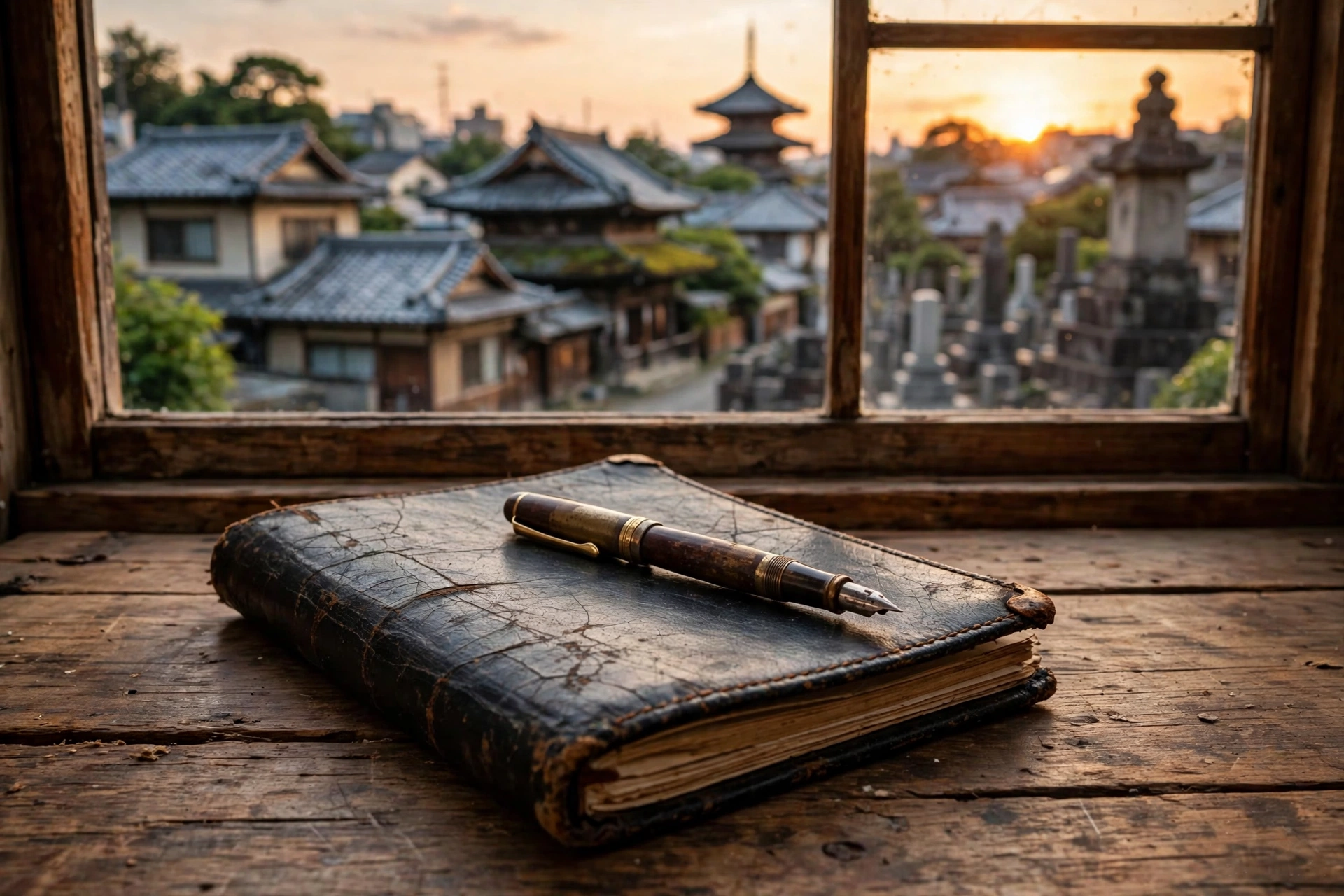
This is episode 5 of the serial novel ‘The Black Leather Notebook【偲記手帳-Sikinote-】.’ This story is one that I (Kurashiki Bouzu) had Moka (Muse), my AI butler, write by handing her, just as it was, a novelist prompt I made long ago for a different AI. It is fiction, but underneath it lies my experience from my funeral-director days. You can read episode 1 here.
Chapter Five: August 8, The Lights of Bon
August 8, 1995
As Bon draws near, the town of Yanaka changes its colors. At the flower shops’ fronts, the bundles of Buddhist flowers double, and white lanterns begin to hang from the eaves. From early morning, lines of people visiting graves climb the slope to the cemetery. In this town’s summer, busy with preparations to welcome the dead, the busyness of the living and the thoughts for those who have died melted into the same air.
The telephones of Meiji Funeral Home, too, had not stopped ringing these past few days. I, Tabito Kazeno (24), was running about with reception, telephones, and helping with the setting up. It had not yet been a week since I joined. But this company’s busyness did not leave a newcomer as a newcomer.
Kano Miyoshi (23), between two telephones, was picking up receivers with a composure unrecognizable from before. The figure of the new clerical worker who had welled up with tears on the first day was no longer there. Mari Kawaguchi (31), keeping an eye on Kano’s back, turned the communications to the flower shop, the hall, and the temple without the slightest deviation. Kohei Murase (36) went back and forth between the garage and the street many times a day, to deliver Bon lanterns and to drive cars for grave visits.
“Bon is the season when the dead come home, right? We can’t keep them waiting for the convenience of the living.”
That remark of Murase’s taught me the meaning of this company’s busyness. It was not busyness. This town, all together, was welcoming the people who had died.
That morning, Mari Kawaguchi (31) set down a receiver and said:
“Kazeno. This afternoon, a small funeral has come in. Try doing the reception and the guidance for the offering of incense on your own.” “On my own?” “Watarai will make the program for you. But the one standing at the site is you. ……I’ll attach Miyoshi, too, but the one who gives the voice for the guidance is you.”
The deceased was Shoichi Tamura (74). He had lived alone in an apartment at the edge of Yanaka. His health had broken down in the heat, and Kiku Onodera (68), his landlord, had found him dead in his room. His only kin were distant relatives with whom he was estranged, and the arrangements for the funeral proceeded through contact from Noriko Saeki (45) of the ward welfare office.
Before the preparations of the hall began, Onodera told me, little by little, about Shoichi.
“Shoichi, when he was young, worked at a small factory in town. Even after he retired, every morning without fail, he would sweep in front of my shop. In this heat, I hadn’t seen him for two or three days. ……I saw the newspapers piling up, felt a premonition, and opened the room together with the police.” ”……” “He passed away alone, but you know, he liked to play shogi in the park. He had friends. Today, his shogi companions will come, too, they said.”
Behind the words “few kin,” there was surely this man’s life. Blood ties are not the only human ties, I thought. Saeki from the ward had brought the records of Shoichi’s pension and life in a small envelope. The whole of the public record of this man’s life was that single envelope.
“It will be a small funeral. The mourners: the landlord, the welfare officer, and a few people from the neighborhood. Even so, Kazeno.”
As we were leaving, Ichiji Yamamoto (50) said:
“Even if there are only two mourners, a funeral is a funeral. Don’t cut corners on the number of flowers or the arrangements. ……That man’s life belongs to him alone. Don’t measure it by scale.” “Yes.”
The venue was the company’s small hall. There was only one altar set, but by Shuzo Noda’s (60) hands it was arranged with the same stillness as always. The portrait was a single photograph the landlord had brought in, taken in front of the landlord’s shop. Shoichi, in work clothes, smiling as if embarrassed. Looking at that smile, the fact that this man had surely lived in this town pressed upon my chest.
Before the service, Go Watarai (42), program in hand, called me over.
“Your guiding voice doesn’t need to be loud. But it mustn’t be too small, either. A voice that slips smoothly into the mourners’ ears. ……If you fail, what do you do?” ”……I apologize.” “Wrong. First, don’t stop the place. Apologizing can come later. The service flows for the bereaved. Don’t stop that flow with your failure.” “Yes.” ”……Today’s mourners are all people who gathered to send this man off. Having few kin means that the feelings of each person who gathered are that much heavier. Don’t forget that.”
The service began. There were nine mourners. But each of those nine offerings of incense was quiet and deep. After offering incense, Onodera kept her hands together for a long time before the altar.
“Shoichi always swept in front of my shop for me. ……I never even properly said thank you.”
My voice, giving the guidance, trembled at first, but by the middle of the service, strangely, it had settled. I think the backs of those who send, which I had seen at Shizue’s funeral yesterday, remained within me.
An old man, said to be a shogi companion, was calling out in a small voice before the altar after offering incense.
“Tamura. ……Next time, play against a strong opponent over there.”
At the end of the service, Saeki bowed her head deeply.
“To this man, I could only speak the words of the system. ……But today, he was sent off with the words of people. Thank you very much.”
The service proceeded without a hitch, and the small coffin left the hall, seen off by the hands and eyes of nine people. At the departure, I held the head side of the coffin. The trembling was already gone. In its place, a quiet weight, different from the time of Shizue, remained in my hands.
That day, Meiji Suzuki (57) was not at the office. From the morning, accompanied by Akemi Suzuki (55), he had gone to the hospital. For tests, Mitsuki told me in a small voice.
“What were the results?” “‘We need to examine a little more closely’ — that’s all. Mother won’t say any more than that either. ……Father came back from the hospital and has been resting at home ever since.”
The eyes of Mitsuki Suzuki (24) were wavering with anxiety. Within the company, no one spoke of the chairman’s body in a loud voice. The “courtesy” Noda spoke of was making the air of this company. But there was no longer a single person who had not noticed.
In the evening, the office telephone rang. It was from Kazuko Kitamura (60).
“Kazeno. The seventh-day service is finished. Saori went home yesterday, too. ……I’ve placed the photograph of Mother’s altar beside the Buddhist altar at home. Every morning, I put my hands together.” “Kazuko. ……Thank you.” “It is I who should thank you. Because I had that funeral, I think I was able to send Mother off properly.”
I set down the receiver and stood there for a while. Even after the work of sending ends, in the days of those left behind, the time of the funeral lives on.
At night, as I was helping with writing names on tomorrow’s Bon lanterns at the office, Mitsuki brought me tea.
“Kazeno, your guidance today was calm.” ”……Thanks to Watarai’s program.” “Anyone can make a program. But the one who stands in the place is yourself alone. ……I liked today’s service. Even with only nine people, that such a warm service exists.” “I thought so, too.” “Father used to say, ‘The value of a funeral is not decided by the number of people.’ ……That’s why I want to report today’s service to Father properly.”
Mitsuki stopped her brush on the lantern name-writing and looked again at the door to the home at the back. At her profile, I could say nothing.
A little past eight at night. In the office after the cleanup was finished, Meiji Suzuki came down from the home at the back. His figure, a haori jacket over his room clothes, had taken off the size he had in a suit, and was somehow the figure of a single aging man.
”……You’re still here.” “Yes. I was checking tomorrow’s arrangements.” “Serious, aren’t you. Are all the young ones from Akada’s place like that?”
Meiji sat down in a chair at the counter and looked up at the ceiling for a while.
“Tabito. I leapt into this world at the age of thirty. To the president of a funeral company who had been a real estate client — a man named Susumu Kawakami — I bowed my head. ‘Please let me learn from the beginning.’” “Susumu Kawakami.” “He was a strict man. But behind that strictness, there was a love for the work. ……My ‘strictness is love’ is borrowed from him.” “Is Kawakami still—” “He’s still active. Past sixty, and still standing at sites. ……Compared to him, I’m still a youngster.”
Meiji’s eyes looked into the distance. I thought that the figure of the person at the end of that distance had supported this man’s backbone. To have a teacher means that there is always, above you, a back you cannot reach.
Meiji laughed. The laugh turned into a cough. The cough went on for a long time, and Meiji pressed a hand to his chest and leaned his body against the back of the chair. Under the fluorescent light, I could clearly see the blood draining from his face.
“Chairman!” ”……It’s nothing. I’m just tired from sitting.”
Meiji quietly pushed back the hand I held out. But the strength of that hand was not the strength of the hand of the man who had measured my eyes on the first day.
”……How was today’s funeral?” “There were nine mourners. But it went without a hitch.” “I see. ……The smaller the funeral, the harder it is. Because there’s no room for deception. Well done.”
Saying only that, Meiji stood up and disappeared beyond the door to the home. As I watched that back, I recalled the words I had heard on the first day. Death does not wait. But what tightened my chest now was a different fear. The fear that this man’s time, too, would not wait.
That night, at my lodging, I opened the black leather notebook. Shoichi’s smiling portrait. The nine offerings of incense. Meiji’s cough, and the strengthlessness of the hand that pushed mine back.
Today, I took charge of a part of the proceedings on my own for the first time. It was a small funeral with nine mourners. But in the heart that sends, there was neither small nor large. And at night, I saw it. The weakening back of the man who taught me that strictness is love. What I can do, still, is only to protect the site. —August 8, 1995.
Serial Novel ‘The Black Leather Notebook【偲記手帳-Sikinote-】’
- Previous episode: Episode 4, “August 5, The Morning of the Departure”
- Next episode: Episode 6, “August 10, A Site Without the Chairman”
- November 23, 2026 ― Draft created (based on the Japanese edition, ledger No. 3347. English edition of episode 5 of the serial novel 'The Black Leather Notebook')(8,913 characters)
- November 23, 2026 ― Published (by the user's publication decision, 2026-11-23; all 9 languages at once. The end of the address carries the Japanese edition's ledger number, No. 3347)(8,913 characters)