
Serial Novel 'The Black Leather Notebook【偲記手帳-Sikinote-】' Episode 7 — August 13, The Entrance of Bon
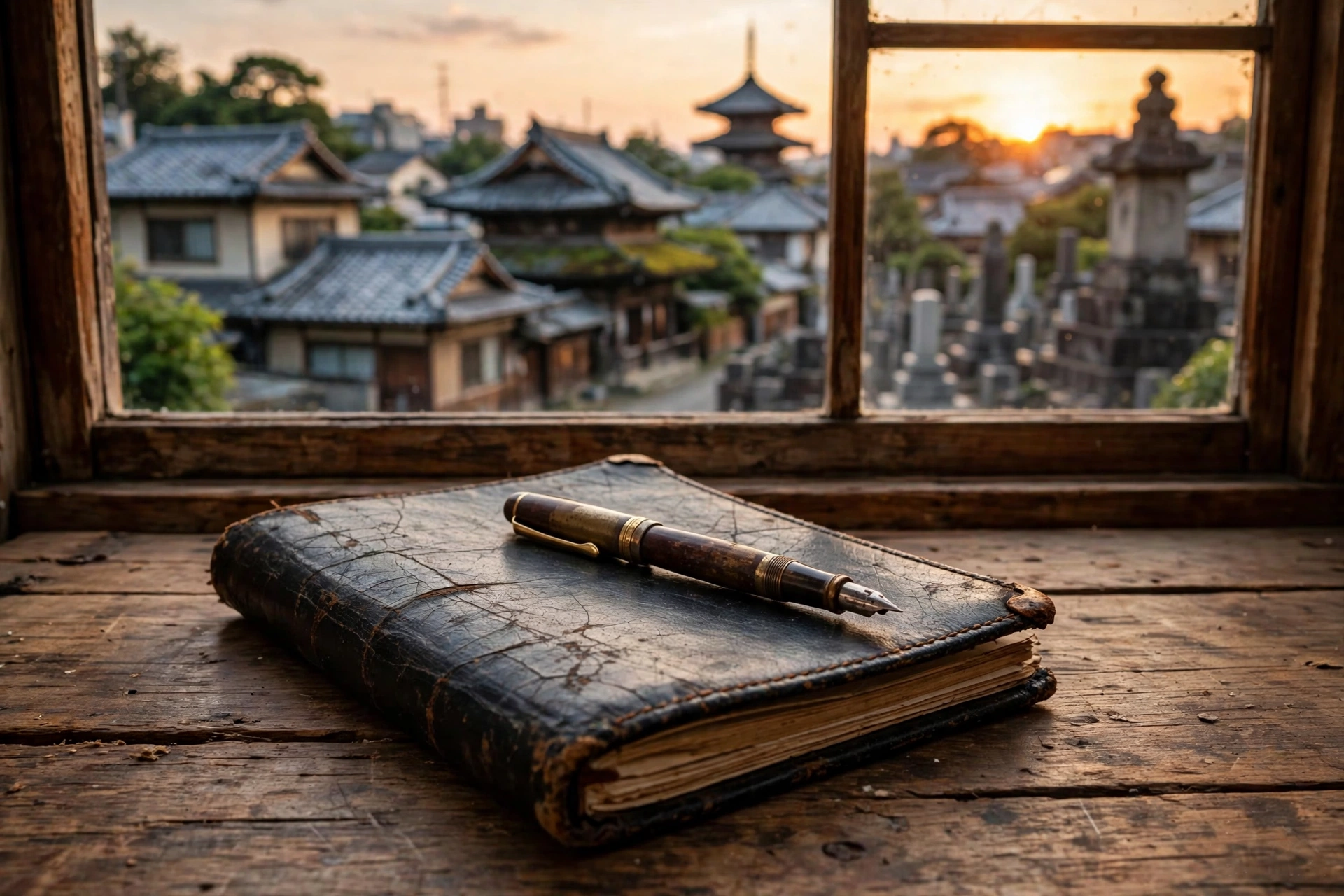
This is episode 7 of the serial novel ‘The Black Leather Notebook【偲記手帳-Sikinote-】.’ This story is one that I (Kurashiki Bouzu) had Moka (Muse), my AI butler, write by handing her, just as it was, a novelist prompt I made long ago for a different AI. It is fiction, but underneath it lies my experience from my funeral-director days. You can read episode 1 here.
Chapter Seven: August 13, The Entrance of Bon
August 13, 1995
August 13. It was the day of the entrance of Bon. From the morning, thin smoke from the welcoming fires rose along the streets of Yanaka. The smell of hemp stalks burned at each eave mingled with the summer heat. People visiting graves, carrying ground cherries, flowers, and incense, climbed the slope to the cemetery. The four days in which the dead return home were beginning on this day.
At the office of Meiji Funeral Home, too, people came and went without pause from the morning. I, Tabito Kazeno (24), was running about, confirming the name-writing on Bon lanterns, answering telephones, and arranging the delivery of lanterns. It had been only eleven days since I joined. But the busyness of Bon did not let a newcomer sit in a newcomer’s seat.
“Kazeno. Today, I’ll entrust the rounds to you.”
Mari Kawaguchi (31) placed a ledger with addresses written in it on my desk.
“The Bon greeting rounds. Houses where we were allowed to do the funeral, and houses we’re close to. Twenty-eight houses. Look at the state of the spirit shelf, offer one stick of incense, and check that there are no problems with the lanterns. Go with Mitsuki, the two of you.” “Twenty-eight houses?” “Bon is the day the dead come home. For the people of that house, it’s the day of the year when they think most about the deceased. Going there and showing our faces is half of our work. ……The other half is doing the funeral day properly.”
On our way out, in front of the garage, Kohei Murase (36) was loading boxes of lanterns into a car.
“Oh, the rounds, huh. It’s hot, so at least keep hydrated. ……The Bon rounds are different from a funeral. The other side isn’t in the middle of grief. On the day of the year when they remember the deceased most, we go and show our faces. ‘We haven’t forgotten’ — that’s what we go to convey.” “Murase……” “So it’s not the work of a single stick of incense. Show your face. The chairman, in the old days, used to do all the rounds himself.”
Together with Mitsuki Suzuki (24), I walked the lanes of Yanaka. Mitsuki could name the nameplate of every house without a map. Her steps were those of a person who, as the daughter of the founding family, had grown up together with the houses of this town.
At the first house, a boy of about elementary school age came out, carefully holding a cucumber horse.
“I made this. So that Grandpa can come home quickly, it’s a fast-legged horse.” “You made it well. Grandpa will be pleased.”
Mitsuki crouched down to meet his eyes. Beside her, I lit the lantern on the spirit shelf and offered incense. The portrait of the deceased had a smiling face. In this house, death was not only something sad. There was the brightness of waiting for a person who is coming home.
The third house was the home of an old man living alone, whose wife we had sent off three years ago. Before the spirit shelf, two small teacups were lined up.
“One is my wife’s. She liked sweet things. At least at Bon, I want to let her eat as much as she likes.”
The old man laughed and served us cold barley tea. What those left behind can do for the person they sent off. Its form differed from house to house, and all of them were right.
The fifth house was the home of a younger sister who had sent off her older brother last winter. On the spirit shelf, somen noodles, which her brother had loved, were offered freshly boiled.
“My brother was a person who, in summer, ate nothing but somen. ……When I prepare them cold, Mother used to say, ‘Don’t make him feel the heat even when he comes home at Bon.’” “Your mother’s words remain, don’t they.” “Yes. I think the manners of those who send are something handed down inside a house, like this.”
Mitsuki quietly offered incense. The manners a funeral company teaches were not the only manners. There surely existed ways of sending, handed down over generations inside a house.
A little past noon, we drank canned tea in front of a vending machine in the shopping district. Mitsuki set the lantern box at her feet and wiped the sweat from her forehead.
”……Kazeno. This afternoon, could you go and visit him?” “The chairman?” “The director seems to intend that, too. Mother goes every day, but no one from the company has gone yet. ……Father is a person who doesn’t want to show weakness to the company’s people. But during Bon, if no one from the company comes even once, I think that, in its own way, would make him lonely.”
Mitsuki’s words were a daughter’s words. I understood that she was measuring the place where her father’s heart rests, not as a person of the company, but as a daughter.
When we returned to the office, Ichiji Yamamoto (50) handed me a wrapped package of gifts for the visit. A new yukata and a basket of fruit, prepared by Akemi Suzuki (55).
“A visit to the chairman. Go as the company’s representative.” “Is it all right for it to be me?” “You are fine. ……Listen, Kazeno. Don’t ask unnecessary things. You can’t take a doctor’s place. But don’t avert your eyes. What the chairman said, and what he did not say. Bring that back, just as it is.” “Yes.”
The hospital was two stations away from Yanaka by train. Inside the white building, the smell of disinfectant and the stillness of a summer afternoon filled the air. The light coming through the corridor windows was strong, and in that light, the shadows of the people passing each other were thin. The daytime of a hospital, a scene of the living, had a face entirely different from the stillness of the morgue we visit at night.
In the bed at the very back of a four-person room was Meiji Suzuki (57). Wearing hospital nightclothes, he had raised his upper body. That figure had cast off the size he had when sitting at the back of the office in a suit, and was the figure of a single, thinned man. His cheeks were sunken, and his arms had grown thin. But the sharpness of the eyes that looked at me was the very eyes that had measured me on the first day.
”……You came.” “Chairman. I have come to visit. This is from everyone at the company.” “In the busyness of Bon, what a burden.”
Beside us, Akemi took the basket of fruit and quietly bowed her head.
“Tabito, thank you. ……I’ll go down to the shop below for a bit. That man does nothing but complain that the hospital food doesn’t suit his mouth.”
Saying that, Akemi left the room. It was a quiet consideration, to leave her husband time alone with the company’s young man.
For a while, we talked of trivial things. The supplies needed for Bon, how crowded the hall was, the whole story of Oshima’s funeral. Meiji gave short acknowledgments and sometimes turned his eyes out the window.
”……Tabito. The results of the tests have come out.” “Yes.” “It seems there’s something troublesome inside my belly. The doctor says they’ll examine it a little more closely. ……It may come to surgery.”
I searched for words. I did not know what I should say. Meiji did not blame me for that.
“I haven’t told Mitsuki in detail yet. Akemi must have heard from the doctor, but she, too, says nothing in front of me. ……The reason I tell you is that, among us, you are the person farthest from me. There are things one can say to a distant person.” “Chairman……” “Don’t sympathize. Don’t make a worried face, either. You’re a man who writes in a notebook, aren’t you. Write what you saw, just as it is. That’s enough. ……That is more than enough.”
Meiji reached for the teacup at his pillow, drank a mouthful, and said quietly:
“I have a request. August 15. There is a house having its first Bon. The house of Masae Shimizu (76). Her husband, Seiichi, we sent off this February. ……At that funeral, I made a promise. ‘At Bon, I will come to offer incense.’” ”……” “It seems I can’t go. Go in my place. With Mitsuki, the two of you. ……But do not lie. Honestly state the reason I cannot come. That person has only just sent off her husband. A lying comfort would be the greatest discourtesy to her.” “Yes. ……I will surely go.” “That person is a strong person. To a strong person, tell the truth. That is courtesy.”
Meiji narrowed his eyes a little.
“On the day of that funeral in February, Masae stood firm from beginning to end. But when it came to putting flowers into the coffin, her hands trembled and she could no longer hold the flowers. ……I, in place of those hands, put a single flower into the coffin. ‘I have delivered it to your husband,’ I said. That was all. But people remember that ‘that was all.’ ……You, too, become a person who can lend such a hand at the site.” “Yes.”
Those words were a teaching, and at the same time, the way a man entrusts something to the one who goes in his place. This man’s promise, together with this man’s way of doing things, had been entrusted to me.
As I was leaving, Meiji called me once more.
“Tabito. The company is entrusted to Ichiji and the others. You protect your own post. ……Bon is the season when the dead come home. Prepare the place they return to, properly.” “Yes.”
Before closing the door of the room, I looked back once more. Meiji was looking out the window. In the summer light, his profile was looking somewhere far away. Perhaps he was watching the line of people climbing the slope to the cemetery.
In the evening, back at the office, I reported the visit to Ichiji. I did not speak of the tests. I thought I could not spread, from my own mouth, what Meiji had not yet told even Mitsuki in detail. All I said was the request: that on the fifteenth, I would go to the Shimizu house to offer the first-Bon incense.
”……I see. A request in the chairman’s own way.”
Saying only that, Ichiji returned his eyes to the Bon arrangement chart. In those eyes, it seemed, even the weight of what I had not said had fully arrived. The people of this company had all acquired the art of receiving what has not been said, as it is, unsaid.
That night, at my lodging, I opened the black leather notebook. The smoke of the town at the entrance of Bon. The boy holding the cucumber horse. The two teacups. And the voice of the chairman, who, in a hospital bed, had put his own body into words for the first time — I wrote it down.
Today, I visited Meiji Suzuki in the hospital. The chairman put his body into words to me alone. There are things one can say to a distant person, he said. And I was entrusted with the promise to the house of the first Bon. A promise does not disappear even if the body of the one who made it can no longer move. By someone fulfilling it in their place, it lives on. —August 13, 1995.
Serial Novel ‘The Black Leather Notebook【偲記手帳-Sikinote-】’
- Previous episode: Episode 6, “August 10, A Site Without the Chairman”
- Next episode: Episode 8, “August 15, The House of the First Bon”
- November 23, 2026 ― Draft created (based on the Japanese edition, ledger No. 3365. English edition of episode 7 of the serial novel 'The Black Leather Notebook')(9,019 characters)
- November 23, 2026 ― Published (by the user's publication decision, 2026-11-23; all 9 languages at once. The end of the address carries the Japanese edition's ledger number, No. 3365)(9,019 characters)