
Serial Novel 'The Black Leather Notebook【偲記手帳-Sikinote-】' Episode 8 — August 15, The House of the First Bon
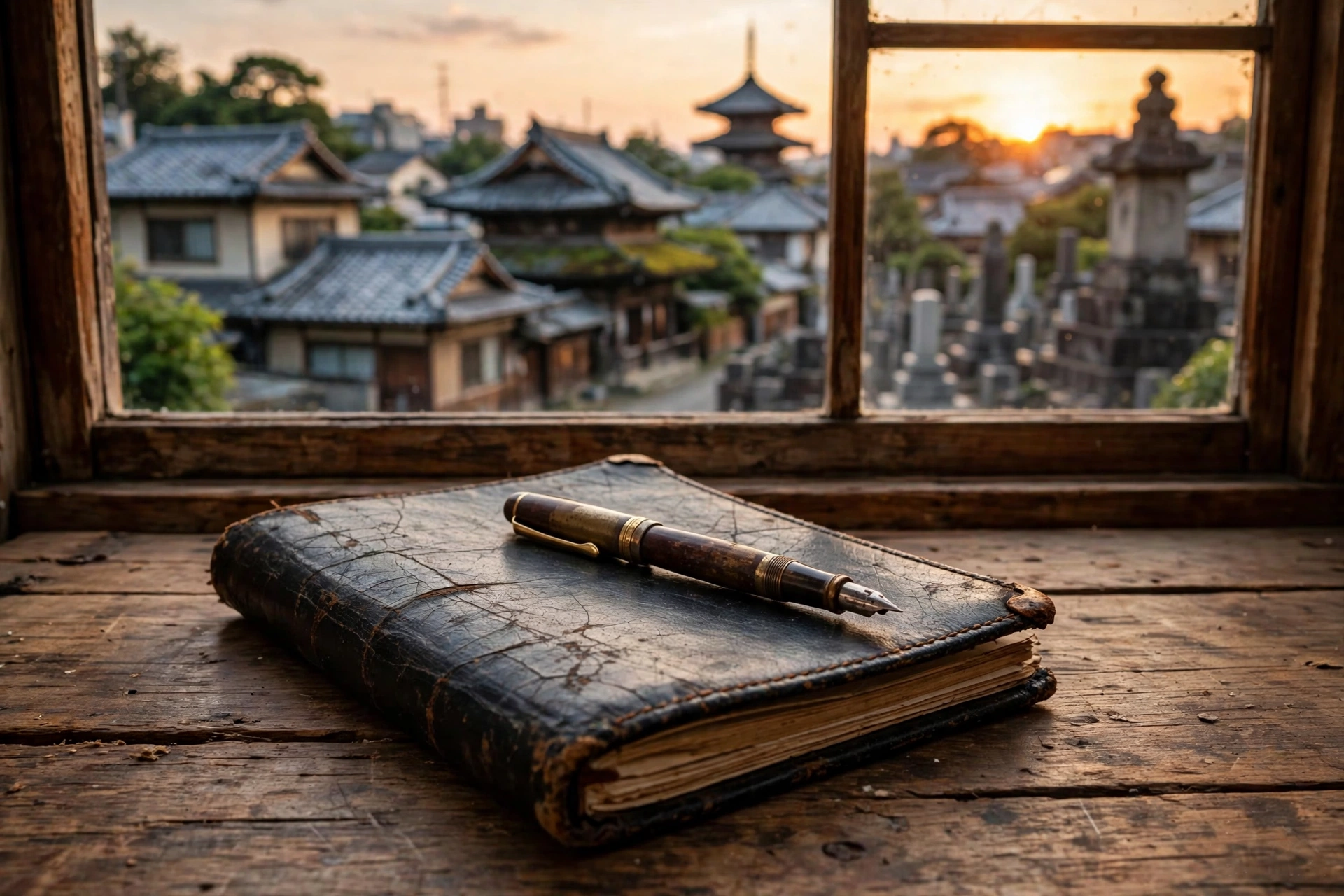
This is episode 8 of the serial novel ‘The Black Leather Notebook【偲記手帳-Sikinote-】.’ This story is one that I (Kurashiki Bouzu) had Moka (Muse), my AI butler, write by handing her, just as it was, a novelist prompt I made long ago for a different AI. It is fiction, but underneath it lies my experience from my funeral-director days. You can read episode 1 here.
Chapter Eight: August 15, The House of the First Bon
August 15, 1995
August 15. It was the middle day of Bon. This day was also, exactly, the fiftieth anniversary of the end of the war. At noon, the siren of the moment of silence resounded faintly across the town of Yanaka. The people visiting graves and the people at the flower shops’ fronts all stopped their hands at once and lowered their eyes. I, Tabito Kazeno (24), too, stood through that one minute in front of the office, still holding a bundle of incense. The lives scattered fifty years ago and the lives returning at this Bon quietly overlapped in the same summer light.
“Those who died in the war come home at Bon, too.”
Beside me, Shuzo Noda (60) said, quietly:
“My older brother comes home, too. ……My brother, who died at twenty, to the place of his younger brother, now past seventy. Bon is that kind of season of mysterious reunions.”
The telephones of Meiji Funeral Home did not stop ringing today either. Kohei Murase (36) had gone back and forth between the cemetery and the town many times since the morning, driving for grave visits. Kano Miyoshi (23) was handling two telephones, no longer showing any tears. Upon the arrangements assembled by Mari Kawaguchi (31), the whole company was moving like a single living thing.
In the morning, one consultation call came in. It was from a young couple who had sent off their mother only this year, saying they did not know how to welcome the first Bon. Kano Miyoshi (23), who took the receiver, no longer flustered. The arrangement of the spirit shelf, how to light the welcoming fire, where to place the lanterns — one by one, matching the speed of the other person’s voice, she explained. When the call ended, Mari Kawaguchi (31) said:
“Kano. Your explanation today — you didn’t falter even once.” ”……Yes. That couple sounded anxious. I didn’t want my voice to increase their anxiety.” “That’s it. You’ve become able to picture the face of the person on the other end of the phone.”
The new clerical worker who had welled up with tears on the first day had surely grown within the busyness of this Bon. Perhaps this is how one grows at a funeral company. Not by great teachings, but by the accumulation of touching someone’s grief or anxiety every day.
Two in the afternoon. Together with Mitsuki Suzuki (24), I headed for the home of Masae Shimizu (76). It was the day of the first-Bon promise I had been entrusted with by the chairman. On the way, at a flower shop in Yanaka Ginza, Mitsuki bought one branch of ground cherries to add.
“Grandma Shimizu loves ground cherries. Last Bon, too, Father took them to her.” “The chairman remembers even things like that.” “For Father, each and every house on the rounds is a continuation of a funeral. ……It doesn’t end with the funeral. From there, the relationship with that house begins. Father always said that.”
The Shimizu home was a small single-story house deep in a Yanaka lane. At the entrance, the ashes of a burnt-out welcoming fire remained quietly. Masae welcomed us not in mourning clothes, but in an elegant dark-blue outfit for going out.
“My, Mitsuki. And a young man. ……Thank you for coming.”
In the Buddhist room, a splendid spirit shelf had been arranged. The portrait of Seiichi Shimizu (died at 79), who had passed away this February. Before it were lined up a cucumber horse and an eggplant cow, ground cherries, a heaping pile of fruit, and Masae’s handmade ohagi rice cakes.
“My husband loved sweet things. ……Ohagi, at least, had to be my handmade ones, he insisted.”
Seiichi had been a joiner craftsman of great reputation even in Yanaka, I was told. Masae pointed to a small frame beside the shelf. Inside it, the plane (kanna) Seiichi had used was stored, wrapped in cloth.
“At the funeral in February, Chairman Suzuki displayed this plane beside the coffin for us. ‘Seiichi’s hands know the joinery of all the houses in this town,’ he said. ……The fellow craftsmen who attended, seeing that, all wept.” “The chairman did……” “That person watches the deceased’s ‘work’ very carefully. What a person did to live. He is a person who places that properly within the funeral.”
Masae offered us ohagi as well. Behind the sweetness, a touch of salt — that taste had been Seiichi’s favorite, she said. As I ate, I thought: at this house’s Bon dining table, there was surely a seat for the person who had come home.
Masae spoke as if addressing the portrait. We offered incense and put our hands together. Seiichi’s face was peaceful. Before this shelf, Masae had spent three days together with her husband who had come home.
“Chairman Suzuki — today, he……”
To Masae’s question, I answered honestly, just as the chairman had told me.
”……The chairman is in the hospital now. It is for tests. ‘I am sorry that I cannot keep my promise. In my place, this person,’ he said, and entrusted it to me, and so I have come.”
Masae was silent for a while. Then she nodded quietly.
“So it was true. ……I had heard the rumors. That person is someone who always puts his own affairs last.” “Masae.” “Do you remember the funeral of my husband in February, Mitsuki? When it came to putting the flowers into the coffin, my hands trembled and I could not hold them no matter what. Then Chairman Suzuki, silently, put the flowers in for me. ‘I have delivered them to your husband,’ he said. ……With that single sentence, I was able to send my husband off.”
Tears had welled in Mitsuki’s eyes. But she did not cry. She stood with her back straight, as a person of the company standing in the place of fulfilling her father’s promise.
“Masae. Father must truly be sorry that he could not keep his promise.” “Mitsuki. It is I who should apologize. ……Now, young man. Please tell the chairman. ‘Masae was delighted, saying the promise had been kept for her.’ And one more thing. ‘Now it is your turn to be promised to.’” “His turn to be promised to……?” “That person keeps promises to people as if his life depended on it, but his promises to his own body, he always breaks. ……This time, it is our turn to promise for that person. ‘Get properly better, and come back.’ Please receive that promise from him.”
Masae handed me a single stick of incense from the spirit shelf.
“Beside my husband, I was allowed to pray for Suzuki’s safety as well. This year’s Bon is a strange Bon. The person we were supposed to have sent off is praying for the safety of those who send.”
On our way out, at the entrance, Masae handed Mitsuki a paper package. It was ohagi.
“For Akemi. ……That wife, too, is a person who puts her own affairs last. Someone, please watch over that person properly, too.” ”……Yes. I will surely deliver it.” “And, Mitsuki. When your father leaves the hospital, I will come to visit him. At that time, I will be the one who promises. Let me tell him directly, ‘I prayed for your safety at the Bon shelf.’”
Masae kept waving to us until the corner of the lane was out of sight. That small figure remained in the lane of the evening sun.
On the way home, walking through Yanaka in the evening sun, Mitsuki said in a small voice:
”……Will Father be angry? ‘You’ve done something unnecessary,’ he’d say.” “I don’t think he’ll be angry. ……Because Masae’s words are the best medicine for the chairman.” “Kazeno. Tomorrow, could you convey it to Father? If it’s me, it becomes a daughter’s words. ……I want you to convey it as a person of the company.” “Yes. I will surely convey it.”
In the evening, back at the office, I reported the Shimizu house visit to Ichiji. I conveyed Masae’s words just as they were. Ichiji listened in silence for a while.
”……’His turn to be promised to,’ huh. A harsh medicine, in Masae’s way.” “Yes.” “Can you convey it to the chairman, Kazeno?” “I will convey it. ……Tomorrow, if the chairman is to speak to everyone, then before that, perhaps.” “No. Leave the order to the chairman. After that man has finished speaking of his own matters is fine. ……But be sure to convey it. Those words are words that man needs.”
Then, the preparations for the sending fire began. It is the fire that, at the end of Bon, sends off once more the people who came home. In front of the office, everyone in the company gathered. Ichiji Yamamoto (50), Shuzo Noda (60), Go Watarai (42), Kohei Murase (36), Mari Kawaguchi (31), Kano Miyoshi (23), Mitsuki Suzuki (24), and me.
The hemp stalks were lit, and thin smoke rose into the evening sky. No one said much. Perhaps Noda was thinking of his older brother. Murase, of the person he had sent off on his first transport. Kano, of someone on the other end of a telephone. Each of us, in our hearts, was seeing off our own deceased.
Go Watarai (42), unusually, said in a small voice:
”……The sending fire is a good thing. Though it’s a time that isn’t in the program of a service.” “Watarai.” “It’s not only for the bereaved. We who send, too, are given a point of closure like this. ……I think that every year.”
Even this man, who never compromised in the least on etiquette, before the fire was a single person who sends. I learned anew that those who do funeral work also carry their own deceased and their own grief, and stand at the site.
After the fire went out, the office telephone rang. It was from Akemi Suzuki (55). Mari took the receiver, answered briefly, and looked at us.
”……Tomorrow morning, at the hospital, there will be a detailed talk from the doctor, it seems. The chairman is saying, ‘When the talk is over, I will speak to everyone at the company with my own mouth.’”
The air of the office tightened quietly. The day when he himself opens his mouth was coming. The day beyond the “courtesy” Noda had spoken of.
That night, at my lodging, I opened the black leather notebook. Masae’s spirit shelf, the ohagi, and the words “his turn to be promised to” — I wrote them down.
Today, in the chairman’s place, I went to offer incense at the house of the first Bon. A promise was not only something to fulfill. There is also the form of being fulfilled to — so I was taught by a person on the side of those who were sent off. Meiji Suzuki is a man who has kept people’s promises for nearly fifty years. Now it is that man’s turn to exchange a promise with his own body: to come back. —August 15, 1995.
Serial Novel ‘The Black Leather Notebook【偲記手帳-Sikinote-】’
- Previous episode: Episode 7, “August 13, The Entrance of Bon”
- Next episode: Episode 9, “August 18, From His Own Mouth”
- November 23, 2026 ― Draft created (based on the Japanese edition, ledger No. 3374. English edition of episode 8 of the serial novel 'The Black Leather Notebook')(8,821 characters)
- November 23, 2026 ― Published (by the user's publication decision, 2026-11-23; all 9 languages at once. The end of the address carries the Japanese edition's ledger number, No. 3374)(8,821 characters)