
Serial Novel 'The Black Leather Notebook【偲記手帳-Sikinote-】' Episode 10 — September 2, The First House
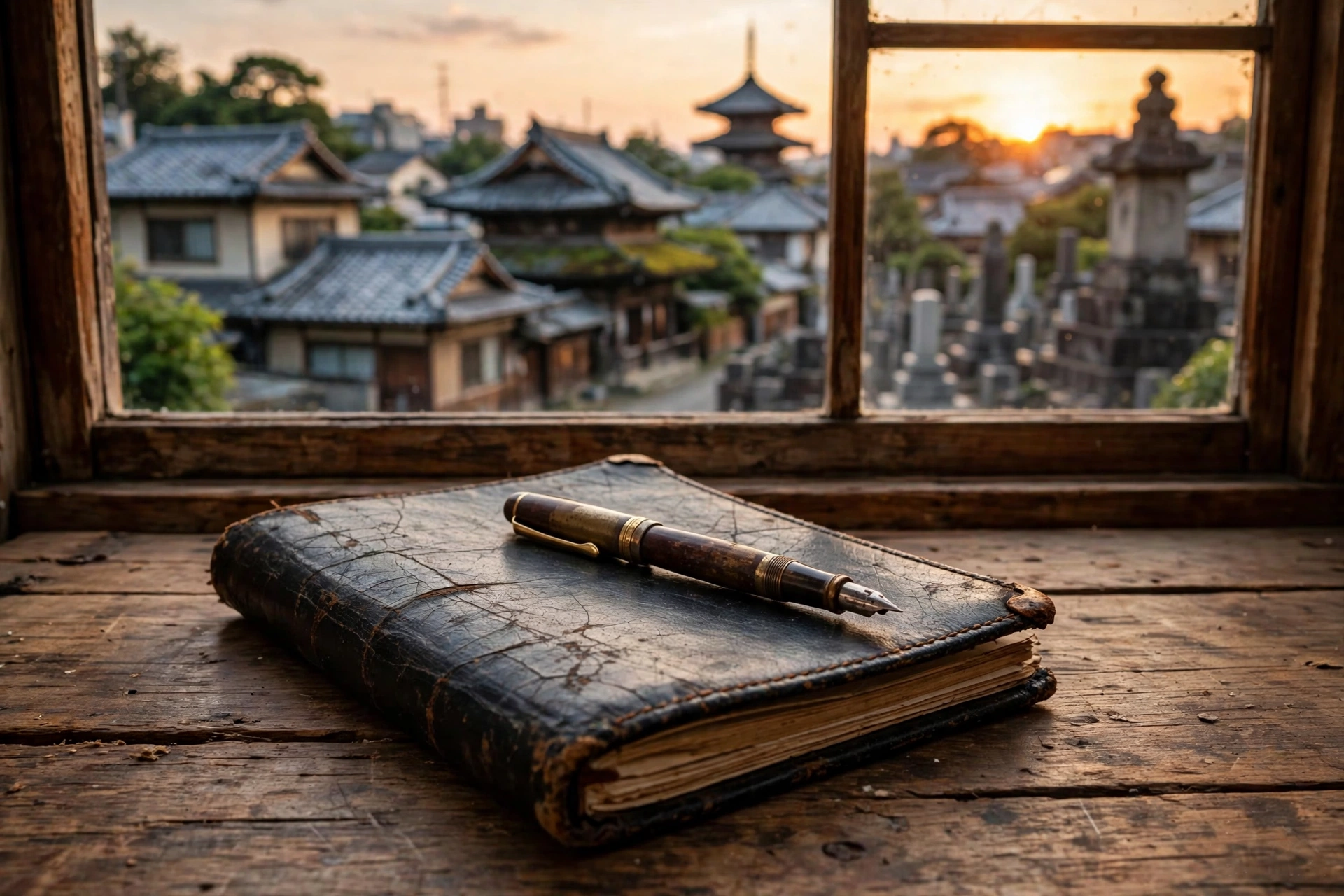
This is episode 10 of the serial novel ‘The Black Leather Notebook【偲記手帳-Sikinote-】.’ This story is one that I (Kurashiki Bouzu) had Moka (Muse), my AI butler, write by handing her, just as it was, a novelist prompt I made long ago for a different AI. It is fiction, but underneath it lies my experience from my funeral-director days. You can read episode 1 here.
Chapter Ten: September 2, The First House
September 2, 1995
Even in September, the heat of Yanaka had not faded. But the color of the morning light had changed, just a little. The green of the cherry trees along the cemetery had deepened, and the evening shadows stretched longer than in August. The season was certainly moving.
At the morning meeting on September 2, Ichiji Yamamoto (50) announced briefly:
“The date of the chairman’s surgery has been decided. September 14. At Komine Memorial Hospital.”
The air of the office tightened quietly. Mitsuki Suzuki (24) gripped again the hands holding the ledger on her lap. For something undecided to be decided is a relief, and at the same time it means that the days of counting on one’s fingers have begun.
“On that day too, the sites will run. Sites without the chairman — we have already experienced them. ……And, Kazeno.” “Yes.” “From today, you begin the rounds of the ledger. September is a month with many anniversaries of death. The first house is today.” “Yes.”
After the meeting, I, Tabito Kazeno (24), opened the entrusted ledger once more. In the neat handwriting of Meiji Suzuki (57), the addresses of houses, the names of the deceased, and their anniversaries were lined up. On its first page was today’s date.
September 2. Mr. Sotaro Okamoto. Died in 1968. Aged forty-five. And beside it, in small letters, this was written:
“The founding, the very first house.”
Twenty-seven years ago. Before I was even born. At thirty, Meiji founded this company, and held its first funeral at this house, so I was told. Since then, for twenty-seven years, he had kept showing his face at this house every September 2. And today, in this twenty-seventh year, the one going in his place was me, barely a month since joining the company.
“You’re nervous.”
Ichiji put a hand on my shoulder.
“The rounds of the ledger are the continuation of the funeral. Think of it as going each year to confirm the promise made on the day of the funeral. ……Offer incense, show your face, and listen. That is enough.” “Yes.” “But listen. If you are asked, say it honestly. About the chairman. Do not hide it. That is that man’s way.”
As I was leaving, Mitsuki Suzuki (24) handed me a package of incense and candles.
“Mr. Kazeno. Please give my regards to Grandma Okamoto.” “Have you been there, Mitsuki?” “Once, when I was a child. ……Father always came home late on September 2, every year. As a child, not knowing the reason, I sulked. Today, seeing the ledger, I understood the reason for the first time.”
Mitsuki gripped, just a little more strongly, the hand that passed the package.
“There were days when that man’s promises came before family time. ……And yet, I find it strange that the one going today to keep that promise is you, Mr. Kazeno, who are not family.” ”……I will go, without fail.” “Yes. Take care.”
The Okamoto house stood deep in an alley in Yanaka. A small house that doubled as a printing shop, with an old sign reading “Okamoto Printing” hanging at the front. The smell of machine oil, ink, and paper drifted as far as the alley. Inside the workshop, the low sound of a printing press echoed at regular intervals.
Waiting at the entrance was Mrs. Fumi Okamoto (72). A small figure with white hair tied neatly. Seeing my face, her eyes widened for a moment, and then she nodded, as if she had understood at once.
”……Mr. Suzuki cannot come, can he.” “Yes. I am very sorry. The chairman is in hospital now. His surgery is scheduled for September 14. I have come in his place. My name is Tabito Kazeno.” “Mr. Kazeno. ……I see. For that man to be unable to come, it must be something serious.”
Fumi showed me into the room with the Buddhist altar. Before the altar, fresh flowers and incense had already been prepared. In the portrait, Mr. Sotaro Okamoto smiled a little shyly, with the face of a man of forty-five in the prime of his working life.
I offered incense and joined my hands. When I raised my face, Fumi, looking at the portrait, began to speak, little by little.
“My husband died in 1968. He was a little older than you are now. It was his heart. In the morning, he collapsed in the workshop, and that was it.” ”……” “For the funeral arrangements, we had meant to ask Mr. Kawakami’s place. He was a funeral director my husband had known for a long time. But the one who came on the day was the young Mr. Suzuki.” “The chairman, you mean?” “Mr. Kawakami said: ‘Today, there is a man who has just set up on his own. I vouch for his skill. Please, let this man do it.’ ……To be honest, I was anxious. He was a young man of thirty. But, you know.”
Fumi’s eyes looked far away.
“That man stayed at our house for three days. Without sleeping, he did everything himself. I saw how his hands trembled as he carried the coffin. ……But those trembling hands never once treated my husband’s body carelessly. At the departure of the coffin, that man said: ‘Madam. Today is my very first house. I will never forget this day as long as I live. On the anniversary of his death, I will surely come and show my face.’”
“Our house was poor. When my husband collapsed, there was no money anywhere for a funeral. Knowing that, that man said, ‘The money can come later. First, let us send your husband off.’ ……For three days he slept in our sitting room, and he contacted the neighbors, and did the procedures at the government office, everything. In those days, Mr. Suzuki was more like a member of our family than a funeral director.”
Twenty-seven years. That promise, I was told, had never once been broken. In years when it fell on a funeral day, he had come rushing in after ten at night, smelling of incense. Even so, he always came within September 2.
“So today too, I was waiting. ……But perhaps it is good that it was you who came. You are the person to whom that man entrusted the ledger he showed to no one.”
From the workshop, the sound of the press stopped. Her son, Mr. Kenichi Okamoto (48), came in, wiping his hands.
“Mother, the incense smoke, my eyes—” “Kenichi. This man is here for your father’s—” “I know. ……Chairman Suzuki is unwell, I hear. Everyone in Yanaka knows.”
Kenichi took a small wooden box from the shelf beside the altar. Inside it, a single old business card was kept with care. “Meiji Funeral Home — Meiji Suzuki.” The printed letters were youthful, and slightly faded.
“The first business card of this company was printed here, at our place. At the end of the year my father died. The chairman came, bowing his head, and said, ‘Please print my cards.’ ……We had no money in those days, and the payment was always put off until later. Even so, my father never complained. This card is like a keepsake of my father.”
Then came the sound of the entrance door opening.
“Excuse me, please.”
It was a low, well-carrying voice. The one who entered the altar room was a lean old man with a straight back. His white hair was cropped short, and he wore a black suit without a gap. He took a single stick of incense, sat before the portrait, and joined his hands for a long time.
Susumu Kawakami (61). The president of the funeral company to whom Meiji had bowed his head and from whom he had learned this world from the very beginning. I held my breath, watching his back.
”……Mrs. Fumi. I have come again this year.” “Mr. Kawakami. You too, every year.” “This day is a special day for me as well.”
Kawakami turned slowly and looked at me. His eyes were of the same kind as Meiji’s eyes, the ones that had measured me on my first day. Eyes that tried to see through everything — lies and weakness alike.
“You are with Meiji’s place.” “My name is Tabito Kazeno. I have come with the ledger the chairman entrusted to me.” ”……Meiji is—” “He is in hospital. The surgery is on the fourteenth. ……I will say it honestly.”
Kawakami was silent for a while. At last, he nodded slightly.
“To say it honestly. That is Meiji’s teaching.” “Yes.” “Twenty-seven years ago today, I handed the funeral of this house to Meiji, who had just set up on his own. It was a house that had been my customer. ……I meant it as a parting gift. I wanted to let that man have his first house. But listen, young man.”
Kawakami looked at Mr. Sotaro in the portrait.
“I come here every year. To witness whether Meiji keeps his promise. ……For twenty-seven years, that man never once failed to come. So I came again this year. And when I came, it was not Meiji who was here. It was you.” ”……” “And I think that is all right. A promise, you see, is not something that ends when the person who made it falls. It is something that is handed to someone, and goes on. ……Meiji understood that, and that is why he gave you the ledger.”
As he was leaving, at the entrance, Kawakami said to me:
“The ledger is heavy, isn’t it.” “Yes.” “It is good for it to be heavy. Do not hold it lightly. ……I will go and visit Meiji myself, too. On my own feet.”
After Kawakami had gone, Fumi laughed softly.
“Mr. Kawakami, when he comes, never stays long. He offers a single stick of incense and goes home at once. But that has been twenty-seven years. ……It is the way men keep each other’s company, I suppose. Those two.”
Fumi saw me off as far as the corner of the alley. In her hand was a paper package: Yanaka senbei crackers, which had been Mr. Sotaro’s favorite, she said.
“Give these to Mr. Suzuki. And tell him, ‘The Okamotos are waiting.’” “I will tell him, without fail.”
Back at the office, I reported to Ichiji. I told him, just as it was, that Susumu Kawakami had been there. Ichiji listened in silence for a while.
”……Mr. Kawakami. That man too — twenty-seven years.” “Yes.” “The chairman and Mr. Kawakami. Two men have watched over a single house for twenty-seven years. ……Kazeno, today you stood right in the middle of that.”
Mari Kawaguchi (31) counted the September pages of the ledger and said:
“The September rounds are eleven houses. There are days when anniversaries overlap. On days you cannot get around them alone, we will share them. ……But until the chairman comes back, you are the keeper of the ledger.” “Yes.”
Eleven houses. In a single month, to show my face on “that day” at eleven houses. That was the shape of one month of Meiji’s twenty-seven years.
That night, at my lodging, I opened my black leather notebook. The Okamoto altar, and the figure of the thirty-year-old Meiji Suzuki who had carried a coffin with trembling hands. And the eyes of Susumu Kawakami, which had measured me. I wrote them down.
Today, I went to the first house in the ledger entrusted to me. It was the house where, twenty-seven years ago, Meiji Suzuki held his first funeral. The promise did not vanish even when the man who made it fell. There is one who hands it on, one who receives it, and one who witnesses it. Today, I was allowed to stand at the very back of that line. —September 2, 1995.
Serial Novel ‘The Black Leather Notebook【偲記手帳-Sikinote-】’
- Previous episode: Episode 9, “August 18, From His Own Mouth”
- Next episode: Episode 11, “September 14, The Day of the Surgery”
- November 23, 2026 ― Draft created (based on the Japanese edition, ledger No. 3392. English edition of episode 10 of the serial novel 'The Black Leather Notebook')(9,273 characters)
- November 23, 2026 ― Published (by the user's publication decision, 2026-11-23; all 9 languages at once. The end of the address carries the Japanese edition's ledger number, No. 3392)(9,273 characters)