
Serial Novel 'The Black Leather Notebook【偲記手帳-Sikinote-】' Episode 16 — November 8, Near the Scene
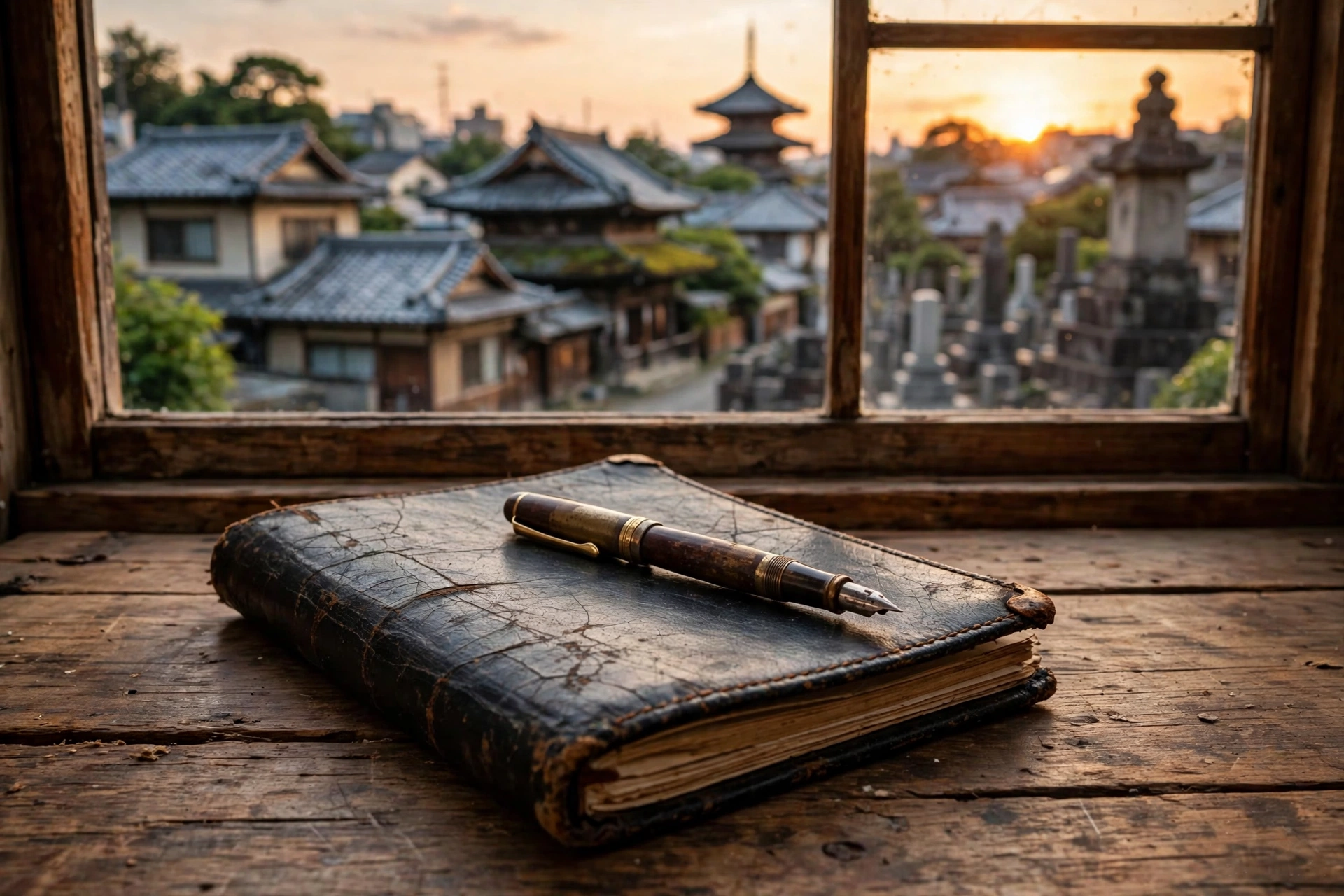
This is episode 16 of the serial novel ‘The Black Leather Notebook【偲記手帳-Sikinote-】.’ This story is one that I (Kurashiki Bouzu) had Moka (Muse), my AI butler, write by handing her, just as it was, a novelist prompt I made long ago for a different AI. It is fiction, but underneath it lies my experience from my funeral-director days. You can read episode 1 here.
Chapter Sixteen: November 8, Near the Scene
November 8, 1995
November 8. The morning in Yanaka had begun to smell of winter. The rows of cherry trees in the cemetery had shed all their leaves, and low morning light fell across the hill lined with stone towers. Each time the office’s glass door opened, the cold air stirred the scent of incense, just a little.
That morning, Meiji Suzuki (57) was sitting, earlier than usual, in the chair in the middle of the office. In his hand was a copy of a letter from Takamine Memorial Hospital. The results of his checkup, a little over a month after his discharge, and his doctor’s words were set out in careful handwriting.
”…It says: ‘For a short time, it is acceptable to go as far as near the scene. However, keep the time spent standing short, and make sure there is a place to sit.’”
Hifumi Yamamoto (50) took the letter and read it again in silence.
“What the doctor allowed is ‘as far as near.’ Not the scene itself.” “I know. …But listen, Hifumi. When a funeral director stops breathing in the smell of the scene and only looks at arrangement sheets, his eyes go dull.” “Chairman.” “Tonight’s wake is a wake at a house in Yanaka. I only need to sit in the car, or on a chair by the entrance. …I won’t attend the departure of the coffin, or the service. Just let me show my face.”
For a long while, Hifumi looked at Meiji. It was the gaze of someone weighing both the words that would stop him and the words that would allow him.
”…Very well. There are conditions. Within one hour. I will prepare the chair. If your color changes even slightly, we go home on the spot. …Even if you resent me, I will stop you.” “Yes. …With conditions of yours, I can break them with peace of mind.” “Chairman.” “I’m joking. I’ll keep them. I promise.”
Meiji smiled faintly. It was an exchange like the continuation of the promise made on October 3, the day of his discharge. The one who stops, and the one who is stopped. That shape had become this company’s new everyday.
Today’s wake house was also one of the houses on the ledger’s circuit. The deceased: Mrs. Toshi Nomura, aged eighty-two. Three days ago, she had passed away quietly at home, they said. Her husband, Mr. Tokujiro Nomura, had died twenty-three years ago. The one who conducted that funeral was Meiji Suzuki, not long after he founded the company.
Mari Kawaguchi (31) placed an old bound record on the desk.
“The record from twenty-three years ago is still here. The handwriting is young—it’s yours, Chairman.” “Show me.”
Meiji took the volume in his hands. It was the record of the funeral of Mr. Tokujiro Nomura, from 1972. The list of attendees, the order of the service, and in a corner, an addition in small handwriting.
“Chief mourner: Akio (35). He kept his hand on his father’s coffin to the very end.”
Meiji traced that one line with his finger.
”…I remember. That son never once took his hand away until the coffin was loaded onto the car. A man of thirty-five, crying with his voice held down.” “That Akio is today’s chief mourner.” “Fifty-eight, is he. …No wonder we grow old.”
Before departure, Meiji had the Nomura family’s arrangement sheet spread out on the desk. His red pencil ran without a pause. But at one place, it stopped.
“The order of the condolence telegrams. Read the one from the printers’ association before the one from the neighborhood association.” “The association, sir?” “Toshi was someone who, even after Tokujiro passed away, helped with the printers’ account books. Her twenty-three years were not only in the kitchen of her house. The people at her workplace knew her ‘afterwards’ better. …The order of the telegrams is the order of that person’s life. Don’t get it wrong.” “Yes, sir.”
Mr. Watarai quietly rewrote the arrangement sheet. Even seated, the Chairman’s eyes were reaching ahead of the scene again today.
In the early afternoon, Mitsuki came to my side carrying a copy of the ledger.
“I’ve met Grandma Nomura several times on the circuit, too. Last winter, she was in bed with a cold, and Father said, ‘That house is a person living alone, so show your face all the more.’ …Whenever I went, Grandma would always bring out pickles for me. ‘Your father is the man who kept his hand on my husband’s coffin to the very end.’ That was her favorite saying.” “At tonight’s wake, the Chairman will meet that son, won’t he?” “Twenty-three years. …A father’s work remains in places like this. Not in documents—in people’s favorite sayings.”
In the afternoon, I, Tabito Kazeno (24), went ahead to the Nomura house with Go Watarai (42) and the others, and advanced the preparations for the wake. The Nomura house was an old wooden house deep in an alley of Yanaka. In the Buddhist altar room, a portrait of Toshi had been placed. It was a photograph with a gentle smile.
The chief mourner, Mr. Akio Nomura (58), was a man who ran a small printing shop. Wearing a mourning jacket over his work clothes, he bowed his head deeply and politely to each of us in turn.
“Mother lived alone in this house for twenty-three years after Father died. …Even after I got a house over in Saitama, she said, ‘This is your father’s house,’ and never left it.” “That sounds like Toshi, the Chairman said as well.” “The Chairman… is he really coming?”
Akio’s voice trembled slightly.
“At my father’s funeral, I was thirty-five. I understood nothing; all I could do was cry. At that time, Mr. Suzuki said to me: ‘Akio. A coffin is heavy. But while you keep your hand on it, it becomes lighter.’ …Because of those words, I was able to keep my hand on it to the very end. Twenty-three years since then. I have never even properly thanked him.”
In the evening, a little before the wake began, the office car stopped in front of the house. Accompanied by Hifumi, Meiji got out slowly. At the entrance, the chair Mari had prepared was placed. Meiji first offered incense in the altar room, and then lowered himself onto the chair. The time spent standing was only a few minutes.
Akio stood before Meiji. A man of fifty-eight, and a man of fifty-seven. Across twenty-three years, the two faced each other.
“Mr. Suzuki. …I am Akio Nomura. Twenty-three years ago, you took care of my father’s funeral.” ”…Akio, is it. I can’t say you’ve grown—you were already a fine son back then.” “Mother has passed away.” “I heard. Toshi—I met her many times on the ledger’s circuit even after Tokujiro. …She was a person who protected this house to the end.” “Mr. Suzuki. Do you remember those words? ‘A coffin is heavy. But while you keep your hand on it, it becomes lighter.’” ”…I said that, did I. Something like that.” “With those words, I was able to send my father off. …Today, I will send my mother. This time too, I will keep my hand on it. I wanted you to be watching, Mr. Suzuki, for the first time in twenty-three years.”
Meiji nodded in silence. His eyes were faintly moist. But he did not cry. With a funeral director’s eyes, he looked straight at the chief mourner’s face.
“Akio. …Today, too, keep your hand on the coffin for her. Your hand should be a far surer hand than it was twenty-three years ago.”
The wake began. The voice of the sutra chanting echoed in the Buddhist room of the old house. From his chair at the entrance, Meiji watched over it. Mr. Watarai’s direction went without a hitch, and Yuma Matsui’s (29) guiding voice carried well. Meiji’s red pencil was not there today. But everyone at the scene felt that his eyes reached into every corner of the wake.
In the line for the incense offering, mixed among the neighbors, were old craftsmen from the printers’ association. All of them wore mourning clothes over their work clothes, and before Toshi’s portrait, they held their hands together for a long time. One old craftsman murmured beside Akio.
“Toshi took great care of us in the accounts office. Even after Tokujiro passed away, her handwriting protected the association’s ledgers.” “Mother wasn’t only a person of the house, was she.” “The person in the coffin you kept your hand on, Akio—that person went on living properly, and working, after that. …Today, it is her turn.”
Akio nodded in silence. At the end of the wake, after the attendees had gone home, Akio remained alone before the coffin. And quietly, he placed his hand on the coffin. From his chair at the entrance, Meiji watched that figure intently. The hand of the thirty-five-year-old of twenty-three years ago, and the hand of today’s fifty-eight-year-old, seemed to overlap on the same coffin.
As the hour drew near, Hifumi stood quietly at Meiji’s side.
“Chairman. It is the promised time.” ”…Yes.”
Meiji rose slowly. As he left, he bowed deeply toward the altar room. Akio came out to the entrance to see him off.
“Mr. Suzuki. …Thank you for coming.” “Akio. Our company will take care of Toshi to the very end. …You just think about keeping your hand on it tomorrow.” “Yes. …Yes.”
In the car, Meiji kept his eyes closed for a while. On the way back to the office, he murmured.
“Tabito. …The work of a funeral director doesn’t end in one generation. We send off the wife of a man we sent off twenty-three years ago. That son is now the chief mourner. …Sometimes, the relationship lasts longer than a person’s life.” “Yes.” “That is why we leave records. Why we keep showing our faces. …The accumulation of plain things bears fruit on a day like today, twenty-three years later.”
When we returned to the office, Mitsuki Suzuki (24) was standing there holding a teacup.
“Father. …Your color looks all right.” “Yes. …Hifumi had a rope around my neck.” “That’s fine. …You kept your promise, after all.”
Meiji took the teacup and lowered himself into his chair. His back looked, just a little, straighter than it had in the morning.
Shuzo Noda (60) said quietly to me as I was leaving.
“The Chairman is a man who can make a scene even without standing at it. …But to be able to sit in the middle of a reunion like today’s—only a man who has kept showing his face for twenty-seven years can do that. That is work that cannot be written on an arrangement sheet.”
I nodded. The arrangements of a funeral—someone else can make those in your place. But the time that flows between two people facing each other again after twenty-three years—no one can make that in another’s place. It was a post that only a human being who had built it up, house by house, person by person, over the years could hold.
That night, at my lodgings, I opened the black leather notebook. I wrote down the small handwriting in the corner of the record from twenty-three years ago, and the face of the fifty-eight-year-old chief mourner who had promised, today, to keep his hand on the coffin.
Today, I was present on the day Meiji Suzuki returned, for a short time only, to near the scene. The Chairman sat in his chair and did nothing. But by that very “being there,” the reunion after twenty-three years supported the chief mourner’s back. I learned that the fruit of the work of sending off ripens beyond ten, twenty years of time. —November 8, 1995.
Serial Novel ‘The Black Leather Notebook【偲記手帳-Sikinote-】’
- Previous episode: Episode 15, “October 26, The Key to the Vacant House”
- Next episode: Episode 17, “November 17, On the Same Table”
- November 23, 2026 ― Draft created (based on the Japanese edition, ledger No. 3446. English edition of episode 16 of the serial novel 'The Black Leather Notebook')(9,546 characters)
- November 23, 2026 ― Published (by the user's publication decision, 2026-11-23; all 9 languages at once. The end of the address carries the Japanese edition's ledger number, No. 3446)(9,546 characters)