
Serial Novel 'The Black Leather Notebook【偲記手帳-Sikinote-】' Episode 15 — October 26, The Key to the Vacant House
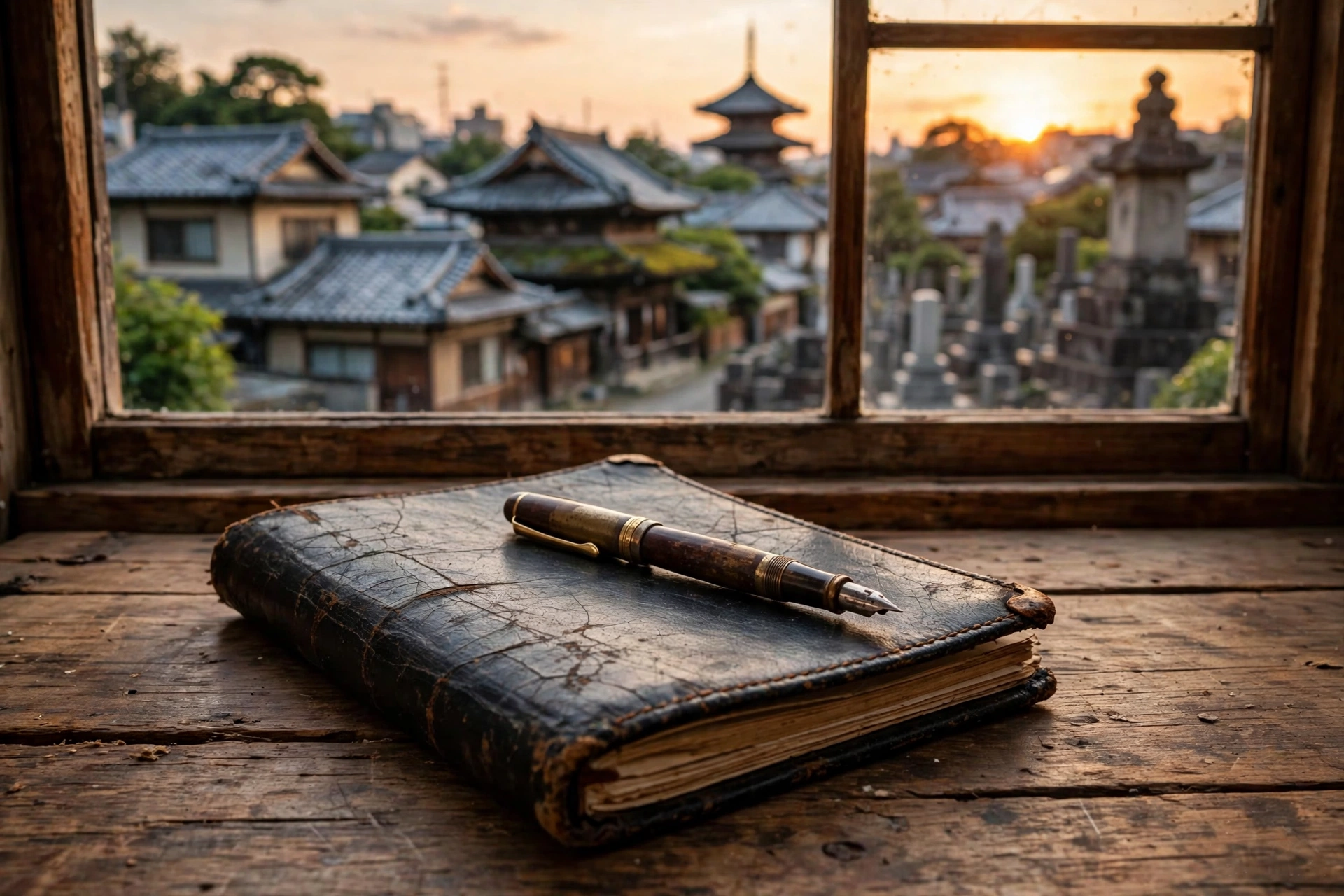
This is episode 15 of the serial novel ‘The Black Leather Notebook【偲記手帳-Sikinote-】.’ This story is one that I (Kurashiki Bouzu) had Moka (Muse), my AI butler, write by handing her, just as it was, a novelist prompt I made long ago for a different AI. It is fiction, but underneath it lies my experience from my funeral-director days. You can read episode 1 here.
Chapter Fifteen: October 26, The Key to the Vacant House
October 26, 1995
October 26. Autumn was deepening. On the streets of Yanaka, the scent of fragrant olive drifted in the cold morning air. The rows of cherry trees in the cemetery had shed half their leaves, and the hill lined with gravestones was quiet, as if beginning its preparations for winter.
My post today, I, Tabito Kazeno (24), was the circuit of houses in the ledger entrusted to me. The houses with death anniversaries in October were many, following on from September.
In the morning, before I left the office, Meiji was checking the October pages of the ledger with his red pencil.
“The Haneda house today is one of the houses I stayed with to the very end last autumn. … Give my regards to the son. Tell him, ‘The chairman is sitting in his chair, looking at the ledger.’” “Yes.” “The circuit is not just going to offer incense, you know. It is work to go and hear each house’s ‘afterwards.’ … Go with your ears open.”
Mari Kawaguchi (31) added, to the parcel of incense and candles, a parcel of tea for today’s houses.
“A house on a death anniversary spends that whole day thinking of the departed. Your face comes into the middle of that day. … Go with a good face on you.”
One of those houses was a house whose death anniversary fell today, October 26.
The departed: Mrs. Toshiko Haneda. Died in 1994, at the age of eighty. In the column for that house in the ledger, in Meiji’s hand, this had been added:
“Eldest son, Kazuhiko, in Saitama. The house is becoming vacant.”
The Haneda house was a small wooden house at the edge of Yanaka. Last autumn, Mrs. Toshiko had died in this house, and Meiji Funeral Home had conducted the funeral. Her only son, Mr. Kazuhiko Haneda (55), had a house of his own in Saitama, and there had been talk of bringing his mother to live with him, but Mrs. Toshiko had said, “I want to die in this house,” and, it was said, never left this house to the end. After the funeral, the house became vacant. Mr. Kazuhiko had been coming back once a month to look in on it.
Today, Mr. Kazuhiko had come from Saitama as well. At the entrance, I bowed deeply.
“Chairman Suzuki—” “He has left hospital. Now he is doing his work seated, at the office. Today, I have come in his place.” “I see. … The chairman truly looked after us at my mother’s funeral. He said then, ‘I will show my face on the death anniversary.’ I never thought he really would come. And after a year, that even the person in his place would come…”
Mr. Kazuhiko inserted into the keyhole the key to the entrance, opened for the first time in a year. With a small creak, the door opened. A year’s worth of shut-in air flowed quietly out. It was the smell of dust, of tatami, and of a faint remaining trace of incense.
Inside, the house was just as it had been when Mrs. Toshiko lived there. A tea cabinet, a sewing box left with its sewing unfinished, and the calendar on the wall, stopped at last October. Mr. Kazuhiko opened the windows one by one, letting the wind through the house.
“A vacant house, you see, Mr. Kazeno—if you don’t let the wind through, it deteriorates quickly. … Since my mother died, I have come back every month, opened the windows, offered incense at the Buddhist altar, and gone home having done just that. For a year, that is what I have done.”
Before the Buddhist altar, we offered incense. Mrs. Toshiko’s portrait was smiling gently.
Mrs. Toshiko, it was said, had from her young days pickled pickles in this town and handed them out around the neighborhood. In the corner of the kitchen, a large pickle crock and its weight still remained even now.
“My mother’s pickles were, you know, the taste of this street. When winter came, from every house came the call, ‘Mrs. Haneda, the daikon radishes are ready,’ and Mother would go around carrying the crock. … The first winter after Mother died. A neighbor said, ‘This year is a winter without Mrs. Haneda’s pickles.’”
Just then, the entrance door was tapped softly. An old woman from next door stood there, holding a bunch of flowers.
“Kazuhiko, I thought you would be here. … It is Toshiko’s death anniversary, isn’t it? I brought chrysanthemums from our garden.” “Auntie. … Thank you.” “Everyone knows that you come every month to open the windows. Even if it is vacant, that house is still a house of this street.”
The old woman offered the flowers at the Buddhist altar, pressed her palms together for a long time, and went home. Watching her back as she left, Mr. Kazuhiko murmured:
”…That is the kind of house this is. In numbers, it is just an old wooden house. But on this street, it is still ‘Toshiko’s house.’”
Amid the thin rising smoke of the incense, Mr. Kazuhiko began to speak, little by little.
“Actually, Mr. Kazeno. There is something I want to consult you about. What to do with this house.” “With the house.” “I am fifty-five now, too. Looking after two houses, the one in Saitama and this one, has honestly begun to take its toll on my body. And yet, when it comes to selling… My mother lived in this house for sixty years. The neighbors still call it ‘Mrs. Haneda’s house.’ The moment I speak to a real estate agent, it becomes just a ‘property,’ measured in numbers—and that is somehow too painful.” “Mr. Kazuhiko.” “I wanted someone from the company that held my mother’s funeral to hear me. … What should be done with this house, I wonder.”
I could not answer at once. It was a consultation that went beyond the scope of a funeral home’s work. But I also thought that being brought such a ‘beyond-scope consultation’ was itself the meaning of this company’s ledger circuit. Because it is work to go and hear how the houses we have sent off are living on afterwards.
”…Mr. Kazuhiko. Today, I cannot take an answer home with me. But just one thing. The man who succeeded the real estate company that our chairman founded in his young days still runs a land company here in Yanaka. He is a man who ‘looks at the person, and looks at the land.’ I think such a man would look at this house first as a house, before the numbers. … May I pass your story on to him?” ”…Is there really such a person?” “His name is Nobutaka Nishioka. He has known the chairman for nearly thirty years.” “Then, may I ask you? … If he is someone who will say ‘house’ before he says ‘property’ of my mother’s house.”
Back at the office, I reported the Haneda family’s consultation to Hifumi Yamamoto (50) and Meiji Suzuki (57). Meiji listened with his eyes closed.
”…Pass it to Nishioka. That man will go and look at the house first. The numbers come after.” “Yes.” “Tabito. A funeral director receiving a real estate consultation—that is not crossing a border. … People’s living begins with a house, and ends with a house. This town needs someone who has seen both.”
That evening, Nobutaka Nishioka (53) stopped by the office to report on how Mrs. Sumiko’s matter was progressing. I told him the Haneda family’s story, making clear that I had Mr. Kazuhiko’s consent. Nishioka received the copy of the floor plan of the house that I had brought with both hands, carefully. It was that gesture of his, as if offering something at a Buddhist altar.
”…Haneda, is it? That house at the edge of Yanaka.” “You know it?” “It is not under our management, but I have the street’s houses more or less in my head. … Kazeno, let me say one thing. I have no intention of using this house as a substitute offering for Mrs. Sumiko’s redevelopment.” “I understand.” “Mr. Haneda has Mr. Haneda’s own future. First, I will hear that future. I will look at the house. … And on that basis, the talk may be different. I may be able to show the developers who want the land around there that ‘there is a way to bring it together without driving anyone out.’ That could become material for negotiations to protect Mrs. Sumiko. But do not get the order wrong. People come first. Negotiations come after.”
Nishioka’s words were slow, and had a core to them. From his chair, Meiji spoke.
“Nishioka. You really are on your way to becoming a ‘demon of compassion,’ aren’t you?” ”…When you say it, Meiji, I am at a loss.”
Unusually, Nishioka lowered his eyes, as if embarrassed. In that profile, I felt I saw layered the figure of the young man who, thirty years ago, had received Meiji Suzuki’s tutelage.
Nishioka made an appointment to visit the Haneda house next week, and went home. The copy of the floor plan he took home in an envelope, held in both hands.
Meiji, who remained at the office, called to me as I was leaving.
“Tabito. You spent four years selling houses, and then came here.” “Yes.” “I, too, was once a man who sold houses. … The work of selling houses is work that stands witness at the beginning of people’s living. A funeral stands witness at the end of that living. The beginning and the end. … In that both are work that stands at a turning point, they are the same.” “Chairman.” “Your four years were not wasted. The reason Mr. Haneda’s son consulted you about the house today is that you hold both kinds of words. … The word ‘property,’ and the word ‘house’—both of them.”
I had no words. These were the words of the man who, on my first day, had said, “Your eyes are not yet the eyes of a person. They are eyes that look at properties.” I had thought I was being told to throw those eyes away. But that was not it. It was to layer the eyes of a person over the eyes that look at properties—that, today, I understood for the first time.
At night, as I put together the day’s report at the office, I thought. On August 2, I returned the key of Akada Real Estate to the president’s desk. It was the last key of my house-selling work. Nearly three months since that day. Today, there is no key itself in my hand. But a story of being entrusted with the ‘from now on’ of one vacant house was certainly in my hand. A key, perhaps, is something that passes from person to person even when it is not shaped out of metal.
As he left, Mr. Kazuhiko, locking the entrance key, said quietly:
“I will come again next month. … This house’s key—I want to keep holding it myself, just a little longer.”
The sound of that key resembled, somehow, the sound of the key I returned in August. The day of letting go is decided by the person’s side. Until that day, to keep holding it, too, was part of sending off.
That night, at my lodgings, I opened the black leather notebook. I wrote down the vacant house with the wind passing through it, the calendar stopped in place, and the words, “If he is someone who will say ‘house’ before he says ‘property’.”
Today, on the ledger’s circuit, I visited a house that had become vacant. The house of a person we had sent off was, even after the sending off, quietly continuing its questions amid the living of those left behind. And that question was handed on to a man of real estate, who looks at people’s futures. My four years of real estate days, today, quietly joined hands with the work of funerals, deep in an alley of Yanaka. —October 26, 1995.
Serial Novel ‘The Black Leather Notebook【偲記手帳-Sikinote-】’
- Previous episode: Episode 14, “October 16, A Consultation About Her Own Funeral”
- Next episode: Episode 16, “November 8, Near the Scene”
- November 23, 2026 ― Draft created (based on the Japanese edition, ledger No. 3437. English edition of episode 15 of the serial novel 'The Black Leather Notebook')(9,493 characters)
- November 23, 2026 ― Published (by the user's publication decision, 2026-11-23; all 9 languages at once. The end of the address carries the Japanese edition's ledger number, No. 3437)(9,493 characters)
- November 23, 2026 ― Updated (added the guide to episode 16)(9,493 characters)