
Serial Novel 'The Black Leather Notebook【偲記手帳-Sikinote-】' Episode 14 — October 16, A Consultation About Her Own Funeral
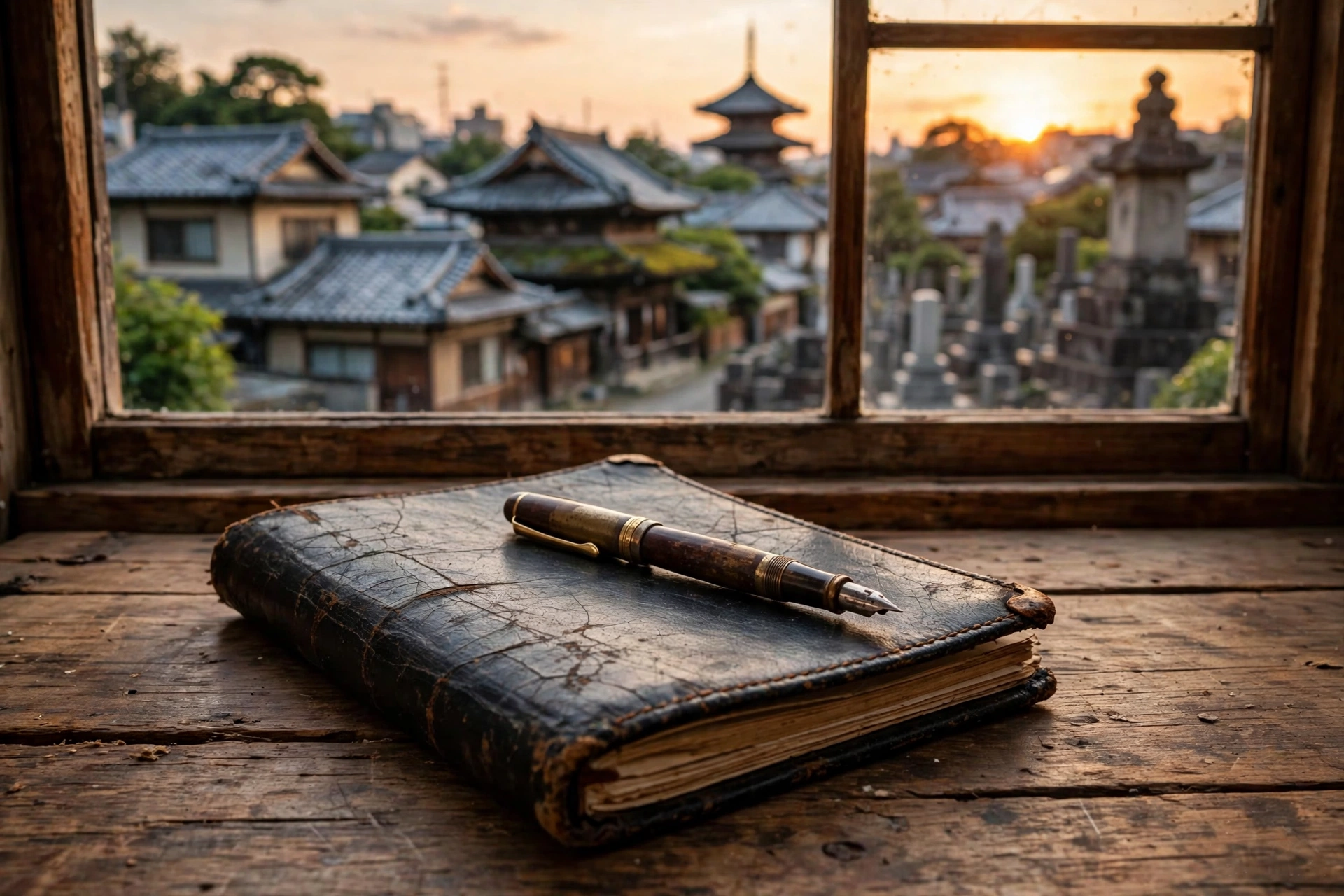
This is episode 14 of the serial novel ‘The Black Leather Notebook【偲記手帳-Sikinote-】.’ This story is one that I (Kurashiki Bouzu) had Moka (Muse), my AI butler, write by handing her, just as it was, a novelist prompt I made long ago for a different AI. It is fiction, but underneath it lies my experience from my funeral-director days. You can read episode 1 here.
Chapter Fourteen: October 16, A Consultation About Her Own Funeral
October 16, 1995
October 16. The sky over Yanaka had been clear since morning. Two weeks after leaving hospital. Meiji Suzuki (57) was growing used, little by little, to his days seated in the chair in the middle of the office. Every morning, Meiji’s red pencil went into the schedule board. He was not yet allowed to go out to the field. But by the mere fact that the chairman was in the middle of the company’s work, the air of the office was different from the days of his hospital stay.
That afternoon, Mrs. Sumiko Fujii (78), accompanied by Nobutaka Nishioka (53), visited the office.
During the morning, Mitsuki Suzuki (24) had brought out from the warehouse shelves one old bound record. It was the record of the funeral of Mr. Kikuo Fujii (aged 74 at death), six years ago. The order of the service, the list of mourners, and even the order for the altar flowers remained in meticulous handwriting.
“At our place, you see, even after a funeral is over, we don’t throw the records away. Because our connection with that house continues.” “So the record from six years ago remains, just as it was.” “It’s Father’s rule. ‘A funeral is one day, a connection is a lifetime.’ …Today’s consultation, too, will surely become a continuation of this bound volume.”
Miss Mitsuki placed the bound volume on the reception table. Beside the record of the man sent off six years ago, a seat was being prepared for the person who would decide things today. In that sight, I felt I saw the way time flows in this company.
Mrs. Sumiko, on her small frame, wore a neat navy outing outfit. Her white hair was tied behind, and her back was straight. Without borrowing the hand Nishioka offered, she opened the glass door with her own feet. The bell rang, chirin.
“Excuse me. …I am Sumiko Fujii. Today, I have come to consult about my funeral.”
Her voice carried well. Mari Kawaguchi (31) guided her to a reception seat, and Mrs. Akemi Suzuki (55) brought tea. Meiji began to rise from his chair, was stopped by the eyes of Go Watarai (42), and, remaining seated, bowed his head deeply.
“Mrs. Sumiko. Thank you for coming. …It has been since your husband Kikuo’s time, hasn’t it.” “Chairman. You have grown thin, too.” “That makes two of us.” “Hehe. …Today, you see, Chairman. I heard the talk from Mr. Nishioka, and I made up my mind and came. I want to decide my funeral myself, while I am still well.”
Mrs. Sumiko, keeping the furoshiki bundle she had brought on her lap, looked straight at Meiji.
“Six years since my husband died. At that funeral, you, Chairman, did everything. I could only cry, and I could decide nothing. …But, you see, because that funeral was there, I think I have been able to live alone these six years. It was then that I first learned that being sent off can be such a support for those left behind.” “Mrs. Sumiko.” “Now it is my turn. I have no children. The only relative I can rely on is my niece Mayumi (49) in Chiba. I don’t want to trouble that child. …And besides, what I cannot bear is that, when I die alone, I might be left for days without anyone noticing. I want to be properly sent off, in the house where my husband waits. That is my wish.”
Meiji nodded in silence. I, Tabito Kazeno (24), in the seat beside him, wrote down Mrs. Sumiko’s words, one character at a time, on the pre-need consultation record form Mari had prepared. It was a different paper from a real-estate contract. It was a paper with a column for “wishes” before the column for amounts.
“I understand. …Let me hear them, one by one. First, the service — how do you want it?” “Small is fine. At my house. Please place my husband’s photograph beside me. For the flowers, I would like not only white chrysanthemums, but seasonal flowers from my husband’s garden plants put in, too. …And, into the coffin, please put the garden shears my husband used. Though he was a man who would not even let me touch those shears, you know.”
Mrs. Sumiko laughed. Within that laugh were six years of living.
“For the temple, the same as my husband’s funeral, Renzui-ji. I would like Chief Priest Kashiwagi (58) to chant the sutras. …As for the cost, I have consulted Mr. Nishioka as well, and I have prepared it little by little. I don’t want my death to leave a debt to anyone.”
Mrs. Sumiko took a small notebook from her furoshiki bundle. In it, in Mrs. Sumiko’s own hand, her wishes were written down meticulously. That after her death, the Buddhist altar and the memorial tablet should be moved to Mayumi’s house in Chiba. That the neighbors should be told quietly, after the service was fine. That the garden plants should be left without being cut down.
“If I don’t write it down, I won’t be able to say it from my own mouth anymore. …What I can say while I am alive, I want to say it all while I am alive.”
The handwriting in that notebook resembled, somehow, the handwriting in Meiji’s notebook. It was meticulous handwriting, as if checking each character one by one. Perhaps people who leave promises on paper all write in a similar hand.
Meiji nodded to each one, and sometimes checked briefly.
“Notifications — to whom?” “To Mayumi, and then, to Mr. Nishioka. …Because there is the matter of the house with Mr. Nishioka, too.” “Understood. …Mrs. Sumiko, may I ask one thing from my side, too?” “Yes.” “Why do you want to decide your own funeral so carefully like this? …Are you not afraid?”
Mrs. Sumiko looked for a while at the street outside the window.
“I am afraid. Dying is frightening. …But, you see, Chairman. What is not decided is even more frightening. If I decide, afterwards I can devote myself to living. After my husband died, I learned that. …To decide is not to give up. It is to make the remaining time my own.”
The office grew quiet. Meiji lowered his eyes, and at last said quietly:
”…I understand. Mrs. Sumiko. Our place will do your funeral. I promise. So that you can meet your end in that house, our place will watch over you.” “Chairman.” “But there is a condition.” ”…What might it be?” “Don’t die before me. …I am now a person under a promise to get better. To take on another person’s promise, first I must fulfill my own. So you, too, live long. That is the condition.”
Mrs. Sumiko blinked for a moment, and then laughed aloud.
“Hehehe. Chairman, you haven’t changed. …I understand. I promise. I will not die before you.”
Mrs. Akemi, who had brought the tea, saw that sight and smiled faintly. Mrs. Sumiko, looking at Mrs. Akemi’s hands, said softly:
“Mrs. Akemi. You, too, are a person who puts your own things last. It shows on your face.” ”…Mrs. Sumiko.” “Both those who send off and those who are sent off tend to put their own promises last. …You, too, make a proper promise. That you will not collapse.” “Yes. …Thank you.”
Mrs. Akemi bowed her head quietly. I felt the distinction between those who send off and those who are sent off dissolving, little by little, at this reception seat. Everyone is, someday, a person who will be sent off, and until that day, a person who sends someone off.
After the consultation ended, Meiji said to me softly:
“Tabito. When I began this work, you know. There was a client who had died alone in an apartment and was found only after a long time. There was no one to send him off. We could not even hold anything like a proper funeral. …At that time I thought: preparation to be sent off can only be done while one is alive.” “That is why the pre-need consultations.” “Yes. I think people like Mrs. Sumiko will increase. People who live alone and die alone. …Work in which a funeral man answers those people’s ‘future’ will be needed from now on.”
On his way out, Nobutaka Nishioka (53), at the office doorway, said to me in a small voice:
“Mr. Kazeno. I am glad I was allowed to sit in on today’s consultation, too. …If I had only talked about land, Mrs. Sumiko’s ‘future’ would not have come onto the desk.” “Mr. Nishioka.” “The redevelopment talk is not over yet. But today I understood one thing. That house is not mere land. It is that person’s remaining time itself. …The one who had misplaced the numbers may have been me.”
Nishioka walked slowly down the street, matching Mrs. Sumiko’s pace. Watching the two of them from behind, I thought: the work of real estate was work that makes the entrance to a person’s living. The work of funerals is work that guards its exit. And today’s consultation was a day when that entrance and exit joined hands on one desk.
In the evening, Meiji stopped me as I was about to make a fair copy of the consultation record.
“Tabito. Show me that record.” “Yes.”
Meiji ran his eyes over the record form and drew a line with his red pencil at one place. It was the place where I had written “to place the deceased’s garden shears in the coffin.”
“Here, you see, write it in the person’s own words. ‘Please put the garden shears my husband used.’ …The moment you change it into our words, the person’s own voice disappears. A pre-need consultation record, you see, is a record of the person’s voice. Those who read it back after death are those left behind. What reaches them is the person’s own words.” “Yes. …I will correct it.” “One who records is not one who writes. He is one who keeps something in trust. …Your notebook is the same, you know.”
I nodded and rewrote the record. Only the sound of the pen running echoed in the evening office.
Then Mari bound the pre-need consultation record into one file.
“Kazeno. From now on, this file, too, is one of your posts. If the ledger’s circuit is ‘promises after sending off,’ this one is ‘promises before sending off.’” “‘Promises before sending off’…” “Both are talks about a person’s future. …Their weight is the same.”
That night, at my lodgings, I opened the black leather notebook. I wrote down Mrs. Sumiko’s straight back, and her words, “To decide is not to give up.”
Today, I sat in for the first time on a pre-need consultation. To decide how one will be sent off was to make the remaining time one’s own. Meiji Suzuki, while seated in his chair, exchanged a promise with one person’s future. The work of sending off is not only for after death. Its root was in living time itself. —October 16, 1995.
Serial Novel ‘The Black Leather Notebook【偲記手帳-Sikinote-】’
- Previous episode: Episode 13, “October 3, The Day of Discharge”
- Next episode: Episode 15, “October 26, The Key to the Vacant House”
- November 23, 2026 ― Draft created (based on the Japanese edition, ledger No. 3428. English edition of episode 14 of the serial novel 'The Black Leather Notebook')(8,884 characters)
- November 23, 2026 ― Published (by the user's publication decision, 2026-11-23; all 9 languages at once. The end of the address carries the Japanese edition's ledger number, No. 3428)(8,884 characters)