
Serial Novel 'The Black Leather Notebook【偲記手帳-Sikinote-】' Episode 13 — October 3, The Day of Discharge
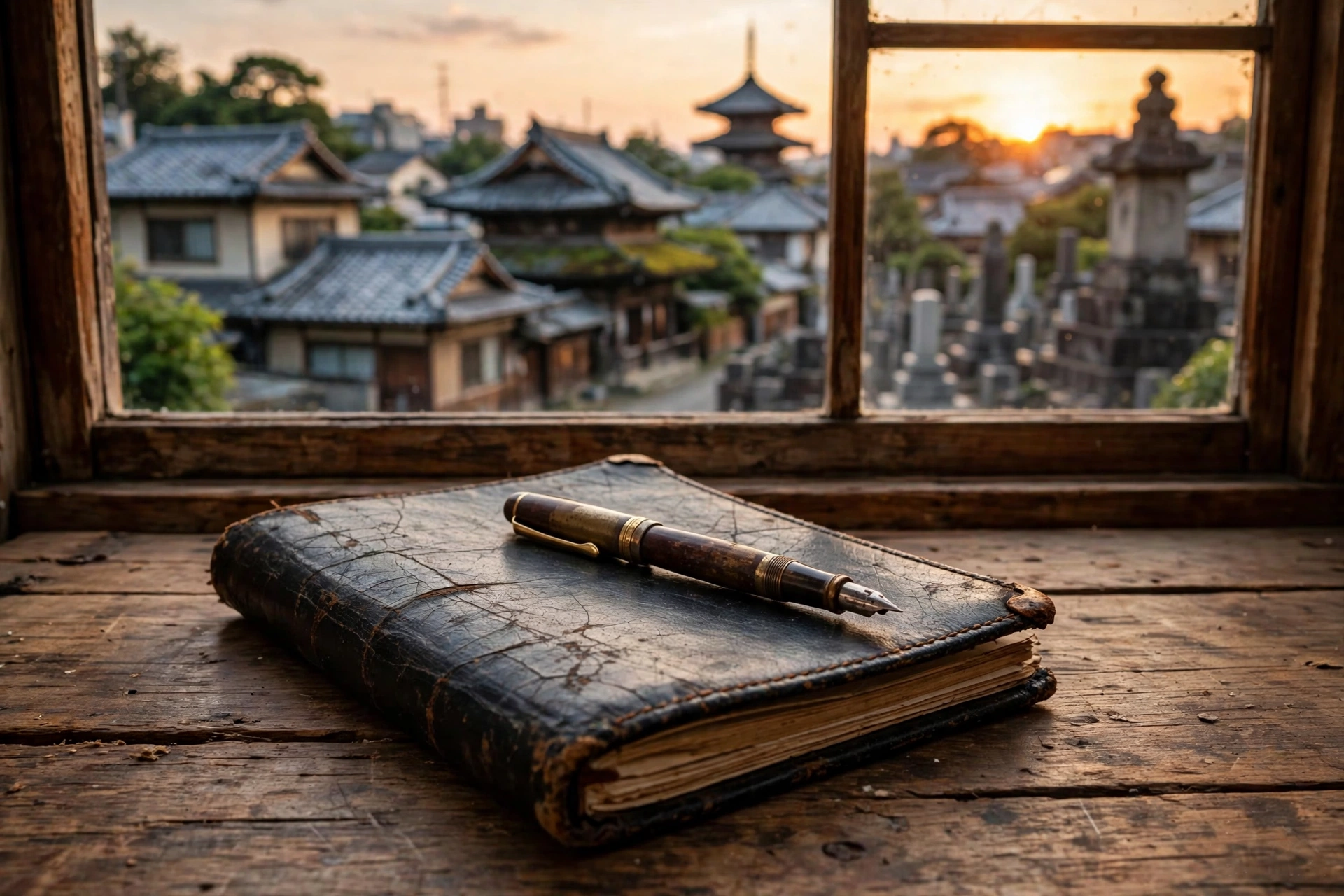
This is episode 13 of the serial novel ‘The Black Leather Notebook【偲記手帳-Sikinote-】.’ This story is one that I (Kurashiki Bouzu) had Moka (Muse), my AI butler, write by handing her, just as it was, a novelist prompt I made long ago for a different AI. It is fiction, but underneath it lies my experience from my funeral-director days. You can read episode 1 here.
Chapter Thirteen: October 3, The Day of Discharge
October 3, 1995
October 3. It was the day Meiji Suzuki (57) was to leave hospital. Yanaka in the morning was clear, as if September’s lingering heat had been a lie. The leaves of the row of cherry trees at the cemetery were beginning to change color, and the steps of the people visiting graves were somehow more unhurried than around Higan. The season had indeed moved into autumn.
At the office of Meiji Funeral Home, everyone had been moving since morning in a somehow restless way. Mari Kawaguchi (31) was straightening the papers on the chairman’s desk more carefully than usual. Kano Miyoshi (23) had washed the teacups again, and Shuzo Noda (60) was silently brushing the dust from the chairman’s chair. No one said it aloud. But everyone in this office had been waiting for this day.
Ichiji Yamamoto (50) said briefly at the morning meeting:
“Today, the chairman comes back. …But let me tell you all. The chairman has not recovered. He has only been discharged.” “Yes, sir.” “The doctor’s orders are clear. For a while, seated work only. We do not let him go out to the field. …That man will certainly try to go. When he does, we stop him. Even if he resents us, we stop him. That is, from today, another of our jobs.”
Go Watarai (42) continued quietly:
“We have placed the chairman’s chair in the middle of the office. The schedule board and the copies of the ledger are all gathered around it. …Things about the field have been arranged so that he can decide them while seated.” “Mr. Watarai.” “If his body cannot move, that man will run the field with his eyes and his mouth. Then we should make, in advance, a shape in which he can run it. I think that is the courtesy of those who stop him.”
I, Tabito Kazeno (24), nodded at those words. Merely stopping him would not stop this man. Prepare an alternative post for him, and have him sit there. The people of this company knew the chairman’s nature better than anyone.
Before noon, a car stopped in front of the office. Accompanied by Mrs. Akemi Suzuki (55), Meiji got out. His black suit looked even larger than before he went into hospital. His cheeks were hollow and his steps small. But it was Meiji himself who opened the glass door with his own feet and rang the bell.
”…I’m home.”
Everyone in the office stood and bowed their heads. Miss Kano, unable to hold back, sniffed quietly, and Kohei Murase (36) looked up at the ceiling. Mitsuki Suzuki (24) looked straight at her father’s thinned figure and stood with her lips pressed together. I saw tears gathering in her eyes. But she did not cry. As one who had protected the place her father would come home to, she would welcome him with a smile — so the straightness of her back said.
“Mitsuki.” “Father. …Welcome home.” “Ah. …How was the shop?” “Without a hitch. …We all protected it.”
Meiji looked slowly around the office. His own desk. His chair. The schedule board on the wall. His eyes were as if checking each one.
”…Not a bad view.”
Just then, the office telephone rang, and before long a funeral request came in from a nearby house. It was a departure of the coffin that afternoon. Meiji suddenly raised the body he had been about to lower into his chair.
“I’ll go too. Even if only to show my face.” “Chairman.”
Mr. Ichiji stood quietly in his way.
“Today is a day for sitting.” “Ichiji. I have been discharged.” “You have been discharged. You have not recovered. …The doctor’s orders are said to be seated work only.” “Are you the doctor’s messenger now, too?”
A stern light returned to Meiji’s eyes. The air of the office grew tense. But Mr. Ichiji did not yield a single step.
“Chairman. On August 18, you made a promise here. ‘I will get better, and I will come back.’ …Coming back does not mean standing here today. It means being in the middle of this shop for decades to come. If you push yourself today and collapse, who will keep that promise?”
There was a long silence. Meiji looked up at Mr. Ichiji, and then slowly lowered himself into his chair.
”…When did you learn to talk like that?” “I was raised by you, Chairman.”
Meiji laughed quietly through his nose. There was no anger in that laugh.
“Very well. Today I will sit. …But let every arrangement pass before my eyes. The time of the coffin’s departure, and the order of the cars, too.” “Understood.”
Mr. Watarai carried the program to the chairman’s desk. Meiji put on his reading glasses and took up a red pencil. From that day, the chair in the middle of the office became Meiji’s new post.
Before long, Meiji’s red pencil stopped at one point on the program.
“Watarai. The order of the condolence telegrams is wrong. The neighborhood association chairman’s telegram does not come after the shopping district association’s. It comes before.” ”…I will check.” “That house, you see, was helped by the neighborhood association first. If we get the order wrong, a thorn will remain in their hearts. …Even a man whose body cannot move can keep his eyes at the field. That is what this means.”
Mr. Watarai took the program and bowed his head deeply. His was not the face of a man who had been scolded. It was the face of a man who had had something checked for him. Running the field while seated. From the first day, that shape was certainly working.
At the departure of the coffin, Meiji walked only as far as the office doorway and saw the coffin off. The back standing in the doorway was still thin. But his eyes alone were the eyes of the field. Beside me, Mr. Noda said quietly:
”…That man, you know, is a funeral man even when he is sitting.”
Past three in the afternoon, a visitor came to the office.
Nobutaka Nishioka (53). The representative director and president of Nishioka Real Estate Co., Ltd. It was originally Suzuki Meiji Real Estate. When Meiji, at thirty, advanced into the world of funerals, this was the man who had taken over that real estate company, changed its name, and protected it ever since. A solid build, in a plain dark-blue suit. Contrary to his somewhat grown stubble, there was not a single wrinkle in his suit. He held the package he carried carefully in both hands, and placed it on the counter with a gesture as if offering it at a Buddhist altar.
“Mr. Meiji. I heard you were discharged. …I came to see your face.” “Nishioka. You came all this way.” “You’ve grown thin.” “You’ve grown old, too.”
Their greetings were only that. But within that brevity, nearly thirty years were sunk. Mrs. Akemi brought tea, and Nishioka received it with a deep bow.
“Actually, Mr. Meiji. It is not only a visit. …I came with a consultation.”
Nishioka, holding his teacup in both hands, was silent for a while. It was the silence of a man choosing his words.
“There is a house we manage. An old single house in Yanaka. A lady named Mrs. Sumiko Fujii (78) lives there alone. Her husband, Mr. Kikuo, died six years ago. That funeral should have been held at your place.” ”…Mrs. Fujii, is it. I remember. Kikuo was a gardener, wasn’t he.” “That’s right. Around that house, you see, a redevelopment project is now becoming the talk. The developer wants to buy up the land together. Our salesman Hikawa (46) is a man of numbers. ‘We should advance the talks while the terms are good,’ he says, every day. …But Mrs. Sumiko has no intention of leaving that house.”
Nishioka lowered his eyes.
“Last month, Mrs. Sumiko said to me: ‘Mr. Nishioka. I want to die in this house. Because this is the only house my husband comes home to. …But there is just one thing I worry about. If I die alone, who will send me off?’”
The office fell quiet. Meiji set down his teacup.
“So, before coming to my place today, your face came to mind. …The only one who can answer that person’s ‘worry’ is a funeral man. And moreover, I thought it had to be your place, which sent off her husband.” “Nishioka.” “Mr. Meiji. There are words you taught me. ‘Land has a past. People have a future.’ …I have made that my creed. But I will say it honestly. I am now caught between. To protect the company, numbers are needed. But numbers made by driving Mrs. Sumiko out go against my creed. …I could not become a ‘demon of human feeling’ like you.”
Nishioka’s voice was low and slow. No emotion showed on his face. But the teacup he held in both hands was trembling faintly.
Meiji looked at Nishioka for a while. At last, he said quietly:
“Nishioka. It is not that you could not become one. …You are trying to become one, and worrying over it. That is enough. A man who does not worry feels no pain at all in driving people out.” “Mr. Meiji.” “Mrs. Sumiko’s worry is a pre-need consultation about a funeral. A consultation to decide, while she is alive, how she will be sent off. …We will take it at our place. It is a talk about that person’s future. It is work true to your creed.” “But you are still—” “I will sit and listen. Then even the doctor will have no complaint. …Can Mrs. Sumiko come to the office? If she cannot come, I will send Tabito and Mitsuki ahead.”
Nishioka bowed his head deeply.
“Thank you. …I will speak to Mrs. Sumiko myself. She will surely be glad.” “Nishioka. One more thing.” “What is it.” “Do not deny the numbers Hikawa speaks of out of hand. Protecting a company is also people’s work. …What matters is not whether you drive out or protect. It is whether you can place that person’s ‘future’ on the desk together.”
On his way out, Nishioka turned back at the office doorway. And he looked at me.
“Are you Kazeno? I have heard of you from Mr. Meiji. ‘A strange young man, but a precious funeral man,’ he said.” ”…Y-yes. I am Tabito Kazeno.” “I am Nobutaka Nishioka. …To look at people, and to look at land. That is my saying, you see. Today I came to look at a person, and I was right.”
After Nishioka left, Meiji looked for a while at the Yanaka street outside the window.
“Tabito. A pre-need consultation, you see, is the work, among funeral work, that faces the most living person. …What cannot be asked of the person after they die can all be asked while they are alive.” “Yes.” “When Mrs. Sumiko comes, you sit in, too. …Make yourself ears that can hear a person’s ‘future.’”
That night, at my lodgings, I opened the black leather notebook. I wrote down the thinned back of the man who had left hospital, the eyes that saw the coffin off at the doorway, and the consultation about one old woman’s “future,” brought in by a man of nearly thirty years’ acquaintance.
Today, Meiji Suzuki left hospital and returned to the office. The chairman could not go out to the field. But, while seated, he received an old friend’s consultation and nodded at a talk about a person’s future. I learned that the work of sending off does not begin only from the side of death. It also begins from the worries of a living person. —October 3, 1995.
Serial Novel ‘The Black Leather Notebook【偲記手帳-Sikinote-】’
- Previous episode: Episode 12, “September 23, The Middle Day of Higan”
- Next episode: Episode 14, “October 16, A Consultation About Her Own Funeral”
- November 23, 2026 ― Draft created (based on the Japanese edition, ledger No. 3419. English edition of episode 13 of the serial novel 'The Black Leather Notebook')(9,354 characters)
- November 23, 2026 ― Published (by the user's publication decision, 2026-11-23; all 9 languages at once. The end of the address carries the Japanese edition's ledger number, No. 3419)(9,354 characters)