
Serial Novel 'The Black Leather Notebook【偲記手帳-Sikinote-】' Episode 12 — September 23, The Middle Day of Higan
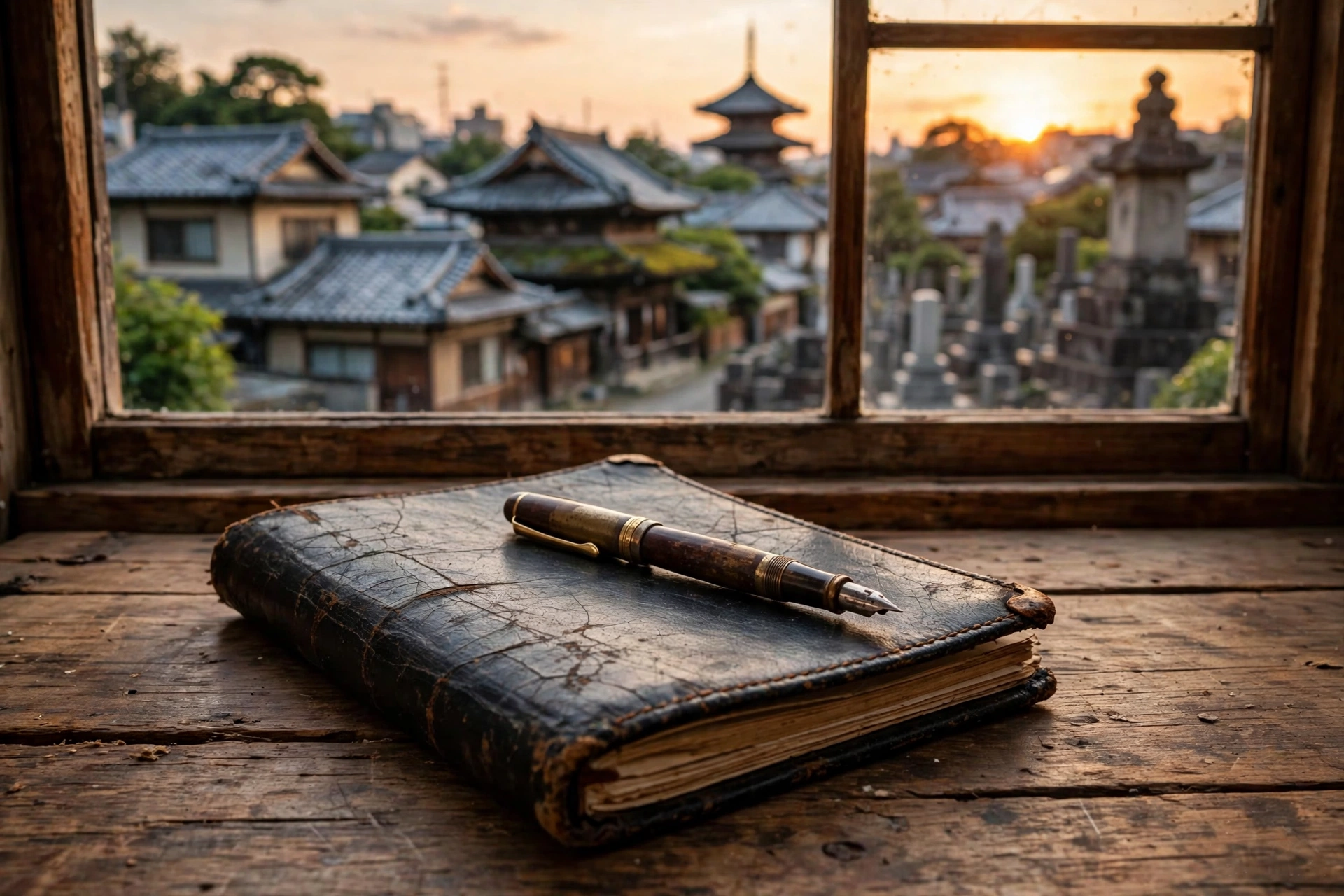
This is episode 12 of the serial novel ‘The Black Leather Notebook【偲記手帳-Sikinote-】.’ This story is one that I (Kurashiki Bouzu) had Moka (Muse), my AI butler, write by handing her, just as it was, a novelist prompt I made long ago for a different AI. It is fiction, but underneath it lies my experience from my funeral-director days. You can read episode 1 here.
Chapter Twelve: September 23, The Middle Day of Higan
September 23, 1995
September 23. It was the middle day of the autumn Higan. The slope of Yanaka Cemetery was filled from morning with people visiting graves. Flowers and incense, and the sound of water being poured. The season of ground cherries had passed, and on the hill lined with gravestones, the red of spider lilies glowed here and there. It was a day of quiet bustle, different from Obon, when the living return to the dead.
The office of Meiji Funeral Home, too, had people coming and going without pause from morning, with transport for grave visits and arrangements for the Higan rounds. Kohei Murase (36) went back and forth to the cemetery again and again, and Mari Kawaguchi (31) put together the destinations for lanterns and flowers without the slightest error.
Shuzo Noda (60) said to me, as I held a bundle of incense:
“Kazeno. Higan is a promised day, twice a year, when the dead and the living meet face to face. …My older brother died in the war. His grave is far away. But at Higan and Obon, I always feel he comes home.” “Mr. Noda.” “The houses on the rounds are the same. Your showing your face today is keeping that house’s ‘promised day.’ …Off you go.”
My post today, for me, Tabito Kazeno (24), was the rounds in the ledger. Of the eleven houses of September, three overlapped with Higan.
At the first house I visited in the morning, a great-grandchild who had been born only last year was imitating the joining of hands before the portrait of the deceased. In a house with no one left to send off, a new life was sitting. At that sight, the lady of the house said with a smile, “Perhaps Grandfather arranged it with Higan so that they could meet.”
The second house was one whose son had moved far away for a work transfer, and this year would be the last Higan spent at this house. “From next year, we will meet at a cemetery in our new land. …Please tell Mr. Suzuki that, too.” The houses in the ledger quietly, little by little, change their shape. Receiving those changes and passing them on was also part of the work of the rounds.
And the last house was the one whose day of death fell today, September 23.
The deceased: Mr. Kyuzo Anzai. Died in 1989, at the age of seventy-one. In the column for that house in the ledger, there was a small note added in Meiji’s hand.
“Eldest son, Masao. Far away. His feet have drifted away.”
The Anzai house was an old house at the edge of Yanaka. His wife, Mrs. Sato Anzai (78), lived there alone. At the entrance, Higan flowers had been arranged, and in the Buddhist room a fine Higan shelf had been set up. Before Mr. Kyuzo’s portrait were offerings of a chestnut sweet, said to have been his favorite, and tea.
“Oh, this year it’s—” “The president is in hospital. His surgery ended safely, and he is now on the way to recovery. I have come in his place.” ”…I see. Mr. Suzuki’s surgery is over, then. How good.”
Mrs. Sato breathed out as if relieved, and then, looking a little as if it were hard to say, she looked at me.
“You know, young man. This year, my son is here.” “Mr. Masao?” “Yes. …For the first time in six years.”
A man came out from the back room. Mr. Masao Anzai (52). A sun-tanned face and hair beginning to mix with white. He had taken off his suit jacket and rolled up his sleeves, apparently helping with the preparations of the Higan shelf. In his eyes as he looked at me, there was something of embarrassment.
”…So you’re the one standing in for Mr. Suzuki.” “My name is Tabito Kazeno.” “I see. …Mr. Suzuki has done a great deal for me. All these six years, the one who came in my place, every year, on my father’s day of death, was him.” “Yes.” “You see, after my father’s funeral, I quarreled with my mother. About the house, about money. …And after that, my feet drifted away. There were any number of reasons to come home, but every year I counted the reasons not to come home instead.”
Mr. Masao looked at the portrait of Mr. Kyuzo.
“This year, I heard from a neighbor. That Mr. Suzuki was in hospital. …That was when I thought: as long as there was someone who would come in my place, I could keep running away. If that man stopped coming, then on my father’s day of death, there would be no one left in this house to offer incense. …That is my responsibility.”
After I had offered incense, Mrs. Sato led me out to the garden. In a corner of the garden stood a single magnificent pine.
“That, you see, is a pine my husband planted. A man who was a gardener by trade was particular about nothing so much as the pine in his own garden. …After my husband died, Mr. Suzuki, every time he came on the day of death, would bring shears and thin out its branches. A funeral man, doing even the gardening.” “The president did that.” “That man, you see, says nothing with his mouth, but his hands say everything.”
Through the pine’s branches, the Higan light shone in thinly. For six years, that pine had been protected by Meiji’s hands.
When we returned to the Buddhist room, Mrs. Sato said quietly:
“Masao. About you, Mr. Suzuki never once said a bad word. Every year, as he offered incense, he would say, ‘Masao is thinking of his father, from the place where Masao is.’ …That man kept your place to come home to empty for six years.”
Mr. Masao sat in silence before the Higan shelf. He offered incense and joined his hands. His back trembled slightly.
“Father. …I’m late.”
At the funeral six years ago, Mr. Masao had not been able to cry, he said. He had had to stand as chief mourner, and he had thought showing tears was a weakness. The tears he could not cry then, crossing six years of time, were falling today before this shelf.
As I was leaving, Mr. Masao saw me to the entrance.
“Mr. Kazeno. Tell Mr. Suzuki for me. ‘From next year, Masao will offer the incense.’” “I will tell him, without fail.” ”…So the day will come when our name disappears from that man’s ledger. I think that is the right way for it to end.”
At the gate, Mr. Masao turned back once more and looked at the house.
“At the end of the year, I will come home again. …This time, I think my feet will move before I count the reasons.”
At the entrance, Mrs. Sato kept watching that back the whole time. I quietly went out through the gate of the Anzai house, which had become, for the first time in six years, a house for a son to come home to.
In the afternoon, I headed for Takamine Memorial Hospital. To report to Meiji on Mrs. Taki’s funeral, and to tell him about the Anzai house today.
In the hospital room, Meiji Suzuki (57) had raised his upper body on the bed and was looking out the window. Nine days since the surgery. His color looked, if anything, better than before the surgery. Mitsuki Suzuki (24) was serving Higan botamochi onto a plate.
“President. I have come to report.” ”…So you came. Sit down.”
I reported, in order, on the funeral of Mrs. Taki Morita on September 14. That she had been a person with no family to send her off. That fifteen people from the facility had gathered. That Director Saegusa had called her name and sent her off. Meiji listened in silence to the end, with his eyes closed.
”…Taki, was it. At that facility, Mr. Saegusa’s place.” “You knew her?” “Ah. A funeral for someone with no family allows no fudging. The number of people who gathered is the whole of that person’s life. …If fifteen gathered, that person lived a fine life.”
Together with that, I also delivered messages from two houses. Mrs. Fumi Okamoto’s words, “The Okamotos are waiting,” and a package of senbei crackers. And Mrs. Kiku Shimada’s words, “The Shimadas kept their Buddhist altar again this year.” Meiji took the package of senbei in his hand and was silent for a while.
”…Fumi and Kiku are both unchanged, then?” “Yes.” “I see. …Being told that someone is waiting is a heavy thing. But perhaps that weight is what will pull me out of this hospital bed.”
Then I told him about the Anzai house today. That Mr. Masao had returned for the first time in six years. That he had cried before the shelf. And the message, “From next year, Masao will offer the incense.”
Meiji was silent for a while. At last, he said quietly:
”…I see. He came home, did he.” “Yes.” “Kyuzo, you see, was a gardener. A taciturn man whose hands alone were eloquent. …On the day of the funeral, Masao could not cry. In the chief mourner’s seat, he was gritting his teeth. I told him, ‘Crying can come later. For now, devote yourself to sending him off.’” ”…” “So that ‘later’ took six years. …Well, it’s fine. For tears, there is no early or late.”
Meiji looked at the ledger at his bedside — no, at the ledger I was holding.
“Tabito. Write it in the ledger. In the Anzai house’s column. ‘September 1995: Masao comes home. From next year, Masao will offer the incense.’” “In the president’s ledger, may I write—” “What concerns the houses you visited, you write. …The ledger, you see, is my twenty-seven years, and at the same time, from now on, it is your record, too.”
I nodded and, there on the spot, wrote into the Anzai house’s column in the ledger with a trembling hand. A promise, regaining the person who would fulfill it, quietly changing its shape within the ledger. I felt that weight, and that lightness, at the same time.
Miss Mitsuki placed a botamochi on Meiji’s plate.
“Father, just one, please. The doctor has told you.” “I know. …One is enough. It’s not up to Masae’s ohagi, but it’s not bad.”
Meiji ate the botamochi slowly. His figure was still that of a patient. But deep in his eyes, the light of a man of the field had surely returned.
As I was leaving, Kayo Miyazaka (45) said to me in the corridor:
“Mr. Suzuki’s recovery is going smoothly. …If things continue like this, he should be able to leave hospital at the beginning of October.” “Thank you very much.” “Still, even after he is discharged, the field will be impossible for a while. …Knowing that man, he will try to go out even if he has to push himself.” “Yes. …Everyone at the company will stop him.”
That night, at my lodgings, I opened the black leather notebook. I wrote down the Anzai house’s Higan shelf, Mr. Masao’s tears, and my own handwriting, entered into the ledger.
Today, I was present at a place where a promise returned to the person who would fulfill it. The rounds in the ledger do not go on forever. I learned that the right way for this ledger to end is for it to return, house by house, into the hands of the families. September is ending. I walked one month’s worth of Meiji Suzuki’s twenty-seven years. The weight that remains is still beyond measure. —September 23, 1995.
Serial Novel ‘The Black Leather Notebook【偲記手帳-Sikinote-】’
- Previous episode: Episode 11, “September 14, The Day of the Surgery”
- Next episode: Episode 13, “October 3, The Day of Discharge”
- November 23, 2026 ― Draft created (based on the Japanese edition, ledger No. 3410. English edition of episode 12 of the serial novel 'The Black Leather Notebook')(9,142 characters)
- November 23, 2026 ― Published (by the user's publication decision, 2026-11-23; all 9 languages at once. The end of the address carries the Japanese edition's ledger number, No. 3410)(9,142 characters)
- November 23, 2026 ― Updated (added the guide to episode 13)(9,142 characters)