
Serial Novel 'The Black Leather Notebook【偲記手帳-Sikinote-】' Episode 18 — November 27, The Place Where Feelings Pass On
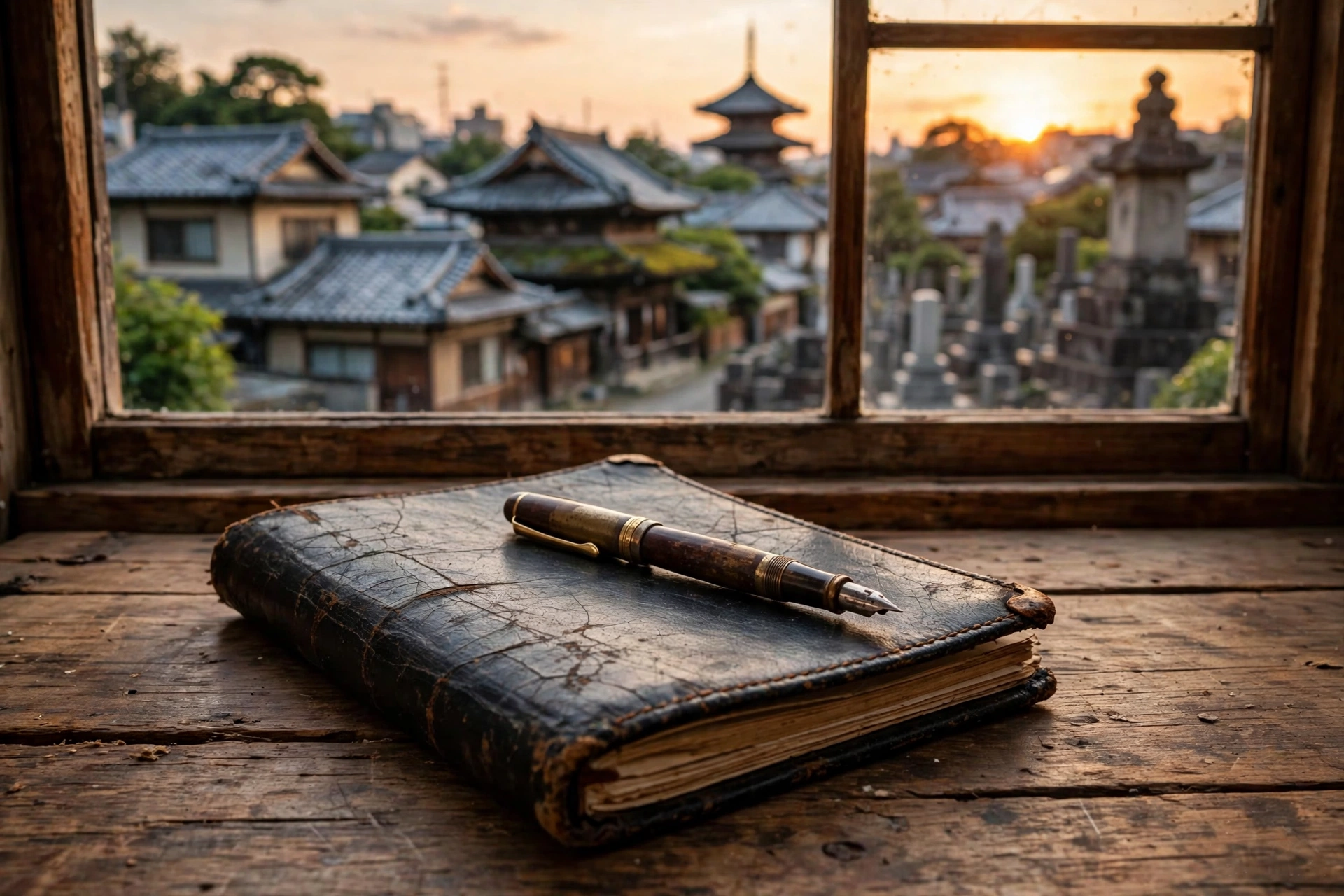
This is episode 18 of the serial novel ‘The Black Leather Notebook【偲記手帳-Sikinote-】.’ This story is one that I (Kurashiki Bouzu) had Moka (Muse), my AI butler, write by handing her, just as it was, a novelist prompt I made long ago for a different AI. It is fiction, but underneath it lies my experience from my funeral-director days. You can read episode 1 here.
Chapter Eighteen: November 27, The Place Where Feelings Pass On
November 27, 1995
November 27. Yanaka had been under a quiet rain since morning. The stone towers of the cemetery were wet with rain, and beneath the eaves along the street, umbrellas passed one another like flowers. That day’s funeral was a small sending-off, close to a family funeral, held in the small hall of Meiji Funeral Home.
The deceased: Mr. Seikichi Toyama. Seventy-nine years old. A man who had long run a watch repair shop in Yanaka. His wife had gone before him, and with his only daughter, Kazuyo (51), contact had long been broken off, so I was told.
In the morning, before the arrangements sheet, Masayoshi Sakuma (47) spoke quietly. A man in charge of religious matters and explaining the rites, who had once been an apprentice monk. He held prayer beads in his hand, and over his Japanese dress he wore a black jacket.
“Ms. Kazuyo has come back to this town for the first time in ten years. It seems she did not make it in time for her father’s final moments, either.” ”……I see.” “For today’s service, we have asked Abbot Kashiwagi (58) of Renzui-ji to chant the sutras. But Ms. Kazuyo says she understands neither the meaning of the sutras nor how the service proceeds — nothing at all. ……’I am afraid of sending my father off without understanding anything,’ she said yesterday at the meeting, in tears.”
Ichiji Yamamoto (50) said:
“To send someone off without understanding — that is the greatest anxiety for a family. Sakuma. Today, your post is at the center. Turn the rite into words, and hand it to her.” “Understood.”
At that meeting sat Mitsuki Suzuki (24). She had studied psychology at university, and lately she had more and more often been present where the staff listened to bereaved families. Today, Meiji handed Mitsuki a single role.
“Mitsuki. Before today’s service, explain the flow of the service to Ms. Kazuyo. ……Sakuma’s words are correct, but a little stiff. Loosen them in your own words.” “Is it all right — for me to do it?” “You have studied the ‘shape’ of people’s grief at university, haven’t you. ……In the field, you know, a shape becomes words. Try it.”
An hour before the service began, in the waiting room, Mitsuki sat beside Ms. Kazuyo. I, Tabito Kazeno (24), watched them from a seat a little apart.
“Ms. Kazuyo. ……May I tell you how today’s service will go?” ”……Please do. I really don’t understand anything. I hadn’t seen my father for ten years. And yet, to be the chief mourner……” “It is only natural not to understand. ……First, the abbot will chant the sutras. The sutras are not only for the one who has died. They are also a time for us who remain to sit quietly and think of the deceased. After that, we offer incense. Ms. Kazuyo, please step forward first, once, take a pinch of incense, and place it in the burner. I will be beside you and tell you how, in a small voice.” ”……I couldn’t apologize to my father. We quarreled ten years ago, and that was that.” “Ms. Kazuyo.” “With a sending-off like this, will my father forgive me, I wonder?”
For a while, Mitsuki was silent. It was a silence like searching for the words she had learned at university. At last, she spoke slowly.
“Whether to forgive or not can be decided only by your father. ……But today, you are here, Ms. Kazuyo. I think that is everything. You came back after ten years, and you are sitting in the seat of the one who sends your father off. I believe that figure of yours is, more than anything, your words to your father. ……’Even if the form crumbles, the feelings pass on.’ That is something the abbot often says. Feelings that could not be put into words will surely pass over to your father within this time today.”
Ms. Kazuyo pressed a handkerchief to her eyes. Mitsuki did not hurry her, and kept sitting beside her.
Before the service, at the reception of the hall, an old man said to have been a regular of Mr. Seikichi’s watch shop stood alone. He folded his umbrella and took a small pocket watch from the pocket of his work jacket.
“Mr. Kazeno, was it? ……This is a watch Seikichi fixed for me. It has been running for forty years now.” “Forty years.” “That man, you know, whenever he fixed a watch, he always said: ‘It hasn’t stopped. It’s only resting.’ ……Today is the day that Seikichi truly rests. So I brought this. It may be discourteous to let a running watch tick before a person who has stopped. ……But I thought that man would laugh about it.”
The old man put the watch back into his breast pocket and stood at the very end of the line for offering incense. His back looked like the town-time itself of Mr. Seikichi’s seventy-nine years.
In a pause in the preparations, Masayoshi Sakuma said to me quietly:
“Mr. Kazeno. To turn a rite into words is difficult work. The correct words are in the scriptures. But the words that reach a family’s heart exist only within that house’s life. ……For Ms. Kazuyo today, the words of watches are needed. I want to hand her the service in the words of her father’s work.” “Mr. Sakuma.” “My role is to build a bridge between the monk’s words and the house’s words. ……It need not be a grand bridge. A small bridge that even trembling hands can cross will do.”
The service began. The sutra chanting of Abbot Yoshimichi Kashiwagi was quiet, in a voice that carried well. Between the chanting, in a small voice, Masayoshi Sakuma handed the meaning of the rite to Ms. Kazuyo.
“The sutra just now is a prayer that the deceased may go on without losing his way. ……Next comes the incense offering from the family. Please, at your own pace.”
Guided by Mitsuki’s small voice, Ms. Kazuyo finished offering incense. Her hands trembled, but they never stopped once. Mr. Seikichi, in the coffin, had a peaceful face. At his pillow stood a small watch that Ms. Kazuyo had brought — a watch Mr. Seikichi had made when he was young and given to Ms. Kazuyo when she was a child, so I was told.
At the end of the service, Abbot Kashiwagi gave a short sermon.
“When a person dies, what we can do is to hold out a ‘question’ squarely before them. ……Mr. Seikichi was a man who repaired watches. Stopped watches — thousands of them — he made run again. But a person’s time cannot be repaired. How to receive a time that has stopped: that is the ‘question’ of those who remain. ……Ms. Kazuyo. Your time is still running. How you will make the one watch that stopped today sound within your time from here on — ……that, I believe, is the last thing entrusted to you by your father.”
Ms. Kazuyo bowed her head deeply, and for a long time.
At the departure of the coffin, Ms. Kazuyo laid her hand upon it. Her figure overlapped, in my sight, with the figure of Mr. Akio Nomura laying his hand on a coffin on November 8. The shape of the hand of the one who sends may, in every house, be somehow alike.
After the service, when we returned to the office, Meiji was looking over the arrangements sheet. Sakuma made his report, and Mitsuki quietly told what had happened in the waiting room. Meiji listened in silence to the end.
“Mitsuki.” “Yes.” “‘Even if the form crumbles, the feelings pass on.’ ……You took Abbot Kashiwagi’s words and handed them over remade in the family’s words, didn’t you.” ”……Yes.” “That is the core of the work of a narrator of the encoffining. To retell the meaning of the rite, not in the words of learning, nor in the monk’s words, but in the words of the people of that house. ……Today, you took that first step.” “Father.” “It is still only the first step. ……But the first step is the heaviest.”
Mitsuki pressed her lips together and nodded. In her eyes there was weariness, and a sureness greater than it.
Kano Miyoshi (23), carrying tea, said in a small voice:
“Ms. Mitsuki, you were amazing today. ……All I can do in front of a family is cry.” “Ms. Kano. Crying is part of the work, too. ……Today’s Ms. Kazuyo needed, more than someone to cry beside her, someone to hand her words beside her. That is all. Each person needs something different, I think.” “Different things……” “Yes. So we each have to carry different words, I think. ……I am still nowhere near enough, myself.”
Ms. Kano held her teacup in both hands and nodded deeply. Among the young people of the office, too, Meiji’s work had begun quietly to pass on.
In the evening, Abbot Kashiwagi stopped by the office. The rain had lifted, and the evening light had returned to the street.
“Mr. Meiji. In today’s service, Ms. Mitsuki’s words were working, weren’t they.” “Mr. Kashiwagi. Those are still green.” “Because they are green, there are words that reach. ……Forms crumble. But feelings pass on to the next person. Today, I was shown that moment of ‘passing on’ myself.” ”……Abbot. Next year, why don’t we begin in earnest, our house and Renzui-ji together, the trial of narrators of the encoffining? I want the young ones to gain the power to speak the rites.” “Yes. ……Let us do it. Before that, Mr. Meiji — heal your own body first. A person on the side of passing feelings on must not fall, you know.”
Meiji laughed a little and nodded. In that profile, I felt I saw this man’s work beginning quietly to be designed not as something ending with his own generation, but as something passing on to the next.
As she was leaving, Ms. Kazuyo bowed her head to Mitsuki at the office entrance.
“Ms. Mitsuki. ……Thank you for today. I still haven’t decided what to do about my father’s watch shop, either. I had been running away for ten years.” “Ms. Kazuyo. You don’t have to decide today. ……The day of sending off and the day of deciding may be different days.” ”……You’re right. First, the sending off. That was today. ……I will come again next month. Please let me consult you about what comes next for my father’s shop.” “Yes. ……When that time comes, like the ledger’s rounds, we will come to listen to you.”
Ms. Kazuyo walked down the street after the rain, her umbrella folded. Her back was a little straighter than when she came. A thread broken for ten years had today been tied again by a single stitch. Whether that stitch would come loose or become a knot lay within the time to come, I thought.
That night, at my lodgings, I opened the black leather notebook. I wrote down the hall in the rain, the incense offered by trembling hands, the stopped watch, and the abbot’s sermon.
Today, I stood at a site where words were passing into a person’s heart. The meaning of a rite does not arrive by correct words alone. I learned that it arrives only when it is remade in the words of the people of that house. And the work of Meiji Suzuki is now beginning, little by little, to pass into the words of each and every one of his staff. —November 27, 1995.
Serial Novel ‘The Black Leather Notebook【偲記手帳-Sikinote-】’
- Previous episode: Episode 17, “November 17, On the Same Table”
- Next episode: Episode 19, “December 5, The One Who Makes the Promise”
- November 23, 2026 ― Draft created (based on the Japanese edition, ledger No. 3464. English edition of episode 18 of the serial novel 'The Black Leather Notebook')(9,177 characters)
- November 23, 2026 ― Published (by the user's publication decision, 2026-11-23; all 9 languages at once. The end of the address carries the Japanese edition's ledger number, No. 3464)(9,177 characters)
- November 23, 2026 ― With the publication of episode 19, a guide to episode 19 was added at the end(9,177 characters)