
Serial Novel 'The Black Leather Notebook【偲記手帳-Sikinote-】' Episode 19 — December 5, The One Who Makes the Promise
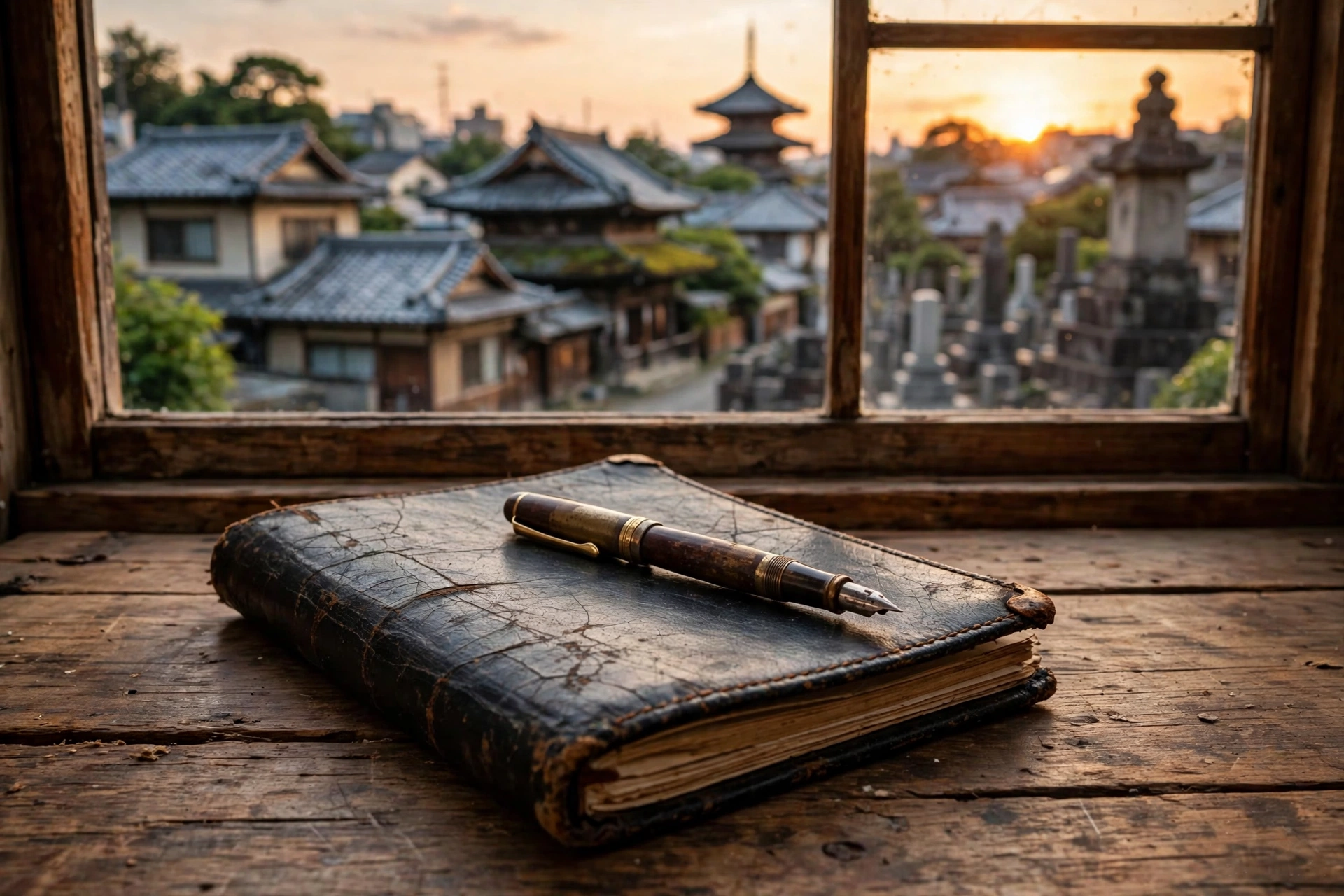
This is episode 19 of the serial novel ‘The Black Leather Notebook【偲記手帳-Sikinote-】.’ This story is one that I (Kurashiki Bouzu) had Moka (Muse), my AI butler, write by handing her, just as it was, a novelist prompt I made long ago for a different AI. It is fiction, but underneath it lies my experience from my funeral-director days. You can read episode 1 here.
Chapter Nineteen: December 5, The One Who Makes the Promise
December 5, 1995
December 5. In Yanaka, a cold wind had been blowing since morning. The cherry trees of the cemetery had shed all their leaves, and over the hill where the stone towers stood in rows, the winter light fell low. The breath of the people visiting graves was white, and the smoke of incense leaned thin as the wind carried it away. The colors of the year’s end were deepening, little by little, over the town.
My mornings — I am Tabito Kazeno (24) — had come to begin with opening the ledger entrusted to me. Entrusted by Meiji in September, three months ago. The pages of the ledger had grown familiar to my hands. Around which part of it the houses of which town were lined up. On days when anniversaries overlapped, in what order to make the rounds so as to finish before dark. From the habits of the handwriting, I had come to tell the days Meiji wrote in haste from the days he sat down and wrote with care.
“Kazeno. The December rounds — did the numbers add up?”
Mari Kawaguchi (31) spoke, holding a bundle of copies.
“Nine houses. Five are death anniversaries. The other four are rounds that double as greetings for the year’s end.” “You counted well. ……In your first month, the eleven houses of September had you blinking in bewilderment.” “It is not easy even now. Only, I feel as if the ledger has grown used to my hands.” “It is the other way around. Your hands have grown used to the ledger.”
Mari laughed and went back to the arrangements sheet. Those words stayed strangely in my chest. The ledger does not change. What had changed was the hands that held it.
In the chair at the center of the office, Meiji Suzuki (57) was marking the morning arrangements sheet with a red pencil. Two months since he left the hospital. His color was coming back, but going out to the sites was still not allowed. That day, Meiji was in unusually good spirits.
“Tabito. Today, you know, we have a guest in the early afternoon.” “A guest?” “Mrs. Masae Shimizu. She said, ‘When you leave the hospital, I will come to visit you,’ didn’t she. ……A faithful person. She is coming to keep, at the year’s end, a promise made at Bon.”
August 15. Mrs. Masae had said: “Next time, it is your turn to be the one who is promised to.” And she had promised Mitsuki, “When your father leaves the hospital, I will come to visit him.” Today was the day of that promise.
At the time of the midday preparations, Mitsuki Suzuki (24) was arranging the cushions of the reception seats more carefully than usual.
“Mrs. Masae, today I will make the tea. ……In August, you see, I promised. ‘I will come to visit him,’ she said. I heard those words beside her, and I feel as if I promised together with her.” “Mitsuki.” “Father is a man who is poor at being on the receiving side of a promise. ……So, at least for the seat where a promise is received, I want to have it properly in order.”
Mitsuki placed two teacups on a tray. In her practiced hands, there overlapped the figure of that day in August, standing straight before the spirit shelf.
In the morning, I went out on the rounds of the ledger. Today’s anniversary was Mr. Toramatsu Ishii. Died in 1992. Eighty-four years old. In the column of the ledger, in Meiji’s hand, there was only this: “Wife, Haru. Guards the family altar alone.”
The Ishii house was an old merchant house below the slope of the cemetery. The ones who welcomed me were his wife, Mrs. Haru Ishii (79), and one more person, a young man.
“Oh my, this year…… well now, Naoki. Prepare the incense.” “Yes, Grandmother.”
Mr. Naoki Ishii (28). Mrs. Haru’s grandson, who at the time of Mr. Toramatsu’s funeral had only just left university, so I was told. This spring he had left his job, returned to this house, and begun a life with the family altar in it, Mrs. Haru told me happily.
“This child, you see, from this year, guards the family altar together with me. ……Mr. Suzuki cannot come, I see.” “The chairman has left the hospital. Now he is at the office, doing work sitting down. Today, in his place, I—” “I see. ……I am glad that man is safe. For this house, you know, the day that man came was the marker of the year. From next year, it is this child’s turn to offer the incense.”
Beside the family altar leaned the old signboard of the dried-goods shop Mr. Toramatsu had run. At a small shop below the slope, for sixty years, he had sold beans, seaweed, and dried goods, so I was told. The shop closed together with Mr. Toramatsu’s death, but the people of the neighborhood still call that corner “in front of the Ishiis’ shop.”
I offered incense and put my hands together. Beside me, Mr. Naoki put his hands together a little awkwardly. That way of holding his hands resembled my own hands of three years ago. They did not tremble, but they were hands still searching for their own shape.
“On the day before the anniversary, I wipe around the family altar. ……Yesterday, I wiped the signboard too. Grandfather’s shop sign. As I wiped it, I thought: this house, even though the shop has closed, is still ‘the Ishii house.’”
“Mr. Kazeno. To be honest, I know nothing at all about the family altar.” “I was the same at first. ……I think the days of putting your hands together without understanding, year after year, are what pile up.” “On the anniversary of Grandfather’s death, the funeral man comes to us. Just that makes Grandmother’s back straighten. ……That there is someone outside who does not forget this house’s ‘that day’ — that is a big thing, isn’t it.”
As I was leaving, Mrs. Haru said:
“Please tell Mr. Suzuki: ‘The Ishiis have had a change of generation. So there is no need to worry anymore.’ ……Because that man, even while he could not come, must have been worrying about this house.”
Following the Anzai house, another house of the ledger was returning into the hands of its family. The “right way for the ledger to end” that Meiji had spoken of in September was quietly proceeding in December’s Yanaka, too.
Two in the afternoon. The glass door of the office opened, and the bell rang. Mrs. Masae Shimizu (76) stood there, holding a small furoshiki bundle. In a dark blue outfit for going out, she held, in this season that was not the season of ground cherries, a bunch of small white chrysanthemums.
“Excuse me. ……I have come on the visit I promised.”
Meiji began to rise from his chair, noticed the gaze of Go Watarai (42), and, keeping his seat, bowed his head deeply. Mitsuki Suzuki (24) took Mrs. Masae’s hand and guided her to the reception seat.
“Mrs. Masae. Thank you for coming.” “Chairman. ……You have grown thin. But your eyes alone are the same as before.” “Mrs. Masae, too. To think you would remember an August promise until the year’s end.” “A promise is not something to remember. It is something to keep. ……That is what you taught me, isn’t it.”
Mrs. Masae untied the furoshiki bundle. Inside were handmade ohagi and a new hand towel.
“Let Mrs. Akemi eat some, too. ……You may have just one. The doctor has stopped you, hasn’t he.” ”……Mrs. Masae. You know my body better than the people of my own house.” “Those who were sent off, you see, watch closely the people who sent them off. ……At Bon in August, I prayed before the shelf for your safety. Together with my husband, whom I was supposed to have sent off. Whether that prayer reached you — today, I came to see for myself.”
The office fell quiet. Meiji was silent for a while. At last, he spoke slowly.
”……It reached me, Mrs. Masae. Here I am, sitting in a chair, looking at your face.” “I see. ……Then, this time, have you promise me clearly. At next year’s Bon, you will come to my house on your own feet to offer incense. Not the young person in your place — on your own feet.” “Mrs. Masae.” “This year, I was on the side that makes the promise. Next year, it is your turn to return to the side that keeps it. ……All right?” Meiji laughed a little. In that laugh there was the color of a man bested.
”……All right. I promise. At next year’s Bon, I will go on my own feet.” “Yes. That is more like you.”
As she was leaving, at the entrance, Mrs. Masae spoke to me as well.
“Young man. Your face has changed since you came in August. ……It is becoming the face of a person who holds a ledger.” “Mrs. Masae.” “That ledger you hold, you know, is a bundle of promises. A promise is something that goes on, with the side that makes it and the side that receives it trading places now and then. ……You will understand, in time.”
Mrs. Masae walked away down the lane, her back straight. That small back was the same as the figure that had waved a hand in the August evening sun.
At the reception seat, Akemi Suzuki (55) placed just one of Mrs. Masae’s ohagi before Meiji.
“Just one. As Mrs. Masae judged.” ”……That person is stricter than my own doctor.” “The eyes of those who were sent off are sure, you know. ……That person prayed for your safety before the shelf. To that prayer, today, you showed your face. That is enough.”
Meiji ate the ohagi slowly. In August, Mitsuki had said it: in Mrs. Masae’s ohagi, behind the sweetness, salt is at work. That taste had surely reached even the chair at the center of this office.
In the evening, Meiji called me.
“Tabito. Today’s rounds?” “The Ishii house. ……The grandson, Mr. Naoki, will guard the family altar from this year, I was told. I received a message: ‘There has been a change of generation. There is no need to worry anymore.’” ”……I see. A change of generation.”
Meiji looked at the column of the Ishii house in the ledger. The day had come for me to add to that column in my own hand.
“Write it down. ‘December 1995: the grandson, Naoki, takes over the family altar.’ ……The houses of the ledger, you know, return one by one into the hands of their families. That is not a sad thing. It means a promise has borne fruit.” “Yes.”
I wrote it in the ledger. The trembling of three months ago, when I first wrote in the column of the Anzai house, was gone. The pen moved forward without hesitation. Noticing that, I was a little surprised. The weight of the ledger had not changed. What had changed was the hands that held it.
That night, at my lodgings, I opened the black leather notebook. I wrote down the bunch of small white chrysanthemums, Mrs. Masae’s words — “a promise is something to keep” — and the tip of my own pen, moving forward without hesitation.
Today, I was present on a day when a person on the side of making a promise came to visit a person on the side of being promised to. A promise was not a one-way thing. It was something that goes on through the years, with the side that makes it and the side that receives it trading places. And my hands are growing used, little by little, to the ledger entrusted to me. To grow used to it does not mean forgetting its weight. I learned that it means becoming accustomed to carrying that weight. —December 5, 1995.
Serial Novel ‘The Black Leather Notebook【偲記手帳-Sikinote-】’
- Previous episode: Episode 18, “November 27, The Place Where Feelings Pass On”
- Next episode: Episode 20, “December 13, Where the Key Is Kept”
- November 23, 2026 ― Draft created (based on the Japanese edition, ledger No. 3491. English edition of episode 19 of the serial novel 'The Black Leather Notebook')(9,334 characters)
- November 23, 2026 ― Published (by the user's publication decision, 2026-11-23; all 9 languages at once. The end of the address carries the Japanese edition's ledger number, No. 3491)(9,334 characters)