
Serial Novel 'The Black Leather Notebook【偲記手帳-Sikinote-】' Episode 20 — December 13, Where the Key Is Kept
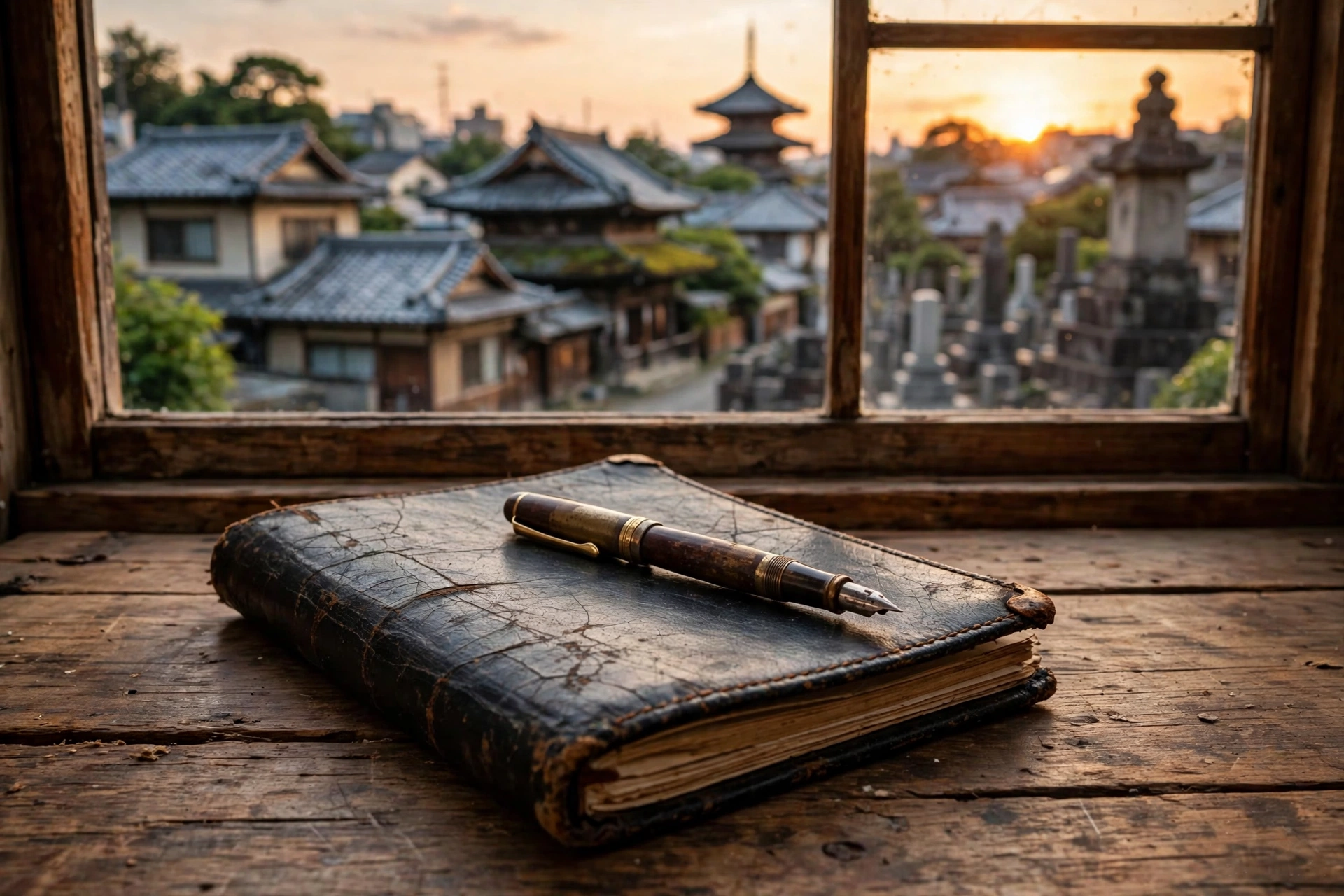
This is episode 20 of the serial novel ‘The Black Leather Notebook【偲記手帳-Sikinote-】.’ This story is one that I (Kurashiki Bouzu) had Moka (Muse), my AI butler, write by handing her, just as it was, a novelist prompt I made long ago for a different AI. It is fiction, but underneath it lies my experience from my funeral-director days. You can read episode 1 here.
Chapter Twenty: December 13, Where the Key Is Kept
December 13, 1995
December 13. The morning in Yanaka had the quiet of frost. Thin ice had formed on the plant pots at the eaves, and even the footsteps of people climbing the slope of the cemetery seemed somehow restrained. A little over half a month remained until the year’s end. In the shopping street, bundles of shimenawa ropes and pine decorations had begun to line up.
That morning at the office, the preparations for the year’s end had begun. Mari Kawaguchi (31) entrusted me with the year’s-end greeting calls to the houses on the ledger’s rounds.
“For the houses you cannot visit in person, a call will do. ……But even a voice alone reaches that house’s year’s end, you know.”
I called the house of Mrs. Fumi Okamoto (72). The house of September 2, the very first one.
”……Oh my, Mr. Kazeno. I knew by your voice.” “Mrs. Fumi. I am calling with greetings for the year’s end. The chairman, too, is back at the office.” “I see. ……Mr. Suzuki is sitting in his chair, then. Knowing that man, he must be unable to sit still.” “Everyone is holding him back.” “Hehe. ……Please do hold him back for him. That man, you see, for the sake of others, will go as far as it takes. When it is his own turn, he needs someone to hold him back. ……On next year’s September 2, you know, I would like Mr. Suzuki himself to come. And you with him, too.”
Putting down the receiver, I thought: the houses of the rounds already remember my voice. It was not that the hands holding the ledger had grown used to it. The houses of the town had welcomed me in as a face of the rounds.
That morning, Nobutaka Nishioka (53) opened the glass door of Meiji Funeral Home. It was to report on the Haneda matter.
“Mr. Meiji. I went to Mr. Haneda’s house. Twice — last week and this week.” ”……How was it?”
Meiji Suzuki (57), sitting in the center chair, set down his teacup. I, Tabito Kazeno (24), was in the seat beside him, in the position of hearing the report. It was because I was the one who had connected Mr. Kazuhiko’s consultation in October.
“Mr. Kazuhiko, you know, opened all the windows of the house and spoke with me for a long time before the family altar. ……I will give you the conclusion first. Mr. Kazuhiko says he will not decide within this year.” “Will not decide.” “At New Year, it seems, the family from Saitama will gather at the Yanaka house. They will talk as a family before his mother’s family altar. ……’How to handle Mother’s house, I want to decide in front of Mother,’ he said. Whether to sell it or to keep it, it is the same.” ”……That is fine.” “Mr. Kazuhiko said: ‘The key — I will hold it a little longer.’ ……They were the very words you heard in October, Kazeno.”
I nodded. October 26, at the entrance of the Haneda house. As he locked the door, Mr. Kazuhiko had said: “The key of this house — I would like to hold it just a little longer.” A month and a half since that day. That key was still in Mr. Kazuhiko’s hands.
“Mr. Kazuhiko said one more thing. ‘At New Year I will talk with the family, and decide by spring. ……When I have decided, the first to be told will be Mr. Nishioka and Meiji Funeral Home.’ ……A person on the side of being driven out deciding for himself even the order of who is told. That, I think, is the time that man has taken back.” ”……Yes.” “I told the developer’s side. The Haneda house will not join talks that set a deadline. It is a house that decides in its owner’s own time. ……Hikawa made the document for me. It was a document in which the words ‘while the terms are good’ did not appear even once.” “Hikawa did.” “That fellow is changing, too. ……After the November meeting, it seems he went alone to greet Mr. Haneda at his house. Without carrying the documents of numbers. At that time, Mr. Kazuhiko is said to have said to him: ‘Did you come to look at a house, or did you come to look at land?’” ”……And Hikawa, what did he say?” “He answered, ‘Today, I came to look at a house,’ so I am told. ……He came back and reported to me: ‘President. That house was still a house waiting for someone’s return.’”
For a while, Meiji kept his eyes closed.
“Nishioka. When a person takes back even one piece of the order, you know, even their words change.” “Yes. ……The numbers are still on the desk. But their place has moved to the back.”
In the afternoon, there was a different guest. Naho Mizushima (36), of the Akatsuki Judicial Scrivener’s Office. It was a first meeting to put the pre-need consultation of Mrs. Sumiko Fujii (78) into legal shape. The introduction had come through Nishioka Real Estate.
Mizushima was a woman in a dark blue pantsuit, with light makeup and a way of speaking that was logical and orderly. On the office desk she spread out copies of the documents of Mrs. Sumiko’s house and, as if touching the small mole on her forehead, squared the edges of the documents with her fingertips.
”……Well then, shall we first check the registry? Mrs. Sumiko’s house was inherited from her husband, and is in Mrs. Sumiko’s own name. ……When this part is in order, the talks that follow become much easier to move forward.”
Mrs. Sumiko sat with her own small notebook on her knees, looking straight at Mizushima. Today was the day to change the many wishes she had settled at the office in October into a sure shape on paper.
“Ms. Mizushima. My wishes, you know, are just as written in this notebook. The family altar and the memorial tablet are to go to my niece in Chiba. The costs, from what I have set aside. The garden plants are not to be cut down.” “Yes. Let us give them shape, one by one. ……First, the will. To leave Mrs. Sumiko’s wishes in legally sure words. Where the family altar and the memorial tablet are to go, where the money set aside for the costs is, the order of the people to be contacted. ……The procedures are a little complicated, but if we do them one at a time, it will be all right.”
From his chair, Meiji spoke.
“Ms. Mizushima. There is just one thing I would ask. ……The words of the will, you know — I want them written in the person’s own words. The moment they are rewritten into the words of the law, the person’s own voice disappears — I have seen that scene many times at funeral sites.” “Chairman. ……I understand your feelings. Legal documents require set ways of saying things. But before that, there is a form we can take: to keep Mrs. Sumiko’s very words themselves as an accompanying record. ……The person’s own voice, and the shape of the law. We put both of them into the same envelope.”
Mizushima spoke quietly, but clearly. Within the softness of her sentence endings, there was a core that would not yield.
”……Both, into the same envelope.” “Yes. ……In this land, someone’s time lies sleeping. Documents are what hand that time, without mistaking it, to the next hands. When it is handed over, if the person’s own voice is not with it, half of the time will not be handed over.”
The talk moved into details. The money set aside for the costs would be kept, within the savings Mrs. Sumiko had built up little by little, divided off as the portion for the funeral. The order of contact was: first her niece in Chiba, Mrs. Mayumi Ogawa (49); next, Nishioka; and to the people of the neighborhood, after the service. One by one, Mizushima confirmed each item in Mrs. Sumiko’s words, and before replacing them with the words of the law, she always looked at Mrs. Sumiko’s face.
“Mrs. Sumiko. Once the will is made, our office can keep it for you as well. ……But as for where the original is, let us tell only Mrs. Mayumi. Because ‘remaining unable to say it’ is what troubles those left behind the most.” ”……You are right. While I can still say it, I will say it. Because from my own mouth, I will no longer be able to say it.”
Mrs. Sumiko quietly repeated the same words she had used at the consultation in October. Mizushima did not take a note of those words. In place of a note, she looked into Mrs. Sumiko’s eyes and nodded. Even in a legal professional’s work, there are scenes that are entrusted to the eyes before any record, I learned.
Meiji watched Mizushima for a while. At last, he nodded slightly.
”……A good professional. Nishioka’s eye is not bad, either.”
I wrote down the record of that day, as always, in the person’s own words. Mrs. Sumiko’s words — “To decide is not to give up” — and Mizushima’s words of today — “the person’s own voice, and the shape of the law” — just as they were. This record, too, was something held in trust for someone who would someday read it back.
In the evening, word reached the office that Tatsuya Hikawa (46) had telephoned Nishioka. From the developer’s side, about the proposal to remove Mrs. Sumiko’s house from the targets of the plan, the reply had come: “We will consider it, with conditions.”
“It is not a settlement. ……But for the developer to say ‘we will consider it’ — that did not happen before November.”
Nishioka’s voice, even over the telephone, was unhurried.
“Things placed on a desk, you know, do not get moved aside so easily anymore. Beside the numbers, we placed a person’s future. I think that weight reached the other side, too.”
After he hung up, Meiji murmured:
”……Mrs. Sumiko’s time is returning to being Mrs. Sumiko’s own.” “Yes.” “Tabito. Write today’s events not only in the ledger, but in your own notebook as well. ……Mr. Haneda’s key, and Mrs. Sumiko’s envelope — all of today’s talk is the story that ‘the one who decides is the person herself.’ The work of a funeral man, you know, is not to decide in a person’s place. It is to protect the time until that person decides.”
In the evening, Mari Kawaguchi (31) bound today’s record into the file of the pre-need consultation. That file, which had begun with Mrs. Sumiko’s consultation in October, had grown considerably thick in two months.
“To think that the file of the ‘promise made before the sending off’ would grow this thick — in October, I never imagined it.” “Mari.” “A promise does not end on the day it is decided, does it. After that, too, it grows thicker, one page at a time. ……Just like the ledger.”
That night, at my lodgings, I opened the black leather notebook. I wrote down the son’s hand, still holding the key; the judicial scrivener’s words, about putting the person’s own voice and the shape of the law into the same envelope; and the numbers that had moved to the back on the desk.
Today, I saw a form of work: “protecting the time until a person decides.” What to do with a house, and how to arrange one’s own sending off — the one who decides was the person herself. The funeral man, the man of the real estate office, and the judicial scrivener — none of today’s work was ever to decide in another’s place. It was to keep standing beside the person until that person’s time ripened in that person’s own hands. Where the key is kept is still within its owner’s hands. And that is as it should be, I think. —December 13, 1995.
Serial Novel ‘The Black Leather Notebook【偲記手帳-Sikinote-】’
- Previous episode: Episode 19, “December 5, The One Who Makes the Promise”
- Next episode: Episode 21, “December 30, The Ledger at the Year’s End”
- November 23, 2026 ― Draft created (based on the Japanese edition, ledger No. 3500. English edition of episode 20 of the serial novel 'The Black Leather Notebook')(9,364 characters)
- November 23, 2026 ― Published (by the user's publication decision, 2026-11-23; all 9 languages at once. The end of the address carries the Japanese edition's ledger number, No. 3500)(9,364 characters)