
Serial Novel 'The Black Leather Notebook【偲記手帳-Sikinote-】' Episode 21 — December 30, The Ledger at the Year's End
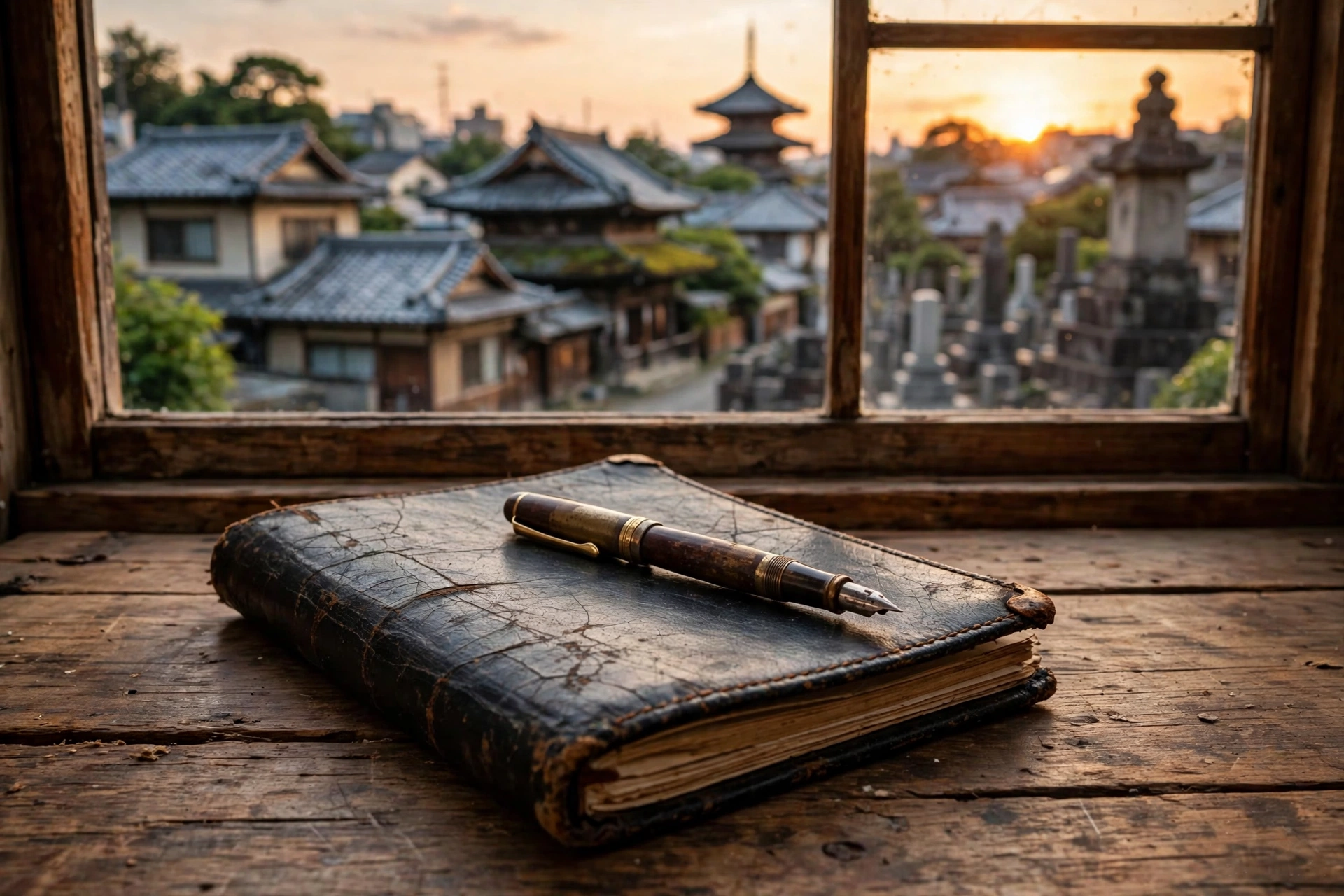
This is episode 21 of the serial novel ‘The Black Leather Notebook【偲記手帳-Sikinote-】.’ This story is one that I (Kurashiki Bouzu) had Moka (Muse), my AI butler, write by handing her, just as it was, a novelist prompt I made long ago for a different AI. It is fiction, but underneath it lies my experience from my funeral-director days. You can read episode 1 here.
Chapter Twenty-One: December 30, The Ledger at the Year’s End
December 30, 1995
December 30. It was the morning of the year’s end. On the streets of Yanaka, people carrying pine decorations came and went, and the front of the flower shop was filled with New Year flowers. On the gravestones of the cemetery, the morning frost remained white, and the line of people visiting graves was quietly long, as if announcing the closing of the year.
As I was leaving, Meiji took back, just once, from my hands the ledger he had entrusted to me, and checked the pages of December.
“The rounds — for this year, were they all made?” “Yes. The five houses of anniversaries, and the four of greetings. ……Not one was missed.” “I see. ……The ledger that I did not miss for twenty-seven years — you, in your very first year, did not miss it either.” “Chairman.” “Do not think it a matter of course. ……A promise, while it is not missed, is praised by no one. But the moment it is missed, everything collapses. That is the kind of thing it is.”
Meiji returned the ledger to me and straightened the collar of his coat. That back had surely recovered from the days of his hospitalization.
That morning, Meiji Suzuki (57) headed to Takamine Memorial Hospital for a checkup. Accompanying him were Akemi Suzuki (55) and I, Tabito Kazeno (24).
The hospital corridor had a quiet that did not seem like the year’s end. The head nurse, Kayo Miyasaka (45), welcomed Meiji and moved the checks forward without a pause.
“Mr. Suzuki. Today is the checkup to see how things have gone since the surgery. ……Your color has come back a good deal, hasn’t it.” “When the head nurse says that to me, I feel relieved.” “It is still too early to feel relieved. ……The numbers are not bad. The course of the part removed in surgery is settled as well. But as for the detailed nature of the tumor, we are not yet at a stage where anything can be stated for certain. We will examine it regularly as we watch its course. That, for now, is what is certain.” ”……Understood.” “As for work, for the time being, keep it in its present form. Work sitting down, and within a range that is not unreasonable. ……Let us keep that promise until next summer.”
Next summer. At those words, Meiji’s eyes moved, just slightly.
On the way back from the checkup, in the corridor of the ward, the chief nurse Maho Katagiri (37) found Meiji and came running up. She was one of the nurses who had looked after Meiji in the ward on the day of the surgery in September.
“Mr. Suzuki. ……The speed of your walking is completely different from before the surgery.” “Thanks to all of you.” “In our ward, you know, Mr. Suzuki is still talked about as ‘the man who, on first waking, asked about a funeral.’ ……The work of a nurse, too, has places close to the work of sending off. Let us meet again next year at your checkups. And then, with a healthier face.” “Yes. ……I am in everyone’s debt.”
Meiji bowed his head deeply. A person on the side of sending off, bowing his head as one who is seen off. That figure, too, was one of the precious scenes of this year.
On the way back, the hospital director, Shigenori Takamine (65), spoke to Meiji in the corridor.
“Mr. Meiji. You will make it across the year.” “Thanks to you, Director.” ”……The work of a doctor, you know, the more exact it is, the more it is a work of learning one’s helplessness. Even when we cannot cure, we can lessen suffering. The rest is how you yourself use your time. ……So that by next year’s Bon, you can walk on your own feet. Let that be the goal.” “Yes. ……There is someone I have promised, you see.”
In the car, Meiji looked out of the window for a while.
“Tabito. At next year’s Bon, I will go to Mrs. Masae’s house on my own feet. ……Today, for that promise, half of the doctor’s permission came out.” “Half?” “Yes. The rest is the part my own body must keep. ……A promise, you know, is not made only with the other person. It was something made with one’s own body as well.”
When we returned to the office a little past noon, the great cleaning was in full swing. Hifumi Yamamoto (50) was on a stepladder, wiping the shelves of the altar; Shuzo Noda (60) was tending the toolboxes; Kohei Murase (36) was polishing the hearse. Mari Kawaguchi (31) was sorting the mountain of documents by year, and Kano Miyoshi (23) was polishing the teacups and tea things, one by one.
“Kazeno, you take the ledger shelf. ……The chairman’s ledgers, and the ledger you are keeping — this year’s portions, set them in order within this year.”
I sat before the ledger shelf. Bindings of records spanning decades stood there, the years lined up on their spines. It was the paper form of Meiji’s twenty-seven years. In its newest place, this year’s binding would be shelved. My own handwriting was already among its pages, I thought.
Go Watarai (42) was checking the implements of the hall one by one, and replacing a worn white cloth.
“Implements, you know, reflect the heart of the person who uses them. ……To set the implements in order at the year’s end is the first greeting to next year’s bereaved families.” “Mr. Watarai.” “Kazeno. Next year, there will be more scenes where you are entrusted with the center of the proceedings. ……Have the names of the implements and where they are kept all in your head.”
Mitsuki Suzuki (24) was quietly wiping her father’s desk.
“This desk, since August, someone has always been protecting it. While Father was in the hospital, and after he came out, too. ……Next year, I hope it will be a year when the master of this desk can sit at it longer.”
To that profile, I could say nothing. But that this wish was the wish of everyone at this company went without saying.
In the afternoon, the head of the sales strategy section, Kaito Takimoto (37), brought the report of the year’s-end numbers. Polished leather shoes and a slim tie. A rationalist who had come over from a securities company, a man between whom and the field friction sometimes arose.
“Chairman. The year’s-end tally. ……I will say it honestly. This year, with the chairman’s hospitalization, I thought the numbers would fall. But the result is almost the same as last year.” ”……I see.” “At first, I could not understand it. The top leaves the field — why do the numbers not fall? ……But I read all the field reports, and I understood. It was not that they did not fall. It was that everyone kept them from falling. Every person in the field was reaching out a hand as far as the chairman’s own post.” “Takimoto.” “Numbers are honest. But with numbers alone, this reason cannot be written. ……Next year, please let me think of a form of report that places, beside the numbers, the words of the field as well.”
Meiji watched Takimoto for a while. At last, he spoke quietly.
”……People, you know, when they take back the order of placing things, their words change. You are one of them, too.” “Yes. ……A good New Year to you, Chairman.”
In the evening, I went out on the last greeting rounds of the year to the houses of the ledger. At the house of Mrs. Kiku Shimada (80), beside the family altar, a small kagami mochi had been offered.
“This year, you know, was the year you came to us in Mr. Suzuki’s place. ……Next year, I wonder if I can meet Mr. Suzuki himself.” “For next year’s September 14, everyone is protecting his health so that the chairman himself can come.” “I see. ……Tell him I am looking forward to it. A promise, you know, is something one may look forward to.”
There is one more house I greeted by telephone. The Anzai house. Beyond the receiver, Mr. Masao Anzai (52) said:
“Mr. Kazeno. This year’s end, you know, I am here in this house, offering incense. ……Mother, too, before the family altar, is making the New Year preparations. It is the first year’s end of parent and child together in six years.” “Mr. Masao.” “Tell Mr. Suzuki for me: ‘Masao has come back.’ ……Tell him that the column for our house in that man’s ledger should by now be a column with nothing to worry about.”
The voice of a person who had taken back a place to return to was bright even through the receiver. That a promise returns into the hands of a family — this was the kind of voice it meant.
When I returned to the office, Meiji, in the center chair, had just closed the binding of this year’s arrangements sheets.
“Tabito. What kind of year was this year?” ”……I came in August; it has been five months. It feels both long and short.” “I see. ……You had the eyes of a man who looks at properties. Now those have become the hands that hold a ledger. Do not throw away the eyes. Do not stop the hands, either. ……Next year, you know, together with Mr. Kashiwagi of Renzui-ji, we will begin in earnest the trial of narrators of the encoffining. It is work to give the young ones the power to speak the rites. You, too, join that circle.” “Yes.” “A funeral does not end with one generation. ……This year, you should have seen the edge of that.”
At night, the people of the company made simple preparations at the office to cross the year. Everyone gathered around the New Year’s Eve soba that Akemi had made. Kano declared that next year she would not cry, and was laughed at; Murase said that next year, too, he would not throw up, and was laughed at even more.
Hifumi Yamamoto (50), slurping his soba, murmured:
”……This year was a year when everyone protected the field in the chairman’s absence. Next year, let us make it a year when everyone protects the field with the chairman in it.” “Yes.”
Everyone’s reply overlapped beyond the steam. Amid that laughter, Meiji, from the center chair, was looking slowly around at everyone’s faces. Those eyes were the same eyes that, on August 2, had measured me, who had only just arrived. But what those eyes reflected now was, I think, the faces of people who had grown, beyond the point of being appraised.
On the way back to my lodgings, beyond Yanaka’s cemetery, I could see the lights of a temple making preparations for the New Year’s Eve bell. Soon, the year would turn.
Back at my lodgings, I lined up two ledgers on my desk. One was my black leather notebook. The other was the worn-out ledger entrusted to me by Meiji. When I came to Yanaka on August 2, what was in my hands were empty hands, after I had returned the key of the Osaka office. Those hands now hold five months’ worth of people’s names, and two ledgers.
Today, at the end of 1995, I lined up two ledgers. In one are the people I have seen. In the other are Meiji Suzuki’s twenty-seven years. The work of sending off did not end on the day of the funeral alone. A promise was something that goes on through the years, with the side that makes it and the side that receives it trading places. And a promise was, at times, something made with one’s own body as well. Next year, I will go on walking the continuation of this ledger. —December 30, 1995.
Serial Novel ‘The Black Leather Notebook【偲記手帳-Sikinote-】’
- Previous episode: Episode 20, “December 13, Where the Key Is Kept”
- Next episode: Episode 22, “January 9, The Answer of the New Year”
- November 23, 2026 ― Draft created (based on the Japanese edition, ledger No. 3509. English edition of episode 21 of the serial novel 'The Black Leather Notebook')(9,295 characters)
- November 23, 2026 ― Published (by the user's publication decision, 2026-11-23; all 9 languages at once. The end of the address carries the Japanese edition's ledger number, No. 3509)(9,295 characters)
- November 23, 2026 ― With the publication of episode 22, a guide to episode 22 was added at the end(9,295 characters)