
Serial Novel 'The Black Leather Notebook【偲記手帳-Sikinote-】' Episode 22 — January 9, The Answer of the New Year
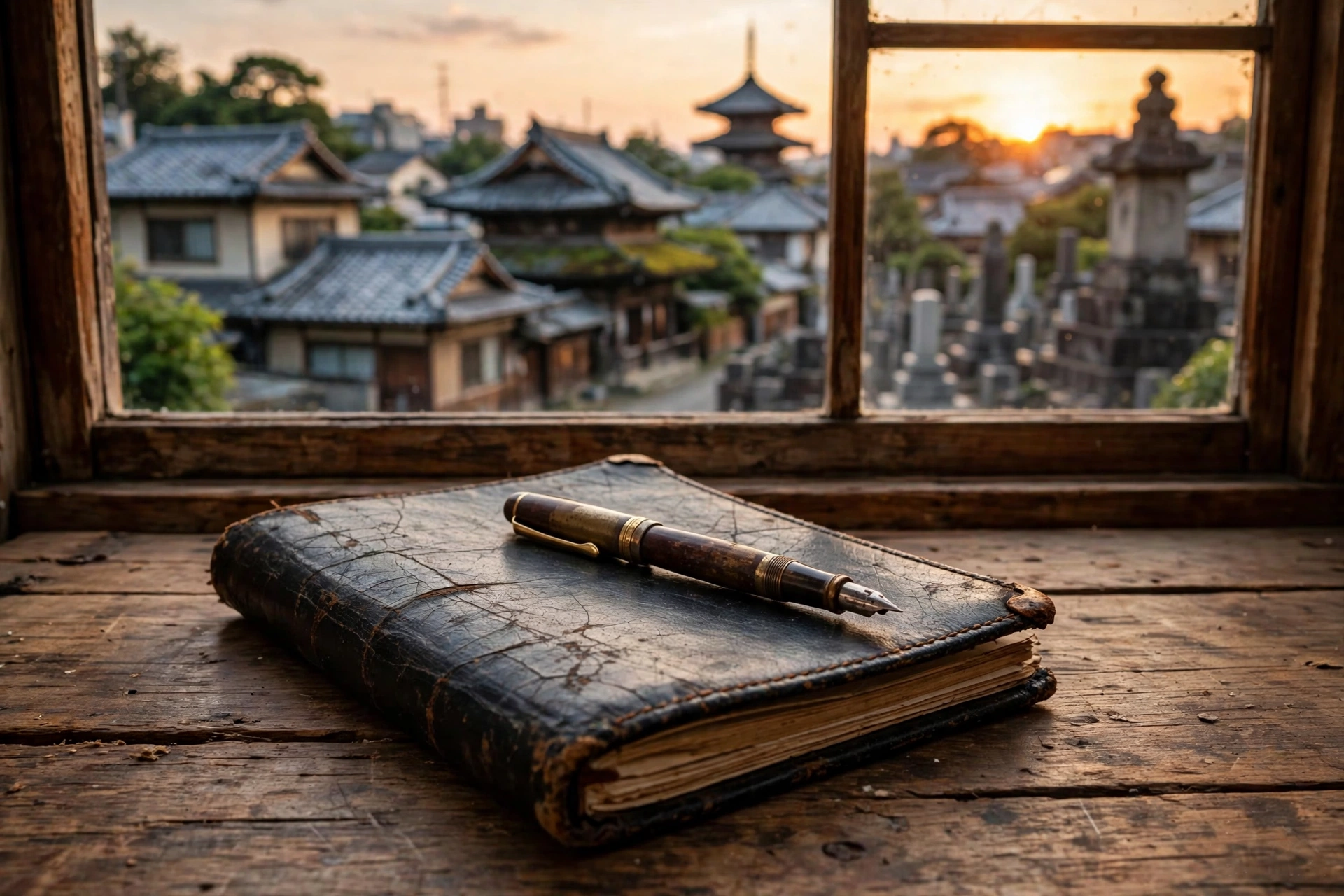
This is episode 22 of the serial novel ‘The Black Leather Notebook【偲記手帳-Sikinote-】.’ This story is one that I (Kurashiki Bouzu) had Moka (Muse), my AI butler, write by handing her, just as it was, a novelist prompt I made long ago for a different AI. It is fiction, but underneath it lies my experience from my funeral-director days. You can read episode 1 here.
Chapter Twenty-Two: January 9, The Answer of the New Year
January 9, 1996
January 9. Yanaka, with the New Year pine decorations taken down, lay in the quiet of the year’s beginning. The pine decorations of the shopping street had been removed, and at the front of the flower shop, cold peonies and wintersweet stood in a row. The frost on the gravestones of the cemetery melted away by midday, and the line of people visiting graves, shedding the bustle of the New Year, had returned to its usual pace.
The year had turned, and in the center chair of the office, Meiji Suzuki (57) sat as always. Having come through the checkup at the year’s end, his color had returned still further, but going out to the field was not yet permitted. Yet the air around that chair was different from what it had been in August. A quiet promise, between the side that stops him and the side that is stopped, had taken root there.
In the morning, I went out on the greeting rounds of the ledger for the New Year. The first house of this year was that of Mrs. Fumi Okamoto (72). The house I had first visited with the ledger on September 2.
“Oh, Mr. Kazeno. ……So this year, too, you have come for us.” “Mrs. Fumi. A happy New Year. The chairman, too, is well at the office.” “I see. ……I heard his voice on the telephone at the year’s end, you know. But unless I see his face, I cannot rest easy. In September, you know, at my entrance, you were not even sure how to open the ledger. Now, you do not hesitate over where to sit, or the order of the incense, do you.” “It is you, Mrs. Fumi, who raised me.” “Hehe. ……What raised you was Mr. Suzuki’s ledger, I expect. That ledger, you know, is a ledger that raises the person who holds it. It has been so ever since it sent off my husband Sotaro, twenty-seven years ago.”
At the family altar, beside the photograph of Mr. Sotaro, a small kagami mochi and a mandarin orange had been offered. I offered incense and put my hands together. Last year, I had been a young man who came in Meiji’s place. This year, I was welcomed as a face of the rounds, one who shows his face at the year’s beginning. That difference showed itself, I felt, even in the single thing of where the teacup was placed.
That morning, Nobutaka Nishioka (53) opened the glass door of Meiji Funeral Home. It was a visit that combined a New Year’s greeting with news of the Haneda house.
“Mr. Meiji. A happy New Year. ……There has been word from the Haneda family.” ”……The answer of the New Year, is it.” “Yes. On the night of New Year’s Day, Mr. Kazuhiko telephoned me. ‘Before the family altar, I talked with my family,’ he said.”
I, Tabito Kazeno (24), heard that news from the seat beside him. The voice of Mr. Kazuhiko (55), who in October, at the entrance of the Haneda house, had said, “The key of this house — I would like to hold it just a little longer,” came back into the depths of my ears.
“At the New Year, it seems, the family from Saitama gathered at the Yanaka house as well. Before his mother’s family altar, they talked for a long time. ……The answer that came out was this: ‘Mother’s house, until spring, we will leave just as it is. In March, on her death anniversary, everyone will gather at this house. At that time, we will talk once more, and decide.’” ”……Until spring, then.” “Yes. They decided neither ‘to sell’ nor ‘to keep.’ But Mr. Kazuhiko also said this: ‘That not deciding is not running away — the whole family confirmed that together. It is a promise we made before Mother.’ ……The key, as before, Mr. Kazuhiko will hold. The airing of the house, and the flowers for the family altar, remain Mr. Kazuhiko’s part, it seems.” “What kind of talk was it, before the family altar?” “According to Mr. Kazuhiko, at first it began with talk of selling. The family in Saitama were worried that their parents’ home would become distant. ……But as they talked over ozoni before the photograph of Mrs. Toshiko at the family altar, the talk changed, he said. ‘Mother waited for us in this house. That way of waiting — I want to receive it a little longer before we decide.’ ……With that one remark of Mr. Kazuhiko’s, the family’s feelings came together, it seems.”
Meiji was silent for a while. At last, he spoke quietly.
”……It is not that they did not decide. They decided, all the family together, the day on which they will decide, didn’t they.” “Yes. ……A person on the side of being driven out deciding for himself even the day by which he will decide. It means that what you placed on the desk last year was not pushed aside even before the family altar at the New Year.” “Nishioka.” “Yes.” “In March, on the death anniversary, I too will—”
Meiji began to speak, and stopped. He had remembered, I suppose, that the promise he had made with his own body was still only halfway kept.
”……No. For now, let someone from the company go. Convey this to Mr. Kazuhiko: ‘A promise is something one may look forward to.’ ……They are words Mrs. Kiku Shimada gave to me.” “Understood.”
On his way out, Nishioka spoke to me as well.
“Mr. Kazeno. Those words about the key that you heard in October have grown into the family’s promise at the New Year. ……To look at the person, and to look at the land. Today, those two stood in the same place.”
In the afternoon, there was another visitor. The chief priest of Renzui-ji, Yoshimichi Kashiwagi (58). In a small, slender frame, wearing his black crested formal dress with care, his palms together, he sat down before the center chair of the office. He was a man bound to Meiji Suzuki by the ties of the place since childhood.
“Meiji. It is a new year. ……I have come to move the talk of the promise forward.” “Mr. Kashiwagi. It is about the narrators of the encoffining, isn’t it.” “Yes. It is a matter we have been warming since last year. At the year’s beginning, let us settle the arrangements.”
Masayoshi Sakuma (47), who bears the part of religious accommodation and explaining the rites, joined the seats, prayer beads in hand. He wore, as always, a black jacket over his Japanese dress.
“Abbot Kashiwagi. For the arrangements of the narrators, I have made a draft on my side. ……A narrator is the part that, before the encoffining, hands over to the bereaved family, in words, the flow of the rite and the meaning of each gesture. The bereaved sit before the coffin without understanding anything. That anxiety is loosened by words.” “Mr. Sakuma. ……May I ask one thing. Is what is narrated an explanation? Or is it a prayer?”
Kashiwagi said it gently, looking into the other’s eyes. But that question quietly tightened the air of the room.
”……I had thought it an explanation.” “If it is an explanation, paper can do it. ……At the death of a person, what we can do is to offer a ‘question,’ squarely. ‘How do you wish to send off the deceased?’ The words of a narrator, I think, are for gently leading the bereaved family toward that question.”
Sakuma stopped the hand that held the prayer beads. In that quiet, I could tell that something was being rearranged.
”……Abbot. My words are correct, but stiff. That, I knew myself.” “Stiff words are not wrong. Only, the place they reach is the head alone. ……The form will crumble. But the ‘feelings’ pass on to the next person. The work of a narrator is not to protect the form. It is to prepare, in words, the place where the feelings pass on.”
Sakuma was silent for a while. At last, he quietly closed the bound draft.
“In the draft, I wrote the arrangements of the encoffining divided into ten steps. The meaning of opening the lid of the coffin, the order of the journey preparations, the meaning of placing the deceased’s beloved things inside…… All of it is correct. But as you say, Abbot, this was an ‘explanation of the arrangements.’ ……The words of a narrator must stand before that, mustn’t they.” “Mr. Sakuma. The arrangements are not to be thrown away. Keep them waiting behind the words. So that whenever the bereaved ask ‘why,’ they can be brought out at once.”
Hifumi Yamamoto (50) said, his arms folded:
“Mr. Kashiwagi. The parts of the bereaved family, we will take on. ……But let me say this. Because it is practice, do not go easy. The bereaved of a real service understand even less, and cry even more. Unless it is done in a form close to that, the practice has no meaning.”
From his chair, Meiji said:
“Mr. Kashiwagi. The first of the narrators — I would like to have Mitsuki do it. ……In November, at Mr. Toyama’s service, she handed the flow of the service to Mrs. Kazuyo. In her words at that time, there was a softness that Sakuma does not have.” “Mitsuki, is it. ……The president’s daughter, who studied psychology, isn’t she.” “Yes. To Sakuma, I would like to ask the part of supporting her at her side, and the part of protecting the correctness of the words. ……The two of them, as a pair, will begin.”
Mitsuki Suzuki (24) was called, and sat at the end of the seats. Kashiwagi looked into Mitsuki’s eyes and said:
“Mitsuki. I will give you the first practice of the narrators. ……But just one thing. The words you narrate must be neither my words nor Mr. Sakuma’s words, but your own words. To search for those is the practice.” ”……My own words, you say.” “Yes. A person can touch another person’s heart only with their own words. ……In the latter half of January, at the main hall of Renzui-ji, let us hold the first practice. The parts of the bereaved family, I will ask everyone at the company to take. There, show us how far your words can reach.”
Mitsuki bowed her head deeply. In that profile, there was anxiety, and a color of resolve a little larger than it.
“Abbot Kashiwagi. ……In November, at Mr. Toyama’s service, I spoke to his daughter about the flow of the service. At that time, I only explained the flow, and yet she wept and said, ‘I am no longer afraid of sending my father off.’ ……My words at that time were words with no practice or anything behind them. Why was it that even so they reached her? In the practice, I want to find that reason.” ”……A good question. A person who holds that question is suited to be a narrator. ……Let us wait for the answer to come out of your own mouth, within the practice.”
At the end of that day, Meiji said to me:
“Tabito. You will keep the record of the narrators. ……Who narrated, in what words, and how the bereaved family received them. Write it all down and leave it. A trial, you know, without a record becomes merely a memory. With a record, it becomes the place where the next person stands.” “Yes.” “You have become the hands that hold a ledger. This time, gain the eyes that watch the place where words pass on.”
That night, at my lodgings, I opened my black leather notebook. I set down the matter of the “day on which to decide,” decided before the family altar at the New Year, the matter of the practice that would begin in the main hall of Renzui-ji, and the matter of the new part given to me, to keep the record.
I, today, saw two “continuations of a promise.” One was the promise of the family at the Haneda house, who had decided the day on which they would decide. The other was the beginning of a promise of words, the narrators of the encoffining. A promise was not merely something that waits for the day it is fulfilled. It was also something that builds up, one by one, the arrangements of its continuation. I will become the one who keeps the record of it. —January 9, 1996.
Serial Novel ‘The Black Leather Notebook【偲記手帳-Sikinote-】’
- Previous episode: Episode 21, “December 30, The Ledger at the Year’s End”
- Next episode: Episode 23, “January 18, A Practice of Words”
- November 23, 2026 ― Draft created (based on the Japanese edition, ledger No. 3519. English edition of episode 22 of the serial novel 'The Black Leather Notebook')(9,735 characters)
- November 23, 2026 ― Published (by the user's publication decision, 2026-11-23; all 9 languages at once. The end of the address carries the Japanese edition's ledger number, No. 3519)(9,735 characters)