
Serial Novel 'The Black Leather Notebook【偲記手帳-Sikinote-】' Episode 23 — January 18, A Practice of Words
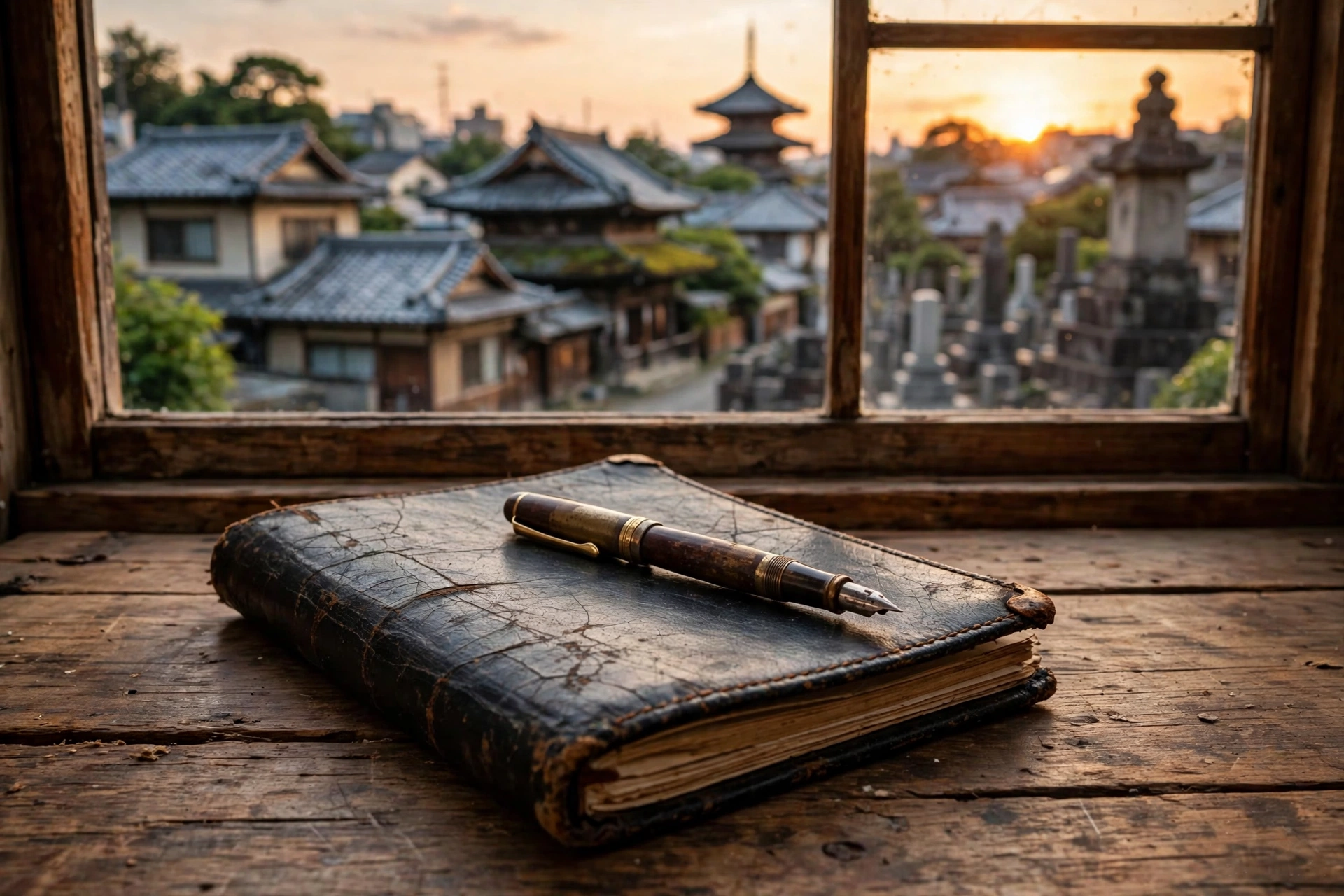
This is episode 23 of the serial novel ‘The Black Leather Notebook【偲記手帳-Sikinote-】.’ This story is one that I (Kurashiki Bouzu) had Moka (Muse), my AI butler, write by handing her, just as it was, a novelist prompt I made long ago for a different AI. It is fiction, but underneath it lies my experience from my funeral-director days. You can read episode 1 here.
Chapter Twenty-Three: January 18, A Practice of Words
January 18, 1996
January 18. In the main hall of Renzui-ji, the morning cold had soaked into even the weave of the tatami. A temple of the Jodo Shinshu Hongwanji school, standing at the edge of Yanaka. Its fifteenth chief priest, Yoshimichi Kashiwagi (58), wearing his black crested dress and his kesa with care, sat in the middle of the main hall. For that day’s practice, inside the hall, a single coffin carried in from the hall of Meiji Funeral Home had been quietly placed. Inside the coffin was nothing. But standing before that empty coffin, a person’s back straightened of itself.
Those who had gathered were Mitsuki Suzuki (24), Masayoshi Sakuma (47), Hifumi Yamamoto (50), Go Watarai (42), and I, Tabito Kazeno (24). Meiji Suzuki (57) remained in his chair at the office. The results of the practice were to be carried back in the record. That was the part handed to me.
On the way to Renzui-ji, Mitsuki was silent the whole time. At the place where we had climbed to the top of the cemetery hill, she said, in a small murmur:
“Mr. Kazeno. ……Last night, you know, I tried writing something like a script. All the words I would say.” “Mitsuki.” “But this morning, I threw it away and came. ……Abbot Kashiwagi’s words would not leave my head. ‘They must be your own words.’ The words I wrote felt like yesterday’s words of mine, not today’s.” ”……I think that was the right thing.” “There is no basis for it, though.”
Mitsuki laughed a little. In that laugh there was a color a little different from the tension of that day in August, when she had stood straight-backed before the spirit shelf. That day’s tension had been a tension for protecting. Today’s tension was a tension for stepping out.
“Today is a practice. ……But in a practice of standing before a coffin, there is no ‘pretend.’ Those playing the bereaved family, please sit as if it were the real thing.”
Kashiwagi put his palms together, and looked into the eyes of Yamamoto and Watarai, one by one.
Yamamoto and Watarai sat in the seats before the coffin. Their parts were the chief mourner and his younger brother. Those two backs changed the air of the practice into the air of a real service.
The first to stand was Sakuma. Sakuma, prayer beads in hand, stood beside the coffin and began quietly to narrate. The arrangements of the encoffining, the meaning of the journey preparations, the origins of the things placed in the coffin. Each one was correct, and there was no cloudiness in the words. But when he had finished narrating, in the main hall, only quiet remained.
”……Mr. Sakuma. It was splendid. Just as in the textbook.” “Abbot.” “But just now, I could not picture the face of the deceased. ……What was narrated was the rite called ‘encoffining,’ and not the ‘someone’ inside this coffin.”
Sakuma lowered the hand that held the prayer beads.
”……Before the practice, you said it, Abbot. The words of a narrator are for leading the bereaved family toward a question. In my narration, that question was not there.” “Yes. ……Correctness is to be kept waiting behind. What is brought forward is the question. Now, Mitsuki. It is your turn.”
Mitsuki stood before the coffin. Her hands were trembling slightly.
”……Um. Today, the preparations for your father’s journey…… First, the encoffining is a rite in which the deceased is given their final dressing……”
Her words grew thin halfway. Yamamoto, still in the part of the chief mourner, said quietly:
“Mitsuki. ……Forgive me. I am supposed to be in the part of a grieving man, but your words are flowing over the top of my head. Nothing remains.” ”……I am sorry.” “Do not apologize. It is a practice. ……Once more.”
Mitsuki closed her eyes. There was a long silence. Outside the main hall, a crow called.
Then Mitsuki turned, with her whole body, not toward the coffin, but toward Yamamoto and Watarai.
”……Mr. Yamamoto. Mr. Watarai. The two of you, sitting here today, have only just lost someone dear. There must be many things you do not understand. There must be things you are afraid of, too. ……What I am about to do is not an explanation. It is a time for finding, together, what you would like to do for your father, at the very end.”
The air changed. Yamamoto’s folded arms came undone.
”……A person does not make their final preparations only for themselves. That the family left behind can feel ‘we sent him off properly’ is also part of those preparations. From here, we will cleanse your father’s body and dress him in the garments of the journey. I will put each one of those into words, so if there is anything you do not understand, please ask, right there. To ask is not a discourtesy. ……That you ask will become a gift to your father.”
Watarai quietly opened the hands that had been folded on his knees.
”……Mitsuki. Then, may I ask. ……Why do we put things into the coffin? Even the cigarettes my brother liked — may we put those in?” “Yes. ……You may. There is an old saying that it is so the deceased will not be in want in the other world. But I think there is one more meaning. The time spent choosing the things to put in is a time for the family to remember the things the deceased loved. ……What kind of cigarettes did your brother like?”
Yamamoto, with a face that had forgotten the part of the chief mourner, murmured:
”……Mitsuki. Where did you learn those words just now?” “I did not learn them. ……In November, when I spoke to Mr. Toyama’s daughter about the flow of the service, that person, weeping, began of herself to talk about ‘the things my father loved.’ That was when I understood. It was not that my words had reached her; it was that the words that had been inside her had come out. ……The work of a narrator, I think, is not to bring things out, but to prepare the place where they come out.”
The main hall fell silent. Kashiwagi put his palms together again and spoke quietly.
”……The form will crumble. But the ‘feelings’ pass on to the next person. What has happened here, just now, is that. Mitsuki’s words did not carry the arrangements. In their place, they called back, from inside Yamamoto, the figure of his ‘elder brother.’ ……That is a narrator.”
The practice continued until midday. Mitsuki stood before the coffin three times. The second time, when her words caught, Sakuma, from behind her, handed her the correct arrangements in a small voice. By the third time, those arrangements were waiting, naturally, behind Mitsuki’s words. The words to bring out, and the words to hold back. That ordering, in a single day’s practice, gradually took shape.
Watarai rose from the seat of the bereaved family and said quietly:
“Mitsuki. Let me say this, from one who has long done the work of the proceedings. ……In the middle of a service, the faces of the bereaved grow stiffest just before the encoffining. They do not know what is about to begin. That stiffness of ‘not knowing’ — today I saw it loosen under your words.” “Mr. Watarai.” “But one thing. Your words are gentle, and just for that reason, if they grow long, they steal the bereaved family’s time to think. ……One who narrates must also make places to be silent. Half words, and half silence.” ”……Yes. Places to be silent, you say.” “Yes. Silence is the time when the bereaved look at the face of the deceased. A narration that steals that time, however correct it may be, narrates too much.”
Mitsuki wrote those words down in her notebook. On a day of practicing how to narrate, to be taught how to be silent. That order, I thought, was the depth of this work.
As we were leaving, Kashiwagi said:
“Mitsuki. ……For the first real service, let us begin with a small one, in a place where the family has given their understanding. There is no need to force yourself to stand in a large place. Feelings pass on surely in a small place, precisely because it is small.” “Yes.” “Mr. Sakuma. At Mitsuki’s side, please protect the correctness of the words. ……Your correctness is not something to throw away. A new post has been made for you: to keep it waiting behind.” ”……Understood. I, too, today, was on the side that received the practice.”
Before leaving the temple, Sakuma stood for a while beneath the plum tree in the grounds. When I spoke to him, he said quietly:
“Mr. Kazeno. Since the days when I was an apprentice monk, I have been taught that words must be correct. Correctness, for thirty years, has been my backbone. ……Today, I was told to keep it waiting behind. Honestly, at first, it was as if my bones were being taken out.” “Mr. Sakuma.” “But at Mitsuki’s second time — the words of the arrangements that I handed her from behind, that person changed into her own words and brought them forward. ……My correctness had not disappeared. Behind that person’s words, it had become a support. Correctness that supports — today, I learned of it for the first time.”
Sakuma gripped his prayer beads once more. In that gesture there was not regret, but the quiet resolve of a person standing in a new post.
Returning to the office, I placed the record of the practice on Meiji’s desk. Meiji put on his reading glasses and read it quietly, page by page.
”……Mitsuki was able to say that much, was she.” “Yes. ……Mr. Yamamoto had a face that had forgotten the part of the chief mourner.” “I see. ……Tabito. In the record, write only the facts. There is no need for words of praise. The worth of today’s practice is for the next person who reads this record to decide.” “Yes.” ”……And one more thing.” “Yes.” “I could not go to the place of the practice. But in this record, the air of the main hall reached even me, who could not go. ……A record, you know, is also for those who could not go. Your part is larger than you think.”
I bowed my head. The eyes that keep the record, handed to me after the hands that hold the ledger. Their weight remained quietly in my body, together with the cold of today’s main hall.
That night, at my lodgings, I opened my black leather notebook. I set down the matter of the air that had changed before the empty coffin, the abbot’s words about offering a question, and the matter of the new post of keeping oneself waiting behind the words.
I, today, watched a practice of words. To narrate, I had thought, was to deliver. But what happened in today’s main hall was not delivering. A place had been prepared where the words sleeping inside those who listened could come out. The form will crumble. But the feelings pass on to the next person. I learned that the work of preparing the place where they pass on is the narrator’s. —January 18, 1996.
Serial Novel ‘The Black Leather Notebook【偲記手帳-Sikinote-】’
- Previous episode: Episode 22, “January 9, The Answer of the New Year”
- Next episode: Episode 24, “January 25, The First Storyteller”
- November 23, 2026 ― Draft created (based on the Japanese edition, ledger No. 3528. English edition of episode 23 of the serial novel 'The Black Leather Notebook')(9,113 characters)
- November 23, 2026 ― Published (by the user's publication decision, 2026-11-23; all 9 languages at once. The end of the address carries the Japanese edition's ledger number, No. 3528)(9,113 characters)