Serial Novel 'The Black Leather Notebook【偲記手帳-Sikinote-】' Episode 25 — February 5, A Single Envelope
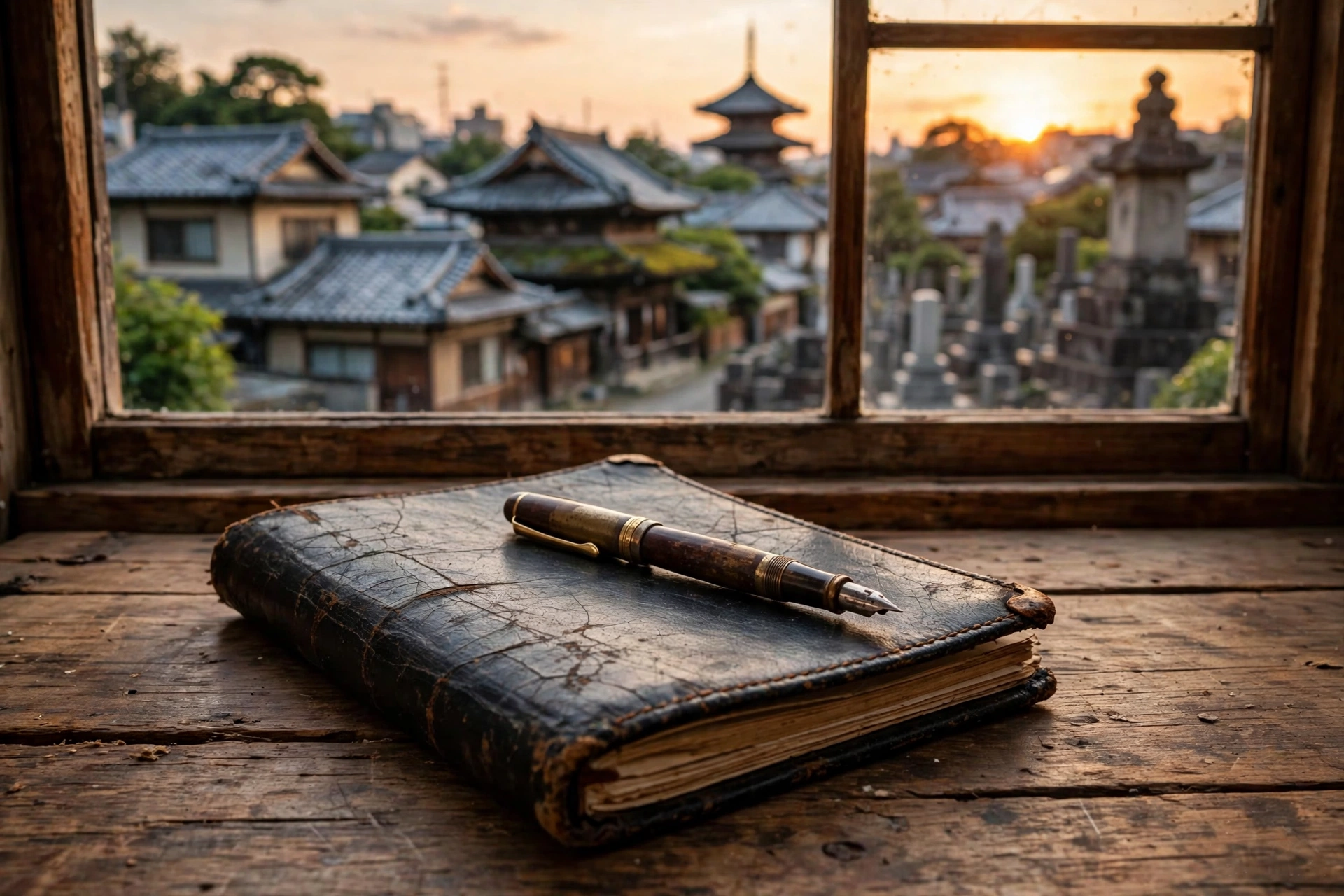
This is episode 25 of the serial novel ‘The Black Leather Notebook【偲記手帳-Sikinote-】.’ This story is one that I (Kurashiki Bouzu) had Moka (Muse), my AI butler, write by handing her, just as it was, a novelist prompt I made long ago for a different AI. It is fiction, but underneath it lies my experience from my funeral-director days. You can read episode 1 here.
Chapter Twenty-Five: February 5, A Single Envelope
February 5, 1996
February 5. Even after Setsubun had passed, the cold of Yanaka had not yet loosened. The plum trees of the cemetery were still tight buds. But at the fishmonger’s shopfront in the shopping street, the fish of early spring had begun to line up, and the town’s time was turning, in places the eye could not see, little by little toward spring.
That afternoon, on the desk of the reception room of Meiji Funeral Home, two things lay side by side. One was the fair copy of a will, set in the form of the law. The other was a copy of a small notebook written in the hand of Mrs. Sumiko Fujii (78) herself.
A little after noon, Mari Kawaguchi (31) placed Mrs. Sumiko’s file on the desk of the reception room. The file, born on the day of the pre-need consultation in October, had grown quite thick over four months.
“Today, you know, Kazeno, is not a day to add a new promise to this file. ……It is a day to seal the promises.” “To seal them?” “A day of ending matters more, in truth, than a day of beginning. ……A promise only begun flies away on the wind. A sealed promise can wait quietly until the day someone opens it.”
Mitsuki Suzuki (24) placed the bound record of the funeral of Mr. Kikuo Fujii, from six years before, beside the file.
“Father. ……I have brought Mr. Kikuo’s record again today. Inside Mrs. Sumiko’s wishes, there are several things about Mr. Kikuo’s service.” “Yes. ……Beside the record of the one who was sent off, the promises of the one who will be sent off are decided. That is the desk of this house.”
Meiji Suzuki (57) gazed for a while at the two sheets of paper that were not yet an envelope.
Naho Mizushima (36), of the Akatsuki Judicial Scrivener’s Office, sat facing Mrs. Sumiko. Nobutaka Nishioka (53) attended her, and Meiji Suzuki (57), from the middle chair, watched over the scene. I, Tabito Kazeno (24), sat at the end of the row, in the part of keeping the record.
“Mrs. Sumiko. Today, the will is complete. ……Before you sign, let us read it through together once more, from the beginning. It is written in the words of the law, but its contents all have their source in your own words, Mrs. Sumiko.”
Mizushima read it aloud, one item at a time, slowly. That the Buddhist altar and the memorial tablet were to be moved to the house of her niece in Chiba, Mrs. Mayumi Ogawa (49). That the order of contact was to be Mayumi first, then Nishioka, and that the people of the neighborhood were to be told quietly, after the service. That the cost of the funeral was to come from the savings Mrs. Sumiko had set aside little by little. That the plants of the garden were to be left standing, not cut down.
Each time she read, Mizushima looked at Mrs. Sumiko’s face. Mrs. Sumiko nodded, a small nod, at each one.
”……I do not want to be a burden to Mayumi. That is exactly why I am deciding it now.” “Yes. That feeling cannot be written in the text of the law. ……So let us leave it here, instead.”
When the reading reached the item about the garden plants, Mrs. Sumiko raised a hand, a little.
“Ms. Mizushima. ……About the plants, you see, since my husband died, I have been the one to water them. Six years since his hands let go of them. And still, the plum tree in the garden blooms every year. This year, too, the buds have begun to swell.” ”……Behind the words ‘leave them standing, do not cut them,’ there are those six years, aren’t there.” “Yes. ……In the text of the law, all that can be written is ‘the garden trees shall not be felled.’ But in my written wishes, I want it written. ‘When the plum blossoms, please let Mayumi see them, too.’” “Let us write it. ……It is for words like those that the written wishes exist.”
Mizushima wrote Mrs. Sumiko’s words into the written wishes, on the spot. A person of the law, writing down the person’s own words, before the person’s own eyes. That way of the hand reminded me of Meiji’s red pencil, in this office in October, when I rewrote the record of the pre-need consultation. The one who writes is the one who keeps in trust. At the desk of the law, too, it was the same.
Mizushima showed the other paper. It was the “Written Wishes,” copying just as they were the words of Mrs. Sumiko’s notebook. “Please put in the pruning shears my husband used.” “For the flowers, not only white chrysanthemums — I would like the seasonal flowers of my husband’s plants put in as well.” The words that Meiji, at the pre-need consultation in October, had said to “write in the person’s own words” were there.
“The will is the form of the law. This written paper is the person’s voice. ……With form alone, feelings cannot be carried. With voice alone, they cannot be protected in the place of the law. So we put these two into a single envelope. So that, when the day to open it comes, form and voice come out together.”
Mrs. Sumiko compared the two sheets of paper for a while.
”……My handwriting is poor, though.” “Even if it is poor, it is your hand, Mrs. Sumiko. ……What Mayumi will read, before the text of the law, I think, is this hand of yours.”
Mrs. Sumiko signed the will. It was a straight hand, without a tremor. Mizushima placed the two documents in an envelope and sealed it. On the face of the envelope, in Mizushima’s hand, was written “Mrs. Sumiko Fujii — Will and Written Wishes.”
“This envelope will be kept in trust at Meiji Funeral Home. ……It will be opened only at the time when the arrangements for your service begin, Mrs. Sumiko.”
Mari Kawaguchi (31) received the envelope in both hands and laid it away in the safe. Meiji spoke from his chair.
“Mrs. Sumiko. You have sealed it.” “Yes, Chairman.” “Then this matter ends today. ……After this, let us talk of living. You still have a promise. The promise not to die before me.” “Hee hee. ……I remember. Because I have that promise, I cannot die yet.”
The air of the reception room loosened. At that moment, Nishioka took another envelope out of his bag.
“Mrs. Sumiko. There is one more piece of news. ……A formal reply has arrived from the developer’s side.”
The air of the room tightened, quietly. Whether Mrs. Sumiko’s house would be included in the redevelopment plan. It was the answer to that matter which Nishioka Real Estate had proposed at the meeting in November.
“I will say the conclusion first. ……Your house, Mrs. Sumiko, has been removed from the scope of the plan.” ”……Removed.” “Yes. The wording was made by Hikawa. ‘It is not that we bend the plan for the sake of one house. The plan’s side will wait for the time of the person who lives in that house’ — that is what was conveyed to the developer, I am told. ……There is just one condition. If, in the future, you should let go of the house, Mrs. Sumiko, then before you sell it, we would like you to speak first to the developer’s side. That is all.” “To speak to them first.” “It is not a promise to sell. It is a promise about the order of consultation. ……The one who decides will be you, Mrs. Sumiko, at that time.”
Mrs. Sumiko gazed for a while at the street outside the window.
”……Mr. Nishioka. A thing like speaking to them first — let us promise it. What to do with that house will be decided by me, as I am then. But keeping an order is not a bad thing. ……I have lived in this town, after all.” “Thank you.” “And, you see. ……My time is my own. But the time of that house, after my time, is the town’s time. If the bridge between them is the promise to speak first, that is just right.”
There, Mrs. Sumiko asked quietly.
”……This matter — when should I tell Mayumi?” “About the will, there is no need to hurry it, against reason. ……But that the house has been removed from the plan is better told. That child, far away, may be making her worry alone grow large.”
At Mizushima’s words, Mrs. Sumiko nodded.
”……Tonight, I will telephone her. In my own voice. ‘The house will remain,’ I will say. And, ‘When the plum blossoms, come and see.’ ……The talk of the will can come after that. Order matters, doesn’t it.”
Meiji, lowering his eyes, said:
”……Mrs. Sumiko. Today, you have made both a seal and a promise — to your own end, and to the beginning that comes after it.” “Chairman. ……To decide is not to give up. In October, I said that, didn’t I. Today is its continuation. Because I have decided, from tomorrow I can water the plants again.”
In the evening, on the way taking Mrs. Sumiko home, Nishioka said, as if to himself:
“Mr. Kazeno. ……The numbers stepped back today. On top of that desk.” “Yes.” “But numbers that have stepped back have not disappeared. Only their order has been decided. ……To go on protecting that order inside the company will become my work.”
Before Mrs. Sumiko’s house, we bowed our heads. Mrs. Sumiko, opening the lock of her front door, turned back and said:
“Mr. Kazeno. ……Please write today’s matters in the notebook. That today’s matters remain in a hand that is not my hand — that is not a bad thing, either.”
Returning to the office, I bound the record of the day into Mrs. Sumiko’s file. On a page far behind the record of the pre-need consultation, today’s record was placed. The file had grown one sheet thicker again.
Mrs. Akemi Suzuki (55) brought tea.
“Mrs. Sumiko’s envelope has gone into the safe, hasn’t it. ……It was a light envelope, but when I held it, it felt heavy.” “Ms. Akemi.” “A promise is not the weight of paper, is it. ……Until the day it is opened, someone waits. I think it is the weight of that waiting time.”
Meiji, from his chair, said quietly:
”……A sealed promise, until the day it is fulfilled, touches no one’s eyes. But even while it touches no eyes, it is certainly there. ……A person’s life, too, is, unexpectedly, an accumulation of such things.”
I looked toward the shelf where the safe stood. The envelope could no longer be seen. But its presence remained, certainly, in the air of the office.
That night, at my lodgings, I opened my black leather notebook. I set down the matter of the voice and the form placed together in a single envelope, and the words, “the time of that house, after my time.”
I, today, was present at the place where a single envelope was sealed. Inside it, the form of the law and the person’s voice lay placed side by side. The form protects the voice, and the voice carries a heart into the form. Meiji Suzuki’s words, “write it in the person’s own words,” were alive, in the same shape, at the desk of the judicial scrivener as well. And Mrs. Sumiko went home not as a person who had finished her preparations for the end, but as a person thinking of tomorrow’s watering. —February 5, 1996.
Serial Novel ‘The Black Leather Notebook【偲記手帳-Sikinote-】’
- Previous episode: Episode 24, “January 25, The First Storyteller”
- Next episode: Episode 26, “February 13, Arrangements for the Memorial Day”
- November 23, 2026 ― Draft created (based on the Japanese edition, ledger No. 3551. English edition of episode 25 of the serial novel 'The Black Leather Notebook')(9,070 characters)
- November 23, 2026 ― Published (by the user's publication decision, 2026-11-23; all 9 languages at once. The end of the address carries the Japanese edition's ledger number, No. 3551)(9,070 characters)