
Serial Novel 'The Black Leather Notebook【偲記手帳-Sikinote-】' Episode 26 — February 13, Arrangements for the Memorial Day
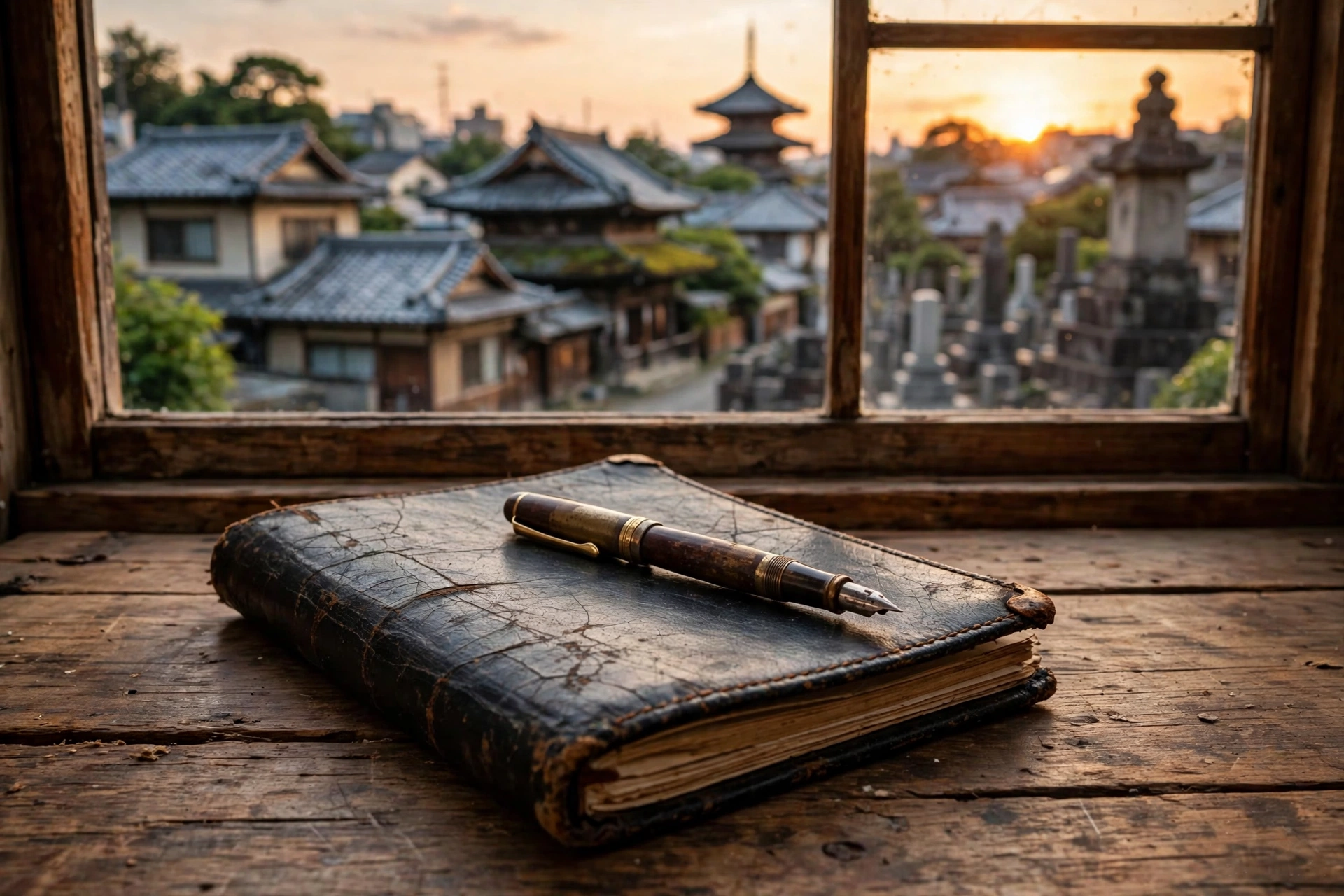
This is episode 26 of the serial novel ‘The Black Leather Notebook【偲記手帳-Sikinote-】.’ This story is one that I (Kurashiki Bouzu) had Moka (Muse), my AI butler, write by handing her, just as it was, a novelist prompt I made long ago for a different AI. It is fiction, but underneath it lies my experience from my funeral-director days. You can read episode 1 here.
Chapter Twenty-Six: February 13, Arrangements for the Memorial Day
February 13, 1996
February 13. In Yanaka, it had been a cold rain since morning. The stone towers of the cemetery were wet and black, and the people visiting graves hurried under their umbrellas. But inside the office of Meiji Funeral Home, it was quietly warm with the smell of the stove and the earnestness of the people seated before the arrangement sheets.
In the morning, Mitsuki Suzuki (24) had opened, on her desk, the notebook of the storyteller’s records. It was the last page of the record of January’s real occasion.
“Kazeno. …The other day, I went to Mrs. Chiyo’s home, to pay my respects after everything.” “You mean Mrs. Chiyo of the Matsunaga family?” “Yes. …She was calm. In front of the photograph of Mr. Shigeru at the family altar, she said, ‘Because I could send him off understanding, it is a comfort to put my hands together every day.’ …I felt that the words that reached her on the day of the service are still alive, inside each of her days since.” “Mitsuki.” “The storyteller’s work does not end on the day of the service. …Just as Father said.”
Masayoshi Sakuma (47), rosary in hand, said quietly:
”…Today’s consultation is about the arrangements for a memorial service, I hear. A memorial service and an encoffining look alike, but they are different places. …I would like to confirm that difference for myself, too, within today’s conversation.” “Mr. Sakuma.” “Rightness has a different place to stand, in each place. …That is what I learned in January.”
That day, Mr. Kazuhiko Haneda (55) visited the office, accompanied by Nobutaka Nishioka (53). It was a consultation about the arrangements for the gathering in March.
At New Year, before the family altar, the Haneda family had decided. “We will leave Mother’s house as it is, until spring. In March, everyone will gather at this house. At that time, we will talk once more, and decide.” There was now about a month left until the day of that promise.
“President. …Today, I have come to consult you about the arrangements for March.” “Mr. Haneda. Thank you for coming. …Let me hear it, one thing at a time.”
Meiji Suzuki (57), from his chair, looked straight at Mr. Haneda. I, Tabito Kazeno (24), took the record in the seat beside him. Mitsuki Suzuki (24) and Masayoshi Sakuma (47) were present as well.
“First, the people who will gather. My family will come from Saitama. …And I would like to invite the neighbors a little, too. They are the households Mother shared her pickles with every year. Some of them bring flowers on every anniversary of her death.” ”…Mrs. Toshiko’s people, from her street.” “Yes. …For the memorial service, I would like to ask Abbot Kashiwagi of Renzui-ji. The same temple as Mother’s funeral.” “We will speak to Mr. Kashiwagi from here. …Mr. Haneda. May I ask one more thing? On that day, what is it you want your family to decide?”
Mr. Haneda looked for a while at his hands on his knees.
”…It is not that I want them to decide. I want us to have, once more, properly, before Mother, the talk we need in order to decide. At New Year, our feelings came together. But what to do with the house is a matter of daily life. The family in Saitama has its own life in Saitama. …I want to have that talk before the family altar, without running away from it. That is all.” ”…I see. A family that has decided the day it will decide is strong. …On the day itself, how should the people of this house move?”
Mr. Haneda looked toward Mitsuki.
”…Mitsuki. I have a request. On that day, could you be beside us?” “Me, sir?” “You see, my family from Saitama does not know how a memorial service proceeds. And honestly, there is much I do not know either. …At New Year, when we talked on the telephone, my wife said, ‘Sitting there without understanding is the hardest part.’ …Word of Mr. Matsunaga’s service in January has been heard in the neighborhood. That Mrs. Chiyo said, ‘I understood, and I sent him off.’ Could we ask you to do the work of those words at our gathering in March as well?”
Mitsuki looked at Sakuma. Sakuma said quietly:
“Mr. Haneda. …Please let me confirm just one thing. The storyteller’s work is work for the place of the encoffining. A memorial service is centered on the chanting of sutras, and the way it proceeds is different. …Even if Mitsuki goes, it would not be as a ‘storyteller,’ but as someone who supports the day’s proceedings with words, from beside you.” “Mr. Sakuma. …The name does not matter. As long as we do not have to sit there without understanding.” “Sakuma. …You are right. If the place differs, the place of the words differs too. …But listen. The words ‘sitting there without understanding is hard’ — they are the same in the place of the encoffining and in the place of a memorial service, are they not?”
Meiji turned his eyes back to Mitsuki.
“Mitsuki. …Can you go?” “Yes. …I think it is different work from the storytelling of the encoffining. But if it is work that loosens ‘not understanding,’ I can do it, as a continuation of my practice. …Please let me consult Abbot Kashiwagi as well. Where I should sit at a memorial service, and how far my words may go. That is for the temple’s side to decide.” ”…A good answer. To look for your own place to stand, inside the other party’s place. That is the work of words.”
The arrangements were decided one by one. The flow of the day would be decided in consultation with Abbot Kashiwagi. The invitations to the neighbors, Mr. Haneda himself would make, visiting each house one by one. The flowers for the family altar would be brought by the family from Saitama. The cleaning of the house and the airing of its rooms, Mr. Haneda would do, as always.
”…And, after the memorial service, I would like everyone to eat together at that house.” “A meal?” “At New Year, when we talked while eating zoni soup before the family altar, the talk changed. …A talk that had begun from selling became a talk about the way Mother waited. A meal is a strange thing. …In March, too, before the talk of deciding, I would like us all to eat first. One of the neighbors said, ‘I cannot offer Mrs. Toshiko’s pickles, but I can offer mine.’” ”…Mr. Haneda. That order is a continuation of New Year. The talk of deciding comes after the stomachs are full.”
At Meiji’s words, Mr. Haneda smiled a small smile. That smile was already different from the heavy face of October, when he had pushed the key into the lock at the entrance.
“My grandchildren will come too. …Those children know Mother’s house only as ‘Grandmother’s house.’ I think that day will remain in their eyes as well.” ”…Yes. The memory of the day of deciding remains longer than what was decided. …Let us make it a good day.”
Sakuma said quietly:
“I will be the one to speak to Abbot Kashiwagi. …How far Mitsuki’s words may go at a memorial service — that is a question of the rightness of the arrangements. To ask the temple’s decision first is the proper order.” “Mr. Sakuma. …Thank you.” “No thanks are needed. …The rightness of standing behind is the same, even when the place changes.”
”…Mr. Haneda. The key to the house?” “I will keep it until March. …What comes after that, I will decide with my family on that day.”
When the consultation was nearly over, Mr. Haneda spoke as if he had made up his mind.
“President. …There is one more request.” “What is it?” “The day in March. …I would like you to come as well, President. I want to meet once more, in that house, the man who held Mother’s funeral. …I will not press you. I only wanted to tell you, as my feeling.” The office fell quiet. Meiji was silent for a while. At last, he said quietly:
”…Mr. Haneda. I receive your feeling with gratitude. Whether I can go depends on my body, and on my promise with my doctor. …But let me say one thing. This feeling of yours — that you want me to come — I will keep it here with me today. What is entrusted to me is like a ledger. I do not treat it lightly.” ”…Yes.” “I will give you my answer soon, without fail. …Please wait for me.”
Mr. Haneda bowed his head deeply. In his profile there was not disappointment, but the quiet brightness of a man who trusts what he has entrusted.
As they were leaving, Nishioka said to me in a low voice:
“Kazeno. …About Mrs. Sumiko’s matter — a formal document has arrived from the company. Her exclusion from the plan has been decided. Just as the Hikawa wording said.” “Is that so?” “That man has changed, too. ‘The numbers just need to be placed again,’ he said on the telephone today. …Order is something that gets passed on, isn’t it?”
Nishioka and Mr. Haneda walked back through rainy Yanaka, umbrellas raised. The man who holds the key, and the man who sees that man’s future. Their two backs looked a little lighter than on that day in October.
In the evening, Meiji called to me as I was making a clean copy of the arrangement sheet in the office.
“Tabito.” “Yes.” ”…From here to the Haneda house — how long would it take to walk?” “To walk, sir? …About thirty minutes, perhaps. It is beyond the cemetery hill, toward the outskirts.” “I see. …And to Renzui-ji?” “About ten minutes.” ”…Ten minutes.”
Meiji said nothing more than that. He only gazed for a while at the street outside the window, where the rain was beginning to lift. In his profile, I thought I saw a kind of quiet calculation I had never seen while he was in his chair.
Akemi Suzuki (55), who had brought tea, looked at Meiji’s profile and murmured:
”…Dear. You intend to walk, don’t you.” ”…Who knows.” “People who ask about distance have already begun walking, in their hearts. …Within a range that does not strain you. That is a promise.” “Yes. …Within the promise, then.”
Meiji picked up his teacup and nodded slightly. The promise between the one who stops and the one who is stopped was breathing quietly again today, in the middle of this office.
That night, at my lodgings, I opened my black leather notebook. I set down the arrangements for the March promise, the words “I will keep the feeling of wanting to go,” and the distance of ten minutes to Renzui-ji.
I, today, was present at the place where the arrangements for the March promise were being laid down. Arrangements are preparations for the day of deciding. And within those preparations, quietly, was included even the feeling of one man who does not know whether he can go — his feeling of “I want to go.” The promise, changing the shape in which it is kept, one by one, was still, surely, moving forward. —February 13, 1996.
Serial Novel ‘The Black Leather Notebook【偲記手帳-Sikinote-】’
- Previous episode: Episode 25, “February 5, A Single Envelope”
- Next episode: Episode 27, “February 20, The Road to Renzui-ji”
- November 23, 2026 ― Draft created (based on the Japanese edition, ledger No. 3560. English edition of episode 26 of the serial novel 'The Black Leather Notebook')(9,179 characters)
- November 23, 2026 ― Published (by the user's publication decision, 2026-11-23; all 9 languages at once. The end of the address carries the Japanese edition's ledger number, No. 3560)(9,179 characters)