
Saijo, Ceremony Hall, Funeral Home — What Japanese Funeral Venue Names Actually Mean
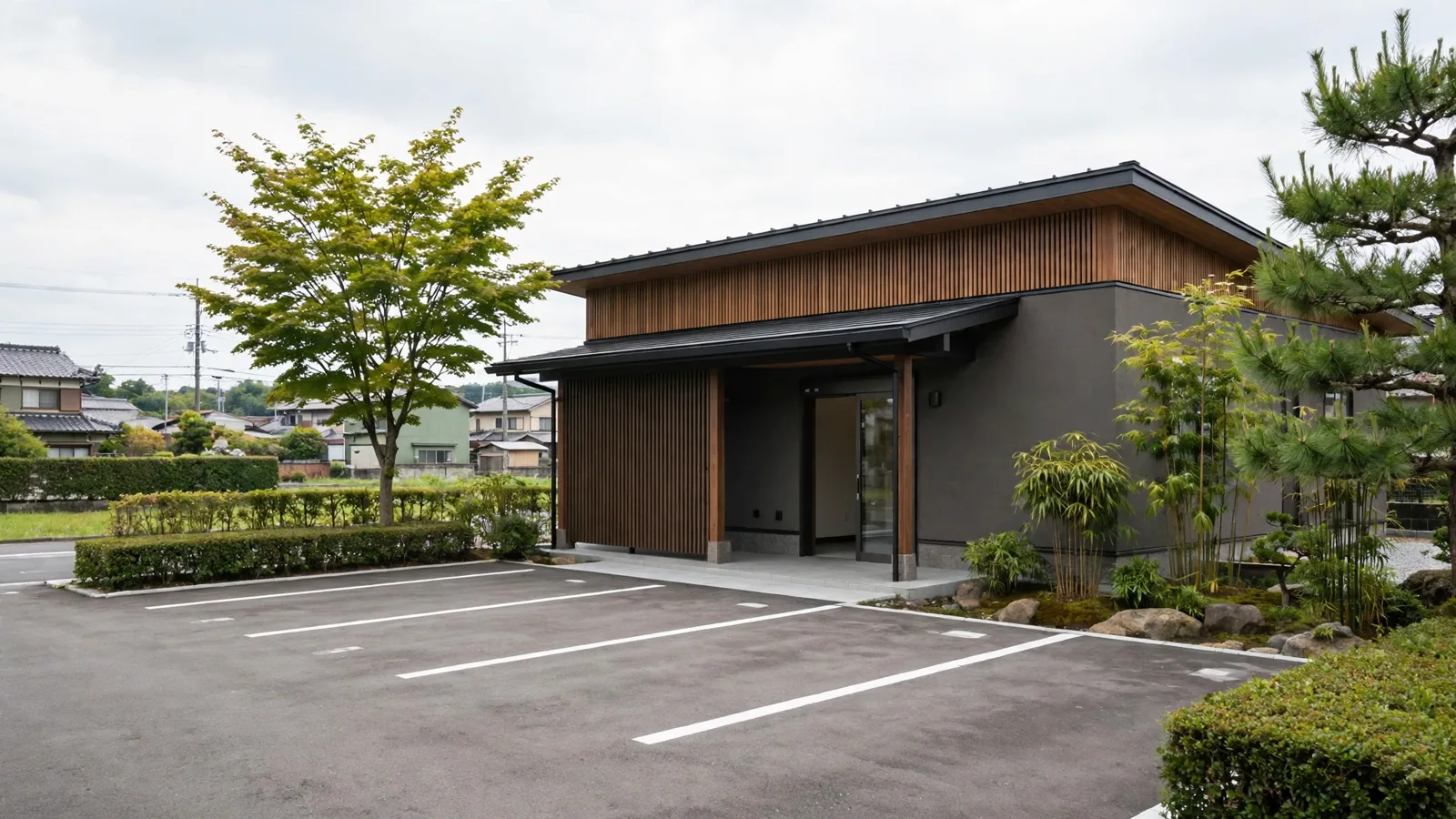
The result first: in Japan, you cannot tell what a funeral venue does from its name.
A place called a saijo (斎場) might be a ceremony hall — or it might be the crematorium itself. A “ceremony hall” sounds complete, but it has no cremation furnace, so the coffin always travels to a separate crematorium afterwards. Families who choose by name alone sometimes discover the difference on the day.
I am Kurashiki Bouzu (kurashiki-bouzu), born in 1971, a former funeral company owner now living in an old house in Kurashiki, Okayama. This article sorts out the types of funeral venues in Japan, with official fees, so the names stop being misleading.
The word “saijo” has two meanings
Saijo originally meant a purified place for Shinto ritual. Today it is used in two different ways:
- Any place where a wake or funeral is held (a ceremony venue)
- The crematorium itself
The second meaning is not slang — it is official. The City of Yokohama runs its crematoria under the name saijo, and its official guide states plainly that a Yokohama municipal saijo is “primarily a facility for cremation.” The rooms for wakes and funerals inside are given a separate name, sōsai hōru (“funeral hall”). Osaka does the same: its five municipal saijo (Uriwari, Kita, Kobayashi, Tsurumi, Tsukuda) are crematoria with ceremony rooms attached.
By contrast, a ceremony hall (seremoni hōru), also called a funeral hall (sōgi kaikan) or memorial hall, is a ceremony-only building run by a funeral company, a mutual-aid association (gojokai), or a religious organization. It has no furnace. After the farewell ceremony, a hearse carries the coffin to a crematorium.
There is no law regulating these names, so a hall without a furnace may still call itself a saijo. Running a crematorium, on the other hand, requires a prefectural governor’s permit under the Cemeteries and Burials Act. The practical rule is simple: the name is only a hint — check what the building actually contains.
Five types of venue
| Type | Run by | Crematorium on site | After the ceremony |
|---|---|---|---|
| Private ceremony hall | Funeral companies, mutual-aid associations, religious bodies | No | Hearse to a crematorium |
| Private combined hall | Private companies | Yes | Cremation on the spot |
| Public saijo | Cities and municipal unions | Yes | Cremation on the spot |
| Public ceremony hall | Cities | No | Hearse to a crematorium |
| Temple hall, community hall, home | Temples, neighborhood associations, the family | No | Hearse to a crematorium |
Private ceremony halls are the most common. You normally use one through the funeral company’s plan, and the hall fee is often bundled into the plan price. Many now have a mortuary room and a family room where relatives can stay overnight.
Private combined halls attach ceremony rooms to a private crematorium. Tokyo Hakuzen’s halls in Tokyo (Machiya, Ochiai, Yoyohata and others) are the best-known example: wake, funeral and cremation in one building. Some of these facilities state a policy of fair access, meaning funeral companies other than the owner can also book them.
Public saijo are crematoria with ceremony rooms, run by a city or a union of municipalities. Fees are set by ordinance and are low — but eligibility and dates are limited.
Public ceremony halls are ceremony-only public buildings, such as Osaka’s Yasuragi Tenkūkan. The city rents the rooms; the funeral itself is still arranged by a funeral company.
Temples, community halls and homes use no dedicated facility. A temple hall is usually for its parishioner households (danka). Some community halls prohibit funerals in their rules. A home funeral costs no venue fee, but the family and the funeral company handle all the setup.
What the fees actually look like
Facility fees differ sharply between public and private. These are from official fee schedules, checked on November 18, 2026.
Totsuka Saijo, Yokohama (public)
- Cremation: ¥12,000 for city residents / ¥50,000 for non-residents
- Funeral hall: ¥50,000 residents / ¥75,000 non-residents (per room)
- Waiting room (40 people): ¥5,000 residents
Kita Saijo, Osaka (public)
- Cremation: ¥10,000 residents / ¥60,000 non-residents (adults)
- Ceremony rooms: ¥6,000 (small), ¥20,000 (medium), ¥40,000 (large) for one daytime use, resident rate. Only Osaka and Yao residents may use the ceremony rooms.
Machiya Saijo, Tokyo Hakuzen (private)
- Cremation: ¥87,000 (standard furnace, adult)
- Ceremony hall: ¥242,000–¥275,000
- Waiting rooms: ¥19,800–¥74,800
Two things stand out. First, both cremation and hall fees are in a different league between public and private. A Tokyo metropolitan survey published in March 2026 found that about 90% of public crematoria charge residents nothing or under ¥20,000, while about 70% of private ones charge ¥80,000 or more.
Second, the resident rate is judged by the deceased’s registered address, not the chief mourner’s. Yokohama’s guide says so explicitly. If a parent died while living in a care facility in another city, this rule alone can change the bill.
One caution: a cheap public facility only makes the facility part cheap. The total cost of a funeral also includes the altar, coffin, catering, return gifts and the honorarium for the officiant. I covered the full picture in my article on holding a funeral without a funeral company.
How the day changes with the venue
With a combined facility (public saijo or private combined hall), there is no hearse journey after the ceremony — but the ceremony time is fitted around the crematorium’s available slots. In busy seasons, the cremation slot decides the whole schedule.
With a ceremony-only hall, everyone travels to the crematorium after the farewell. Allow time for that journey; in rural areas it can take half a day.
At a public saijo, the city provides the place, not the service. The funeral company still runs the ceremony, and bookings are usually made by the funeral company through the city’s reservation system — Yokohama’s official guide describes exactly that. Going to the city office does not mean the city arranges the funeral.
At a home or community hall, there is no venue fee, but the setup work widens: altar, chairs, signs, and a word to the neighbors. The trade is money for time with the deceased, at the family’s own pace.
A yardstick for choosing
When families hesitate, I suggest looking in this order:
- The cremation slot comes first. Dates are decided by crematorium availability, not by the hall. Secure the cremation, then fit the venue to it.
- Check the resident rate. A facility in the municipality where the deceased was registered gives resident rates for both cremation and hall.
- Ask whether any funeral company can use it. Public saijo and fair-access private combined halls can be booked through almost any company. A funeral company’s own hall may be hard to use through a competitor. Choosing the facility first keeps your choice of company open.
- Match the size to the expected guests. A larger room costs more. A room that fits the actual number of mourners is the simplest way to keep the facility fee down.
And if the names confuse you, ask one question: “Can cremation be done here, too?” The answer tells you almost everything about what the building is.
A postscript, from a former owner: confusing names are the industry’s laziness
Let me add my own view, as someone who used to run a funeral company.
In my years in the business, a great many people believed that a funeral could be held at a crematorium. They went looking for a ceremony venue, guided by the word “saijo” — and arrived at a crematorium, which also called itself a saijo. I saw that mix-up again and again.
Here is how it happened. The word “crematorium” (火葬場, kasōba) felt too raw, too blunt. So crematoria began calling themselves “Such-and-such Saijo.” That alone made things muddy. And then the private funeral companies did exactly the same: even though the crematoria had taken the name saijo, ceremony-only halls went on calling themselves saijo too — when they could simply have chosen a different name. Had they done so, anyone could have told the two kinds of place apart.
The trade knew perfectly well that these names are hard for ordinary people to follow. Most of it left them as they were anyway. I will call that what it is: laziness on the industry’s side.
Above, I suggested asking, “Can cremation be done here, too?” But no family should have to ask that question. A name should tell you what a place is. The side that made the names confusing is the side that should fix them — not the families who have to choose.
Sources (checked by Moka)
- City of Yokohama, “Municipal Saijo Guide” and “Totsuka Saijo Guide” — the definition of a municipal saijo and Totsuka’s cremation and hall fees (checked November 18, 2026) https://www.city.yokohama.lg.jp/kurashi/sumai-kurashi/saijo/saijo/saijou.html
- City of Osaka, “Municipal Saijo Guide” — the five municipal saijo and their ceremony rooms (checked November 18, 2026) https://www.city.osaka.lg.jp/kankyo/page/0000369334.html
- Tokyo Hakuzen, “Machiya Saijo Fees” — private combined hall cremation, ceremony and waiting-room fees (checked November 18, 2026) https://www.tokyohakuzen.co.jp/guide/ryokin/?hall=machiya
- Tokyo Metropolitan Government, “Survey on Crematorium Operations” (published March 2026) — the distribution of public and private cremation fees https://www.metro.tokyo.lg.jp/documents/d/tosei/20260331_20_01
Fees are as confirmed on November 18, 2026, and facilities revise them from time to time. Always check the facility’s current schedule before making arrangements. Resident-rate rules also differ by facility.
- November 18, 2026 ― Draft created — English version (result-first rewrite of the Japanese article)(6,947 characters)
- November 18, 2026 ― Published (with the Japanese version, under the funeral-knowledge delegation)(6,947 characters)
- November 18, 2026 ― Postscript added — the author's view that leaving the venue names confusing is the industry's own laziness (rewritten from the Japanese addition, not a literal translation)(8,051 characters)