
For Websites That Need Large Photos, It Does Not Have to Be WordPress — Astro Shows Things As They Are, and Works Well With Moka, My AI Butler on Muse
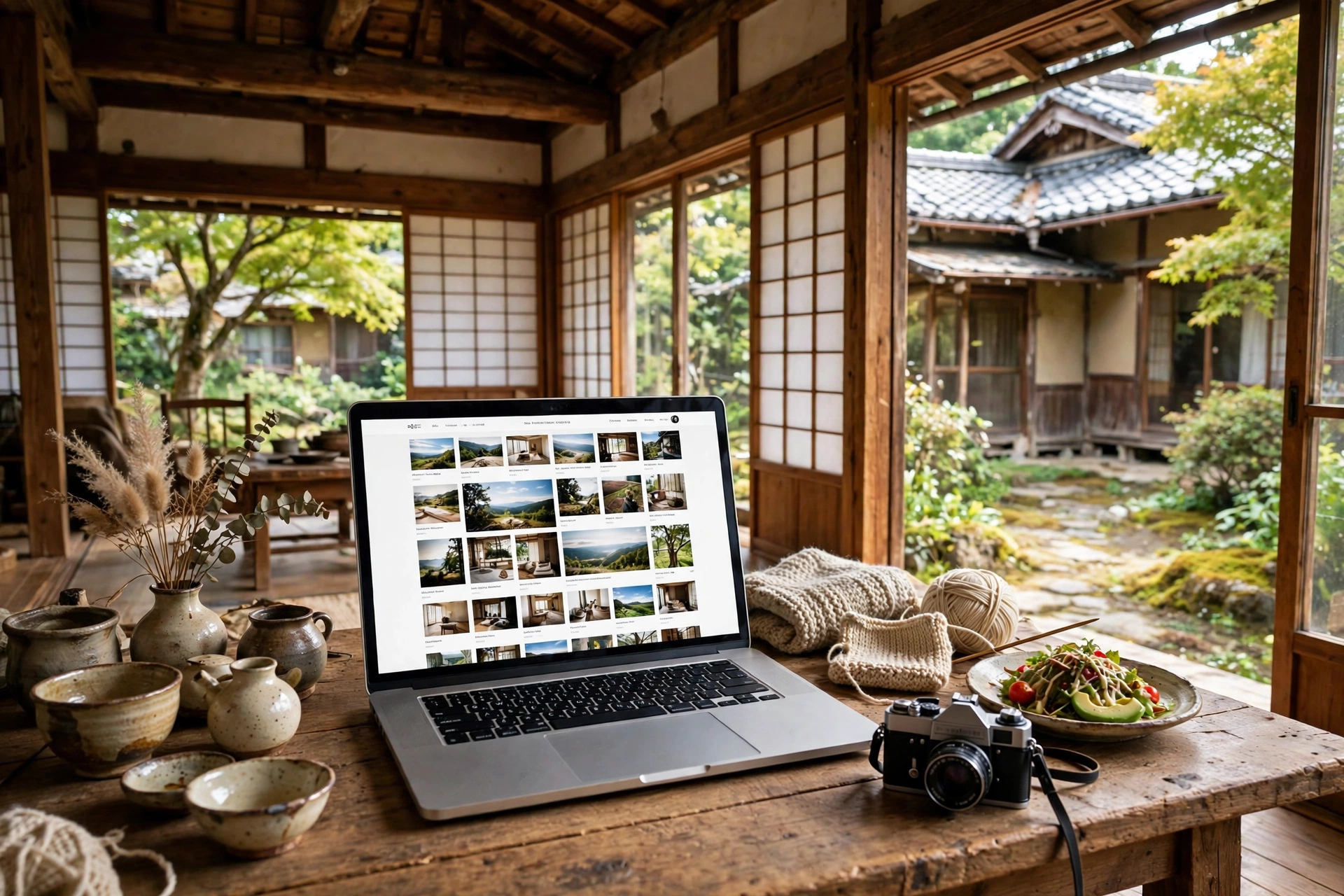
The result first: if photos decide whether your work is understood, you do not have to choose the crowded side. I chose Astro — still only 0.3% of sites — because its files work so well with Moka, my AI butler on Muse, and that combination got my blog published and keeps it running every day.
I am Kurashiki Bouzu (kurashiki-bouzu). This article is for people who want to show photos large on a website.
People who make handmade crafts. People whose work is pictures or photographs. People who run a restaurant. People who handle old folk houses in a region. People who want to let go of a family home. And staff in towns and cities who handle vacant houses.
In work like this, photos speak before words do. The texture of a work, the steam from a dish, the breadth of an old folk house garden. With small photos, what should be conveyed is not conveyed.
Normally, people say, “For a website, WordPress.” I also built my company’s website with WordPress myself. But now, my blog is not WordPress. It uses a different way of building, called Astro. Today I will write the reason, without technical terms.
Let me write the biggest reason first.
The deciding factor was how well Astro works with my AI butler “Moka” (my partner on the AI called Muse).
An Astro website has all of its contents in the form of “files,” like paper manuscripts. If it is a bundle of manuscripts, Moka can read it, make a clean copy, choose and arrange photos, and deliver it to the place of publication. When I hand over bullet points, Moka shapes them into an article, publishes it, and checks the published page. My blog now runs every day on that compatibility. The talk about showing photos large, and the talk about cost, come after that. First, this compatibility is the foundation.
I made a diagram of how the files are divided at the time of publication. It is the actual division used for my blog.
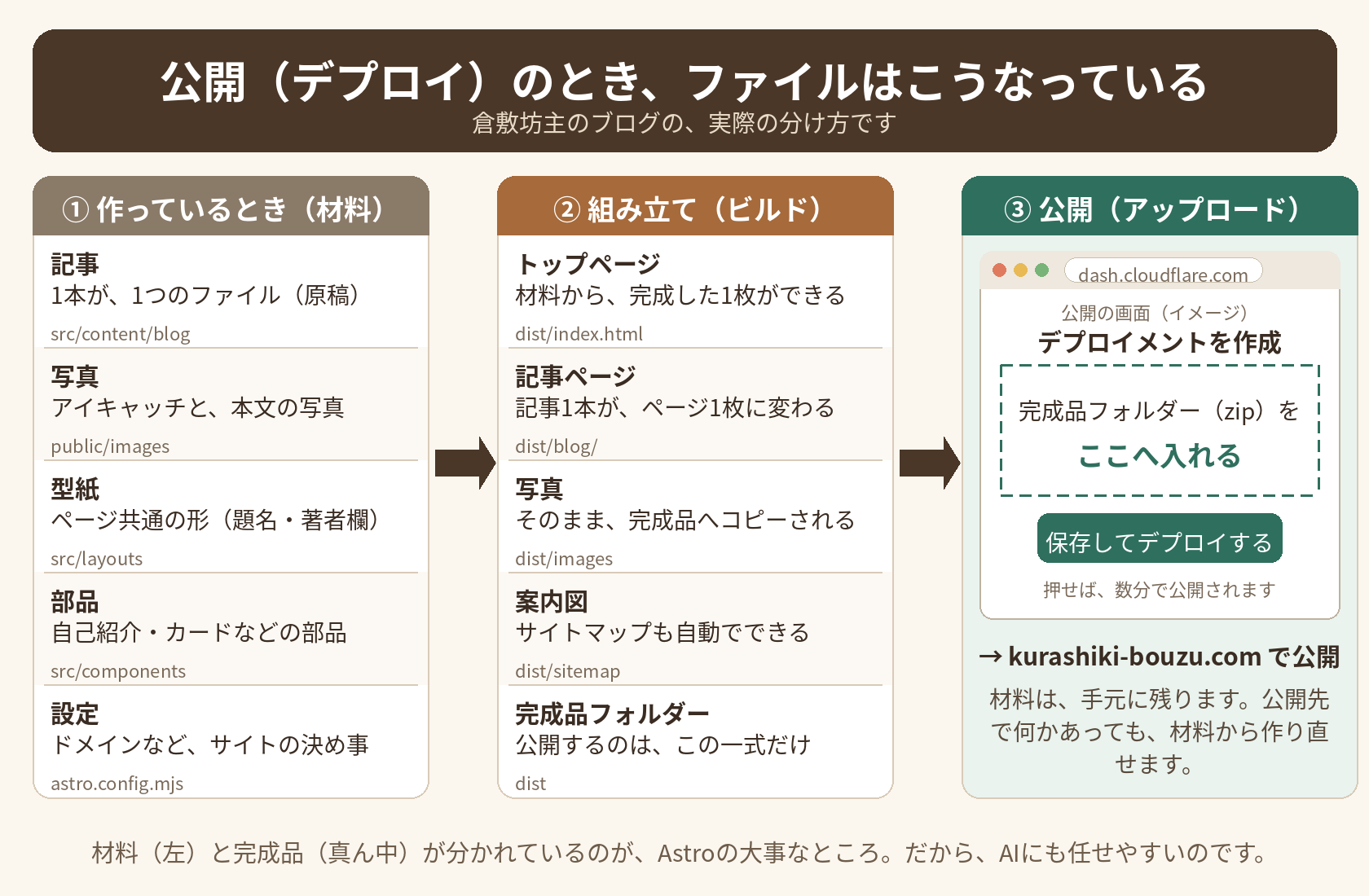
The English names in the diagram are not for memorizing. It is enough to look at them and think, “So they are divided with names like this.” Even if you build it yourself, what you normally touch is only “articles” and “photos” on the left side. If you ask Moka, that part is also included — everything can be left to her.
First, my story of failure
Please laugh. I am a person who could build his company’s website himself. I have used four servers — places to keep a website — X Server, Sakura Server, Lolipop, and Colorful Box.
That same person, with a tool called Django in a programming language called Python, could not reach publication even after studying for 1 year.
Publication is called “deploy.” It means placing what you have made on the internet, in a state everyone can see. In the words of the old Homepage Builder, it corresponds to transferring (uploading) a finished page to a server. In cooking terms, I could taste the food, but I stopped at the final step of putting it on a plate and serving it to the customer. That is how it felt.
There was also a problem of words here. At this age, words used in daily life and words used today can sound like completely different things, even when they mean the same thing. Hearing “deploy” does not ring a bell. But if someone says “upload to the server,” I think, “Ah, that,” and my hands move.
Even though it is something I could actually do, just because the words are different, I stop touching it at all. That happens very often for our generation. If you work in this field, it may be different. But we are different. We have lived all along with our own work and the words of daily life. It is not limited to computer talk. So in this article, when a new word appears, I will replace it with a word that has been around for a long time. It would be a waste to stop because of words.
The tool was not bad. A tool where you assemble everything yourself from the system is simply that difficult. If I, who could build a company website, stopped there, it is only natural that a beginner would stop.
WordPress is already on the “crowded” side
There are numbers for how widespread WordPress is. According to W3Techs, which researches how sites are built, as of November 2026:
- Of sites whose building method is known, WordPress is 58.2%
- By the same measure, Astro is 0.3%
Source: W3Techs WordPress page / Astro page
Nearly 6 out of 10 houses are WordPress, and Astro is 3 out of 1,000 houses. WordPress is convenient, and it helped me. But there are already mountains of explanations about how to build with it, templates for its appearance, and businesses that will build it for you. In a sense, it is saturated. Even if you start now in the same form, the number of people already there is on a different scale.
Astro, in contrast, is still empty. Its users are increasing, and according to Astro’s official review, use of the tool grew by about 2.5 times in the single year of 2025 (Astro official blog, “2025 year in review”). Even so, seen as a whole it is 0.3%. It is “a place that may be coming, but where no one is yet.”
Astro is a way of building where the “frame” for photos is free
WordPress, to use an example, is a house with equipment already installed. It is convenient because the kitchen and bath are included, but the floor plan is decided, and inspection of the equipment follows you forever.
Astro is a house with strong walls and a roof. You can decide the floor plan yourself. You can place a photo across the whole screen, and you can change how works are arranged for each piece.
And because it is a way of building where pages are “made in advance and kept ready,” rather than “assembled each time,” display stays light even with many photos. Large photos can also be prepared in a light, tidy form before they are shown.
Showing photos large is not for exaggerating. It is the opposite. It is to express scenery and appearance just as they are. The weave of a craft, the steam from a dish, the breadth of an old folk house garden, and the honest appearance of damaged places. What can be glossed over in a small photo appears as it is in a large photo. My rule of not exaggerating, and large photos, actually point in the same direction.
By field, it looks like this.
Handmade crafts and art
If a photo of a work is small, neither the weave nor the color of the glaze is conveyed. When seen on a smartphone, whether the work spreads across the whole screen — that itself becomes “whether I want it or not.”
Photography work
For a photographer, a website is the collection of works itself. I think what matters is being able to arrange photos so that the photos are the main characters, rather than fitting photos into a fixed template.
Restaurants
Photos of dishes, and the brightness inside the shop. With these two, customers mostly decide “whether to go or not.” Occasional updates, such as replacing a menu, work well with the “leave it to Moka” form I will write about later.
Regional old folk house real estate
This way of building does not suit a place that lists tens of thousands of properties nationwide. What it suits is a form that narrows to a region and shows each house carefully, one by one. Floor plans, gardens, before and after repairs. Because the number is small, the photos of each house can be shown large and slowly. When a house is sold, that page is deleted. That update is not difficult either.
For those letting go of a family home — you, too, are an individual blogger
People letting go of a family home are not businesses. Like me, they are individuals. So such a person is, so to speak, on the side of the “individual blogger.” There is no need anywhere to be a website professional.
When you put a family home up for sale, what appears on a property site is only a floor plan, the age of the building, and a few small photos. But that house actually has a story. What could be harvested in the garden. In which room the family gathered. Which parts are damaged, and which are still strong. Only the owner can write such things.
Build a page for that one house alone, like a blog. Place photos large, write the house’s history honestly, and offer it with the words “To the next person who will live here.” If you hand bullet points and photos to Moka, the shaping can be left to her. It is a page not so much for letting go, as for handing over to the next person. For people who live far away and cannot visit the family home many times, I think this form fits especially well.
I will also write honestly about money. If a buyer is found through your own page, no real estate agent stands in between, so no brokerage fee is charged.
This is especially large for inexpensive old folk houses.
I also worked in real estate for a time. In those days, fees were in a world where the upper limit was 5% of the property price (the rate for the inexpensive portion of the price). So years later, when I heard “330,000 yen” from the person in charge at the site, I was honestly surprised. Regardless of the house price, there is a frame of 330,000 yen for the fee. It had become a different world from the real estate calculations I knew.
Under the current rules, for a “low-cost vacant house, etc.” with a sale price of 8 million yen or less, a real estate agent may, on condition of prior explanation and agreement, receive a fee of up to 330,000 yen including tax from each of the seller and the buyer (Ministry of Land, Infrastructure, Transport and Tourism, “Notice on real estate transactions”). In a form called “both sides,” where one agent handles both the seller and the buyer, the total can be up to 660,000 yen. Even if the house price is 10,000 yen, the fee frame is 660,000 yen. In principle, this 330,000 yen is an “upper limit.” But on site, the full upper limit is normal. The cheaper the property, the less the work makes sense for the agent if they discount from there. In fact, in my own transaction, the fee was also at the full upper limit. This is not blaming real estate agents. Research and documents take the same effort as for an expensive house, so it cannot be helped. That nothing sells is no one’s fault — it is a blockage in the system.
From the country’s standpoint, this special rule was probably a last resort after worrying over vacant houses. When fees were too cheap, agents did not bother to try to sell cheap vacant houses. Only effort was required, and the calculation did not add up. So they created a frame of 330,000 yen and gave agents a “reason to handle them.”
But to me, this special rule seems poorly made. When a large frame of 660,000 yen for both sides hangs there, it easily becomes a form where properties are held and left alone with the thought, “Lucky if it sells.” If it does not sell, there is also a path to remove the exclusive contract (a promise that only that company handles it), receive only one side’s 330,000 yen from the seller, and leave finding a buyer to another agent. It is not a system where everyone runs thinking, “I will sell this house no matter what.” The country’s aim of reducing vacant houses and the calculations on site remain out of alignment.
But for an old folk house priced at 1,000 yen or 10,000 yen, the calculation does not work at all. The seller must set a price higher than 330,000 yen, or the fee will be higher than the price and they will be out of pocket. For the buyer, if a 330,000 yen fee is added to a 10,000 yen house, it is 33 times the house. It is natural to give up buying. Even for a house in a price range where a buyer would be found if it were under 1 million yen, when 330,000 yen is added there, the buyer stops and worries.
And what the buyer is looking at is not only the house price. They think in terms of the total, including registration costs, moving costs, and, if they will live while repairing, repair costs. It is similar to funeral costs — the price shown on the surface alone does not make the calculation for daily life stand up. However, houses and funerals have one decisive difference. For a house, there is time to think and room to postpone. For a funeral, there is not. A hospital says, “Please have a funeral company come to collect them quickly,” and you must decide in a hurry, in the middle of grief. A house can still stop. Precisely because it is a purchase where you can stop, showing the total honestly has great meaning. The 330,000 yen weighs as something added on top of that total. The cheaper an old folk house is, the more the very form of a fee standing in between stops the sale.
There is a phrase from the Omi merchants: “Sanpo-yoshi” — good for the seller, good for the buyer, good for society. In the current sale of cheap vacant houses, these three are hard to align. The seller fears being out of pocket, the buyer stops at the total, and in society vacant houses do not decrease. It is not a problem of individual agents’ hearts. The system itself is far from Sanpo-yoshi.
A form where you connect directly through your own page removes this blockage. The seller avoids being out of pocket for a fee, the buyer can decide after seeing large photos and an honest total, and in society one vacant house may decrease. It is a form that comes a little closer to Sanpo-yoshi. However, for important procedures such as contracts and registration, please rely on a specialist such as a judicial scrivener. It is safest to divide it as: finding someone through the page is the individual’s work, and the final procedures are the specialist’s work.
For municipal vacant-house staff
In fact, the form that fits best may be municipal vacant-house listings.
Vacant-house listing pages have roughly the same worries in every town. Photos are small. There are few of them. You cannot tell what the inside of the house is like. Even though it is the entrance for someone to think, “This house is nice,” it is not conveyed at the photo stage. For a vacant house, photos are everything. The exterior, the garden, the kitchen, the bath, and even the damaged places. Showing them large and honestly itself becomes guidance for people considering moving.
Let me tell my own story as a buyer. I found the old folk house I now live in on a website. I saw the photos, looked at the surroundings on a map (Google Maps), and went to view it in person. But when I heard the fee amount there, my feelings stopped once. When you buy, you do not think only about the house price. If you add registration costs, moving costs, and the costs to repair from now on, it exceeds the budget you had in mind. Giving up also crossed my mind.
At that time, the person in charge offered to halve the price that had been presented. If the price goes down, the total including the fee fits inside my plan. And so, that same day, my mind was made up. A buyer who lives far away moves in this order. Even if photos and the appearance of the location bring them to the site, at the end they may stop at the total. That is why it is important to show not only the price, but the whole of the costs involved, honestly. If photos are small and the appearance of the location is unclear, a house drops out of the candidates before the stage of going to the site.
This is the same for people moving to Japan from overseas. Japan’s way of buying real estate has complicated rules even for a single fee, and before the language barrier there is a barrier of the system. In the first place, in many countries such as the United Kingdom and Australia, brokerage fees are mainly paid by the seller, and the buyer does not pay the seller’s agent. But in Japan, the buyer also paying a brokerage fee is built into the system. Seen from overseas, that is the first mystery. Large photos convey even without words. Placing the fee system honestly and in an easy-to-understand way itself becomes an entrance to the feeling, “I would like to live in Japan, I am interested in a Japanese house.”
It also fits the town’s circumstances. The number handled is limited. The budget is not large. Staff change every few years. On that point, Astro costs nothing for its place to be kept, and its contents remain in the form of “files,” like paper manuscripts, so handover to the next person in charge, and leaving work to an AI, are both easy.
Of course, an official municipal website has rules, so this is not about replacing the main site without permission. It is about using it as a separate guide page for introducing vacant houses. Within the rules, there are things that can be done.
The substance of the compatibility with Moka — “You can do it yourself, and you can also leave it to Moka”
The compatibility I wrote about at the beginning means this.
An Astro blog or website has all of its contents in the form of “files.” A file is like a paper manuscript. If it is a bundle of manuscripts, Moka can read it, make a clean copy, and deliver it together. This is different from a way of building where you cannot touch it unless you operate a fixed screen (an administration screen) step by step. An “AI that takes on arrangements” like Moka, and Astro in the form of files, fit together from the start.
In fact, my blog runs in this form. When I hand over materials in bullet points, Moka shapes them into a careful article, chooses photos, uploads them to the place of publication, and checks the published page. My work has become only “experiencing things” and “judging whether it may be published.”
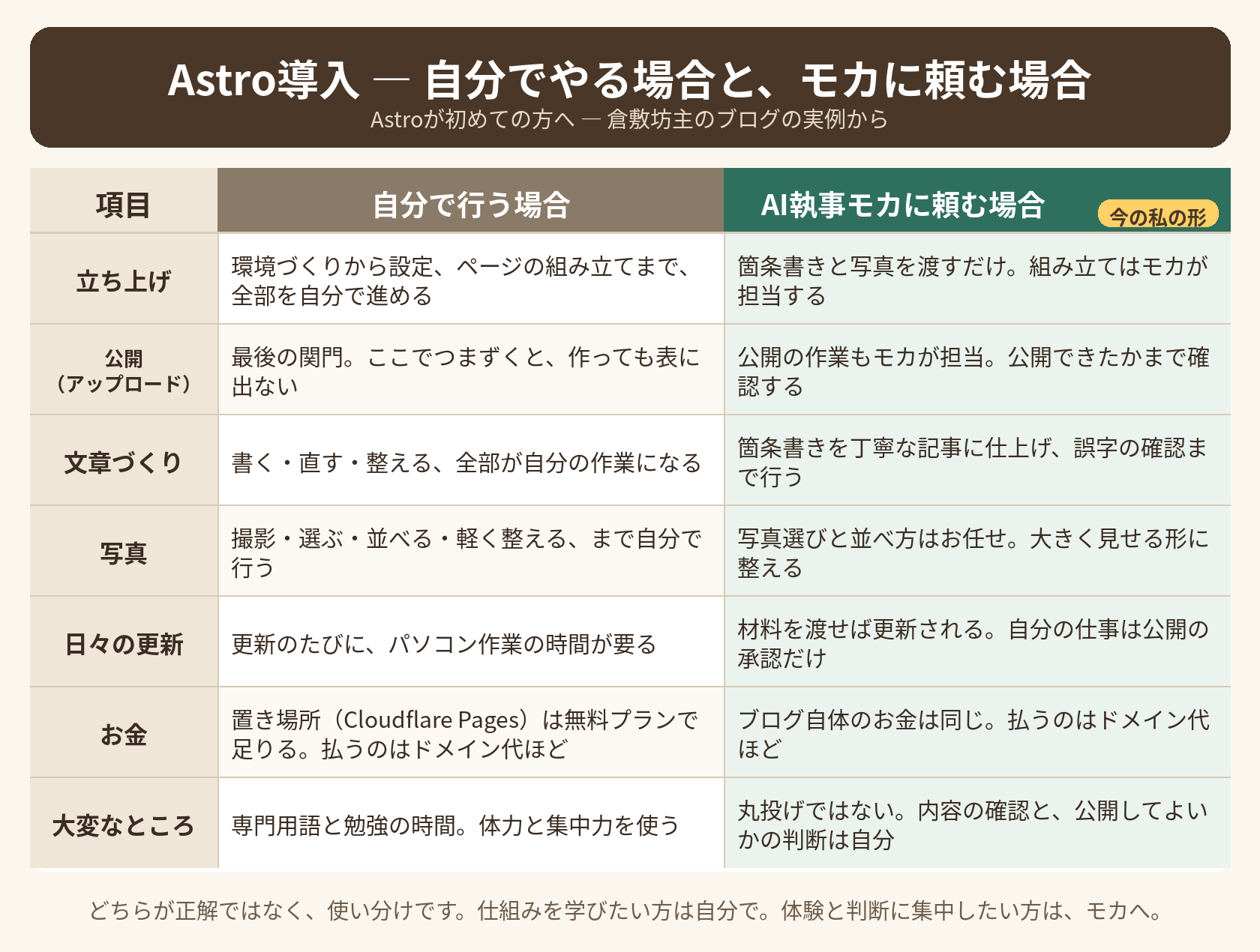
When you compare, it looks like this. There is a path to do it yourself, and a path to ask Moka. What matters is being able to choose the one that fits your own life.
The “publication” wall where I stopped with Django was crossed with Astro by two paths. You can publish it yourself. You can also leave it to Moka. Having both of these was the greatest attraction for me.
I will also write about cost. What I am currently paying for my blog is only the domain fee, which corresponds to the address (the total annual payment is 12.29 dollars, at purchase: about 1,940 yen). There is no cost for the place to keep it. That is different from a form where you keep paying a rental server fee every month. However, this is possible because it is a “form that keeps fixed pages,” and the story changes for a site with a complex system.
Cases where it does not suit, written honestly
Not exaggerating is my rule. There are also cases where Astro does not suit.
- Sites centered on a system where payments and stock move every day, like an online shop
- Sites where member registration and reservations come in constantly
- Sites that put in and take out tens of thousands of pieces of information on a nationwide scale
For things like these, WordPress or a dedicated service for each purpose suits better. It is not about which tool is good or bad, but about using them appropriately. A house with equipment installed suited my company’s site, and a strong house that takes little effort suits my current blog. That is all.
In closing
To those who do work where photos are the deciding factor, and feel you are losing out with your website.
The place you choose does not have to be on the crowded side. Among sites whose building method is known, the side where only 0.3% are. There, build a website that shows photos large, while leaving the arrangements to Moka, using your own experience. I will leave my blog here as an example of that. What mattered most in choosing a tool was not how many functions it had, but its compatibility with my partner.
Do you think the photos on your website are large enough as they are now? I think works, dishes, and houses may be shown much larger.
Related reading
- Why I graduated from WordPress: Why I graduated from WordPress and built a blog with Astro and an AI butler
- Episode 0: In my 50s, living in an old folk house, until I welcomed the AI butler “Muse”
*Deploy means transferring (uploading) the files you have made to a server and publishing them.
- November 18, 2026 ― English draft created (results-first rewrite of the Japanese article, ledger No. 14). Not published; publication is a separate step.(16,129 characters)