
A Complete Beginner in Programming Felt Unease at a 13-Year-Old's PC Class on the Radio — Is School Still Making Obedient Salarymen?
The result first: I cannot write a program, and yet the blog, the FX record site, and the customer management sheets have all taken the shape I wanted, at home. What made that possible was not memorising operations. It was knowing the system, asking well, checking what came out, and deciding myself.
I am Kurashiki Bouzu (kurashiki-bouzu).
Let me write this first. I am a beginner in programming, a complete amateur. I am not an education specialist, either. This is only the story of what an amateur felt.
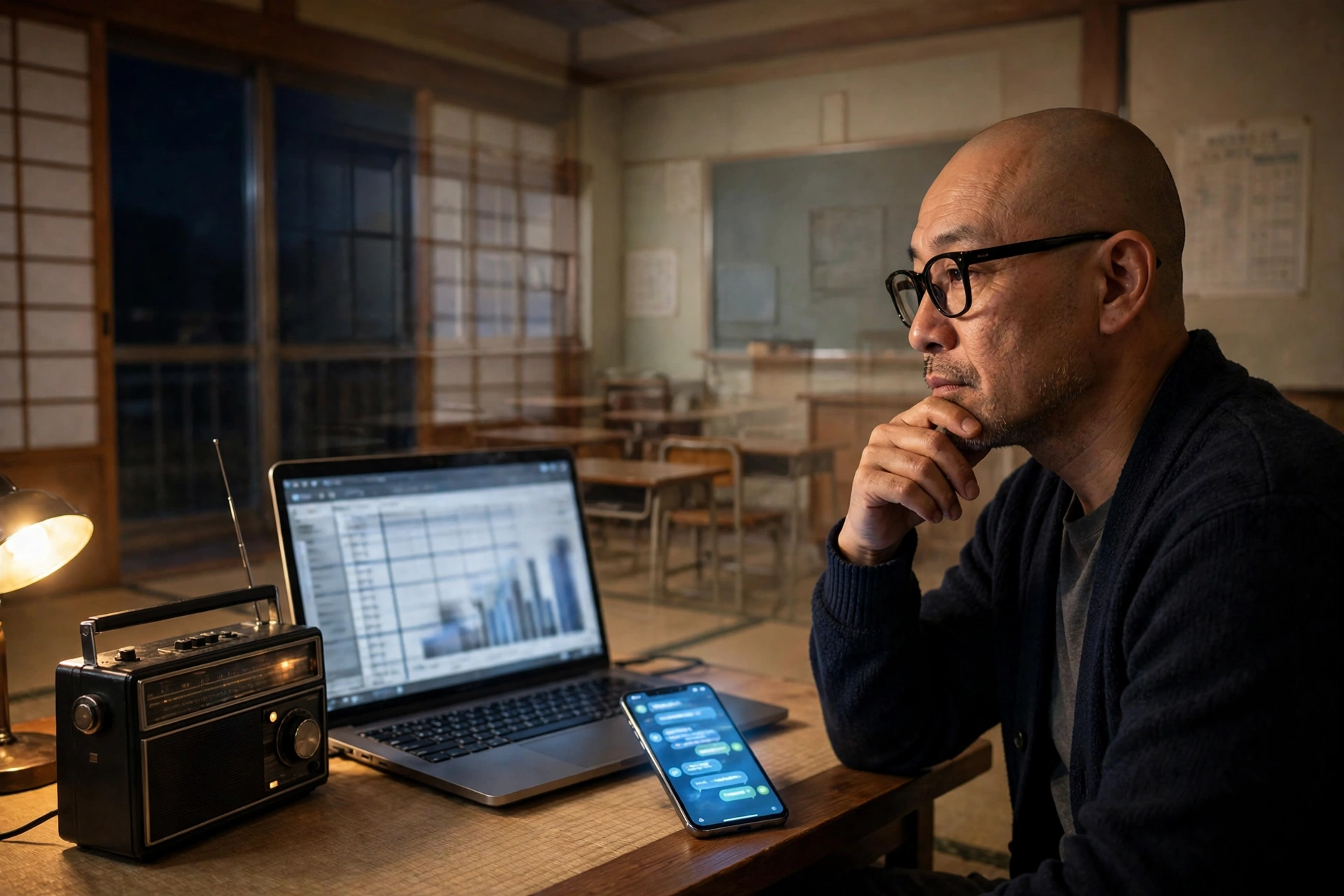
At night, I was listening to the radio. It was a post from a 13-year-old listener, about a computer class.
They learn Word and Excel, take in some AI, make the task given by the teacher, and hand it in. That is what the class is like, it said.
Listening, I felt unease.
“Now, in this age, going out of your way to do that?”
Today is the story of digging into that unease. The trigger was small, but as I thought, I arrived at postwar Japan.
It is not that Word and Excel are bad
Let me say this first. I do not want to say Word and Excel are not needed. Certainly, most companies still use them now.
But anyone who knows a company’s real work will understand. In a company now, in most cases the form of the work is decided, and it has become a system where you only enter, in a decided form, into a decided screen. Scenes where you build a document or a sheet from zero are fewer than you think.
Conversely, in a scene where you make something new, the story changes.
In my case, if there is something I want to make, I ask Moka, my AI butler, in words. If I hand it over in bullet points, it becomes an article, a sheet, a system. I cannot write a program. When I was young, I studied a system called Django for 1 year, but I never reached the place of publishing what I made.
And yet now, the blog, the FX record site, and the customer management sheets take the shape I thought of, at home. I, who cannot write, do.
So, hearing the story of the 13-year-old’s class, I thought: is it right to use that much time on learning operations?
It had the same smell as memorising English words
In my student days, I memorised English words for going on to further education.
Those many words — did I ever use them in my private life? Almost never.
What made me feel that in my bones was when I was 20 years old. Alone, I went on a trip to Australia.
At that time, there was no money to hire an interpreter. I asked people on the road for directions in broken English, but with only what I had learned at school, it did not get through at all. When I learned that, I was stunned.
Now, there is translation on a smartphone. If I ask Moka, “Write in English that I want to go to this shop,” it reaches the other person. But at that time, it was an age with nothing so convenient. While saying the shop’s name, you ask with gestures of the hands and body. For the other person, I must have been a strange Japanese. It was like Tetsuro Degawa today, as people would say (laugh).
Even when I finally arrived at a local shop, the next difficulty was waiting. I could not read the menu. For the time being, I ordered the thing written at the very top, and waited in suspense, not knowing what would come out. I remember that.
Memorise only for the test, and when the test is over, forget it. On that trip, I was made to notice the waste of the time I spent learning English at school. That way of spending time wastefully and the PC class now looked to me to have the same structure.
When memorising itself becomes the purpose, a tool does not become something usable. English was, originally, supposed to be a tool for speaking with the world. A PC, too, is originally supposed to be a tool for making something.
Turning a tool into something to memorise for a test or a task. There was the root of my unease.
With this way of teaching, people who can be of use in the world will not be born from Japan. Listening to the radio, that was the time I thought so.
What is out of step is between the world and school
When I think about it, the true identity of my unease was this “being out of step.”
The world’s side has already changed. If there is something you do not know, you look it up on the spot. In companies, systems where you only enter into a decided form are turning, and what is lacking you ask of AI or a professional of that road. People who work at home, and people who have a side job, are no longer rare now.
And yet school continues to make pupils compete by the amount memorised, and to train them to write the decided answer quickly and accurately. It is using the most time on the power that is becoming least used in the world. That is how it looks to me.
Of course, it is not that the teachers at the field are bad. The teachers, too, are people on the side of advancing a decided plan as decided, and they are working busily. The being out of step is in a place that the field’s effort cannot fill. The system itself is not keeping up with the world’s movement. That is how I feel.
Knowing the system is important. But that is enough
So there is no misunderstanding, let me write one more thing.
Knowing the system is important. Not limited to Word and Excel — with money, a car, or a house, too, if you know by what system it moves, you can notice the strangeness of what comes out. When you ask, too, you can ask accurately.
But that is enough, I think.
Beyond that, for the detailed work, there are professionals of that road. Now, there is AI, too. There is no need for everyone to become able to do every operation alone. Whom to ask, and what. Being able to make that judgment is far more important in the age from now on.
My division with Moka is exactly that. The system and the judgment are mine, the work of making is Moka’s. If school is to teach, should not this “way of asking” and “way of checking” be taught first?
The money class that made me think, “At last”
In contrast, there is also a story I heard gladly recently.
In an elementary school class, they have begun to teach the flow of money — that is, how the economy turns. When I heard that, my honest impression was, “At last.”
The flow of money is the system itself, directly connected to life. Work, receive a salary, use it at a shop, and that money becomes someone’s salary again. Whatever job you choose, everyone is involved for life.
Overseas, they speak of money from early childhood. Including both the good and the bad. Earning, using, failing, and the fear of debt, too, are placed on the same desk.
In Japan, talk of money has been hidden, as if it were somehow dirty, or too early for children. Because it is hidden, people become adults without knowing either its fear or how to handle it.
A class like this should have come before memorisation. At the lateness of that order, I felt “At last.”
When I think about it, compulsory education has made obedient salarymen
Why is school so late? As I thought, I arrived at my own answer.
Japan’s compulsory education until now was, perhaps, for the purpose of making up obedient salarymen and collecting taxes from the people — was it not?
Come at a decided time, and do what is decided, without complaining. Seen as training for that, the form of school is well made. Given a task, and handing it in. The 13-year-old’s PC class, too, looked to me to be on that lineage.
I remember the story of the postwar days. There was an age when Hiropon, that is, a stimulant, came into citizens’ hands as a matter of course. Under the name of postwar reconstruction, it was sold as a “medicine that takes away tiredness,” and working people moved their bodies with it.
After that, too, the root did not change. There was an age when Regain’s commercial could air without hesitation: “Company warriors, can you fight for 24 hours?”
1989, the adults television was showing
1989, when Showa changed to Heisei. “Can you fight for 24 hours?” was a word that even entered that year’s New Word and Buzzword Grand Prize.
It is the catchphrase of that commercial, where the actor Saburo Tokito, dressed as a businessman, sings holding Regain. “Yellow and black are the sign of courage” — the song “Sign of Courage” was such a hit that it became a CD.
Working fiercely, with all-night work as nothing, was considered good. That commercial certainly reflected the figure of Japan in those days, I think. Remembering it now, before nostalgia, a little fear comes first.
Around the same time, in another nutritional drink, Yakult’s Toughman, Shiro Ito sang “You are Toughman” in showy clothes. It is natural that there are 2 faces I remember: in that age, on television, every small bottle was stirring working people up.
In the spring of that same 1989, Nintendo released the “Game Boy.” On a small black-and-white screen, the movement was jerky, just like a digital clock. The elementary school pupils of the world played outside, surrounding 1 Game Boy. I, who was 18 at the time, was not playing. I was watching beside them. While the adults drank small bottles and “fought,” the children were absorbed in the world inside a small screen. That contrast, too, was a figure of that age, I think.
The world at this time — 1989, what television was conveying
- In spring, the female high school student concrete-encased murder case came to light, and all Japan received a shock
- In the Recruit case, over unlisted shares, even the big figures of the political world were indicted, and the Takeshita cabinet resigned as a whole
- In summer, the criminal of the series of abductions and murders of young girls that continued in Tokyo and Saitama was arrested
Behind the bright buzzwords, television was conveying heavy news like this almost every day, too.
Making people overcome the limits of a person with spirit and drinks. That was considered a virtue.
And the problem of death from overwork arose, and at last the work-style reform came.
It is always on the back foot. After the problem grows large, they hurry to fix it. The money class and the AI class, too, look to me to be following the same order.
School has been made to match the figure of the adult society asks for. In the age when what was asked for was “an adult who can fight,” there was a school for that. That is how it looks to me.
But the age had changed first
However, now is different.
Thanks to the internet, it has become an age where you can work even from home. Physically, it has become far easier than long ago. The commute, and long hours of restraint — the form of work itself is changing.
And thanks to the development of AI like Moka, even a person like me who cannot write a program has become able to make the software they want. An age where being able to put “what I want to make” into words becomes, as it is, the power to make.
In an age where the people who can have the power to make increase, only school remains in a place of “making everyone memorise the same operation.” That difference was the root of my unease.
What school should teach has changed
Let me gather it.
What I would like the schools from now on to teach is not the memorisation of operations.
- To put what you want to make into words
- To ask a professional or AI accurately
- To check what came out
- At the end, to decide yourself
This is exactly the division I do every day with Moka. It is not a story of a special talent. Know the system, ask, check, and decide. By repeating that, even a man in his 50s who cannot write a program has been able to make a blog, systems, and products.
By the time the 13-year-old children become adults, that AI exists should be even more a matter of course. The tool to hand to that generation, I want it to be not the memorisation of old operations, but the new way of making.
May the elementary school pupils of now, when they go out into society, not have to have the same regret as me. I earnestly wish so.
One more request to fathers and mothers. Even if 1 computer breaks, is that not all right? If children who will build the future show interest and try to touch it themselves, please let them touch it freely. Inside the small box called a computer, there is a world school cannot teach. If they do not touch it, interest will not grow.
It was a night when I thought such things of the 13-year-old beyond the radio.
- November 18, 2026 ― English draft created (results-first rewrite of the Japanese article, ledger No. 48). Not published; publication is a separate step.(9,933 characters)