
Chionin — The Head Temple of the Jodo School, Where Honen Shonin Began the Nembutsu
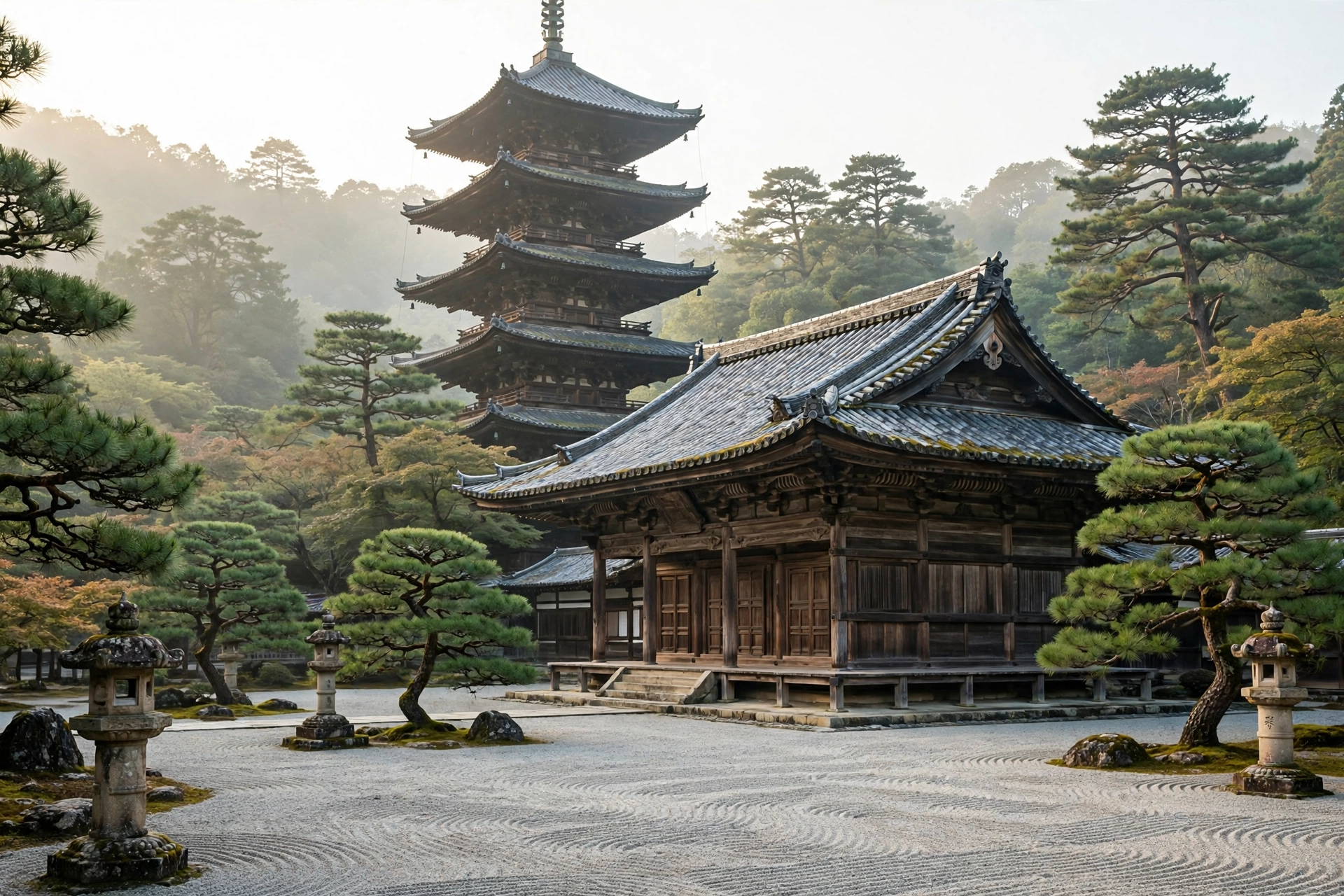
The point first: Chionin in Higashiyama Ward, Kyoto, is the head temple (Sohonzan) of the Jodo School, standing where Honen Shonin built a hermitage in 1175 and began teaching the exclusive practice of the nembutsu. Its Sanmon gate and Mieido hall are National Treasures, designated in 2002. The grounds themselves carry no stated admission fee on the official page — only its two gardens are paid: the Yuzen-en at ¥300 for adults and the Hojo Garden at ¥400, with a combined ticket at ¥500 (gates open 6:00, close 16:00; reception from 9:00). Its official site does carry a memorial guide — ancestral memorials covering memorial transfers (eko), interment and the Eitai Shido (perpetual hall), received at the Mieido from 9:00 to 16:00 — but the amount for the perpetual memorial could not be confirmed, and no dedicated guide to funerals themselves or tree burials was found, so this article writes neither figure nor claim.
I am Kurashiki Bouzu (kurashiki-bouzu), born in 1971, a former funeral professional now living in an old house in Kurashiki, Okayama, working with Moka, my AI butler.
This is one article in a series introducing temples across Japan, one temple at a time. This time it is Chionin in Higashiyama Ward, Kyoto City. This article is organized from official published sources such as the temple’s official site; it is not an account of a visit I made myself.
Basic information
- Name: Chionin
- School: head temple (Sohonzan) of the Jodo School
- Address: 400 Hayashishita-cho, Higashiyama Ward, Kyoto City, postal code 605-8686
- Telephone: 075-531-2111 (main)
The Mieido, its main hall, is the hall enshrining Honen Shonin, and within the grounds there is an Amida-do. However, an official notation giving the principal image in a single word could not be confirmed on the official pages opened this time. A clear statement of a formal appellation including the mountain name (sango) also could not be confirmed in the text of the official pages. Points that could not be confirmed are not stated definitively.
The name Mieido carries the meaning of a hall enshrining the “sacred image” (mie) of the founder — the figure of Honen Shonin. For those who have held a funeral or memorial service at a Jodo School temple, Chionin may be familiar as its head temple. It stands in Kyoto’s Higashiyama, where many temples and shrines gather around it. Among them, Chionin is a temple with large grounds as the center of the Jodo School.
History
The origin of Chionin is 1175 (Shoan 5). The official “History of Chionin” records that Honen Shonin (1133–1212) built a hermitage at Yoshimizu in Higashiyama and began the propagation of the exclusive nembutsu (senju nembutsu).
Honen entered nirvana in 1212, and his disciples built a mausoleum hall at Otani, the place of his passing. The mausoleum hall was destroyed in 1227, but in 1234 his disciple Genchi raised the halls with Honen as founding priest. In 1530 the Seishido was rebuilt, and imperial plaques reading “Chion Kyoin” and “Otani-dera” were bestowed by Emperor Go-Nara, it is recorded. Tokugawa Ieyasu designated Chionin in 1603 as his family’s perpetual place of repose (eidai bodaijo).
That the teaching of the nembutsu, which began from a small hermitage, continues to the present as a head temple — and that this is the land where it began — is the weight of Chionin.
Highlights
The Sanmon and the Mieido are National Treasures. The official “History” records that they were designated National Treasures in 2002. The official English page also introduces the Sanmon, Mieido and Great Bell Tower as National Treasures and Important Cultural Properties.
Two gardens are open to the public: the Yuzen-en and the Hojo Garden. The New Year’s Eve bell of the Great Bell Tower is known as a representative event of Chionin and is also guided on the official top page. The approach itself — passing through the great Sanmon and climbing the stone steps — is also a highlight characteristic of this temple. It is a place where you can feel not only the size of the buildings but the air of standing on land connected with Honen.
Events
The Gyoki Daie (memorial assembly for Honen) runs from April 19 to 25. It is clearly stated in the gate-hours table of the official visiting information, and during this period the gates open at 5:00. It is an important event for the Jodo School, corresponding to the memorial service on the anniversary of Honen Shonin’s death.
The New Year’s Eve bell is on December 31, and the official top page carries a guide that it is by advance application. The method of holding it changes by year. The autumn illumination (special night viewing) is given in the official top page’s guide as November 17 to December 6, 17:30 to 21:30, ¥800 for adults and ¥400 for children, but this is a guide for the year of holding, so please check the official site before visiting.
Funerals and memorial services
I will organize this from a former funeral professional’s viewpoint. Chionin’s official site has a guide to “ancestral memorials (memorial transfers, interment and the Eitai Shido).” In addition to the daily midday services, memorial transfers (eko) and interment are received from 9:00 to 16:00. Reception is at the Mieido. Regarding the ossuary (nokotsudo), the official “History” records its completion in 1930.
That the form of the Eitai Shido (perpetual hall) is officially shown is a guide fitting the head temple of the Jodo School. However, the amount for the perpetual memorial could not be confirmed on the official pages opened this time, so no amount is written here. If you are considering applying, please check the official guide or by telephone. Note that a dedicated guide to funerals themselves and to tree burials could not be confirmed on the official pages opened this time.
A supplement as a former funeral professional: eko means turning the merit of a service toward the departed. At Chionin, eko is performed within the daily midday services, and the official guide says individual applications are also received at the Mieido from 9:00 to 16:00. The form of entrusting memorials to the daily services of a head temple can be one option also for those who live far away, or for whom managing a grave has become difficult.
However, amounts and the conditions of interment differ by temple. Since the amount could not be confirmed on the official page, this article does not write an amount by guesswork. If you are considering it, I recommend inquiring at the Mieido within reception hours or confirming by telephone. In consulting about memorials, confirming the conditions first is more important than anything.
Practical information for a visit
According to the official visiting information, the gates open at 6:00 and close at 16:00, and reception is from 9:00. Some event and service days differ. No notation of an admission fee for the grounds themselves appears on the official page; what is paid is the gardens. Garden admission is: Yuzen-en ¥300 for adults, Hojo Garden ¥400 for adults, combined ticket ¥500; for children (elementary and junior high school students) ¥150, ¥200 and ¥250 respectively.
Amounts and hours may change. Please check the visiting information on the official site before your visit.
Finally, I will add one way of seeing this temple. Chionin’s guide takes the form in which no admission fee for the grounds themselves is stated on the official page, and only the two gardens, Yuzen-en and the Hojo Garden, are paid. Gazing up at the National Treasure Sanmon and Mieido, and spending quiet time in the gardens. During the Gyoki Daie period the gates open at 5:00 in the morning — the opening time also changes with events. The New Year’s Eve bell has years when an advance-application guide appears, so if you visit at year’s end, please check the official top page’s guide early. In the sense of standing on the land where Honen built his hermitage, I think it is a temple where a visit can touch the origin of the nembutsu.
For the details of visiting and memorials, checking the visiting information and the official top page’s guides on the official site is the basis. The notation of the principal image and the amount of the perpetual memorial, written in this article as “could not be confirmed,” I hope to organize again in this series once the official guides can be verified.
Sources
- Official top page
- Visiting information (official)
- History of Chionin (official)
- English notices (official)
- Chion-in Temple (Jodo School official, English)
- November 22, 2026 ― Published in English (translation of the Japanese article, ledger No. 2897)(7,065 characters)