
Mount Hiei Enryakuji — The Head Temple of the Tendai School, Called the Mother Mountain of Japanese Buddhism
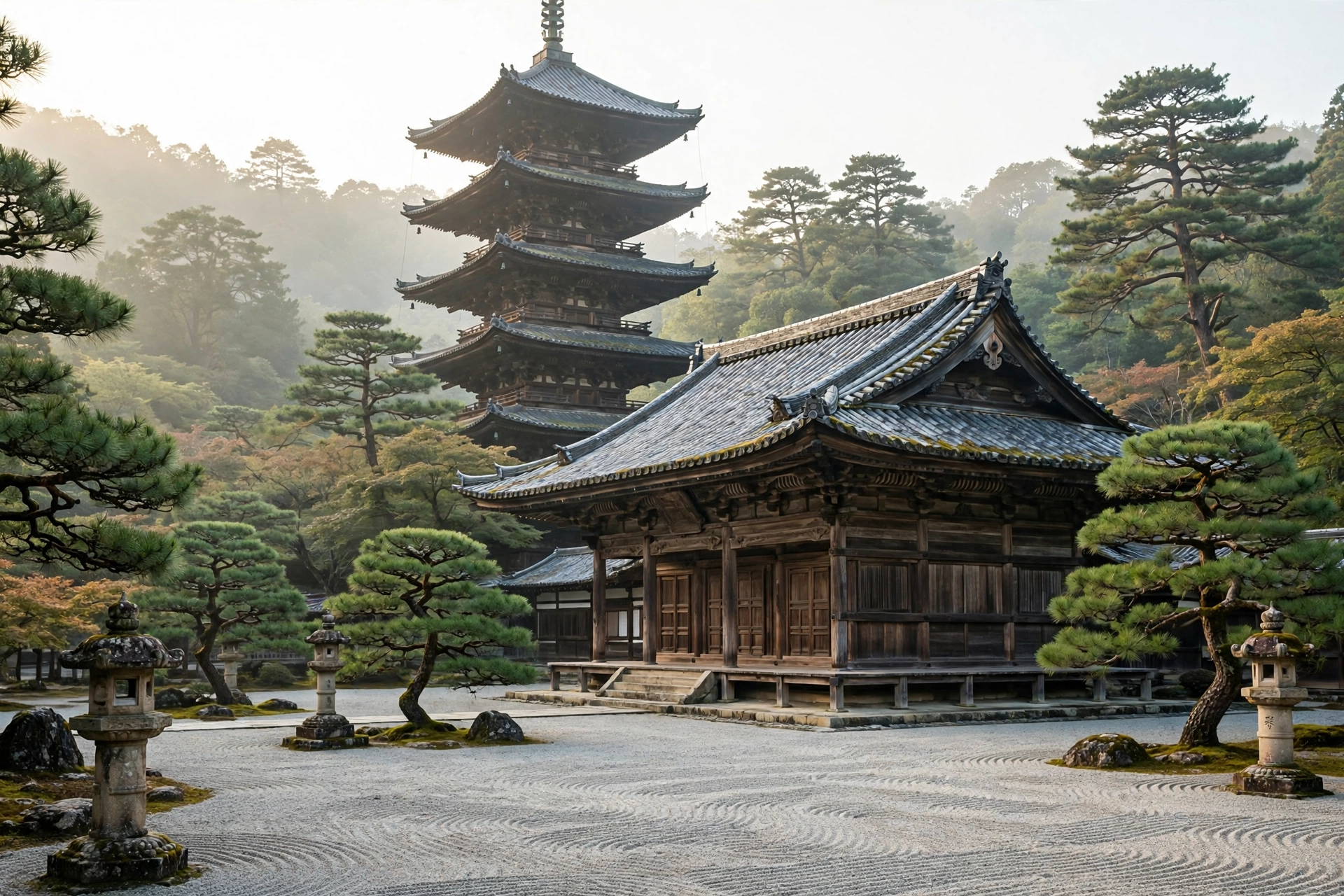
The point first: Mount Hiei Enryakuji in Otsu, Shiga, is the head temple of the Tendai School, founded by Saicho in 788, and is revered as the “mother mountain of Japanese Buddhism” because the founders of many schools — Honen, Shinran, Eisai, Dogen and Nichiren — all studied there. It is not a single building but the collective name for halls spread across Mount Hiei, in three districts: Todo (Eastern Pagoda), Saito (Western Pagoda) and Yokawa. Unusually among the temples in this series, its official site does carry a memorial guide: at the Amida-do in Todo it accepts interment and perpetual memorials regardless of school (reservation required), with no time limit on the perpetual memorial and the offering (myoga-ryo) payable only once at the start — the official table lists, for example, special perpetual (with interment) from ¥2,000,000 and individual one-session memorials from ¥5,000. A guide to funerals themselves, however, could not be confirmed, and the specific amounts of the visiting fees also could not be confirmed in the official pages opened this time, so this article does not invent those figures.
I am Kurashiki Bouzu (kurashiki-bouzu), born in 1971, a former funeral professional now living in an old house in Kurashiki, Okayama, working with Moka, my AI butler.
This is one article in a series introducing temples across Japan, one temple at a time. This time it is Mount Hiei Enryakuji in Otsu City, Shiga Prefecture. This article is organized from official published sources such as the temple’s official site; it is not an account of a visit I made myself.
Basic information
- Name: Mount Hiei Enryakuji. Not the name of a single building, but the collective name for buildings scattered across Mount Hiei
- School: head temple of the Tendai School
- Principal image: the principal image of the Konpon Chudo is Yakushi Nyorai (the Medicine Buddha). The principal image of the Amida-do is Amida Nyorai
- Address: 4220 Sakamoto Honmachi, Otsu City, Shiga Prefecture, postal code 520-0116. Mount Hiei lies on the border of Shiga and Kyoto Prefectures
The grounds are divided into three districts: Todo, Saito and Yokawa. That the whole mountain is one temple is this temple’s first characteristic.
A supplement on the address: the official perpetual memorial guide gives Otsu City, Sakamoto Honmachi 4220, while Kyoto Prefecture’s World Heritage guide gives “Sakamoto Honmachi, Otsu City, Shiga Prefecture / Sakyo Ward, Kyoto City,” explaining that the mountain lies on the border of the two prefectures. That one mountain spans two prefectures also tells of Mount Hiei’s breadth. Todo, where the Konpon Chudo stands, is the central district, and the Amida-do is also in Todo. That is why the memorial guide is issued from Todo and the Amida-do.
History
In Enryaku 7 (788), Dengyo Daishi Saicho founded the Ichijo Shikan-in (later the Konpon Chudo) and carved Yakushi Nyorai as its principal image, as recorded in the official “History.” After Saicho’s death, this Ichijo Shikan-in received the temple name “Enryakuji” by imperial grant, and came to be called Mount Hiei Enryakuji.
On Mount Hiei, the founders of the various schools — Honen, Shinran, Eisai, Dogen and Nichiren — studied. For that reason Enryakuji is revered as the “mother mountain of Japanese Buddhism.” Many of the currents of Japanese Buddhism today began on this mountain. In Heisei 6 (1994), it was registered as a component of the UNESCO World Heritage “Historic Monuments of Ancient Kyoto.”
Highlights
The Konpon Chudo is a National Treasure. Together with Important Cultural Properties such as the Daikodo (Great Lecture Hall), Enryakuji is guided as holding 10 National Treasures and more than 50 Important Cultural Properties. Pilgrimage through the three districts of Todo, Saito and Yokawa, and the Kokuhoden (National Treasure Hall), are also highlights.
Note that the official site’s top page announces that the Konpon Chudo is under major renovation. The progress of the renovation and the form of viewing will change, so please check the latest guide on the official site before visiting. The three districts within the mountain are far apart, so a plan with ample time is advisable.
Events
According to the official perpetual memorial guide, on the 15th of every month a general memorial service (so-ekō hōyō) is held at the Amida-do, led by the Tendai Zasu (chief abbot) as principal officiant. There are also the Spring Higan-e, seven days centered on the spring equinox day, and the Autumn Higan-e, seven days centered on the autumn equinox day. The Urabon-e runs from August 13 to 16, and the Segaki-e is on August 16.
A system of sending notices in time for annual memorial services, the spring and autumn Higan-e and the Urabon-e is also in place. It is a form in which those who requested memorials and the temple remain connected at each year’s milestones.
Funerals and memorial services
I will organize this from a former funeral professional’s viewpoint. Enryakuji’s official site has a guide, “Ancestral Memorials and Perpetual Memorials,” at the Amida-do in Todo. Its contents are perpetual memorials, interment and memorial services, and it accepts interment and perpetual memorials regardless of school (reservation required). There is no time limit on “perpetual,” and the offering (myoga-ryo) is payable only once, at the first time — that is its form.
As examples of the offering, the official table lists: special perpetual (interment) from ¥2,000,000; perpetual tablet (interment) from ¥800,000; perpetual monthly tablet from ¥500,000; perpetual yearly tablet from ¥300,000; hyakuman-rei (interment) from ¥100,000; and an individual one-session memorial from ¥5,000. Amounts may change, so please check the official guide before applying.
On the other hand, a guide to funerals themselves could not be confirmed on the official pages checked this time. Even at a great head temple, funerals are often held within connections with local temples. That a receptacle for memorials and interment is officially shown is a characteristic of this temple’s guide.
What catches my eye as a former funeral professional is the acceptance “regardless of school,” and the way of showing “no time limit on perpetual” and “offering only once at the start,” which makes later burdens easy to see. Perpetual memorials differ greatly by temple in how they are handled after application. Whether there is a time limit, and whether additional costs arise, are points that must always be checked before applying. That these points are shown in advance in the official table is, I think, a kind form for those applying. Also, a guide to tree burials could not be confirmed on the official site, so this article does not deal with it.
When I think of the history in which monks who studied on Mount Hiei went on to found schools in many places, the stance of accepting regardless of school also feels fitting for this mountain. When consulting about memorials, a reservation is required, so please check the application flow from the official guide in advance.
Practical information for a visit
Visiting hours differ by season and district, and the official top page guides that group discounts apply to fees. However, the specific amounts of the visiting fees and the details of visiting hours by district could not be confirmed in the text of the official pages opened this time. I will not write figures I do not know here. Before visiting, please check the amounts and hours in the “Visiting hours and fees” guide on the official site.
When touring the three districts, I recommend planning including travel time. Please check the official site before your visit.
Finally, I will add one way of seeing this temple. Enryakuji is not a temple for viewing a single hall; it is a temple where the way of walking the mountain itself becomes the act of worship. The districts of Todo, Saito and Yokawa are divided because places of practice and prayer have been placed in each. Its World Heritage value also lies in the group of buildings centered on the National Treasure Konpon Chudo and in the landscape of the whole mountain. For a first visit, a plan centered on Todo first, widening to other districts if you have room, is easy to make. In any case, I recommend reading the official precinct guide first and confirming the relative positions of the districts before setting out.
Sources
- Official top page
- History (official)
- Outline of Enryakuji (official)
- Precinct guide (official)
- Guide to ancestral memorials and perpetual memorials (official)
- World Heritage Enryakuji (Kyoto Prefecture)
- November 22, 2026 ― Published in English (translation of the Japanese article, ledger No. 2861)(7,181 characters)