
Ginkakuji (Jishoji) — The Silver Sand Garden and Togudo, a Temple of Higashiyama Culture
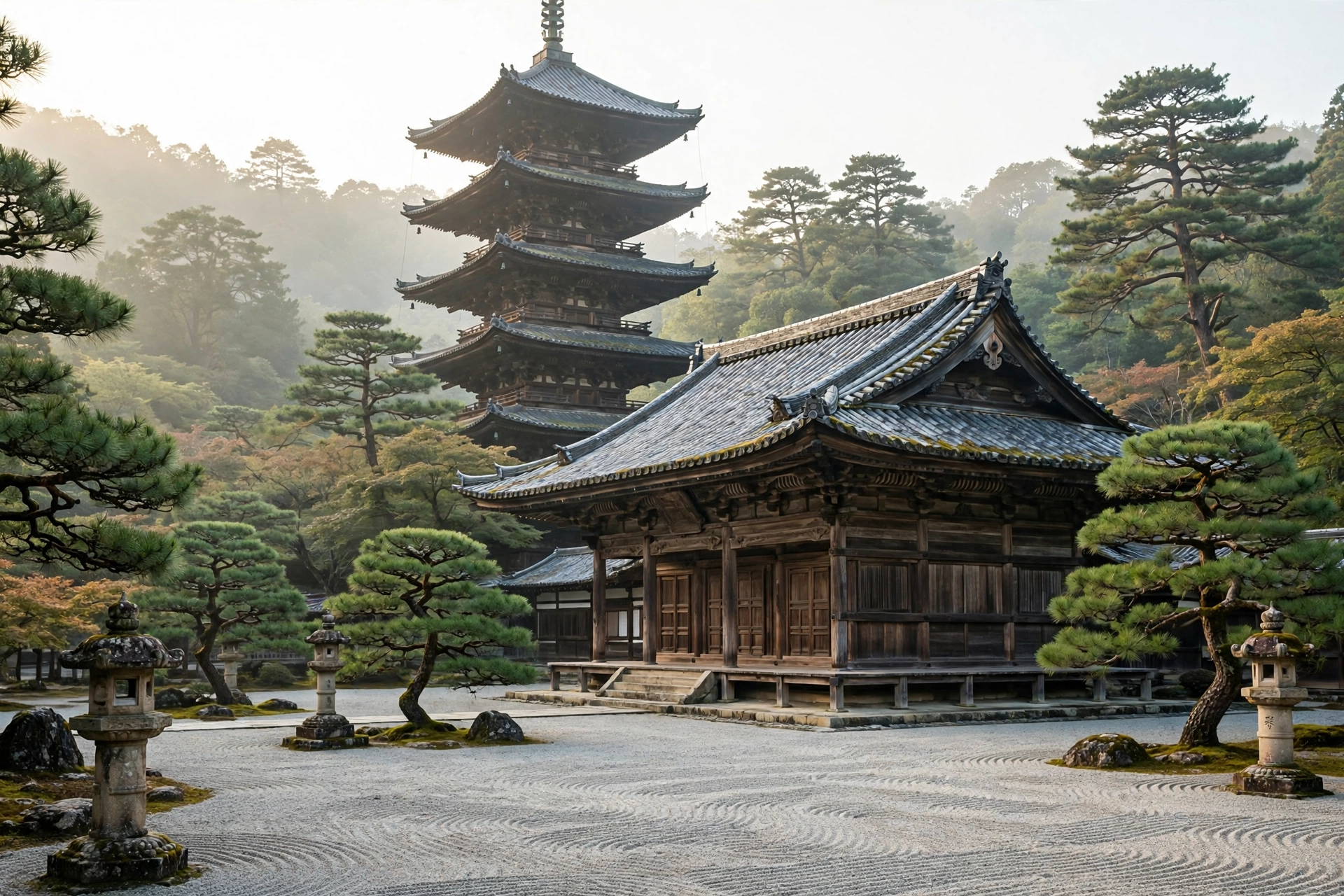
The point first: Ginkakuji’s formal name is Higashiyama Jishoji, a sub-temple of Shokokuji of the Rinzai school in Sakyo Ward, Kyoto, registered in 1994 as a UNESCO World Heritage site as part of the “Historic Monuments of Ancient Kyoto.” Contrary to its name, no silver leaf was ever applied to the Kannon-den (the Silver Pavilion, National Treasure, built 1489); its quiet appearance itself is the symbol of Higashiyama culture. The Togudo (National Treasure, built 1485) contains the Dojin-sai, the oldest surviving study with an attached alcove shelf arrangement, regarded as the origin of shoin-zukuri. The visiting offering was revised on April 1, 2026, to ¥1,000 for high school students and above (previously ¥500), so older guides may show the old price. No general guide to funerals or memorial services was found on the official page checked, and this article says so plainly.
I am Kurashiki Bouzu (kurashiki-bouzu), born in 1971, a former funeral professional now living in an old house in Kurashiki, Okayama, working with Moka, my AI butler.
This is one article in a series introducing temples across Japan, one temple at a time. This time it is Ginkakuji in Sakyo Ward, Kyoto — formally Higashiyama Jishoji. This is not a record of a visit I made myself; it is an article organizing only confirmed facts from the official site of Shokokuji and published sources of Kyoto City. Please read it as preparation before a visit.
Basic information
- Temple name: the formal name is Higashiyama Jishoji, commonly called Ginkakuji. Its mountain name (sango) is Higashiyama (Mount Higashiyama)
- School: Rinzai School, Shokoku-ha. One of the sub-temples of Shokokuji located outside its grounds (kegai tatchu)
- Address: 2 Ginkakuji-cho, Sakyo Ward, Kyoto City, Kyoto Prefecture
- Principal image: said to be Shaka Nyorai (Shakyamuni), enshrined in the main hall (Hondo / Hojo). However, a statement of the principal image could not be confirmed on the official top page and access page checked this time, so I will write honestly that this point could not be verified
In 1994, Jishoji was registered as a UNESCO World Heritage site as one of the “Historic Monuments of Ancient Kyoto.”
History
The origin lies in 1482 (Bunmei 14), when Ashikaga Yoshimasa built his villa, the Higashiyama Villa (Higashiyama-dono), at the foot of the Higashiyama mountains. Kyoto City explains that the Higashiyama Villa was modeled on Saihoji.
After Yoshimasa’s death, the villa was converted into a Zen temple in accordance with his will. The temple name derives from Yoshimasa’s cloister name, “Jisho’in-dono.” Muso Soseki is revered as its invited founding priest.
Afterward it fell into ruin for a time, but was restored in the mid-17th century. The Silver Pavilion is often spoken of alongside the Golden Pavilion of his grandfather Yoshimitsu, and its course overlaps with Kinkakuji in that a villa changed into a temple after its owner’s death.
Highlights
The Kannon-den (the Silver Pavilion, National Treasure) is a two-story pavilion built in 1489 (Chokyo 3). The lower floor is in shoin style and the upper floor in Zen temple hall style. Contrary to its name, no silver leaf is applied. Its calm appearance itself is regarded as a symbol of Higashiyama culture.
The Togudo (National Treasure) is a Buddha hall and study built in 1485 (Bunmei 17). The four-and-a-half-mat room on its east side, the Dojin-sai, has the oldest surviving attached shoin alcove and staggered shelves, and is positioned as the origin of shoin-zukuri.
The garden is a pond-strolling garden centered on Kinkyo-chi pond, also known for sand formations called Ginshadan (Silver Sand Garden) and Kogetsudai (Moon-Viewing Platform). The garden is a Special Historic Site and Special Place of Scenic Beauty. In ordinary visiting, the interior of the Silver Pavilion is not open to the public, and the main hall, Togudo and Rochintei are opened in special spring and autumn viewings.
To add a little more: the Silver Pavilion and the Togudo were built close in year to each other, and both carried the center of Yoshimasa’s Higashiyama Villa. The figure of the Kannon-den looking down over the garden as a pavilion, and the figure of the Togudo conveying the quiet of a study, are contrasting, yet I think both were born from the same aesthetic sense of the era. That the Dojin-sai’s attached shoin and staggered shelves are regarded as the origin of shoin-zukuri is proof that its influence reached even the form of Japanese homes. When you think that a temple building became a model for the form of later daily life, the way you see it changes a little.
The sand formations of Ginshadan and Kogetsudai are also a highlight unique to this garden. Devices expressing water and the moon in sand, not only in the pond’s water, are placed within the garden, and there I feel the depth of Higashiyama culture. I think the reason the garden is designated a Special Historic Site and Special Place of Scenic Beauty also becomes gradually clear as you walk and view it. Because many buildings are normally closed inside, the special viewing opportunities are precious. If the dates suit you, please check the official notices early.
Events
- Autumn special viewing: in 2026, from November 1 to December 5. The main hall, Togudo and Rochintei are opened with guided tours, and the special viewing fee is ¥2,000 (the ordinary visiting offering is separate). In some years a similar special viewing is also held in spring
- Ginkakuji zazen meetings: guided on the official site. Please check the schedule on the official site
For regular annual events, no official guide was found in the range checked. The dates of annual events other than the zazen meetings and special viewings also could not be verified in the full text of an official events page, so this article writes no more than this.
Funerals and memorial services
As a former funeral professional, what draws my attention is guidance on funerals and memorials. In the range of the Ginkakuji page on the official site of Shokokuji checked this time, no general guide to funerals, memorial services, perpetual memorials, interment or tree burials was found. To be honest, no such guide appeared on the official site.
Jishoji is a temple that was changed from a villa into a Zen temple by Yoshimasa’s will. It can be read as an example in which a person’s own wishes decided the form of a place after their death. But this article does not connect that to modern funeral guidance. Not writing what is not known is the rule of this series.
Practical information for a visit
From the official site’s guide, the confirmed contents:
- Visiting hours: from March 1 to November 30, 8:30–17:00; from December 1 to the end of February, 9:00–16:30. Open every day of the year
- Visiting offering: high school students and above ¥1,000; elementary and junior high school students ¥500. This is the amount after the revision of April 1, 2026; before the revision it was ¥500 and ¥300. The amounts of ¥1,000 and ¥500 were also confirmed on the access page of the English version of the official site
Fees and hours may change. Please check the latest guide on the official site before going.
Finally, I will write the caution about fees once more. The visiting offering was revised on April 1, 2026, and for high school students and above rose from ¥500 to ¥1,000. Older guides and travel accounts may still show the pre-revision amount, so please check the current official amount before going. Ginkakuji is often spoken of alongside the splendor of Kinkakuji, but as a place where the calm figure without silver leaf, the Togudo conveying the beginning of shoin-zukuri, and the sand garden come together, it is a temple with its own value. I hope you will feel the depth within its quiet. Visiting hours change by season: from 8:30 in the summer period and from 9:00 in the winter period. Please check the opening time for the season as well, and set out into the quiet scenery at the foot of Higashiyama. I wish you a good visit.
Sources
- Ginkakuji official site (Rinzai School, Shokoku-ha)
- Ginkakuji official, access (English version)
- Kyoto City, “Jishoji”
- November 22, 2026 ― Published in English (translation of the Japanese article, ledger No. 2843)(6,764 characters)