
Kinkakuji (Rokuonji) — The Golden Shariden and Mirror Lake Pond, a Temple of Kitayama Culture
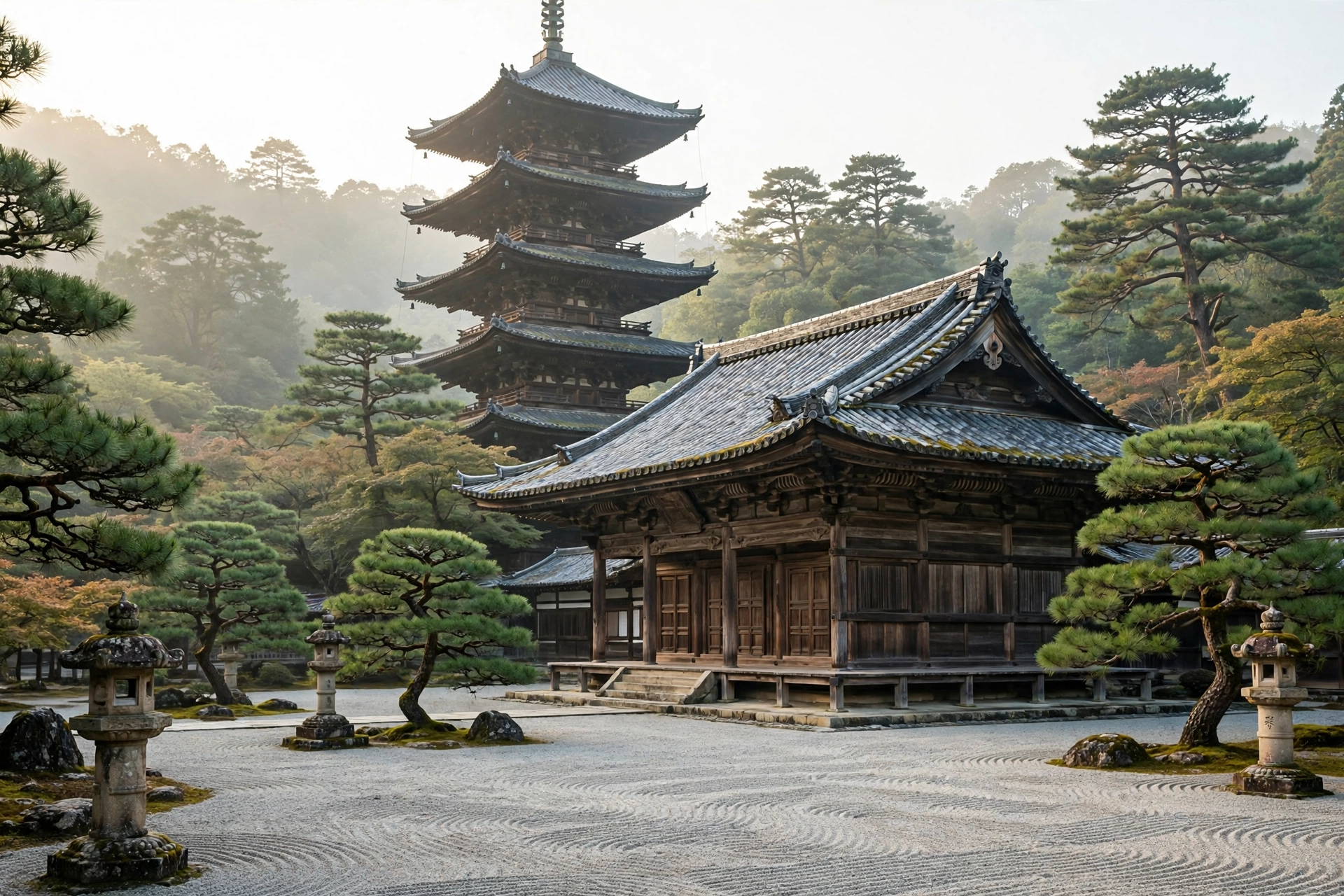
The point first: Kinkakuji’s formal name is Rokuonji, a sub-temple of Shokokuji of the Rinzai school in Kita Ward, Kyoto, registered in 1994 as a UNESCO World Heritage site as part of the “Historic Monuments of Ancient Kyoto.” Its Shariden, the Kinkaku, is a three-story pavilion — palace style on the first floor, samurai-house style on the second, Zen temple style on the third — with gold leaf covering the second and third floors in full, reflected in Mirror Lake Pond (Kyoko-chi). The present Kinkaku is not a National Treasure: the original burned down in 1950, and the present building is a faithful reconstruction completed in 1955. Visiting is open every day, 9:00–17:00. No general guide to funerals or memorial services was found on the official page checked, and no regular event of Kinkakuji alone could be confirmed — this article states both plainly.
I am Kurashiki Bouzu (kurashiki-bouzu), born in 1971, a former funeral professional now living in an old house in Kurashiki, Okayama, working with Moka, my AI butler.
This is one article in a series introducing temples across Japan, one temple at a time. This time it is Kinkakuji in Kita Ward, Kyoto — formally Rokuonji. This is not a record of a visit I made myself; it is an article organizing only confirmed facts from the official site of Shokokuji and published sources of Kyoto City. Please read it as preparation before a visit.
Basic information
- Temple name: the formal name is Rokuonji, commonly called Kinkakuji. Its mountain name (sango) is Kitayama (Mount Kitayama)
- School: Rinzai School, Shokoku-ha. One of the sub-temples of Shokokuji located outside its grounds (sangai tatchu)
- Address: 1 Kinkakuji-cho, Kita Ward, Kyoto City, Kyoto Prefecture
- Principal image: a guide to the precinct introduces a seated statue of Sho Kannon Bosatsu enshrined in the Hojo (abbot’s quarters, the main hall). However, the full text of the precinct guide could not be verified, so this article avoids a definitive statement and presents it as an introduction. The Shariden “Kinkaku” itself is a building enshrining relics of the Buddha (busshari), not a hall that enshrines a principal image
In 1994, Rokuonji was registered as a UNESCO World Heritage site as one of the “Historic Monuments of Ancient Kyoto.”
History
Ashikaga Yoshimitsu took over a villa of a Kamakura-period aristocrat in 1397 (Oei 4) and remodeled it into his villa, the Kitayama Villa (Kitayama-dono).
After Yoshimitsu’s death, in 1422 (Oei 29) it was made a Zen temple with Muso Soseki as its founding priest. The temple name is said to derive from Yoshimitsu’s posthumous Buddhist name, “Rokuon’in-dono.”
The Kinkaku was lost to fire in 1950 (Showa 25) and rebuilt in a faithful reconstruction in 1955 (Showa 30). The present Kinkaku is this reconstruction and is not a National Treasure. Because the Kinkaku before the fire was a National Treasure, the two are easily confused, but this article does not call the present building a National Treasure.
Highlights
The Shariden “Kinkaku” is a three-story pavilion. The first floor is in palace style (shinden-zukuri), the second in samurai-house style (buke-zukuri), and the third in Zen temple hall style (zenshu butsuden-zukuri) — the style differs by floor, and the second and third floors are covered in gold leaf over their whole surface. It is regarded as a symbol of Kitayama culture.
The garden is a pond-strolling garden centered on Mirror Lake Pond (Kyoko-chi). It borrows Mount Kinugasa as scenery and is arranged with celebrated stones. As the Rokuonji Garden, it is designated a Special Historic Site and Special Place of Scenic Beauty. Many readers will picture the Kinkaku reflected in the pond.
Within the grounds there are also the Sekka-tei teahouse, the Ryumon Falls and the Ginga-sen spring. Buildings and garden together convey the form of the culture of Yoshimitsu’s era to the present — that is the highlight.
To add a little more: that each of the Kinkaku’s three floors has a different style is an important clue to understanding this building. Because elements of the architecture of the time — palace style, samurai-house style and Zen temple hall style — are layered in a single building, the Kinkaku has been spoken of not as a mere golden building but as a gathering of the culture of Yoshimitsu’s era. Viewed from the shore of Mirror Lake Pond, the building, the garden and the borrowed mountain scenery come together as a single landscape.
That the garden is designated a Special Historic Site and Special Place of Scenic Beauty is also a point not to miss. Rather than seeing only the Kinkaku and leaving, walking around the pond and enjoying the arrangement of stones and the changing angles of view is, I think, how this garden is savored. That there is a teahouse such as Sekka-tei also quietly tells us that the Kitayama Villa was a place of culture.
Also, that the present Kinkaku is a reconstruction of 1955 is not a flaw but part of its history. Having passed through the event of its loss by fire and been rebuilt faithfully by people’s hands, the Kinkaku still stands by the pond today. When you view it knowing the circumstances of the rebuilding, beyond the shine of the gold leaf you may also sense the feelings of the people who kept protecting it.
Events
In the range of the official site’s events page checked, no guide to regular events of Kinkakuji alone was found.
Some materials introduce an opening of the hidden statue of Fudo Myo-o at the Fudo-do on February 3 (Setsubun) and August 16, but this could not be directly confirmed on an official page, so this article does not state it definitively as an event. If this concerns you, please check the official guide for that year.
I will also state honestly that the full text of an official annual-events list page could not be verified regarding the presence or dates of annual events.
Funerals and memorial services
As a former funeral professional, what draws my attention is guidance on funerals and memorials. In the range of the Kinkakuji page on the official site of Shokokuji checked this time, no general guide to funerals, memorial services, perpetual memorials, interment or tree burials was found. To be honest, no such guide appeared on the official site.
Rokuonji became a Zen temple after Yoshimitsu’s death, taking his posthumous name as the temple’s name. The form of leaving a departed person’s name in the name of a temple can be read as one expression of the heart of memorial. But this article does not connect that to modern funeral guidance. Not writing what is not known is the rule of this series.
Practical information for a visit
From the official site’s guide, the confirmed contents:
- Visiting hours: 9:00–17:00, open every day of the year
- Offering for a visit: general visitors (high school students and above) ¥500; elementary and junior high school students ¥300. There are no group discounts
- The postal code of the address is 603-8361, based on the address notation on the English version of the official site
Fees and hours may change. Please check the latest guide on the official site before going.
Finally, I will leave what this article could not cover. On the principal image, I limited myself to introducing the seated statue of Sho Kannon Bosatsu of the Hojo, because the full text of the precinct guide could not be verified. The same applies to events: what could not be confirmed is not stated definitively as an event. Behind the golden figure everyone knows, Kinkakuji is a temple with a weighty history — its change from villa to Zen temple, and its loss by fire and reconstruction. I hope knowing that history helps you see the scenery more deeply. Visiting is open every day, with the easy-to-follow hours of 9:00 to 17:00. It is a temple where even first-time visitors to Kyoto’s temples can plan easily, but please check the official guide for crowd conditions and go with a plan that leaves you room. I hope you will slowly savor the view, like a single painting, where the Kinkaku, Mirror Lake Pond and the scenery of Kitayama overlap. I wish you a good visit.
Sources
- Kinkakuji official site (Rinzai School, Shokoku-ha)
- Kinkakuji official, access (English version)
- Kyoto City, “Rokuonji”
- November 22, 2026 ― Published in English (translation of the Japanese article, ledger No. 2834)(6,814 characters)