
Tanjoji (Kumenan) — A Special Jodo Temple on the Site of Honen's Birthplace Home
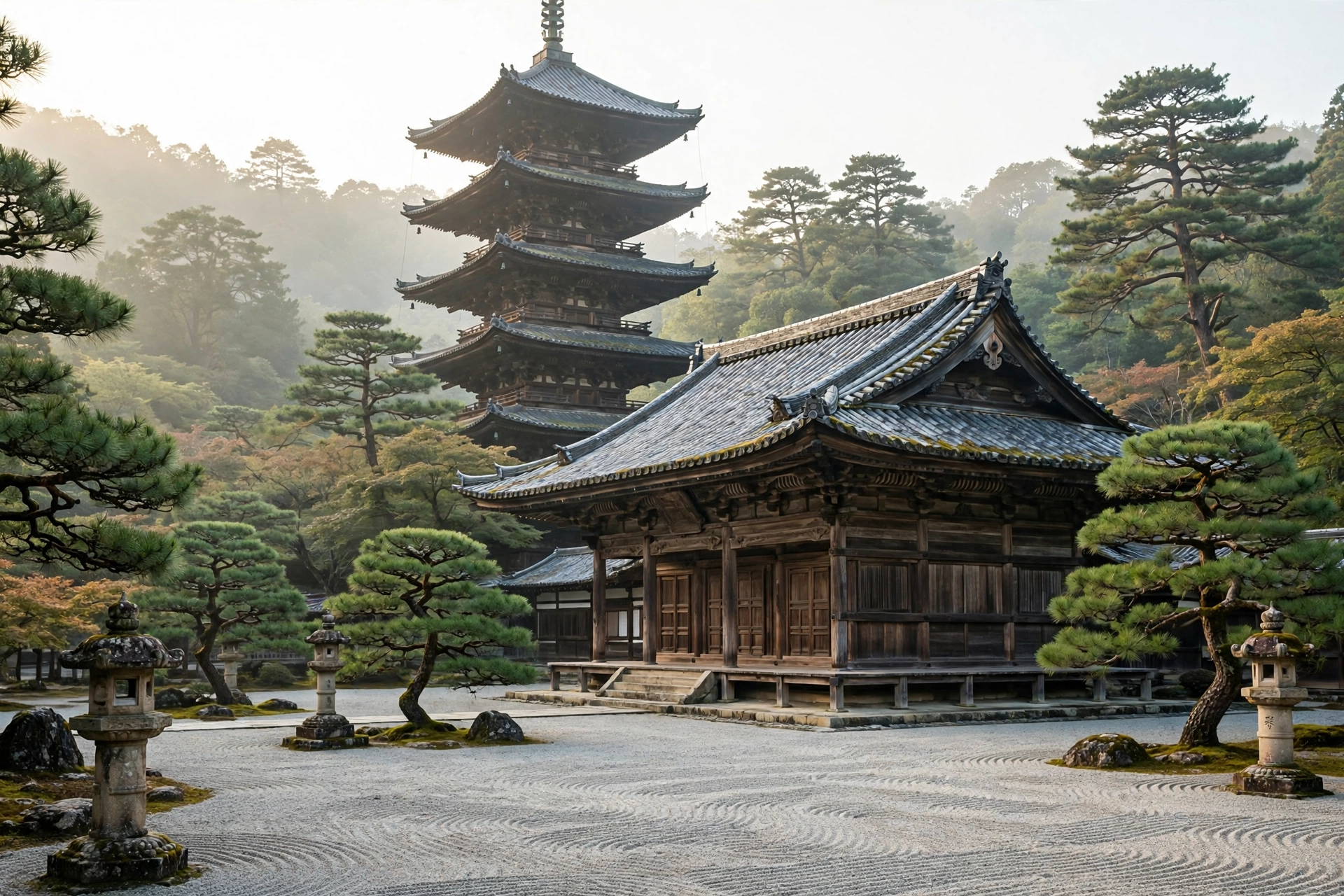
The point first: Tanjoji stands on the site of the birthplace home of Honen, founder of the Jodo School, and is the first temple on the Honen Twenty-Five Sacred Sites pilgrimage. Its Mieido hall and gate are national Important Cultural Properties. Its great Oeshiki ceremony, which memorializes Honen’s parents, is described as the Jodo School’s only great service of its kind, and the temple also publishes a guide to perpetual memorials and its ossuary — offered not as “permanent,” but for set periods such as 10, 20 or 30 years.
I am Kurashiki Bouzu (kurashiki-bouzu), born in 1971, a former funeral professional now living in an old house in Kurashiki, Okayama, working with Moka, my AI butler.
This is one article in a series introducing temples across Japan, one temple at a time. This time it is Tanjoji in Kumenan, Kume District, Okayama Prefecture. This article was organized from official sources published by the temple and public bodies; it is not a record of a visit I made myself.
Basic information
- School: Jodo School (a special temple of the Jodo School)
- Address: 808 Satakata, Kumenan, Kume District, Okayama Prefecture 709-3602
- Principal image: the Mieido hall enshrines an image of Honen said to have been carved by Honen himself (Honen at 43, the age of founding the school)
The standing Amida Nyorai statue regarded as the former principal image is now displayed in the treasure hall. The official cultural property guide also introduces the discovery of about 1,000 printed Buddhist images inside it.
History
Honen (1133–1212) was born in Inaoka-sho, Kume Nanjo, Mimasaka Province, to Urushima Tokikuni, a local magnate, and a woman of the Hata clan. His childhood name was Seishimaru. Tanjoji stands on the site of his birthplace home, and the Honen birthplace is a Historic Site designated by Okayama Prefecture (designated in Showa 34, 1959). The prefecture’s cultural property commentary notes that the site is thought to have formerly been the residence of his father, Urushima Tokikuni.
The founder was his disciple Kumagai Naozane (Rensho Hoshi). According to the official site, in Kenkyu 4 (1193), following Honen’s instruction, he converted the former Urushima residence into a temple and founded it. The position of the main hall’s altar is said to be where the room in which Honen was born stood.
The Jodo School is the school Honen opened in Shoan 5 (1175), at age 43: a faith that trusts in Amida Buddha’s compassion and chants “Namu Amida Butsu” in the wish for birth in the Pure Land.
Highlights
The Mieido hall is a national Important Cultural Property, rebuilt in Genroku 8 (1695). It is a double-roofed five-bay hall with a karahafu-gabled porch, regarded as valuable in architectural history. The gate is also a national Important Cultural Property, a three-bay yakuimon gate founded in Shotoku 6 (1716).
In the precinct stands a great ginkgo tree said to have been planted by Honen himself (the “upside-down ginkgo”). Kumenan Town gives its age as 850 years. Tradition says that when he left at age 15, he stuck the ginkgo staff he had used, roots upward, into the ground, and roots grew from it.
Other features include the Amida hall (Zuio-den) rebuilt in Heisei 15 (2003), the Seishi-do with his parents’ graves and the well of his first bath, the Shaba-do enshrining six Jizo, the Kannon-do (Oshichi Kannon), and a treasure hall displaying an Amida Nyorai statue and the “Taiko kettle.”
As a sacred site, it is also counted among the special sites of the Chugoku Thirty-Three Kannon pilgrimage and as the first site of the Chugoku Thirty-Three Jizo pilgrimage.
Events
The representative event is the Oeshiki service. Its formal name is very long — the great service for repaying the kindness of Honen’s parents, with twenty-five bodhisattvas and heavenly children welcoming them — and it is designated an Intangible Folk Cultural Property of Okayama Prefecture. It is the Jodo School’s only great service memorializing his parents, counted among Japan’s three great neri-kuyo processions, and held on the third Sunday of April each year. On its beginnings, sources differ: the temple transmits that it has continued since the Muromachi period, while the town guide dates the present form from the Genroku era.
In form, the Mieido is likened to the Pure Land of Ultimate Bliss and the Shaba-do to this world, and the twenty-five bodhisattvas come to welcome his parents into the Pure Land. His father and mother are memorialized in alternate years.
An official notice also records that the Goju Sodan teaching ceremony was held in May of Reiwa 8 (2026) for the first time in 13 years.
Funerals and memorial services
At the center of its memorials is the Oeshiki, which memorializes his parents. The Jodo idea — chant the nembutsu and be welcomed into the Pure Land after death — continues here in the form of a ceremony. I feel it is a service that has kept the feeling of sending off one’s parents in visible form for hundreds of years.
A guide to perpetual memorials and the ossuary is also officially published. The temple memorializes on the family’s behalf, but not “permanently” — for set periods — and an official notice says contracts matched to each family, such as 10, 20 or 30 years, are accepted. In an example published as of Reiwa 6 (2024), a 30-year period with an aluminum ossuary shelf was ¥800,000, and wooden ossuary shelves had tiers of ¥500,000, ¥800,000 and ¥1,000,000. Amounts and sections may change, so please confirm the latest with the temple office.
Even when a funeral was held through a funeral company, accepting only the interment of ashes is possible, and the official explanation says interment is basically done at the same time as the 49th-day service.
Practical information for a visit
- Temple office hours: 9:00–17:00, no holidays
- Parking: 100 standard cars, 7 large vehicles. Parking is free, but an official FAQ notes a fee may be required during the April Oeshiki and great services
- Public transport: 15 minutes on foot from Tanjoji Station on the JR Tsuyama Line
- Admission: the treasure hall and the abbot’s quarters garden are ¥300 each (from January 1, Reiwa 6, 2024). Viewing of the abbot’s quarters and garden is 9:00–16:00, according to an Okayama Prefecture official tourism article
- Inquiries: Tanjoji temple office, 086-728-2102
Individual precinct admission beyond the above could not be confirmed on the official site. Please check the latest information before your visit.
Sources
- Tanjoji official site https://www.tanjoji.or.jp/
- Same, “Precinct viewing and surroundings” https://www.tanjoji.or.jp/keidai.html
- Same, “Cultural properties of Tanjoji” https://www.tanjoji.or.jp/bukazai.html
- Same, “About the sacred sites” https://www.tanjoji.or.jp/reijyou.html
- Same, “About perpetual memorials” https://tanjoji.or.jp/kuyo.html
- Same, “Notices” https://www.tanjoji.or.jp/posts/news_archive.html
- Same, FAQ https://tanjoji.or.jp/posts/faq2.html
- Kumenan Town official site, “Tanjoji” https://www.town.kumenan.lg.jp/sightseeing_event/sightseeing/tanjoji.html
- Same, “Great people of the hometown” https://www.town.kumenan.lg.jp/living/culture/culture/senjin.html
- Okayama Prefecture official tourism web https://www.okayama-kanko.jp/spot/detail_13107.html
- Same, “Okatabi” https://www.okayama-kanko.jp/okatabi/1041/page
- Okayama Prefecture cultural property commentary PDF https://www.pref.okayama.lg.jp/uploaded/attachment/262283.pdf
- Cultural Heritage Online https://bunka.nii.ac.jp/heritages/region/33/33663
- Jodo School official site https://jodo.or.jp/newspaper/news/9005/
- November 22, 2026 ― Published in English (translation of the Japanese article, ledger No. 2663)(6,391 characters)