
A Virtual Funeral I Was Thinking About at 25 — A Form You Can Attend From a Hospital or a Nursing Home
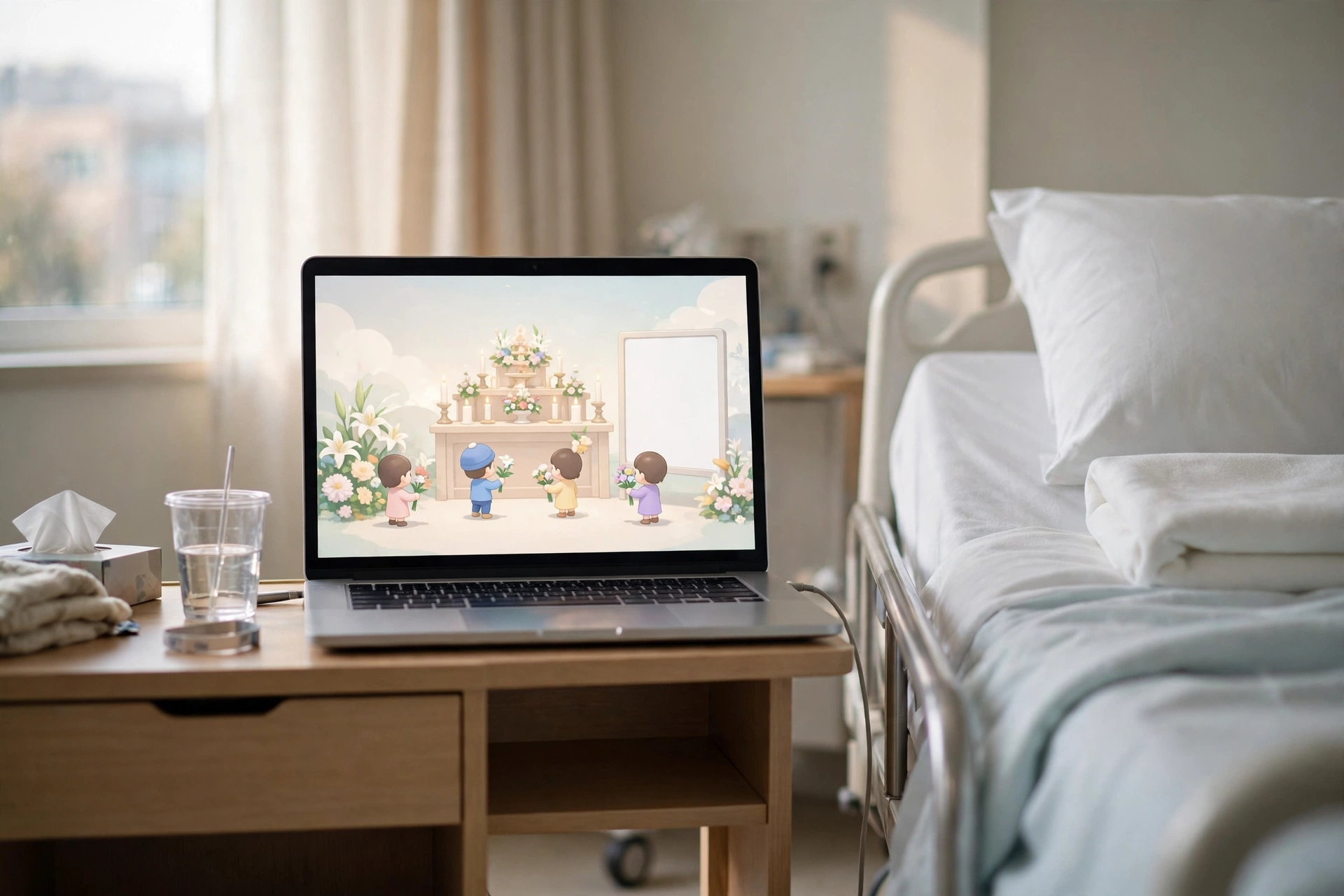
The result first: the virtual funeral I was thinking about at 25 was not a broadcast of a real ceremony. Inside virtual space there is a funeral hall, an altar in the middle, and mourners are there as avatars, offering flowers one by one; at the same time as the offering, each person’s farewell words are written in letters on something like a message board (shikishi) in the space. The reason I clung to the virtual was that people who cannot move from a hospital bed or a nursing home could attend as a well-dressed avatar, without showing their weakened figure on camera, and without the raw live images of a real funeral hall — coffin, crying voices and all — being shown as they are. That picture has now been realized, in the hands of others.
I am Kurashiki Bouzu.
I am a former funeral home owner. I was involved in funeral work for more than 20 years.
Today, I will write a slightly strange story. A banner with the name ”@ Funeral” (@葬儀), which I saw on some site several years ago and which remained in a corner of my head. The other day, I looked it up again. When I did, today’s reality had come closer to the picture of a “virtual funeral” that I, at 25 about 30 years ago, had been thinking about in my head.
Let me write honestly first. This is not a story that I invented something. At the time, there was neither the technology to make it, nor did I actually make it. “Technical matters aside, I had an image.” It is only a recollection of that much.
When I Looked Up the Banner Again
@ Funeral was a service that began in 2020. It was not just a matter of streaming a real funeral by camera; its main form was a memorial page on the Web, where a portrait of the deceased and photographs of memories are placed, incense can be offered inside the screen, and condolence money and flower offerings can also be ordered. In the time of COVID, these “funerals beyond the screen” spread all at once.
The form of broadcasting the state of a funeral hall as it is is also no longer rare now. People who live far away, people whose bodies are not free, people who are overseas, can attend from a smartphone or a computer. The reasons are proper, and I think there are many families who are actually helped.
However, as I kept looking, a form that goes further ahead appeared. A form that does not stream video, but makes the “place” itself inside virtual space.
It Is Realized Now — Kaze no Rei, and VR Ceremony
A representative example is the metaverse cemetery “Kaze no Rei.” It is a service begun in September 2024 by Alpha Club Musashino, in the ceremonial industry, and HIKKY, a virtual-space company, in which you enter a virtual cemetery from a computer or smartphone and can visit a grave as your own alter ego (avatar). There is also a room where photographs and videos of memories with the deceased can be decorated, and registration and visiting are free, it is said. Avatars are chosen from six types.
In February 2026, a funeral-hall part, “Kaze no Ma,” was also added inside it. Linked with a real funeral, the actual state of the ceremony is streamed inside, and while remaining an avatar, you can sit on a chair and offer incense or flowers before the altar, it is said.
In order, Kaze no Rei began from the “cemetery,” and the “funeral hall” was added later. What I was thinking about at the time was the reverse: from the funeral hall side. Even though the order is different, while looking it up, I was a little surprised that the pictures we arrive at overlap. That photographs and videos of memories can be decorated in a room to remember the deceased is also close to my feeling at the time, in the point of making a “place for the deceased” inside a screen.
Another example, the Tanseisha Group’s “VR Ceremony,” is a form that does not connect with a real ceremony, but makes the venue itself inside virtual space. Reception, the organizer’s greeting, a hall with a portrait of the deceased, memorial videos, an exhibition of photographs, messages, a greeting of thanks, and leaving — the flow of a real ceremony is a space as it is. Publication is for a maximum of one year, it is said.
I thought: ah, it has come this far. In a virtual place, everyone’s alter egos gather and say farewell. There are now people who have made that into a business. This is a story of honest respect for the people who realized it. The place where I, who was thinking about it long ago, stand and the place where the people making it now stand are completely different.
The Virtual Funeral Hall I Was Thinking About at 25
The time when I was 25 was around 1996 to 1997. It was a period when I was doing something like work making homepages, and a time when it was fun to think about what could be done inside a screen.
The picture that was in my head at that time was like this.
Inside virtual space, there is a funeral hall. In the middle, there is an altar. The mourners are there in the form of their own avatars. One by one, they step forward and offer flowers.
And at the same time as the flower offering, that person’s farewell words are written, as letters, on something like a message board (shikishi) in the space — in today’s words, something like a whiteboard.
The words are not something to be read aloud by voice. Nor are they something to line up in a corner of a page. At the same time as the gesture of offering a flower, that person’s words increase on the message board. As the ceremony proceeds, the message board of gathered writings is gradually filled — that was the image.
At the time, the technology for that did not exist around me. It was a time when neither screens nor communications could be compared with now. Now, if I say “like Second Life,” the image may be conveyed, but at the time there was no such name either.
Even so, only the picture was floating up. While looking at a homepage, a flat screen where letters and photographs are lined up, I think I was wondering whether a “place like a room” could be made beyond it. “Technical matters aside” means that kind of thing. I did not know how to make it. But the picture of a form it would be nice to have was in my head first.
So That People Could Attend From a Hospital or a Nursing Home
Why did I think of such a form? The reason was a very practical one.
Because there are people who cannot move, from home or from a facility. People who are hospitalized, people who live in a nursing home and cannot come to the funeral hall. Even though they have the feeling of wanting to say farewell, their bodies do not follow. I was thinking whether there might not be a form in which such people could at least attend.
Then, the story becomes: why not just show the funeral hall with a Web camera? However, I was caught on that point. Showing a real funeral hall as it is is raw.
Especially in a hospital or a nursing home, I think so. In a place where your own body is also weakened, in a place where there are other people you did not choose around you, to show the raw video of a ceremony, including the coffin and crying voices, on a screen as it is. That seemed too heavy, both for the person watching and for the people around them.
If it is a virtual place, one soft membrane goes in between. The watching person can “be” at the ceremony in the form of an avatar even from on a bed, can offer flowers, and can go as far as leaving words on the message board. While the weight of a funeral remains, it does not become a bare video. Even though the aim is the same as what is now called an “online funeral,” the reason I clung to the virtual was that I wanted to avoid this rawness.
There is one more good point about avatars: “you can hide your figure.” In the form of attending by camera, the figure on a hospital bed or the inside of a facility room may be seen by the other party. Even though you came to say farewell, you end up showing your weakened figure. That is also painful for the attending side. With an avatar, you can face the ceremony properly as your own alter ego wearing mourning clothes. I think that for people who are weakened all the more, such a form is easier to attend in feeling.
If I Did It Now, I Would Receive an Avatar MD
Then, if I were to do it again with today’s tools, what would I do? The other day, I suddenly thought about it.
Now, I would have the mourners install the app of an AI called Muse (Moka). Each person consults with their own Moka and has their own avatar made. The definition of that avatar and an MD — a text file — in which the farewell words are written are received by the operating side.
What the operator takes custody of is not heavy data, but only one light text file. The farewell words in it, at the same time as the flower offering, are written on the message board in the virtual funeral hall. At the time there was simply no container to carry the words; now, those words can be carried on an MD.
What is written in the MD need only be the minimum necessary for the ceremony. The name to display, the relationship to the deceased, the features of the avatar’s figure, clothing, and the farewell words. Because it is made by your own Moka, who knows you well, it becomes an avatar that is different for each person and true to that person. After the ceremony is over, whether to keep that MD or erase it can be decided by the person who sent it. It is not something for the side taking custody to keep holding forever.
To write honestly, Moka does not have a fixed system of “carrying mourners’ avatars in an MD.” This is a story of a device of passing a definition in an MD. For a form in which everyone walks around a 3D space at the same time, a dedicated system like Kaze no Rei is needed. Even so, we have come to a point where the picture of the avatar and the message board can be tried even with today’s tools.
And I noticed one more thing. This form has no condolence money. Attendance is saying farewell, and the scene of wrapping money was not in my picture from the beginning. In today’s online funerals, that condolence money can be paid from the screen has become a big selling point. I think that is also a convenient thing. However, if condolence money were attached even to the form of attending from a hospital bed, I feel it would become a little heavier again. What is there is only the sharing of time to remember the deceased.
In fact, at the same age of 25, I was also thinking about a funeral of the video kind. Photographs of the deceased from childhood to the end move quietly, and at the end the deceased person themselves bows once. That is all the Web funeral is. I wrote about that side in another article.
About 30 years ago, a picture that existed only in my head, technical matters aside. That I can now put it into words like this is itself, I think, a sign of an interesting era.
Sources
- Kaze no Rei (PR Times) https://prtimes.jp/main/html/rd/p/000000075.000070704.html
- Kaze no Ma (via Magazine Summit) https://topics.smt.docomo.ne.jp/article/magazinesummit/life/magazinesummit-https_editor.magazinesummit.jp_p_149393
- ITmedia, “Metaverse Cemetery ‘Kaze no Rei’ Opened” https://www.itmedia.co.jp/news/article/2409/11/1240911140/
- VR Ceremony (Tanseisha Group) https://butsuji.net/sogi/18727
- November 18, 2026 ― English draft created (results-first rewrite of the Japanese article, ledger No. 115). Not published; publication is a separate step.(9,123 characters)